
 100% FREE ACCESS
11th Standard Syllabus & Materials
11th Standard
TN 11th Tamil இயற்கை வேளாண்மை,சுற்றுச்சூழல் -செய்யுள் - மனோன்மணீயம் Important Questions And Answers Study Material - QB365 Set A
NEW11th Standard
TN 11th Tamil என்னுயிர் என்பேன் -துணைப்பாடம் - இசைத்தமிழர் இருவர் Important Questions And Answers Study Material - QB365 Set A
NEW11th Standard
TN 11th Tamil மொழி கலை -செய்யுள் - ஒவ்வொரு புல்லையும் Important Questions And Answers Study Material - QB365 Set A
NEW11th Standard
TN 11th Tamil பீடு பெற நில் - இலக்கணம் - பகுபத உறுப்புகள் Important Questions And Answers Study Material - QB365 Set A
NEW11th Standard
TN 11th Tamil பீடு பெற நில் - துணைப்பாடம் - வாடிவாசல் Important Questions And Answers Study Material - QB365 Set A
NEW11th Standard
TN 11th Tamil பீடு பெற நில் - செய்யுள் - குறுந்தொகை Important Questions And Answers Study Material - QB365 Set A

Published on: 12/11/2019
Download Tamil Nadu 11th Standard Business Maths and Statistics question papers, model tests, one-mark questions, important questions, and public exam papers in PDF format. Free study materials and answer keys for TN State Board students.
Questions + Answers key
Take MCQ Business Maths and Statistics Test
1.
Find the parametric equations of the circle x2 + y2 = 25
2.
Evaluate: cos 20° + cos 100° + cos 140°
3.
Show that the function f(x) = 5x -3 is continuous at x = +3
4.
Convert the equation of the parabola x2+y=6x-14 into the standard form.
5.
In how many ways can 10 beads of different colours form a necklace?
6.
In a railway compartment, 6 seats are vacant on a bench. In how many ways can 3 passengers sit on them?
7.
Using the property of determinants show that \(\begin{vmatrix} x &a &x+a \\ y & b &y+b \\z & c & z+c \end{vmatrix}=0.\)
8.
If \(A=\begin{bmatrix} 1 & 2 \\ 4 & 2 \end{bmatrix}\) then show that |2A| = 4 |A|.
9.
Resolve into partial fractions for the following : \(\frac{3 x+7}{x^2-3 x+2}\)
10.
Harmonic mean is better than other means if the data are for _________.
Speed or rates.
Heights or lengths.
Binary values like 0 and 1
Ratios or proportions.
11.
The geometric mean of two numbers 8 and 18 shall be _________.
12
13
15
11.08
12.
A person brought 100 shares of 9% stock of face value Rs. 100, at a discount of 10%, then the stock purchased is _______.
Rs. 9000
Rs. 6000
Rs. 5000
Rs. 4000
13.
The brokerage paid by a person on the sale of 400 shares of face value Rs.100 at 1% brokerage ________.
Rs. 600
Rs. 500
Rs. 200
Rs. 400
14.
The dividend received on 200 shares of face value Rs.100 at 8% is ________.
Rs. 1600
Rs. 1000
Rs. 1500
Rs. 800
15.
If u = 4x2 + 4xy + y2 + 32 + 16 , then \(\frac { \partial ^{ 2 }u }{ \partial y\partial x } \) is equal to ________.
8x + 4y + 4
4
2y + 32
0
16.
17.
Marginal revenue of the demand function p = 20–3x is _______.
20–6x
20–3x
20+6x
20+3x
18.
\(\frac{d}{dx}(5e^x-2logx)\) is equal to ________.
5ex - \(\frac{2}{x}\)
5ex - 2x
5ex - \(\frac{1}{x}\)
2 log x
19.
For what value of x, f(x) = \(\frac{x+2}{x-1}\) is not continuous?
-2
1
2
-1
20.
The value of \(cosec^{-1}\left(\frac{2}{\sqrt{3}}\right)\) is ________.
\(\frac{\pi}{4}\)
\(\frac{\pi}{2}\)
\(\frac{\pi}{3}\)
\(\frac{\pi}{6}\)
21.
The value of 1 - 2sin245o is _______.
1
\(\frac{1}{2}\)
\(\frac14\)
0
22.
The value of \(\sin15^o\) is ______.
\(\frac{\sqrt{3}+1}{2\sqrt{2}}\)
\(\frac{\sqrt{3}-1}{2\sqrt{2}}\)
\(\frac{\sqrt3}{\sqrt2}\)
\(\frac{\sqrt3}{2\sqrt2}\)
23.
If kx2 + 3xy - 2y2 = 0 represent a pair of lines which are perpendicular then k is equal to _______.
1/2
-1/2
2
-2
24.
25.
The greatest positive integer which divides n(n + 1) (n + 2) (n + 3) for n \(\in\) N is ________.
2
6
20
24
26.
The possible outcomes when a coin is tossed five times _________.
25
52
10
\(\frac { 5 }{ 2 } \)
27.
If A = \(\begin{vmatrix}cos \theta & sin \theta \\ -sin \theta&cons\theta \end{vmatrix},\) then |2A| is equal to ________.
4 cos 2 \(\theta\)
4
2
1
28.
Which of the following matrix has no inverse.
\(\begin{pmatrix} -1 & 1 \\ 1 &-4 \end{pmatrix}\)
\(\begin{pmatrix} 2 & -1 \\ -4 &2 \end{pmatrix}\)
\(\begin{pmatrix} cos\ a & sin\ a \\ -sin\ a & cos\ a \end{pmatrix}\)
\(\begin{pmatrix} sin\ a & cos\ a \\ -cos\ a & sin\ a \end{pmatrix}\)
29.
The co-factor of -7 in the determinant \(\begin{vmatrix} 2 & -3 & 5 \\ 6 & 0 & 4 \\ 1 & 5 & -7 \end{vmatrix}\) is________.
-18
18
-7
7
30.
A firm has revenue function R = 8x and production cost function \(C = 150000 + 60\left(x^2\over 900\right)\) Find the total profit function and the number of units to be sold to get the maximum profit.
31.
A factory has 3 machines A1, A2, A3 producing 1000, 2000, 3000 bolts per day respectively. A1 produces 1% defectives, A2 produces 1.5% and A3 produces 2% defectives. A bolt is chosen at random and found defective. What is the probability that it comes from machine A1?
32.
a bank pays 8% interest compounded quarterly. Determine the equal deposits to be made at the end of each quarter for 3 years so as to receive Rs.300 at the end of 3 years.
33.
The first of three urns contains 7 White and 10 Black balls, the second contains 5 White and 12 Black balls and third contains 17 White balls and no Black ball. A person chooses an urn at random and draws a ball from it. And the ball is found to be White. Find the probabilities that the ball comes from
(i) the first urn
(ii) the second urn
(iii) the third urn
34.
Find the value of tan \(\left( {{\pi}\over{8}}\right).\)
35.
If a parabolic reflector is 20 cm in diameter and 5 cm deep, find the focus.
36.
Differentiate: xy + y2 = tan x + y.
37.
If the fourth term in the expansion of \({ \left( ax+\frac { 1 }{ x } \right) }^{ n }\) is \(\frac { 5 }{ 2 } \) then find the values of a and n.
38.
Find the equation of the parabola which is symmetrical about x-axis and passing through (-2, -3).
39.
Let a, b and c denote the sides BC, CA and AB respectively of \(\Delta\) ABC. If \(\left| \begin{matrix} 1 & a & b \\ 1 & c & a \\ 1 & b & c \end{matrix} \right| =0\), then find the value of sin2 A + sin2B + sin2C.
40.
If \({ A }^{ -1 }=\left[ \begin{matrix} 1 & 0 & 3 \\ 2 & 1 & -1 \\ 1 & -1 & 1 \end{matrix} \right] \) then, find A.
41.
42.
Convert the following into the product of trigonometric functions. sin9A + sin7A
43.
Find adjoint of \(A=\left[ \begin{matrix} 1 & -2 & -3 \\ 0 & 1 & 0 \\ -4 & 1 & 0 \end{matrix} \right] \)
44.
Separate the intervals in which the function x3 + 8x2 + 5x - 2 is increasing or decreasing.
45.
Find the purchase price of Rs.9300,8 3/4% stock at 4% discount?
46.
Ten cards numbered 1 to 10 are placed in a box, mixed up thoroughly and then one card is drawn randomly. If it is known that the number on the drawn card is more than 4. What is the probability that it is an even number?
47.
If the dividend received from 9% of Rs. 20 shares is Rs. 1,620, then find the number of shares.
48.
The demand function of a commodity is p = 200 - \(\frac { x }{ 100 } \) and its cost is C = 40x + 12000 where p is a unit price in rupees and x is the number of units produced and sold. Determine (i) profit function (ii) average profit at an output of 10 units (iii) marginal profit at an output of 10 units and (iv) marginal average profit at an output of 10 units.
49.
Find the elasticity of demand in terms of x for the demand law \(p={(a-bx)^{1\over 2}}.\) Also find the values of x when elasticity of demand is unity.
50.
Differentiate: sin x.sin 2x. sin 3x with respect to 'x'.
51.
For what value of \(\lambda \) are the three lines 2x-5y+3 = 0, 5x-9y+\(\lambda \)=0 and x-2y+1=0 are concurrent?
52.
If y = 2 sin x + 3 cos x, then show that y2 + y = 0
53.
Solve : \(\frac { (2x+1)! }{ (x+2)! } .\frac { (x-1)! }{ (2x-1)! } =\frac { 3 }{ 5 } \)
54.
Prove that \(\left| \begin{matrix} x & sin\theta & cos\theta \\ -sin\theta & -x & 1 \\ cos\theta & 1 & x \end{matrix} \right| \) is independent of \(\theta\)
1.
Here \({ r }^{ 2 }=25\Rightarrow r=5\)
Parametric equations are \(x=rcos\theta ,y=rsin\theta \)
\(\Rightarrow x=5cos\theta ,y=5sin\theta ,0\le \theta \le 2\pi \)
2.
\(\cos 20^{\circ}+\cos 100^{\circ}+\cos 140^{\circ}\)
\(\cos 20^{\circ}+\left(\cos 100^{\circ}+\cos 140^{\circ}\right) =\cos 20^{\circ}+2 \cos \left(\frac{100^{\circ}+140^{\circ}}{2}\right) \cos \left(\frac{100^{\circ}-140^{\circ}}{2}\right) \)
\(=\cos 20^{\circ}+2 \cos 120^{\circ} \cos \left(-20^{\circ}\right)\)
\(=\cos 20^{\circ}+2 \cos \left(180^{\circ}-60\right) \cos 20^{\circ}\)
\(=\cos 20^{\circ}-2 \cos 60^{\circ} \cos 20^{\circ}\)
\(=\cos 20^{\circ}-2\left(\frac{1}{2}\right) \cos 20^{\circ}\)
\(=\cos 20^{\circ}-\cos 20^{\circ}=0\)
3.
Given f(x) = 5x - 3
\(L\left[ f\left( x \right) \right] _{ x=3 }\) =\(\underset { x\rightarrow 3 }{ lim } f(x)=\underset { h\rightarrow 0 }{ lim } f(3-h)\)
= \(\underset { h\rightarrow 0 }{ lim } 5(3-h)-3=\underset { h\rightarrow 0 }{ lim } (15-5h-3)\)
= \(\underset { h\rightarrow 0 }{ lim } \) (12-5h) = 12-0=12
\(R\left[ f\left( x \right) \right] _{ x=3 }=\underset { x\rightarrow 3^{ + } }{ lim } f(x)=\underset { h\rightarrow 0 }{ lim } f(3+h)\)
= \(\underset { h\rightarrow 0 }{ lim } 5(3+h)-3=\underset { h\rightarrow 0 }{ lim } 15+5h-3\)
= \(\underset { h\rightarrow 0 }{ lim } 12+5h=12-0=12\)
\(L\left[ f\left( x \right) \right] _{ x=3 }=R\left[ f\left( x \right) \right] _{ x=3 }\)
ஃ f(x) is continuous at x = 3
4.
Equation of the parabola is x2+y=6x-14
⇒ x2-6x=-y-14
⇒ x2-6x+9=-y-14+9 (Adding 9 both sides)
⇒ (x-3)2=-y-5
⇒ (x-3)2=-1(y+5)
⇒ x2=-y where X = x - 3, Y = y + 5
5.
Number of ways of forming necklace
\(\frac { (10-1)! }{ 2! } =\frac { 9! }{ 2 } =181440\)
6.
Number of ways for first passenger to occupy seat = 6. ....(1)
Number of ways for the second passenger to occupy seat = 5
Number of ways for the third passenger to occupy seat = 4.
∴By fundamental principle of counting, the total number of ways for all the three to occupy seats
= 6 x 5 x 4 = 120.
7.
Let A = \(\begin{vmatrix} x &a &x+a \\ y & b &y+b \\z & c & z+c \end{vmatrix}\)
Applying the elementary transformation, \(C_1\rightarrow C_1+C_2\) we get,
\(A=\begin{vmatrix} x+a&a&a+x\\y+b&b&y+b\\z+c&c&z+c\end{vmatrix}=0[C_1\equiv C_3]\)
\(\therefore\) |A| = 0.
8.
Given = \(\begin{bmatrix} 1 & 2 \\ 4 & 2\end{bmatrix},\) then 2A = \(\begin{bmatrix} 2 & 4 \\ 8 & 4 \end{bmatrix}\)
\(\therefore\) |2A| = \(\begin{vmatrix}2 & 4 \\8 & 4 \end{vmatrix}\) = 8 - 32 = -24 ...(1)
Also, |A| = \(\begin{vmatrix} 1&2 \\4 & 2 \end{vmatrix}\) = 2 - 8 = -6
\(\therefore\) 4|A| = 4(-6) = -24 ....(2)
From (1) and (2), |2A| = 4.|A|
9.
\(\frac { 3x+7 }{ { x }^{ 2 }-3x+2 } =\frac { 3x+7 }{ (x-1)(x-2) } =\frac { A }{ x-2 } +\frac { B }{ x-1 } \)
\(\frac{3 x+7}{(x-1)(x-2)}=\frac{A(x-2)+B(x-1)}{(x-1)(x-2)}\)
\(3 x+7=A(x-2)+B(x-1)\) ...(1)
If x = 1
\(3+7=\mathrm{A}(1-2) \Rightarrow \mathrm{A}=-10\)
If x = 2
\(6+7=\mathrm{B}(2-1) \Rightarrow \mathrm{B}=13\)
\(\therefore\)\(\frac { 3x+7 }{ { x }^{ 2 }-3x+2 } \)=\(\frac { -10 }{ x-1 } + \frac { 13 }{ x-2 } \)
10.
(a)
Speed or rates.
11.
GM = \(\sqrt{8 \times 18} = \sqrt{144} = 12\)
12.
If F.V = 100, Investment = 90
FV 10,000,
Investment \(= \frac{ 90 \times 10,000}{100} = 9000\)
13.
Brokerage = 100 x 400 x \(\frac{1}{100}=400\)
14.
Investment = 200 x 100 x \(\frac{8}{100}\)= Rs. 1600
15.
\(\frac{\partial u}{\partial x} =8 x+4 y+4 \)
\(\frac{\partial^2 u}{\partial y \partial x} =4 \)
16.
(b)
17.
R = px = 20x- 3x2
M.R = dR/dx = 20 - 6x
18.
(a)
5ex - \(\frac{2}{x}\)
19.
(b)
1
20.
(c)
\(\frac{\pi}{3}\)
21.
1 - 2sin245o = cos 2(45o)
= cos 90o = 0
22.
\(\sin15^o = \sin(45^o - 30^o) = \sin45^o \cos 30^o - \cos 45^o \sin 30^o\)
\(= \frac{\sqrt{3}}{2\sqrt{2}} - \frac{1}{2\sqrt{2}}\)
23.
\(a+b=0 \Rightarrow k-2=0\)
24.
(c)
25.
Since if n = 1 then (1) (2) (3) (4) = 24 is divisible by = 24
26.
(a)
25
27.
\(|A|=\cos ^2 \theta+\sin ^2 \theta=1\)
\(|2 A|=2^2(1)=4\)
28.
\(\text {Since }|A|=4-4=0\)
29.
\(\text {Co-factor of }-7=\left|\begin{array}{cc} 2 & -3 \\ 6 & 0 \end{array}\right|=0+18=18\)
30.
Given R = 8x, \(C = 150000 + 60\left(x^2\over 900\right)\)
Profit = Revenue - Cost
\(P=8x- 150000- 60\left(x^2\over900\right)\)
Differentiating w.r.t. 'x' we get,
\({dP\over dx}=8-{120x\over 900}=8-{2x\over 15}\)
Condition for maximum is \(dp\over dx\)and \({d^2P\over dx^2}<0\)
\({dP\over dx}=0⇒8={2x\over 15}⇒{8\times15\over2}=x\)
⇒x=60
Also, \({d^2P\over dx^2}={-2\over 15}<0\)
∴ Profit is maximum when x = 60.
So, to get the maximum profit, we should sell 60 units.
31.
Total Number of bolts produced = 1000 + 2000 + 3000 = 6000
\(P({ A }_{ 1 })=\frac { 1000 }{ 6000 } =\frac { 1 }{ 6 } \)
\(P({ A }_{ 2 })=\frac { 2000 }{ 6000 } =\frac { 1 }{ 3 } \)
\(P({ A }_{ 3 })=\frac { 3000 }{ 6000 } =\frac { 1 }{ 2 } \)
Let B be the event of selecting defective bolts.
\(\therefore \) P(B/A1) = 1% = \(\frac { 1 }{ 100 } \) = 0.01
P(B/A2) = 1.5% = 0.015
and (P(B/A3) = 2% = 0.02
\(\therefore P(A_{ 1 }/B)=\frac { P({ A }_{ 1 }).P\left( B/{ A }_{ 1 } \right) }{ P({ A }_{ 1 }).P(B/{ A }_{ 1 })+P({ A }_{ 2 }).P\left( B/{ A }_{ 2 } \right) +P({ A }_{ 3 }).P\left( B/{ A }_{ 3 } \right) } \)
\(=\frac { \frac { 1 }{ 6 } \times 0.01 }{ \frac { 1 }{ 6 } \times 0.01+\frac { 1 }{ 3 } \times 0.015+\frac { 1 }{ 2 } \times 0.02 } =\frac { 1 }{ 600 } \times 60=\frac { 1 }{ 10 } \)
\(\therefore P(A_{ 1 }/B)=0.1\)
32.
Given A = Rs.3000,r =\(\cfrac { 8 }{ 100 } \times \cfrac { 1 }{ 4 } \) = 0.02,n = 3 x 4 =12
A=\(\cfrac { a }{ i } \left[ \left( 1+i \right) ^{ n }-1 \right] \)
3000=\(\cfrac { a }{ 0.02 } \left[ \left( 1.02 \right) ^{ 12 }-1 \right] \)
3000 x 0.02 = a[1.2690-1]
60 = a[0.2690]
a=\(\cfrac { 60 }{ 0.2690 } =223.04\)
a = Rs.223 (app)
(1.02)12 = 12 log (1.02)
= 12 (0.0086)
= 0.1032
Antilog of 0.1032 is 1.2690
33.
Let the events E1, E2, E3 and A be defined as
E1 = I urn is chosen
E2 = II urn is chosen
E3 = III urn is chosen
A - Ball drawn is white in color
\(\therefore\) P(E1) = P(E2) = P(E3) = \(\frac{1}{3}\)
P(A/E1) \(=\frac{7}{17},\)
P(A/E2 ) \(=\frac{5}{17},\)
P(A/E3 ) \(=\frac{17}{17},\)
(i) \(P(E_{ 1 }/A)\)
\(=\frac { P({ E }_{ 1 }).P(A/{ E }_{ 1 }) }{ P({ E }_{ 1 }).P(A/{ E }_{ 1 })+P({ E }_{ 2 }).P(A/{ E }_{ 2 })+P({ E }_{ 3 }).P(A/{ E }_{ 3 }) } \)
(By Baye's theorem)
\(=\frac { \frac { 1 }{ 3 }. \frac { 7 }{ 17 } }{ \frac { 1 }{ 3 }. \frac { 7 }{ 17 } +\frac { 1 }{ 3 } . \frac { 5 }{ 17 } +\frac { 1 }{ 3 } . \frac { 17 }{ 17 } } \)
\(=\frac {\frac {7}{51}}{\frac {7+5+17}{51}}=\frac{7}{29}\)
(ii) \(P(E_{ 2 }/A)\) \(=\frac {\frac {1}{3}.\frac{5}{17}}{\frac {29}{51}}=\frac{5}{29}\)
(iii) \(P(E_{ 3 }/A)\) \(=\frac {\frac {1}{3}.\frac{17}{17}}{\frac {29}{51}}=\frac{17}{29}\)
34.
\(\tan \frac{A}{2}=\pm \sqrt{\frac{1-\cos A}{1+\cos A}}\)
Put \(A=\frac{\pi}{4}\)
\(\tan \frac{\pi}{8}=\sqrt{\frac{1-\cos \pi / 4}{1+\cos \pi / 4}}\left[\because \tan \frac{\pi}{8} \text { is }+v e\right]\)
\(=\sqrt{\frac{1-1 / \sqrt{2}}{1+1 / \sqrt{2}}}\)
\(=\sqrt{\frac{\sqrt{2}-1}{\sqrt{2}+1} \times \frac{\sqrt{2}-1}{\sqrt{2}-1}}\)
\(=\sqrt{\frac{(\sqrt{2}-1)^2}{2-1}}=\sqrt{2}-1\)
35.
Taking vertex of the parabola as reflector at origin, x-axis along the axis of the parabola, equation of the parabola is y2 = 4ax
Given depth = 5 cm, diameter = 20 cm
\(\therefore\) (5, 10) lies on the parabola
\(\therefore\) 102 = 4a(5) ⇒ 100 = 20a ⇒ a = \(\frac{100}{20}\) = 5
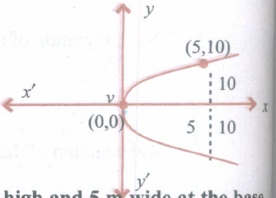
\(\therefore\) Focus is (a, 0) = (5, 0) which is the mid-point of the given diameter
36.
Given xy + y2 = tan x + y
Differentiating with respect to 'x' we get,
\(x.\frac { dy }{ dx } +y\left( 1 \right) +2y\frac { dy }{ dx } =\sec ^{ 2 }{ x } +\frac { dy }{ dx } \)
\(\Rightarrow x.\frac { dy }{ dx } +y+2y\frac { dy }{ dx } =\sec ^{ 2 }{ x } +\frac { dy }{ dx } \)
\(\Rightarrow \frac { dy }{ dx } \left( x+2y-1 \right) =\sec ^{ 2 }{ x-y } \Rightarrow \frac { dy }{ dx } =\frac { \sec ^{ 2 }{ x-y } }{ x+2y-1 } \)
37.
In \({\left( ax+{{1}\over{x}} \right)}^{n},n=n,x=ax,a={{1}\over{x}}\)
Compare \(\left(ax+{{1}\over{x}} \right)^n\) with (x+a)n
\(\therefore\) General term is tr+1 = nCrXn-r ar
\(\Rightarrow\) tr+1 = nCr (ax)n-r \({\left( {{1}\over{x}} \right)}^{r}=nC_r{a}^{n-r}{x}^{n-2r}\)
To find the fourth term, put r = 3
\({t}_{4}=nC_3{a}^{n-3}{x}^{n-2(3)}={{5}\over{2}}\)
\(\Rightarrow\) \(nC_3{a}^{n-3}{x}^{n-6}={{5}\over{2}}\)
Equating the powers of x both sides, we get
n - 6 = 0 \(\Rightarrow\) n = 6
Putting n = 6 in (1) we get,
\(6{C}_{x}{a}^{6-3}{x}^{0}={{5}\over{2}}\)
\(\Rightarrow\) \(6C_3a^3={{5}\over{2}}\) \([\because\ n{C}_{r}=n{C}_{n-r}]\)
\(\Rightarrow\) 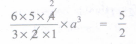
\(\Rightarrow\) 20 a3 = \({{5}\over{2}}\Rightarrow{a}^{3}={{5}\over{2\times20}}\)
\(\Rightarrow\) \({a}^{3}={{1}\over{8}}={\left({{1}\over{2}} \right)}^{3}\)
\(\Rightarrow\) \(a={{1}\over{2}}\)
\(\therefore\) n = 6 and \(a={{1}\over{2}}\)
38.
Equation of parabola \(y^2=-4 a x\)
It passes through (-2, -3)
\(9=-4 a(-2) \Rightarrow 4 a=\frac{9}{2}\)
Required equation \(y^2=\frac{-9 x}{2}\)
39.
Given A = \(\left| \begin{matrix} 1 & a & b \\ 1 & c & a \\ 1 & b & c \end{matrix} \right| =0\)
Applying R2 \(\rightarrow\) R2-R1 and R3 \(\rightarrow\) R3 - R1
we get A = \(\left| \begin{matrix} 1 & a & b \\ 0 & c-a & a-b \\ 0 & b-a & c-b \end{matrix} \right| =0\)
Expanding along C1 we get
\(1\left| \begin{matrix} c-a & a-b \\ b-a & c-b \end{matrix} \right| =0\)
\(\Rightarrow\) (c - a) (c - b) - (b - a) (a - b) = 0
\(\Rightarrow\) c2 - bc - ac + ab - (ab - b2 - a2 + ab) = 0
\(\Rightarrow\) a2 + b2 + c2 - ab - bc - ca = 0
Multiplying both sides by 2 we get, 2a2 + 2b2 + 2c2 - 2ab - 2bc - 2ca = 0
\(\Rightarrow\) (a - b)2 + (b - c)2 + (c - a)2 = 0
\(\Rightarrow\) a = b = 0, b - c = 0,c - a = 0
\(\Rightarrow\) a = b = c
\(\Rightarrow\) \(\Delta\) ABC is equilateral.
\(\therefore A=B=C=\frac { \pi }{ 3 } \)
\(\therefore { sin }^{ 2 }A+{ sin }^{ 2 }B+{ sin }^{ 2 }C=3{ sin }^{ 2 }\frac { \pi }{ 3 } =3{ \left( sin\frac { \pi }{ 3 } \right) }^{ 2 }=3{ \left( \frac { \sqrt { 3 } }{ 2 } \right) }^{ 2 }=3\times \frac { 3 }{ 4 } =\frac { 9 }{ 4 } \)
40.
Given \({ A }^{ -1 }=\left[ \begin{matrix} 1 & 0 & 3 \\ 2 & 1 & -1 \\ 1 & -1 & 1 \end{matrix} \right] \)
\(\left|A^{-1}\right|=1[1-1]-0+3[-2-1]\)
\(=-9 \neq 0\)
\(\therefore\left(\mathrm{A}^{-1}\right)^{-1} \text { exists }\)
\(A_{11}=\text {Co-factor of } 1=1-1=0 \)
\(A_{12}=\text {Co-factor of } 0=-(2+1)=-3 \)
\(A_{13}=\text {Co-factor of } 3=(-2-1)=-3\)
\(A_{21}=\text {Co-factor of } 2=-(0+3)=-3\)
\(\mathrm{A}_{22}= \text {Co-factor of }1=1-3=-2\)
\(A_{23}= \text {Co-factor of }-1=-(-1-0)=1\)
\(A_{31}=\text {Co-factor of }1=0-3=-3\)
\(A_{32}= \text {Co-factor of } -1=-1(-1-6)=7\)
\(\mathrm{A}_{33}= \text {Co-factor of }1=1-0=1\)
\(\text {Co-factor matrix }=\left(\begin{array}{ccc} 0 & -3 & -3 \\ -3 & -2 & 1 \\ -3 & 7 & 1 \end{array}\right)\)
\(\text {Since }\left(A^{-1}\right)^{-1}=A\)
\(\mathrm{A}=\frac{1}{\left|A^{-1}\right|} \text { adj } A^{-1}\)
\(=\frac{1}{-9}\left(\begin{array}{ccc} 0 & -3 & -3 \\ -3 & -2 & 7 \\ -3 & 1 & 1 \end{array}\right)\)
\(A=\frac{1}{9}\left(\begin{array}{ccc} 0 & 3 & 3 \\ 3 & 2 & -7 \\ 3 & -1 & -1 \end{array}\right)\)
41.
42.
\(\sin 9 A+\sin 7 A= 2 \sin \left(\frac{9 A+7 A}{2}\right)
\cos \left(\frac{9 A-7 A}{2}\right)\)
\(=2 \sin \left(\frac{16 A}{2}\right) \cos \left(\frac{2 A}{2}\right)\)
\(=2 \sin 8 A \cos A\)
43.
Aij = (–1)i+jMij
A11 = (–1)1+1M11 = \(\left| \begin{matrix} 1 & 0 \\ 1 & 0 \end{matrix} \right| \) = 0
A12 = (–1)1+2M12 = \(-\left| \begin{matrix} 0 & 0 \\ -4 & 0 \end{matrix} \right| \) = 0
A13 = (–1)1+3M13 = \(\left| \begin{matrix} 0 & 1 \\ -4 & 1 \end{matrix} \right| \)= 0 - (-4) = 4
A21 = (–1)2+1M21 = \(-\left| \begin{matrix} -2 & -3 \\ 1 & 0 \end{matrix} \right| \)= -(0 - (-3)) = -3
A22 = (–1)2+2M22 = \(\left| \begin{matrix} 1 & -3 \\ -4 & 0 \end{matrix} \right| \) = 0 - 12 = -12
A23 = (–1)2+3M23 = \(-\left| \begin{matrix} 1 & -2 \\ -4 & 1 \end{matrix} \right| \) = -(1-8) = 7
A31 = (–1)3+1M31 = \(\left| \begin{matrix} -2 & -3 \\ 1 & 0 \end{matrix} \right| \) = 0 - (-3) = 3
A32 = (–1)3+2M32 = \(-\left| \begin{matrix} 1 & -3 \\ 0 & 0 \end{matrix} \right| \) = 0 - 0 = 0
A33 = (–1)3+3M33 = \(\left| \begin{matrix} 1 & -2 \\ 0 & 1 \end{matrix} \right| \) = 1 - 0 = 1
\(\left[ { A }_{ ij } \right] =\left[ \begin{matrix} 0 & 0 & 4 \\ -3 & -12 & 7 \\ 3 & 0 & 1 \end{matrix} \right] \)
Adj A = [Aij]T
\(=\left[ \begin{matrix} 0 & -3 & 3 \\ 0 & -12 & 0 \\ 4 & 7 & 1 \end{matrix} \right] \)
44.
Let y = x3+8x2+5x-2
Differentiating w.r.t. 'x' we get
\({dy\over dx}=3x^2+16x+5\)
\({dy\over dx}=0⇒3x^2 + 16x + 5=0\)
⇒ (x+5)(3x+1)=0
⇒ x = - 5, -1/3

The possible intervals are (-∞, - 5), (-5, -1/3) and (-1/3, ∞)
| Intervals | Sign of \(dy\over dx\) | Nature of Function |
|---|---|---|
| (-∞, - 5) say x = - 6 | 3(-6)2 + 16(-6) + 5 = 17 (Positive) | Increasing Function |
| (-5, -1/3) say x = -1 | 3(-1)2 + 16(-1) + 5 = - 8 (Negative) | Decreasing Function |
| (-1/3, ∞) say x = 0 | 3(0)2 + 16(0) + 5 = 5 (Positive) | Increasing Function |
Hence the given function is increasing in the intervals (-∞, - 5), (-1/3, ∞) and decreasing in (-5, -1/3).
45.
Cost of one share = 100-4 = 96
Stock = 9300
Number of shares purchased = \(\frac { \text {Stock }}{ FV } \)
=\(\frac { 9300 }{ 100 } \) = 93
\(\therefore\) Purchase price of 93 shares = 93 x 96 = Rs.8928
46.
S = {1, 2, 3,.....10}
n(S) = 10
Let B be the event of drawing a card greater than 4
B = {5, 6,.... 10}
\(P(B) =\frac { 6 }{ 10 } \)
Let A be the event of getting an even number
A = {2, 4, 6, 8, 10}
\(P(A) =\frac { 5 }{ 10 } \)
\(A\cap B\) = {6, 8, 10}
\(P(A\cap B)=\frac { 3 }{ 10 } \)
\(P(A/B)=\frac {P(A\cap B)}{P(B)}=\frac{\frac{3}{10}}{\frac{6}{10}}=\frac{3}{6}=\frac{1}{2}\)
47.
Let the number of shares be x.
Dividend = No.of shares x F.V x Rate percentage.
1620 = \(x \times 20 \times \frac { 9 }{ 100 } \)
x = \(\frac { 1620\times 100 }{ 20\times 9 } \) = 900 shares
48.
p = 200 - \(\frac { x }{ 100 } \)
R = px \(=200x-{x^2\over100}\)
C = 40x + 120
(i) Profit function = R - C
\(=200x-{x^2\over100}-40x-120\)
\(={x^2\over100}-160x-120\)
(ii) Averange Profit \(=\mathrm{A} \cdot \mathrm{P}=\frac{p(x)}{x}=\frac{R(x)-c(x)}{x}\)
\(=\frac{200 x \frac{-x^2}{100}+40 x+1}{x}=160-\frac{x}{100}-\frac{120}{x}\)
At x = 10 units
\(\text {A.P } =160-\frac{1}{10}-\frac{120}{10} \)
\(=160-12.1= 147.90\)
(iii) Marginal profit \(=\mathrm{M} \cdot \mathrm{P}=\frac{d p}{d x}=\frac{d}{d x} p(x)\)
\(=160-\frac{2 x}{100} \)
\(=160-\frac{x}{50}\)
At x = 10 units
\(\text {M.P }=160-\frac{1}{5}=160-0.2= 159.80\)
(iv) Marginal average profit = M.A.P \( =\frac{d(A P)}{d x}\)
\(=-\frac{1}{100}+\frac{120}{x^2}\)
At x = 10 units
\(\text {M.A.P }=-\frac{1}{100}+\frac{120}{100}= 1.19\)
49.
\(p={(a-bx)^{1\over 2}}\)
Differentiating with respect to the price ‘p’ ,
we get \(1={1\over2}(a-bx)^{1\over2}(-b).{dx\over dp}\)
\(∴\ {dx\over dp}={2(a-bx)^{1\over2}\over-b}\)
Elasticity of demand: \(η_d=-{p\over x}.{dx\over dp}\)
\(=-{(a-bx)^{1\over2}\over x}.{2(a-bx)^{1\over2}\over -b}\)\(={2(a-bx)\over bx}\)
When \(η_d=1,\ {2(a-bx)\over bx}=1\)
2(a - bx) = bx ⇒ output \( x={2a\over 3b}\)units
50.
Let y = sin x. sin 2x. sin 3x
Taking logarithms on both sides we get,
log y = log (sin x. sin 2x. sin 3x)
= log (sin x) + log (sin 2x) + log (sin 3x) [\(\therefore\) log ab = log a + log b]
Differentiating with respect to 'x' we get,
\(\frac { 1 }{ y } \frac { dy }{ dx } =\frac { 1 }{ sin\quad x } .\frac { d }{ dx } (sin\quad x)+\frac { 1 }{ sin\quad 2x } .\frac { d }{ dx } (sin\quad 2x)+\frac { 1 }{ sin\quad 3x } .\frac { d }{ dx } (sin\quad 3x)\)
\(\frac { 1 }{ y } \frac { dy }{ dx } =\frac { cos\quad x }{ sin\quad x } +\frac { 2cos2x }{ sin\quad 2x } =3.\frac { cos\quad 3x }{ sin\quad 3x } \)
= cot x + 2 cot 2x + 3 cot 3x
\(\Rightarrow \frac { dy }{ dx } =y[cotx+2cot2x+3cot3x]\)
\(\Rightarrow \frac { dy }{ dx } \)= sin x sin 2x sin 3x [cot x + 2 cot 2x + 3 cot 3x]
51.
The given lines are
2x - 5y + 3 = 0
5x - 9y + \(\lambda \) = 0
x - 2y + 1 = 0
The condition for the lines to be concurrent is
\(\left| \begin{matrix} 2 & -5 & 3 \\ 6 & -9 & \lambda \\ 1 & -2 & 1 \end{matrix} \right| =0\quad \)
Expanding along R1 , we get
\(2\left| \begin{matrix} -9 & \lambda \\ -2 & 1 \end{matrix} \right| +5\left| \begin{matrix} 5 & \lambda \\ 1 & 1 \end{matrix} \right| +3\left| \begin{matrix} 5 & -9 \\ 1 & -2 \end{matrix} \right| =0\)
\(\Rightarrow 2(-9+2\lambda )+5(5-\lambda )+3(-10+9)=0\)
\(\Rightarrow -18+4\lambda +25-5\lambda -30+27=0\)
\(\Rightarrow -\lambda +4=0\Rightarrow \lambda =+4\)
52.
y = 2 sin x + 3 cos x
y1 = 2 cos x - 3 sin x
y2 = 2 (-sin x) -3 cos x
y2 = -2 sin x -3 cos x = -y
y2 + y = 0.
53.
\({{(2x+1)!}\over{(x+2)!}}.{{(x-1)!}\over{(2x-1)!}}={{3}\over{5}}\)
\(\Rightarrow\) \({{(2x+1)(2x)(2x-1)!}\over{(x+2)(x+1)(x-1)!}}.{{(x-1)!}\over{(2x-1)!}}={{3}\over{5}}\)
\(\Rightarrow\) \({{(2x+1)(2)}\over{(x+2)(x+1)}}={{3}\over{5}}\)
\(\Rightarrow\) 10 (2x+1) = 3 (x+2) (x+1)
\(\Rightarrow\) 20x+10=3 (x2+3x+2)
\(\Rightarrow\) 20x+10+3x2-9x-6=0
\(\Rightarrow\) -3x2+11x+4 = 0
\(\Rightarrow\) -3x2-11x-4=0
\(\Rightarrow\) (x-4)(3x+1)=0
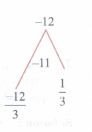
\(\Rightarrow\) x = 4 or x \(={{-1}\over{3}}\)
Since \(x={{-1}\over{3}}\) is not possible, x = 4.
54.
Let A = \(\left| \begin{matrix} x & sin\theta & cos\theta \\ -sin\theta & -x & 1 \\ cos\theta & 1 & x \end{matrix} \right| \)
Expanding along R1 we get
|A| = x\(\left| \begin{matrix} -x & 1 \\ 1 & x \end{matrix} \right| -sin\theta \left| \begin{matrix} -sin\theta & 1 \\ cos\theta & x \end{matrix} \right| +cos\theta \begin{vmatrix} -sin\theta & -x \\ cos\theta & 1 \end{vmatrix}\)
= x(-x2 - 1) - sin \(\theta\) (-x sin \(\theta\) - cos \(\theta\)) + cos \(\theta\) (-sin \(\theta\) + x cos \(\theta\))
\(=-x^{ 3 }-x+xsin^{ 2 }\theta +sin\theta cos\theta +xcos^{ 2 }\theta \)
= -x3 - x + x(sin2\(\theta\) + cos2\(\theta\))
= -x3 - x + x(1) [\(\because\) sin2\(\theta\) + cos2\(\theta\) ] = -1
= -x3 which is independent of \(\theta\)

11th Standard Syllabus & Materials
11th Standard
TN 11th Tamil பீடு பெற நில் - செய்யுள் - காவடிச்சிந்து Important Questions And Answers Study Material - QB365 Set A
NEW11th Standard
TN 11th Tamil பீடு பெற நில் - உரைநடை - மலை இடப்பெயர்கள் : ஓர் ஆய்வு Important Questions And Answers Study Material - QB365 Set A
NEW11th Standard
TN 11th Tamil மாமழை போற்றுதும் - துணைப்பாடம் - யானை டாக்டர் Important Questions And Answers Study Material - QB365 Set A
NEW11th Standard
TN 11th Tamil மாமழை போற்றுதும் - செய்யுள் - ஐங்குறுநூறு Important Questions And Answers Study Material - QB365 Set A



Tamilnadu Stateboard 11th Standard Subjects

Maths

Commerce

Economics

Biology
Business Maths and Statistics

Accountancy

Computer Science

Physics

Chemistry
Maths
Biology
Economics
Physics
Chemistry

History
Business Maths and Statistics

Computer Science
Accountancy

Computer Applications
History
Computer Technology
Commerce
Computer Applications
Computer Technology

Tamil

English

French
Tamilnadu Stateboard Standards
