
 100% FREE ACCESS
11th Standard Syllabus & Materials
11th Standard
TN 11th Tamil இயற்கை வேளாண்மை,சுற்றுச்சூழல் -செய்யுள் - மனோன்மணீயம் Important Questions And Answers Study Material - QB365 Set A
NEW11th Standard
TN 11th Tamil என்னுயிர் என்பேன் -துணைப்பாடம் - இசைத்தமிழர் இருவர் Important Questions And Answers Study Material - QB365 Set A
NEW11th Standard
TN 11th Tamil மொழி கலை -செய்யுள் - ஒவ்வொரு புல்லையும் Important Questions And Answers Study Material - QB365 Set A
NEW11th Standard
TN 11th Tamil பீடு பெற நில் - இலக்கணம் - பகுபத உறுப்புகள் Important Questions And Answers Study Material - QB365 Set A
NEW11th Standard
TN 11th Tamil பீடு பெற நில் - துணைப்பாடம் - வாடிவாசல் Important Questions And Answers Study Material - QB365 Set A
NEW11th Standard
TN 11th Tamil பீடு பெற நில் - செய்யுள் - குறுந்தொகை Important Questions And Answers Study Material - QB365 Set A

Published on: 28/12/2018
11th Half Yearly Model Question
Download Tamil Nadu 11th Standard Business Maths and Statistics question papers, model tests, one-mark questions, important questions, and public exam papers in PDF format. Free study materials and answer keys for TN State Board students.
Questions + Answers key
Take MCQ Business Maths and Statistics Test
1.
Evaluate: \(\underset { x\rightarrow 1 }{ lim } \frac { { x }^{ 3 }-1 }{ x-1 } \)
2.
Prove that \(\frac { sin(-\theta )tan({ 90 }^{ o }-\theta )sec\left( { 180 }^{ o }-\theta \right) }{ sin(180+\theta )cot(360-\theta )cosec({ 90 }^{ o }-\theta ) } =1\)
3.
Show that perpendicular distances of the line x - y + 5 = 0 from origin and from the point P(2, 2) are equal.
4.
A producer has 30 and 17 units of labour and capital respectively which he can use to produce two types of goods X and Y. To produce one unit of X, 2 unit of labour and 3 units of capital are required. Similarly, 3 units of labour and 1 unit of capital is required to produce one unit of Y. If X and Yare priced at HOO and H20 per unit respectively, how should the producer use his resources to maximize the total revenue? Formulate the LPP for the above.
5.
If f(x,y) = 3x2 + 4y3 + 6xy - x2y3 + 6. Find fx(1, -1)
6.
7.
Find the principal value of \(\cos^{-1}\left(\frac{-1}{\sqrt2}\right)\)
8.
The technology matrix of an economic system of two industries is\(\begin{bmatrix} 0.6 & 0.9 \\ 0.20 & 0.80 \end{bmatrix}\). Test whether the system is viable as per Hawkins-Simon conditions.
9.
Resolve into partial fractions for the following : \(\frac{3 x+7}{x^2-3 x+2}\)
10.
The probability of drawing a spade from a pack of card is _________.
1/52
1/13
4/13
1/4
11.
Harmonic mean is better than other means if the data are for _________.
Speed or rates.
Heights or lengths.
Binary values like 0 and 1
Ratios or proportions.
12.
If ‘a’ is the annual payment, ‘n’ is the number of periods and ‘i’ is compound interest for Rs. 1 then future amount of the annuity is _______.
A = \(\frac{a}{i}(1+i)(1+i)^n-1]\)
A = \(\frac{a}{i}[(1+i)^n-1]\)
P = \(\frac{a}{i}\)
P = \(\frac{a}{i}(1+i)[1-(1+i)^{-n}]\)
13.
The brokerage paid by a person on the sale of 400 shares of face value Rs.100 at 1% brokerage ________.
Rs. 600
Rs. 500
Rs. 200
Rs. 400
14.
If r(X,Y) = 0 the variables X and Y are said to be ______.
Positive correlation
Negative correlation
No correlation
Perfect positive correlation
15.
Correlation co-efficient lies between ______.
0 to ∞
-1 to +1
-1 to 0
-1 to ∞
16.
17.
Marginal revenue of the demand function p = 20–3x is _______.
20–6x
20–3x
20+6x
20+3x
18.
Maximize: z = 3x1 + 4x2 subject to 2x1 + x2 ≤ 40, 2x1+ 5x2 ≤ 180, x1, x2 ≥ 0. In the LPP, which one of the following is feasible corner point?
x1 = 18, x2 = 24
x1 = 15, x2 = 30
x1 = 2.5, x2 = 35
x1 = 20.5, x2 = 19
19.
The critical path of the following network is________.
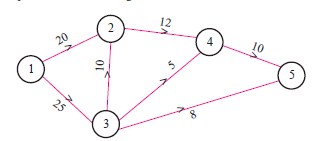
1 – 2 – 4 – 5
1 – 3 – 5
1 – 2 – 3 – 5
1 – 2 – 3 – 4 – 5
20.
\(\frac{d}{dx}(5e^x-2logx)\) is equal to ________.
5ex - \(\frac{2}{x}\)
5ex - 2x
5ex - \(\frac{1}{x}\)
2 log x
21.
\(\frac{d}{dx}(\frac{1}{x})\) is equal to ________.
\(-\frac{1}{x^2}\)
\(-\frac{1}{x}\)
log x
\(\frac{1}{x^2}\)
22.
\(\left(\frac{\cos x}{cosec x}\right)-\sqrt{1-\sin^2x}\sqrt{1-\cos^2x}\) is _______.
cos2x-sin2x
sin2x-cos2x
1
0
23.
The radian measure of 37o30' is ______.
\(\frac{5\pi}{24}\)
\(\frac{3\pi}{24}\)
\(\frac{7\pi}{24}\)
\(\frac{9\pi}{24}\)
24.
The equation of directrix of the parabola y2 = - x is _______.
4x+ 1 =0
4x - 1 = 0
x - 4=0
x + 4 = 0
25.
(1, - 2) is the centre of the circle x2 + y2 + ax + by - 4 = 0, then its radius _______.
3
2
4
1
26.
The value of (5C0 + 5C1) + (5C1 + 5C2) + (5C2 + 5C3) + (5C3 + 5C4) + (5C4 + 5C5 ) is ________.
26-2
25-1
28
27
27.
The number of ways of selecting 4 players out of 5 is _______.
4!
20
25
5
28.
The value of \(\begin{vmatrix} x & x^2 & -yz & 1 \\ y & y^2 & -zx & 1 \\ z & z^2 & -xy &1 \end{vmatrix}\) is ________.
1
0
-1
-xyz
29.
If A \(=\begin{pmatrix} -1 & 2 \\ 1 & -4 \end{pmatrix}\) then A (adj A) is ________.
\(\begin{pmatrix} -4 & -2 \\ -1 & -1 \end{pmatrix}\)
\(\begin{pmatrix} 4 & -2 \\ -1 & 1 \end{pmatrix}\)
\(\begin{pmatrix} 2 & 0 \\ 0 & 2 \end{pmatrix}\)
\(\begin{pmatrix} 0 & 2 \\ 2 & 0 \end{pmatrix}\)
30.
Show that the given lines 3x - 4y - 13 = 0, 8x - 11y = 33 and 2x - 3y - 7 = 0 are concurrent and find the concurrent point.
31.
Solve the following LPP graphically. Maximize Z = 6x1 + 5x2 Subject to the constraints 3x1 + 5x2 ≤ 15, 5x1 + 2x2 ≤ 10 and x1,x2 ≥ 0
32.
A man bought 6% stock of Rs.12,000 at 92 and sold it when the rise to 96.Find his gain.
33.
If two lines of regression are 3X-2Y+1=0, 2X-Y-2=0, find \(\bar {X}\)and \(\bar{Y}\).
34.
A die is thrown. Find the probability of getting
(i) a prime number
(ii) a number greater than or equal to 3
35.
How much will be required to buy 125 of Rs. 25 shares at a discount of Rs. 7
36.
Compared to the previous year the overhead expenses went up by 32% in 1995, they increased by 40% in the next year and by 50% in the following year. Calculate the average rate of increase in overhead expenses over the three years.
37.
A company is producing three products P1, P2 and P3, with profit contribution of Rs.20, Rs.25 and Rs.15 per unit respectively. The resource requirements per unit of each of the products and total availability are given below.
| Product | P1 | P2 | P3 | Total availability |
| Man hours/unit | 6 | 3 | 12 | 200 |
| Machine hours/unit | 2 | 5 | 4 | 350 |
| Material/unit | 1kg | 2kg | 1kg | 100kg |
Formulate the above as a linear programming model.
38.
Find the slope of the lines which make an angle of 45° with the line 3x - y + 5 = 0.
39.
Differentiate the following with respect to x \(\frac { { e }^{ x } }{ 1+{ e }^{ x } } \)
40.
If y = 2 sin x + 3 cos x, then show that y2 + y = 0
41.
Find the number of arrangements that can be made out of the letters of the word "ASSASSINATION".
42.
Verify Euler’s theorem for the function \(u=\frac{1}{\sqrt{x^2+y^2}}\)
43.
For the total revenue function R = - 90 + 6x2 - x3 find when R is increasing and when it is decreasing. Also, discuss the behaviour of marginal revenue.
44.
Every gram of wheat provides 0.1 g of proteins and 0.25 g of carbohydrates. The corresponding values of rice are 0.05 g and 0.5 g respectively. Wheat cost Rs.4 per kg and rice cost Rs.6 per kg. The minimum daily requirements of proteins and carbohydrate for an average child are 50 g and 200 g respectively. In what quantities should wheat and rice be mixed in the daily diet to provide minimum daily requirements of proteins and carbohydrate at minimum cost. Frame an LPP and solve it graphically.
45.
Kamal sold Rs.9000 worth 7% stock at 80 and invested the proceeds in 15% stock at 120. Find the change in his income?
46.
Calculate the Mean deviation about median and its relative measure for the following data.
| X | 15 | 25 | 35 | 45 | 55 | 65 | 75 | 85 |
| frequency | 12 | 11 | 10 | 15 | 22 | 13 | 18 | 19 |
47.
Find the equation of the regression line of Y on X, if the observations ( Xi, Yi) are the following (1, 4) (2, 8) (3, 2) ( 4, 12) (5, 10) (6, 14) (7, 16) ( 8, 6) (9, 18).
48.
The demand for a commodity x is q = 5-2p1+ P2 -\({ p }_{ 1 }^{ 2 }{ p }_{ 2 }\). Find the partial elasticities \(\frac { Eq }{ { EP }_{ 1 } } \) and \(\frac { Eq }{ { EP }_{ 2 } } \) when p1= 3 and p2 = 7
49.
Find the value of tan \(\left( {{\pi}\over{8}}\right).\)
50.
If tan x = \(\frac { -4 }{ 3 } \) and x is in II quadrant, find \(sin\frac { x }{ 2 } ,cos\frac { x }{ 2 } \) and \(tan\frac { x }{ 2 } \)
51.
How many numbers greater than a million can be formed with the digits 2, 3, 0, 3, 4, 2, 3?
52.
By the principle of mathematical induction, prove the following.
13 + 23 + 33 + ....... + n3 = \(\frac { { n }^{ 2 }(n+1)^{ 2 } }{ 4 } \) for all \(n\in N\).
53.
Solve by matrix inversion method: 3x - y + 2z = 13 ; 2x + y - z = 3 ; x + 3y - 5z = - 8.
54.
If \({ A }^{ -1 }=\left[ \begin{matrix} 1 & 0 & 3 \\ 2 & 1 & -1 \\ 1 & -1 & 1 \end{matrix} \right] \) then, find A.
1.
\(\underset { x\rightarrow 1 }{ lim } \frac { { x }^{ 3 }-1 }{ x-1 } \) is of the type \(\frac { 0 }{ 0 } \)
\(\underset { x\rightarrow 1 }{ lim } \cfrac { { x }^{ 3 }-1 }{ x-1 } =\underset { x\rightarrow 1 }{ lim } \cfrac { \left( x-1 \right) \left( { x }^{ 2 }+x+1 \right) }{ \left( x-1 \right) } \)
\(=\underset { x\rightarrow 1 }{ lim } \left( { x }^{ 2 }+x+1 \right) \)
\(=\left( 1 \right) ^{ 2 }+1+1\)
= 3
2.
LHS = \(\frac { sin(-\theta )tan({ 90 }^{ o }-\theta )sec\left( { 180 }^{ o }-\theta \right) }{ sin(180+\theta )cot(360-\theta )cosec({ 90 }^{ o }-\theta ) } =1\)
= \(\cfrac { \left( -sin\theta \right) cot\theta \left( -sec\theta \right) }{ \left( -sin\theta \right) \left( -cot\theta \right) sec\theta } =1\)
3.
Given line is x - y + 5 = 0
Perpendicular distance of the given line from P(2, 2) is
= \(\left| \cfrac { 2-2+5 }{ \sqrt { { 1 }^{ 2 }+{ 1 }^{ 2 } } } \right| \)
= \(\left| \cfrac { 5 }{ \sqrt { 2 } } \right| =\cfrac { 5 }{ \sqrt { 2 } } \)
Distance of (0,0) from the given line
= \(\left| \cfrac { 5 }{ \sqrt { { 1 }^{ 2 }+{ 1 }^{ 2 } } } \right| =\left| \cfrac { 5 }{ \sqrt { 2 } } \right| =\cfrac { 5 }{ \sqrt { 2 } } \)
The given line is equidistance from origin and (2, 2).
4.
(i) Variables:
Let x1, x2 represent the number of units of X and Y.
(ii) Constraints:
| Labour | Capital | |
|---|---|---|
| X | 2 | 3 |
| Y | 3 | 1 |
∴ 2x1 + 3x2 ≤ 30 and 3x1 + x2 ≤ 17
(iii) Non-negative restrictions:
Since the number of units of X and Y cannot be negative,x1, x2 ≥ 0.
Hence, the mathematical formulation of the LPP is maximize \(Z=100{ x }_{ 1 }+120{ x }_{ 2 }\)
Subject to the constraints
\( { 2x }_{ 1 }+3{ x }_{ 2 }\le 30\)
\({ 3x }_{ 1 }+{ x }_{ 2 }\le 17\)
and x1, x2 ≥ 0.
5.
Given f(x, y) =3x2+4y3+6xy-x2y3+6
Differentiating partially w.r.t. 'x' we get,
fx(x, y)=6x + 0 + 6y(1) -y3(2x) + 0
=6x + 6y- 2xy3
\(\therefore f_x(1,-1)=\) 6(1) +6(-1)-2(1)(-1)3
= 6-6+2
= 2
6.
7.
Let \(\cos^{-1}\left(\frac{-1}{\sqrt2}\right)=\theta\)
\(\Rightarrow\cos\theta=-\frac{1}{\sqrt2}\)
We know that the range of principal value of \(\cos^{-1}\)is \([0,\pi]\)
\(\therefore\cos\theta=-\frac{1}{\sqrt2}\Rightarrow-\cos\frac{\pi}{4}=\cos\left(\pi-\frac{\pi}{4}\right)=\cos\frac{3\pi}{4}\)
\(\therefore\cos\theta=\cos\frac{3\pi}{4}\)
\(\Rightarrow\theta=\frac{3\pi}{4}\epsilon[0,\pi]\)
Thus the principal value of \(\cos^{-1}\left(-\frac{1}{\sqrt2}\right)\)is \(\frac{3\pi}{4}\)
8.
B = \(\begin{bmatrix} 0.6 & 0.9 \\ 0.20 & 0.80 \end{bmatrix}\)
I - B = \(\begin{bmatrix} 1 & 0 \\ 0 & 1 \end{bmatrix}-\begin{bmatrix} 0.6 & 0.9 \\ 0.20 & 0.80 \end{bmatrix}=\begin{bmatrix} 0.4 & -0.9 \\ -0.20 & 0.20 \end{bmatrix}\)
|I - B| =\(\begin{bmatrix} 0.4 & -0.9 \\ -0.20 & 0.20 \end{bmatrix}\)
= 0.08 - 0.18 = - 0.1 < 0
Since |I - B| is negative, Hawkins-Simon conditions are not satisfied.
Therefore the given system is not viable.
9.
\(\frac { 3x+7 }{ { x }^{ 2 }-3x+2 } =\frac { 3x+7 }{ (x-1)(x-2) } =\frac { A }{ x-2 } +\frac { B }{ x-1 } \)
\(\frac{3 x+7}{(x-1)(x-2)}=\frac{A(x-2)+B(x-1)}{(x-1)(x-2)}\)
\(3 x+7=A(x-2)+B(x-1)\) ...(1)
If x = 1
\(3+7=\mathrm{A}(1-2) \Rightarrow \mathrm{A}=-10\)
If x = 2
\(6+7=\mathrm{B}(2-1) \Rightarrow \mathrm{B}=13\)
\(\therefore\)\(\frac { 3x+7 }{ { x }^{ 2 }-3x+2 } \)=\(\frac { -10 }{ x-1 } + \frac { 13 }{ x-2 } \)
10.
\(\frac{13}{52}\)=1/4
11.
(a)
Speed or rates.
12.
(b)
A = \(\frac{a}{i}[(1+i)^n-1]\)
13.
Brokerage = 100 x 400 x \(\frac{1}{100}=400\)
14.
(c)
No correlation
15.
(b)
-1 to +1
16.
(b)
17.
R = px = 20x- 3x2
M.R = dR/dx = 20 - 6x
18.
Since x1 = 2.5, x2 = 35 satisfies all the Constraints
19.
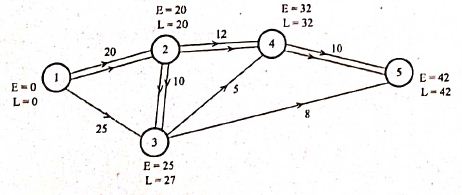
20.
(a)
5ex - \(\frac{2}{x}\)
21.
(a)
\(-\frac{1}{x^2}\)
22.
cos x sin x - cos x sin x = 0
23.
\(37^{\circ} 30^{\prime}=37 \frac{1}{2}^{\circ}=\frac{75}{2} \times \frac{\pi}{180}=\frac{5 \pi}{24}\)
24.
\(4 a=1 \Rightarrow a=\frac{1}{4}\)
Equation x = a
\(x=\frac{1}{4}\)
25.
\(r=\sqrt{g^2+f^2-c}=\sqrt{1+4+4}=3\)
26.
Since sum of all binomial coefficients is 2n
5C0 + 5C1 + 5C2 + 5C3 + 5C4 + 5C5 + (5C1 + 5C2 + 5C3 + 5C4)
= 25 + (25 - (5C0 + 5C5)
= 32 + 32 - (1 + 1)
= 64 - 2 = 26 - 2
27.
No. of ways = 5C4 = 5C1 = 5
28.
\(\left|\begin{array}{ccc} x & x^2 & 1 \\ y & y^2 & 1 \\ z & z^2 & 1 \end{array}\right|+\left|\begin{array}{ccc} x & -y z & 1 \\ y & -z x & 1 \\ z & -x y & 1 \end{array}\right|\)
Multiply R1, R2, R3, of second determinant by x, y, z respectively
\(\left|\begin{array}{ccc} x & x^2 & 1 \\ y & y^2 & 1 \\ z & z^2 & 1 \end{array}\right|-\frac{1}{x y z}\left|\begin{array}{ccc} x^2 & x y z & x \\ y^2 & x y z & y \\ z^2 & x y z & z \end{array}\right|\)
\(=\left|\begin{array}{lll} x & x^2 & 1 \\ y & y^2 & 1 \\ z & z^2 & 1 \end{array}\right|-\frac{x y z}{x y z}\left|\begin{array}{ccc} x^2 & 1 & x \\ y^2 & 1 & y \\ z^2 & 1 & z \end{array}\right|\)
\(=\left|\begin{array}{lll} x & x^2 & 1 \\ y & y^2 & 1 \\ z & z^2 & 1 \end{array}\right|-\left|\begin{array}{lll} x & x^2 & 1 \\ y & y^2 & 1 \\ z & z^2 & 1 \end{array}\right|=0\)
29.
\(|A|=4-2=2\)
\(A(\operatorname{adj} A)=|A| I=\left(\begin{array}{ll} 2 & 0 \\ 0 & 2 \end{array}\right)\)
30.
Given lines 3x - 4y - 13 = 0...(1)
8x - 11y = 33 ...(2)
2x - 3y - 7 = 0 ...(3)
Conditon for concurrent lines is
\(\left| \begin{matrix} { a }_{ 1 } & { b }_{ 1 } & { c }_{ 1 } \\ { a }_{ 2 } & { b }_{ 2 } & { c }_{ 2 } \\ { a }_{ 3 } & { b }_{ 3 } & { c }_{ 3 } \end{matrix} \right| =0\)
i.e.,\(\left| \begin{matrix} 3 & -4 & -13 \\ 8 & -11 & -33 \\ 2 & -3 & -7 \end{matrix} \right| =3\left( 77-99 \right) +4\left( 56+44 \right) -13\left( -24+22 \right) \)
= -66 + 40 + 26 = 0
\(\Rightarrow \) Given lines are concurrent. To get the point of concurrency solve the equations (1) and (3)
| Equation (1) \(\times\) 2 | \(\Rightarrow \) | 6x | - 8y | = 26 |
| Equation (3) \(\times\) 3 | \(\Rightarrow \) | 6x | - 9y | = 21 |
| y | = 5 |
When y = 5 from (2) 8x = 88
x = 11
Point of concurrency is (11, 5)
31.
Since the decision variables x1,x2 are non-negative, the solution lies in the I quadrant.
Consider the equations
\(3{ x }_{ 1 }+5{ x }_{ 2 }=15\)
| \({ x }_{ 1 }\) | 0 | 5 |
| \({ x }_{ 2 }\) | 3 | 0 |
\(5{ x }_{ 1 }+2{ x }_{ 2 }=10\)
| \({ x }_{ 1 }\) | 0 | 2 |
| \({ x }_{ 2 }\) | 5 | 0 |
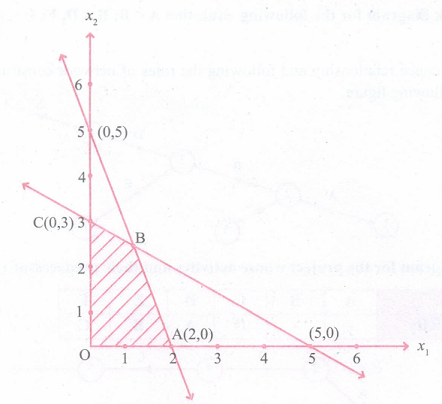
The feasible region is OABC and its co-ordinates are O(0, 0) A(2, 0) C(0, 3) and B is the point of intersection of the lines
\(3{ x }_{ 1 }+5{ x }_{ 2 }=15\) ----(1)
and \(5{ x }_{ 1 }+2{ x }_{ 2 }=10\) ... (2)
Verification of B:
\((1)\times 5\Rightarrow 15{ x }_{ 1 }+25{ x }_{ 2 }=75\\ \quad \quad (-)\quad (-)\quad \quad (-) \\ (2)\times 3\Rightarrow 15{ x }_{ 1 }+6{ x }_{ 2 }=30\\ --------------\\ 19{ x }_{ 2 }=45 \Rightarrow { x }_{ 2 }=\frac { 45 }{ 19 } \)
\(From(1), 3{ x }_{ 1 }+5\left( \frac { 45 }{ 19 } \right) =15\)
\(\Rightarrow 3{ x }_{ 1 }=15-\frac { 225 }{ 19 } \)
\(\Rightarrow { x }_{ 1 }=\frac { 20 }{ 19 } \)
\(\therefore \ B \ is\ \left( \frac { 20 }{ 19 } ,\frac { 45 }{ 19 } \right) \)
| Corner Points | \(Z=6{ x }_{ 1 }+5{ x }_{ 2 }\) |
|---|---|
| O(0,0) | 0 |
| A(2,0) | 12 |
| B\(\left( \frac { 20 }{ 19 } ,\frac { 45 }{ 19 } \right) \) | \(6\times \frac { 20 }{ 19 } +5\times \frac { 45 }{ 19 } =\frac { 345 }{ 19 } \) |
| C(0,3) | 15 |
Maximum of Z occurs at B \(\left( \frac { 20 }{ 19 } ,\frac { 45 }{ 19 } \right) \)
Hence, the solution is \({ x }_{ 1 }=\frac { 20 }{ 19 } ,{ x }_{ 2 }=\frac { 45 }{ 19 } \ and\ { Z }_{ max }=\frac { 345 }{ 19 } \)
32.
Investment = Rs.12,000
FV = Rs.100
Gain in selling one share = 96-92 = 4
\(\therefore\)Gain in the transaction = \(\cfrac { 12000 }{ 100 } \) x 4 = Rs.480
33.
The two lines of regression are
3X-2Y =-1 ..(1)
2X-Y =2 ..(2)
Since these lines meet in (\(\bar {X}\), \(\bar{Y}\)), let us solve (1) and (2)
(1) 3X-2Y =-1
(-) (+) (-)
(2)x2 4X-2Y=4
_________________
Subtracting, -X=-5 \(\Rightarrow\)\(\bar{X}\)=5
Substitutuing \(\bar{X}\)=5 in (1) we gwt,
\(\Rightarrow\)3(5)-2Y=-1 15-2Y=-1
\(\Rightarrow\)16=2Y
\(\Rightarrow\)Y=8
\(\bar{Y}\)=8
Hence, \(\bar{X}\)=5 and \(\bar{Y}\)=8
34.
(i) S = {1, 2, 3, 4, 5, 6}
n(S) = 6
(i) Let A be the event of getting a prime number
A = {2, 3, 5}
n(A) = 3
\(P(A)=\frac { 3 }{ 6 } =\frac { 1 }{ 2 } \)
(ii) Let B be the event that the number is greater than or equal to 3.
B = {3, 4, 5, 6}
n(B) = 4
\(P(B) =\frac { 4 }{ 6 } =\frac { 2 }{ 3 } \)
35.
Market value of one share = 25 - 7 = 18
Market value of 125 shares = 125 x 18
= Rs. 2250
36.
In averaging ratios and percentages, geometric mean is more appropriate. Let us consider X represents Expenses at the end of the year.
| % Rise | X | logX |
| 32 | 132 | 2.1206 |
| 40 | 140 | 2.1461 |
| 50 | 150 | 2.1761 |
| \(\sum\)log X = 6.4428 |
GM = Anti \(\log { \left( \frac { \sum { logX } }{ N } \right) } \)
= Anti \(\log { \left( \frac { 6.4428 }{ 3 } \right) } \)
= Anti log(2.1476)
GM = 140.5
Average rate of increase in overhead expenses
140.5 – 100 = 40.5 %
37.
(i) Variables: Let x1, x2 and x3 be the number of units of products P1, P2 and P3 to be produced.
(ii) Objective function: Profit on x1 units of the product P1 = 20 x1
Profit on x2 units of the product P2 = 25 x2
Profit on x3 units of the product P3 = 15 x3
Total profit = 20 x1 + 25 x2 + 15 x3
Since the total profit is to be maximized, we have to maximize Z = 20 x1 + 25 x2 + 15 x3
Constraints: 6x1 + 3x2 + 12x3 ≤ 200
2x1 + 5x2 + 4x3 ≤ 350
x1 + 2x2 + x3 ≤ 100
Non-negative restrictions: Since the number of units of the products A, B and C cannot be negative, we have x1, x2, x3 ≥ 0
Thus, we have the following linear programming model.
Maximize Z = 20 x1 + 25 x2 + 15 x3
Subject to 6 x1 + 3 x2 + 12 x3 ≤ 200
2x1 + 5x2 + 4x3 ≤ 350
x1 + 2x2 + x3 ≤ 100
x1, x2, x3 ≥ 0
38.
Slope of the line 3x-y+5=0 is
\(\Rightarrow \quad { m }_{ 2 }=-\frac { co-efficient\quad of\quad x }{ co-efficient\quad of\quad y } =\frac { -3 }{ -1 } =3\)
Let m1 = m and \(\theta =45\)
\(\therefore \quad tan\theta =\left| \frac { { m }_{ 1 }-{ m }_{ 2 } }{ 1+{ m }_{ 1 }{ m }_{ 2 } } \right| \)
\(\Rightarrow \quad tan\quad 45=\left| \frac { m-3 }{ 1+3m } \right| \)
\(\Rightarrow \quad 1=\left| \frac { m-3 }{ 1+3m } \right| \)
\(\Rightarrow \quad 1|1+3m|=|m-3|\)
\(\Rightarrow \quad 1+3m=\pm (m-3)\)
\(\Rightarrow \quad 1+3m=m-3\quad or\quad 1+3m=-m+3\)
\(\Rightarrow\) 2m = - 4 or 4m = 2
\(\Rightarrow \) m = - 2 or \(m=\frac { 2 }{ 4 } =\frac { 1 }{ 2 }\)
\(\therefore \) m = - 2 or \(\frac { 1 }{ 2 } \)
39.
Let y = \(\frac { { e }^{ x } }{ 1+{ e }^{ x } } \)
\(=\frac{e^x+e^{2 x}-e^{2 x}}{\left(1+e^x\right)^2}\)
\(\frac{d y^x}{d x}=\frac{\left(1+e^x\right) e^x-e^x \cdot e^x}{\left(1+e^x\right)^2}=\frac{e^x+e^{2 x}-e^{2 x}}{\left(1+e^2\right)^2}\)
\(=\frac{e^x}{\left(1+e^x\right)^2}\)
40.
y = 2 sin x + 3 cos x
y1 = 2 cos x - 3 sin x
y2 = 2 (-sin x) -3 cos x
y2 = -2 sin x -3 cos x = -y
y2 + y = 0.
41.
There are 13 letters in the given word of which 4 are S's, 2 are I's , 3 A's, 2N's 1 - 0 and 1 - T.
No. of arrangements \(=\frac{13 !}{4 ! 3 ! 2 ! 2 !}\)
42.
u(x, y) = (x2+y2)-1/2
u(tx, ty) = (t2x2+t2y2)-1/2 = t-1(x2+y2)-1/2
∴ u is a homogeneous function of degree –1
By Euler’s theorem \(x.\frac { \partial u }{ \partial x } +y.\frac { \partial u }{ \partial y } =\left( -1 \right) u=-u\)
Verification:
\(u =\left(x^2+y^2\right)^{-\frac{1}{2}} \)
\(\frac{\partial u}{\partial x} =-\frac{1}{2}\left(x^2+y^2\right)^{-\frac{3}{2}} \cdot 2 x=\frac{-x}{\left(x^2+y^2\right)^{-\frac{3}{2}}} \)
\(x \cdot \frac{\partial u}{\partial x} =\frac{-x^2}{\left(x^2+y^2\right)^{-\frac{3}{2}}} \)
\(\frac{\partial u}{\partial y} =-\frac{1}{2}\left(x^2+y^2\right)^{-\frac{3}{2}} \cdot 2 y=\frac{-y}{\left(x^2+y^2\right)^{-\frac{3}{2}}} \)
\(y \cdot \frac{\partial u}{\partial y} =\frac{-y^2}{\left(x^2+y^2\right)^{-\frac{3}{2}}} \)
\(\therefore x \cdot \frac{\partial u}{\partial x}+y \cdot \frac{\partial u}{\partial y}=\frac{-\left(x^2+y^2\right)}{\left(x^2+y^2\right)^{-\frac{3}{2}}} \)
\(=(-1) \frac{1}{\sqrt{x^2+y^2}}=(-1) u=-u \)
Hence Euler’s theorem verified
43.
Given R = - 90 + 6x2 - x3
For Revenue Function: \({dR\over dx}=12x-3x^2\)
\({dR\over dx}=0⇒12x-3x^2=0\)
⇒ 4x-x2 = 0 ⇒ x(4 - x) = 0

The possible intervals are (-∞,0), (0, 4) and (4, ∞)
| Intervals | Sign of \({dy\over dx}\) | Nature of Function |
|---|---|---|
| In (-∞, 0) say x =-1 | 12(-1) - 3(-1)2 =.-15 (Negative) | Decreasing |
| In (0,4) say x = 1 | 12(1) - 3(1)2 = 9 (Positive) | Increasing |
| In (4, ∞) say x = 5 | 12(5) - 3(5)2 = -15 (Negative) | Decreasing |
∴ Revenue function is increasing in (0, 4) and decreasing in (-∞, 0) and (4, ∞).
For Marginal Revenue Function:
\(MR={dR\over dx}={d\over dx}(-90+6x^2-3x^3)=12x-3x^2\)
Let y = 12x - 3x2
\({dy\over dx}=0⇒12-6x=0⇒x=2\)
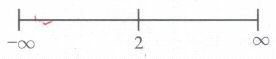
The possible intervals are (-∞, 2) and (2, ∞).
| Intervals | Sign of \({dy\over dx}\) | Nature of Function |
|---|---|---|
| In (-∞,2) say x =0 | 12- 6(0) = 12 (Positive) | Increasing |
| In (2, ∞) say x = 3 | 12- 6(3) = - 6 (Negative) | Decreasing |
Hence, Marginal Revenue function is increasing in (-∞, 2) and decreasing in (2, ∞).
44.
Let x1 g of wheat and x2 g of rice be mixed in the daily diet. Let Z be the minimum cost of diet.
| Proteins | Carbohydrates | Cost | |
|---|---|---|---|
| 1 g of Wheat | 0.1 g | 0.25 g | Rs.4/kg |
| 1 g of Rice | 0.05 g | 0.5 g | Rs.6/kg |
| Minimum Requirement |
50 g | 200 g |
Thus, the mathematical formulation of the LPP
Minimize \(Z=\frac { 4{ x }_{ 1 } }{ 1000 } +\frac { 6{ x }_{ 2 } }{ 1000 } \quad \Rightarrow \quad Z=\frac { { x }_{ 1 } }{ 250 } +\frac { 3{ x }_{ 2 } }{ 500 } \)
Subject to the constraints
\(0.1{ x }_{ 1 }+0.05{ x }_{ 2}\ge 50 \Rightarrow 2{ x }_{ 1 }+{ x }_{ 2 }\ge 1000\)
\( 0.25{ x }_{ 1 }+0.5{ x }_{ 2\quad }\ge 200 \Rightarrow { x }_{ 1 }+2{ x }_{ 2 }\ge 800\)
\(and\ { x }_{ 1 },{ x }_{ 2 }\ge 0\)
Consider the equation
\(2{ x }_{ 1 }+{ x }_{ 2 }= 1000\)
| \({ x }_{ 1 }\) | 0 | 500 |
| \({ x }_{ 2 }\) | 1000 | 0 |
\({ x }_{ 1 }+2{ x }_{ 2 }= 800\)
| \({ x }_{ 1 }\) | 0 | 500 |
| \({ x }_{ 2 }\) | 1000 | 0 |
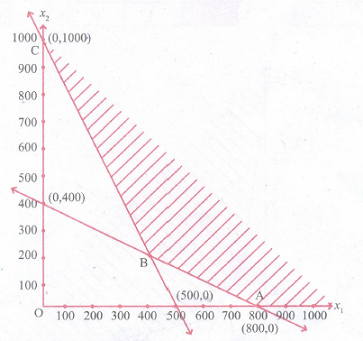
The feasible region is ABC an its co-ordinates are A(800, 0), C(0, 1000) and B is the point of intersection of the lines 2x1+ x2 = 1000 ... (1) x1+ 2x2 = 800 ... (2)
Verification of B:
\(\Rightarrow (1)\times 2 4{ x }_{ 1 }+2{ x }_{ 2 }=2000\)
\(\quad (-)\quad (-)\quad \quad (-)\)
\(\Rightarrow (2) 15{ x }_{ 1 }+6{ x }_{ 2 }=30 \Rightarrow { x }_{ 1 }=400\)
\(--------------\)
Substracting, \(3{ x }_{ 1 }=2000\)
From (2), \(\quad 400+2{ x }_{ 2 }=800\)
\(2{ x }_{ 2 }=400\quad \Rightarrow \quad { x }_{ 2 }=200\)
| Corner Points | \( Z=\frac { { x }_{ 1 } }{ 250 } +\frac { 3{ x }_{ 2 } }{ 500 } \) |
|---|---|
| A(800,0) | \(\frac { 800 }{ 250 } =3.2\) |
| B(400, 200) | \(\frac { 400 }{ 250 } +\frac { 600 }{ 500 } =2.8\) |
| C(0,1000) | \(\frac { 3000 }{ 500 } =6\) |
Minimum of Z occurs at B(400, 200). Hence, the solution is x1= 400, x2 = 200 and Zrnin = 2.8
45.
Stock = Rs.9000
FV =Rs.100
Dividend Rate = 7%
Income on 7% stock =\(\frac { \text {stock} }{ 100 } \)x FV x Rate percentage
=\(\frac { 9000 }{ 100 } \times 100\times \frac { 7 }{ 100 } \) = Rs.630 ...(1)
Cost of price of one share = 80
Sale proceeds = \(\frac { \text {stock} }{ 100 } \) x Cost Price
=\(\cfrac { 9000 }{ 100 } \)x 80 =7200
Investment = Rs.7200
Market Price = Rs.120
Dividend Rate =15%
Income =\(\frac {\text { Investment} }{ \text {Market Price } }\)x Dividend Rate
=\(\frac { 7200 }{ 120 } \)x15=Rs.900 .....(2)
Change in income = 930 - 630 = Rs.270
46.
Already the values are arranged in ascending order then Median is obtained by the following.
| X | f | cf |
| 15 | 12 | 12 |
| 25 | 11 | 23 |
| 35 | 10 | 33 |
| 45 | 15 | 48 |
| 55 | 22 | 70 |
| 65 | 13 | 83 |
| 75 | 18 | 101 |
| 85 | 19 | 120 |
| N = 120 |
Median = size of \(\left( \frac { (n+1) }{ 2 } \right) ^{ th }\)value
= size of \(\left( \frac { (120+1) }{ 2 } \right) ^{ th }\) value
= size of 60.5th item = 55
MD about Median = \(\frac { \Sigma f|X-Median| }{ N } =\frac { \Sigma f|D| }{ N } \)
Mean deviation about Median
| X | f | |D|=|X-55| | f|D| |
| 15 | 12 | 40 | 480 |
| 25 | 11 | 30 | 330 |
| 35 | 10 | 20 | 200 |
| 45 | 15 | 10 | 150 |
| 55 | 22 | 0 | 0 |
| 65 | 13 | 10 | 130 |
| 75 | 18 | 20 | 360 |
| 85 | 19 | 30 | 570 |
| N = 120 | Σf|D| = 2220 |
MD about Median = \(\frac { 2220 }{ 120 } \) = 18.5
Coefficient of mean deviation about median = \(\frac { MD \ about \ Median }{ Median } \)
= \(\frac { 18.5}{ 55 } \) = 0.34
47.
| X | Y | X2 | Y2 | XY |
|---|---|---|---|---|
| 1 | 4 | 1 | 16 | 4 |
| 2 | 8 | 4 | 64 | 16 |
| 3 | 2 | 9 | 4 | 6 |
| 4 | 12 | 16 | 144 | 48 |
| 5 | 10 | 25 | 100 | 50 |
| 6 | 14 | 36 | 196 | 84 |
| 7 | 16 | 49 | 256 | 112 |
| 8 | 6 | 64 | 36 | 48 |
| 9 | 18 | 81 | 324 | 162 |
| \(\Sigma X\) = 45 | \(\Sigma Y\) = 90 | \(\Sigma X^2\) = 285 | \(\Sigma Y^2\) = 1140 | \(\Sigma XY\) = 530 |
\(\bar{X} =\frac{45}{9}=5 \quad \bar{Y}=\frac{90}{9}=10 \)
\(b_{y x} =\frac{N \Sigma X Y-\Sigma X \Sigma Y}{N \Sigma X^2-(\Sigma X)^2} \)
\(=\frac{9(530)-4050}{9(285)-2025}=\frac{720}{540}=1.33\)
Regression equation of Y on X
\(Y-\overset{-}{Y}=b_{yx}(X-\overset{-}{X})\)
Y - 10 = 1.33(X - 5)
Y = 1.33X - 6.65 + 10
Y = 1.33X + 3.35
48.
\(\frac { \partial p }{ \partial { P }_{ 1 } } =2-{ p }_{ 1 }{ p }_{ 2 }\)
\(\frac { \partial p }{ \partial { P }_{ 2 } } =1-{ p }_{ 1 }^{ 2 }\)
(i) \(\frac { Eq }{ { EP }_{ 1 } } =\frac { { p }_{ 1 } }{ q } \frac { \partial p }{ \partial { P }_{ 1 } } =\frac { -p }{ 5-2{ p }_{ 1 }+{ p }_{ 2 }-{ p }_{ 1 }^{ 2 }{ p }_{ 2 } } (-2-{ p }_{ 1 }{ p }_{ 2 })\)
= \(\frac { { 2p }_{ 1 }+2{ p }_{ 1 }^{ 2 }{ p }_{ 2 } }{ 5-2{ p }_{ 1 }+{ p }_{ 2 }-{ p }_{ 1 }^{ 2 }{ p }_{ 2 } } \)
when p1 = 3 and p2 = 7
\(\frac { { E }q }{ { Ep_{ 1 } } } =\frac { 2(3)+2(9)(7) }{ 5-6+7-(9)(7) } =\frac { 132 }{ -57 } =\frac { -132 }{ 57 } \)
\(\frac { Eq }{ { EP }_{ 1 } } =\frac { { p }_{ 2 } }{ q } \frac { \partial p }{ \partial { P }_{ 2 } } =\frac { -p\left( 1-{ p }_{ 1 }^{ 2 } \right) }{ 5-2{ p }_{ 1 }+{ p }_{ 2 }-{ p }_{ 1 }^{ 2 }{ p }_{ 2 } } \)
\(\frac { { -p }_{ 2 }+{ p }_{ 2 }{ p }_{ 1 }^{ 2 } }{ 5-2{ p }_{ 1 }+{ p }_{ 2 }-{ p }_{ 1 }^{ 2 }{ p }_{ 2 } } \)
when p1 - 3 and p2 = 7
\(\frac { { E }q }{ { Ep_{ 2 } } } =\frac { -7+7(9) }{ 5-6+7-(9)(7) } =\frac { 56 }{ -57 } =\frac { -56 }{ 57 } \)
49.
\(\tan \frac{A}{2}=\pm \sqrt{\frac{1-\cos A}{1+\cos A}}\)
Put \(A=\frac{\pi}{4}\)
\(\tan \frac{\pi}{8}=\sqrt{\frac{1-\cos \pi / 4}{1+\cos \pi / 4}}\left[\because \tan \frac{\pi}{8} \text { is }+v e\right]\)
\(=\sqrt{\frac{1-1 / \sqrt{2}}{1+1 / \sqrt{2}}}\)
\(=\sqrt{\frac{\sqrt{2}-1}{\sqrt{2}+1} \times \frac{\sqrt{2}-1}{\sqrt{2}-1}}\)
\(=\sqrt{\frac{(\sqrt{2}-1)^2}{2-1}}=\sqrt{2}-1\)
50.
Since x lies in the II quadrant, cos x is negative
∴ cos x = \(-\left( \frac { 1 }{ 1+\sqrt { { tan }^{ 2 }x } } \right) =\frac { -1 }{ \sqrt { 1+\frac { 16 }{ 9 } } } =\frac { -3 }{ 5 } \)
Now \(\frac { \pi }{ 2 }
\(\therefore cos\frac { x }{ 2 } =\sqrt { \frac { 1+cos\quad x }{ 2 } } =\sqrt { \frac { 1-\frac { 3 }{ 5 } }{ 2 } } =\sqrt { \frac { 5-3 }{ 2\times 5 } } =\sqrt { \frac { 1 }{ 5 } } =\frac { 1 }{ \sqrt { 5 } } \)
\(sin\frac { x }{ 2 } =\sqrt { \frac { 1-cos\quad x }{ 2 } } =\sqrt { \frac { 1+\frac { 3 }{ 5 } }{ 2 } } =\sqrt { \frac { 5+3 }{ 2\times 5 } } =\sqrt { \frac { 4 }{ 5 } } =\frac { 2 }{ \sqrt { 5 } } \)
\(tan\frac { x }{ 2 } =tan\frac { x }{ 2 } =\sqrt { \frac { 1-cos\quad x }{ 1+cos\quad x } } =\sqrt { \frac { 1+\frac { 3 }{ 5 } }{ 1-\frac { 3 }{ 5 } } } =\sqrt { \frac { 8 }{ 2 } } =\sqrt { 4 } =2\)
51.
Any number greater than a million will contain all the seven digits.
Now, we have to arrange these seven digits, out of which 2 occur twice, 3 occurs twice and the rest are distinct.
The number of such arrangements =\(\frac { 7! }{ 2!3! } =\frac { 7\times 6\times 5\times 4\times 3! }{ 2\times 3! } =420\)
These arrangements also include those numbers which contain 0 at the million's place.
Keeping 0 fixed at the millions place, we have 6 digits out of which 2 occurs twice, 3 occurs thrice and the rest are distinct.
These 6 digits can be arranged in \(\frac { 6! }{ 2!3! } =\frac { 6\times 5\times 4\times 3! }{ 2\times 1\times 3! } =60\quad ways\)
Hence, the number of required numbers = 420 - 60 = 360.
52.
Let P (n) denote the statement 13 + 23 + 33 + ....... + n3 = \(\frac { { n }^{ 2 }(n+1)^{ 2 } }{ 4 } \)
Put n = 1
LHS = 13 = 1
\(=\frac { 1^2(2)^2 }{ 4 } \Rightarrow 1\)
LHS = RHS
\(\therefore\) P (1) is true
Let us assume that P(k) is true
p(k) : 13 + 23 + ..... + k3 = \(\frac { { k }^{ 2 }(k+1)^{ 2 } }{ 4 } \)
To prove that P(k+1) IS true
p(k) : 13 + 23 + ..... + k3 + (k + 1)3
\(=P(k)+(k+1)^3\)
= \(\frac { { k }^{ 2 }(k+1)^{ 2 } }{ 4 } +(k+1)^{ 3 }\)
\(=\frac{k^2(k+1)^2+4(k+1)^3}{4}\)
\(=\frac{(k+1)^2\left(k^2+4(k+1)\right)}{4}\)
\(=\frac{(k+1)^2\left(k^2+4 k+4\right)}{4}=\frac{(k+1)^2(k+2)^2}{4}\)
∴ p(k + 1) is true if P(k) is true.
∴ p(n) is true for all \(n\in N\)
53.
\(3 x-y+2 z=13 ; 2 x+y-z=3\)
\(x+3 y-5 z=-8\)
The given system can be written as
\(\left(\begin{array}{ccc} 3 & -1 & 2 \\ 2 & 1 & -1 \\ 1 & 3 & -5 \end{array}\right)\left(\begin{array}{l} x \\ y \\ z \end{array}\right)=\left(\begin{array}{c} 13 \\ 3 \\ -8 \end{array}\right)\)
\(A X=B \Rightarrow X=A^{-1} B\)
\(\text {Where } A=\left(\begin{array}{ccc} 3 & -1 & 2 \\ 2 & 1 & -1 \\ 1 & 3 & -5 \end{array}\right), X=\left(\begin{array}{l} x \\ y \\ z \end{array}\right)\)
\(B=\left(\begin{array}{c} 13 \\ 3 \\ -8 \end{array}\right)\)
\(|A|=3(-5+3)+1(-10+1)+2(6-1)\)
\(=-6-9+10=-5 \neq 0\)
\(\therefore A^{-1} exists\)
\(\mathrm{A}_{11}=\text {Co-factor of } 3=(-5+3)=-2 \)
\(\mathrm{A}_{12}=\text {Co-factor of }-1=-(-10+1)=9 \)
\(\mathrm{A}_{13}=\text {Co-factor of } 2=(6-1)=5\)
\(\mathrm{A}_{21}=\text { Co-factor of } 2=-(5-6)=1\)
\(\mathrm{A}_{22}=\text { Co-factor of } 1=-15-2=-17 \)
\(\mathrm{A}_{23}=\text { Co-factor of }-1=-(9+1)=-10\)
\(\mathrm{A}_{31}=\text {Co-factor of } 1=1-2=-1\)
\(\mathrm{A}_{32}=\text {Co-factor of } 3=-(-3-4)=7 \)
\(\mathrm{A}_{33}=\text {Co-factor of }-5=3+2=5\)
\(\text {Co-factor matrix }=\left(\begin{array}{ccc} -2 & 9 & 5 \\ 1 & -17 & -10 \\ -1 & 7 & 5 \end{array}\right)\)
\(A^{-1}=\frac{1}{|A|} \operatorname{adj} A=\frac{1}{-5}\left(\begin{array}{ccc} -2 & 1 & -1 \\ 9 & -17 & 7 \\ 5 & -10 & 5 \end{array}\right)\)
\(X=A^{-1} B=\frac{-1}{5}\left(\begin{array}{ccc} -2 & 1 & -1 \\ 9 & -17 & 7 \\ 5 & -10 & 5 \end{array}\right)\left(\begin{array}{c} 13 \\ 3 \\ -8 \end{array}\right)\)
\(=\frac{-1}{5}\left(\begin{array}{ccc} -26 & 3 & 8 \\ 117 & -51 & -56 \\ 65 & -30 & -40 \end{array}\right)\)
\(=\frac{-1}{5}\left(\begin{array}{c} -15 \\ 10 \\ -5 \end{array}\right)\)
\(\left(\begin{array}{l} x \\ y \\ z \end{array}\right)=\left(\begin{array}{c} 3 \\ -2 \\ 1 \end{array}\right)\)
\(x=3, \mathrm{y}=-2, \mathrm{z}=1\)
54.
Given \({ A }^{ -1 }=\left[ \begin{matrix} 1 & 0 & 3 \\ 2 & 1 & -1 \\ 1 & -1 & 1 \end{matrix} \right] \)
\(\left|A^{-1}\right|=1[1-1]-0+3[-2-1]\)
\(=-9 \neq 0\)
\(\therefore\left(\mathrm{A}^{-1}\right)^{-1} \text { exists }\)
\(A_{11}=\text {Co-factor of } 1=1-1=0 \)
\(A_{12}=\text {Co-factor of } 0=-(2+1)=-3 \)
\(A_{13}=\text {Co-factor of } 3=(-2-1)=-3\)
\(A_{21}=\text {Co-factor of } 2=-(0+3)=-3\)
\(\mathrm{A}_{22}= \text {Co-factor of }1=1-3=-2\)
\(A_{23}= \text {Co-factor of }-1=-(-1-0)=1\)
\(A_{31}=\text {Co-factor of }1=0-3=-3\)
\(A_{32}= \text {Co-factor of } -1=-1(-1-6)=7\)
\(\mathrm{A}_{33}= \text {Co-factor of }1=1-0=1\)
\(\text {Co-factor matrix }=\left(\begin{array}{ccc} 0 & -3 & -3 \\ -3 & -2 & 1 \\ -3 & 7 & 1 \end{array}\right)\)
\(\text {Since }\left(A^{-1}\right)^{-1}=A\)
\(\mathrm{A}=\frac{1}{\left|A^{-1}\right|} \text { adj } A^{-1}\)
\(=\frac{1}{-9}\left(\begin{array}{ccc} 0 & -3 & -3 \\ -3 & -2 & 7 \\ -3 & 1 & 1 \end{array}\right)\)
\(A=\frac{1}{9}\left(\begin{array}{ccc} 0 & 3 & 3 \\ 3 & 2 & -7 \\ 3 & -1 & -1 \end{array}\right)\)

11th Standard Syllabus & Materials
11th Standard
TN 11th Tamil பீடு பெற நில் - செய்யுள் - காவடிச்சிந்து Important Questions And Answers Study Material - QB365 Set A
NEW11th Standard
TN 11th Tamil பீடு பெற நில் - உரைநடை - மலை இடப்பெயர்கள் : ஓர் ஆய்வு Important Questions And Answers Study Material - QB365 Set A
NEW11th Standard
TN 11th Tamil மாமழை போற்றுதும் - துணைப்பாடம் - யானை டாக்டர் Important Questions And Answers Study Material - QB365 Set A
NEW11th Standard
TN 11th Tamil மாமழை போற்றுதும் - செய்யுள் - ஐங்குறுநூறு Important Questions And Answers Study Material - QB365 Set A



Tamilnadu Stateboard 11th Standard Subjects

Maths

Commerce

Economics

Biology
Business Maths and Statistics

Accountancy

Computer Science

Physics

Chemistry
Maths
Biology
Economics
Physics
Chemistry

History
Business Maths and Statistics

Computer Science
Accountancy

Computer Applications
History
Computer Technology
Commerce
Computer Applications
Computer Technology

Tamil

English

French
Tamilnadu Stateboard Standards
