
 100% FREE ACCESS
11th Standard Syllabus & Materials
11th Standard
TN 11th Tamil இயற்கை வேளாண்மை,சுற்றுச்சூழல் -செய்யுள் - மனோன்மணீயம் Important Questions And Answers Study Material - QB365 Set A
NEW11th Standard
TN 11th Tamil என்னுயிர் என்பேன் -துணைப்பாடம் - இசைத்தமிழர் இருவர் Important Questions And Answers Study Material - QB365 Set A
NEW11th Standard
TN 11th Tamil மொழி கலை -செய்யுள் - ஒவ்வொரு புல்லையும் Important Questions And Answers Study Material - QB365 Set A
NEW11th Standard
TN 11th Tamil பீடு பெற நில் - இலக்கணம் - பகுபத உறுப்புகள் Important Questions And Answers Study Material - QB365 Set A
NEW11th Standard
TN 11th Tamil பீடு பெற நில் - துணைப்பாடம் - வாடிவாசல் Important Questions And Answers Study Material - QB365 Set A
NEW11th Standard
TN 11th Tamil பீடு பெற நில் - செய்யுள் - குறுந்தொகை Important Questions And Answers Study Material - QB365 Set A

Published on: 09/10/2019
Operations Research
Download Tamil Nadu 11th Standard Business Maths and Statistics question papers, model tests, one-mark questions, important questions, and public exam papers in PDF format. Free study materials and answer keys for TN State Board students.
Questions + Answers key
Take MCQ Business Maths and Statistics Test
1.
Develop a network based on the following information.
| Activity | A | B | C | D | B | E |
| Immediate Predecessor | - | - | A | C | E | F |
2.
Construct the network for the following:
| Activity | A | B | C | D | E | F |
|---|---|---|---|---|---|---|
| Immediate Predecessor | - | - | - | A | B | C |
3.
Construct the network for the projects consisting of various activities and their precedence relationships are as given below:
| Immediate Predecessor | A | B | C | D | E | F | G | H | I |
| Activity | B | C | D,E,F | G | I | H | J | K | L |
4.
Solve the following LPP graphically. Maximize \(Z={ x }_{ 1 }+{ x }_{ 2 }\)
Subject to the constraints \({ x }_{ 1 }-{ x }_{ 2 }\le -1,{ -x }_{ 1 }+{ x }_{ 2 }\le 0\quad and\quad { x }_{ 1 }+{ x }_{ 2 }\ge 0\)
5.
Solve the following LPP graphically, Minimize \(Z=3{ x }_{ 1 }+5{ x }_{ 2 }\)
Subject to the constraints \({ x }_{ 1 }+3{ x }_{ 2 }\ge 3,\quad { x }_{ 1 }+{ x }_{ 2 }\ge 2\quad and\quad { x }_{ 1 },{ x }_{ 2 }\ge 0.\)
6.
Solve the following LPP graphically. Minimize\(Z=-3{ x }_{ 1 }+4{ x }_{ 2 }\)
Subject to the constraints \({ x }_{ 1 }+2{ x }_{ 2 }\le 8\quad ,{ 3x }_{ 1 }+{ 2x }_{ 2 }\le 12\quad and\quad \quad { x }_{ 1 }\ge 0,{ x }_{ 2 }\ge 2.\)
7.
Solve the following LPP graphically. ∴ Maximize Z = 3x1 + 4x2 subject to the constraints x1 + x2 ≤ 4 and x1,x2 ≥ 0.
8.
Solve the following LPP graphically. Minimize Z = x1 − 5x2 + 20
Subject to the constraints x1 − x2 ≥ 0,−x1 + 2x2 ≥ 2,x1 ≥ 3,x2 ≤ 4 and x1,x2 ≥ 0.
9.
Solve the following LPP graphically. Maximize Z =−x1 + 2x2
Subject to the constraints −x1 + 3x2 ≤ 10, x1 + x2 ≤ 6,x1 − x2 ≤ 2 and x1,x2 ≥ 0
10.
Solve the following LPP graphically. Maximize Z = 6x1 + 5x2 Subject to the constraints 3x1 + 5x2 ≤ 15, 5x1 + 2x2 ≤ 10 and x1,x2 ≥ 0
1.
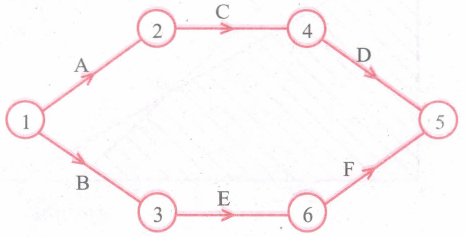
Using the immediate precedence relationship and following the rules of network construction, the required network is shown in the diagram.
2.
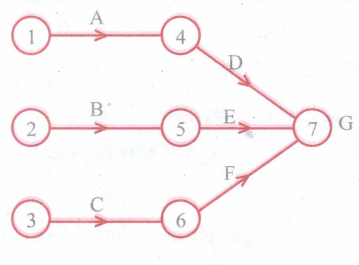
3.
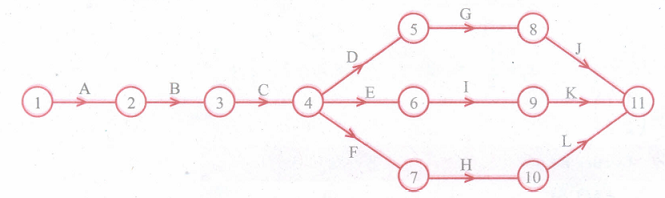
4.
Since the decision variables are non-negative, the solution lies in the I quadrant of the plane.
Consider the equations
\({ x }_{ 1 }-{ x }_{ 2 }=-1\)
| \({ x }_{ 1 }\) | 0 | 1 |
| \({ x }_{ 2 }\) | 1 | 2 |
\({ -x }_{ 1 }+{ x }_{ 2 }=0\)
| \({ x }_{ 1 }\) | 2 | 1 |
| \({ x }_{ 2 }\) | 2 | 1 |
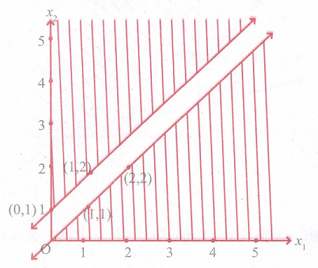
The feasible region is not common. Thus, there is no maximum value of Z.
5.
Since the decision variables are non-negative, the solution lies in the I-quadrant of the plane.Consider the equations
\({ x }_{ 1 }+3{ x }_{ 2 }=3\)
| \({ x }_{ 1 }\) | 0 | 3 |
| \({ x }_{ 2 }\) | 1 | 0 |
\({ x }_{ 1 }+{ x }_{ 2 }=2\)
| \({ x }_{ 1 }\) | 0 | 2 |
| \({ x }_{ 2 }\) | 2 | 0 |
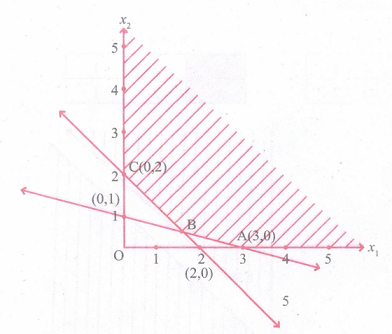
The feasible region is ABC and its co-ordinates are A(3, 0) C(0,2) and B its the point of intersection of the lines
\({ x }_{ 1 }+3{ x }_{ 2 }=3\) ...(1) and \({ x }_{ 1 }+{ x }_{ 2 }=2\) ...(2)
Verification of B:
\((1)\Rightarrow { x }_{ 1 }+3{ x }_{ 2 }=3\)
\( \quad \quad (-)\quad (-)\quad \quad (-)\)
\((2)\Rightarrow { x }_{ 1 }+{ x }_{ 2 }=2\)
\( \quad -----------\)
\(2{ x }_{ 2 }=1\Rightarrow { x }_{ 2 }=\frac { 1 }{ 2 } \)
\( From(2),\ { x }_{ 1 }+\frac { 1 }{ 2 } =2\ \Rightarrow { x }_{ 1 }=2-\frac { 1 }{ 2 } \Rightarrow \frac { 3 }{ 2 } \therefore B\quad is\quad \left( \frac { 3 }{ 2 } ,\frac { 1 }{ 2 } \right) \)
| Corner Points | \(Z=3{ x }_{ 1 }+5{ x }_{ 2 }\) |
|---|---|
| A(3,0) | 9 |
| B\(\left( \frac { 3 }{ 2 } ,\frac { 1 }{ 2 } \right) \) | \(\frac { 9 }{ 2 } +\frac { 5 }{ 2 } =7\) |
| C (0, 2) | 10 |
Minimum of Z occurs at B(3/2, 1/2)
Hence, the solution is x1= 3/2, x2 = 1/2 and Zmin = 7
6.
Since the decision variables are non-negative, the solution lies in the I-quadrant of the plane. Consider the equations
\({ x }_{ 1 }+2{ x }_{ 2 }= 8\)
| \({ x }_{ 1 }\) | 0 | 8 |
| \({ x }_{ 2 }\) | 4 | 0 |
\({ 3x }_{ 1 }+{ 2x }_{ 2 }=12\)
| \({ x }_{ 1 }\) | 0 | 4 |
| \({ x }_{ 2 }\) | 6 | 0 |
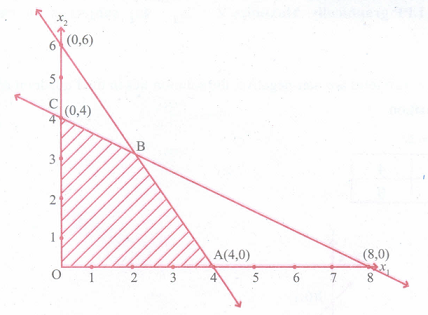
The feasible region is OABC and its co-ordinates are 0(0, 0) A( 4, 0) qo, 4) and B is the point of intersection of the lines
\({ x }_{ 1 }+2{ x }_{ 2 }=8\) ... (1) \(and\quad { 3x }_{ 1 }+{ 2x }_{ 2 }=12\) ...(2)
Verification of B:
\((1)\Rightarrow { x }_{ 1 }+2{ x }_{ 2 }=8\\ \quad \quad (-)\quad (-)\quad \quad (-)\\ (2)\Rightarrow 3{ x }_{ 1 }+2{ x }_{ 2 }=12\\ -----------\\ -2{ x }_{ 1 }=-4 \Rightarrow { x }_{ 1 }=2\)
\(From(1), 2+2{ x }_{ 2 }=8\Rightarrow 2{ x }_{ 2 }=6\Rightarrow { x }_{ 2 }=3\)
∴ B is (2,3)
| Corner Points | \(Z=-3{ x }_{ 1 }+4{ x }_{ 2 }\) |
|---|---|
| O(0,0) | 0 |
| A(4, 0) | -12 |
| B (2, 3) | 6 |
| C(0,4) | 16 |
Minimum of Z occurs at A(4, 0).
Hence, the solution is x1= 4, x2 = 0 and Zmin = - 12.
7.
Since the decision variables are non-negative, the solution lies in the I quadrant of the plane.
Consider the equation
\({ x }_{ 1 }+{ x }_{ 2 }= 4\)
| \({ x }_{ 1 }\) | 0 | 4 |
| \({ x }_{ 2 }\) | 4 | 0 |
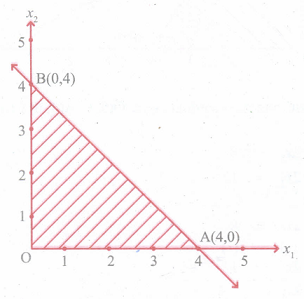
The feasible region is OAB and its co-ordinates are O(0, 0), A(4, 0) and B(0, 4)
| Corner Points | \(Z=3{ x }_{ 1 }+4{ x }_{ 2 }\) |
|---|---|
| O(0,0) | 0 |
| A(4,0) | 12 |
| B(0,4) | 16 |
Maximum of Z occurs at B(0, 4)
Hence, the solution is x1= 0, x2 = 4 and Zmax = 16
8.
Since the decision variables are non-negative, the solution lies in the I quadrant of the plane.
Consider the equations
\({ x }_{ 1 }-{ x }_{ 2 }= 10\)
| \({ x }_{ 1 }\) | 0 | 1 |
| \({ x }_{ 2 }\) | 0 | 1 |
\({ -x }_{ 1 }+2{ x }_{ 2 }=2\)
| \({ x }_{ 1 }\) | 0 | 2 |
| \({ x }_{ 2 }\) | 1 | 2 |
x1 = 3 is a line parallel to x2-axis at a distance of 3 units from it.
Also, x2 = 4 is a line parallel to x1 - axis at a distance of 4 units from it.
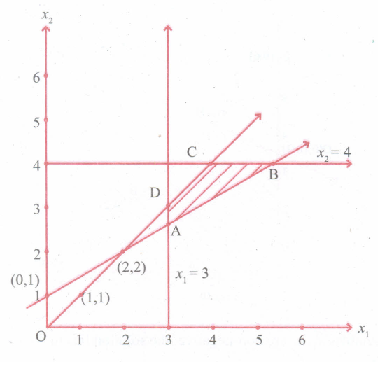
The feasible region is ABCD and its co-ordinates are A is the point of intersection of x1 = 3 and −x1 + 2x2 = 2
Verification:
\(-3+{ 2x }_{ 2 }=2 \Rightarrow { 2x }_{ 2 }=5 \Rightarrow { x }_{ 2 }=\frac { 5 }{ 2 } \)
\( \therefore A\left( 3,\frac { 5 }{ 2 } \right) \)
B is the point of intersection of x2 = 4 and −x1 + 2x2 = 2
\(\Rightarrow -{ x }_{ 1 }+8=2\Rightarrow -{ x }_{ 1 }=-6 \Rightarrow { x }_{ 1 }=6\)
\(\therefore B\quad is\quad \left( 6,4 \right) \)
C is the point of intersection of x2 = 4 and \({ x }_{ 1 }{ -x }_{ 2 }=2\)
\(\Rightarrow { x }_{ 1 }=4\)
\(\therefore \text {C is (4,4)}\)
D is the point of intersection of x1= 3 and \({ x }_{ 1 }{ -x }_{ 2 }=2\)
\(\Rightarrow { x }_{ 2 }=3\)
∴D is (3,3)
| Corner Points | \(Z={ x }_{ 1 }-5{ x }_{ 2 }+20\) |
|---|---|
| \(A\left( 3,\frac { 5 }{ 2 } \right) \quad \quad \) | \(3-\frac { 25 }{ 2 } +20=\frac { 21 }{ 2 } \) |
| B(6,4) | 6-20+20=6 |
| C(4,4) | 4-20 + 20 =4 |
| D(3,3) | 3-15+20=8 |
Minimum of Z occurs at C(4, 4)
Hence, the solution is x1 = 4, x2 = 4 and Zmin = 4.
9.
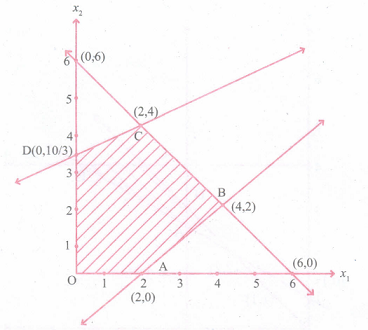
Since the decision variables x1 ,x2 are non-negative, the solution lies in the I quadrant of the plane.
Consider the equations
\(-{ x }_{ 1 }+3{ x }_{ 2 }=10\)
| \({ x }_{ 1 }\) | 0 | 2 |
|---|---|---|
| \({ x }_{ 2 }\) | 10/3 | 4 |
\({ x }_{ 1 }+{ x }_{ 2 }=6\)
| \({ x }_{ 1 }\) | 0 | 6 |
|---|---|---|
| \({ x }_{ 2 }\) | 6 | 6 |
\({ x }_{ 1 }{ -x }_{ 2 }=2\)
| \({ x }_{ 1 }\) | 4 | 2 |
|---|---|---|
| \({ x }_{ 2 }\) | 2 | 0 |
The feasible region is OABCD and its co-ordinates are O(0, 0)A(2, 0) B(4, 2) C(2, 4) and D(0, 10/3)
| Corner Points | \(Z=-{ x }_{ 1 }+2{ x }_{ 2 }\) |
|---|---|
| 0(0,0) | 0 |
| A(2, 0) | -2 |
| B (4, 2) | 0 |
| C(2,4) | 6 |
| D\(\left( 0,\frac { 10 }{ 3 } \right) \) | \(\frac { 20 }{ 3 } \) |
Maximum of Z occurs at\(D\left( 0,\frac { 10 }{ 3 } \right) \). Hence, the solution is \({ x }_{ 1 }=0,{ x }_{ 2 }=\frac { 10 }{ 3 } \quad and\quad { Z }_{ max }=\frac { 20 }{ 3 } \)
10.
Since the decision variables x1,x2 are non-negative, the solution lies in the I quadrant.
Consider the equations
\(3{ x }_{ 1 }+5{ x }_{ 2 }=15\)
| \({ x }_{ 1 }\) | 0 | 5 |
| \({ x }_{ 2 }\) | 3 | 0 |
\(5{ x }_{ 1 }+2{ x }_{ 2 }=10\)
| \({ x }_{ 1 }\) | 0 | 2 |
| \({ x }_{ 2 }\) | 5 | 0 |
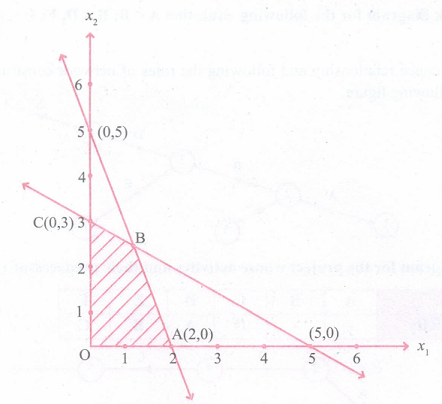
The feasible region is OABC and its co-ordinates are O(0, 0) A(2, 0) C(0, 3) and B is the point of intersection of the lines
\(3{ x }_{ 1 }+5{ x }_{ 2 }=15\) ----(1)
and \(5{ x }_{ 1 }+2{ x }_{ 2 }=10\) ... (2)
Verification of B:
\((1)\times 5\Rightarrow 15{ x }_{ 1 }+25{ x }_{ 2 }=75\\ \quad \quad (-)\quad (-)\quad \quad (-) \\ (2)\times 3\Rightarrow 15{ x }_{ 1 }+6{ x }_{ 2 }=30\\ --------------\\ 19{ x }_{ 2 }=45 \Rightarrow { x }_{ 2 }=\frac { 45 }{ 19 } \)
\(From(1), 3{ x }_{ 1 }+5\left( \frac { 45 }{ 19 } \right) =15\)
\(\Rightarrow 3{ x }_{ 1 }=15-\frac { 225 }{ 19 } \)
\(\Rightarrow { x }_{ 1 }=\frac { 20 }{ 19 } \)
\(\therefore \ B \ is\ \left( \frac { 20 }{ 19 } ,\frac { 45 }{ 19 } \right) \)
| Corner Points | \(Z=6{ x }_{ 1 }+5{ x }_{ 2 }\) |
|---|---|
| O(0,0) | 0 |
| A(2,0) | 12 |
| B\(\left( \frac { 20 }{ 19 } ,\frac { 45 }{ 19 } \right) \) | \(6\times \frac { 20 }{ 19 } +5\times \frac { 45 }{ 19 } =\frac { 345 }{ 19 } \) |
| C(0,3) | 15 |
Maximum of Z occurs at B \(\left( \frac { 20 }{ 19 } ,\frac { 45 }{ 19 } \right) \)
Hence, the solution is \({ x }_{ 1 }=\frac { 20 }{ 19 } ,{ x }_{ 2 }=\frac { 45 }{ 19 } \ and\ { Z }_{ max }=\frac { 345 }{ 19 } \)

11th Standard Syllabus & Materials
11th Standard
TN 11th Tamil பீடு பெற நில் - செய்யுள் - காவடிச்சிந்து Important Questions And Answers Study Material - QB365 Set A
NEW11th Standard
TN 11th Tamil பீடு பெற நில் - உரைநடை - மலை இடப்பெயர்கள் : ஓர் ஆய்வு Important Questions And Answers Study Material - QB365 Set A
NEW11th Standard
TN 11th Tamil மாமழை போற்றுதும் - துணைப்பாடம் - யானை டாக்டர் Important Questions And Answers Study Material - QB365 Set A
NEW11th Standard
TN 11th Tamil மாமழை போற்றுதும் - செய்யுள் - ஐங்குறுநூறு Important Questions And Answers Study Material - QB365 Set A



Tamilnadu Stateboard 11th Standard Subjects

Maths

Commerce

Economics

Biology
Business Maths and Statistics

Accountancy

Computer Science

Physics

Chemistry
Maths
Biology
Economics
Physics
Chemistry

History
Business Maths and Statistics

Computer Science
Accountancy

Computer Applications
History
Computer Technology
Commerce
Computer Applications
Computer Technology

Tamil

English

French
Tamilnadu Stateboard Standards
