
 100% FREE ACCESS
11th Standard Syllabus & Materials
11th Standard
TN 11th Tamil இயற்கை வேளாண்மை,சுற்றுச்சூழல் -செய்யுள் - மனோன்மணீயம் Important Questions And Answers Study Material - QB365 Set A
NEW11th Standard
TN 11th Tamil என்னுயிர் என்பேன் -துணைப்பாடம் - இசைத்தமிழர் இருவர் Important Questions And Answers Study Material - QB365 Set A
NEW11th Standard
TN 11th Tamil மொழி கலை -செய்யுள் - ஒவ்வொரு புல்லையும் Important Questions And Answers Study Material - QB365 Set A
NEW11th Standard
TN 11th Tamil பீடு பெற நில் - இலக்கணம் - பகுபத உறுப்புகள் Important Questions And Answers Study Material - QB365 Set A
NEW11th Standard
TN 11th Tamil பீடு பெற நில் - துணைப்பாடம் - வாடிவாசல் Important Questions And Answers Study Material - QB365 Set A
NEW11th Standard
TN 11th Tamil பீடு பெற நில் - செய்யுள் - குறுந்தொகை Important Questions And Answers Study Material - QB365 Set A

Published on: 13/09/2019
Download Tamil Nadu 11th Standard Business Maths and Statistics question papers, model tests, one-mark questions, important questions, and public exam papers in PDF format. Free study materials and answer keys for TN State Board students.
Questions + Answers key
Take MCQ Business Maths and Statistics Test
1.
Show that the given lines 3x - 4y - 13 = 0, 8x - 11y = 33 and 2x - 3y - 7 = 0 are concurrent and find the concurrent point.
2.
If ey (x + 1) = 1, show that \(\frac { { d }^{ 2 }y }{ { dx }^{ 2 } } ={ \left( \frac { dy }{ dx } \right) }^{ 2 }\)
3.
Find the equation of the circle which touches the line x = 0, y = 0 and x = a.
4.
Differentiate the following with respect to x. cos3x
5.
Differentiate the following with respect to x. \(\frac { { e }^{ x } }{ 1+x } \)
6.
Differentiate the following with respect to x (ax2 + bx + c)n
7.
Solve: 2x + 5y = 1 and 3x + 2y = 7 using matrix method.
8.
Expand the following by using binomial theorem.\(\left( x+\frac { 1 }{ y } \right) ^{ 7 }\)
9.
If y = x and z = \(\frac{1}{x}\) then \(\frac{dy}{dz}=\)________.
x2
1
-x2
\(-\frac{1}{x^2}\)
10.
\(\lim _{ x\rightarrow \infty }{ \frac { \tan { \theta } }{ \theta } } =\)________.
1
\(\infty\)
\(-\infty\)
\(\theta\)
11.
The graph of y = ex intersects the y-axis at _______.
(0,0)
(1,0)
(0,1)
(1,1)
12.
The graph of the line y = 3 is _______.
Parallel to x-axis
Parallel to y-axis
Passing through the origin
Perpendicular to x-axis
13.
If f(x) = x2 - x + 1, then f (x + 1) is _______.
x2
x
1
x2 + x + 1
14.
If p sec 50o = tan 50o then p is _______.
cos 50o
sin 50o
tan 50o
sec 50o
15.
The value of \(\sin15^o\) is ______.
\(\frac{\sqrt{3}+1}{2\sqrt{2}}\)
\(\frac{\sqrt{3}-1}{2\sqrt{2}}\)
\(\frac{\sqrt3}{\sqrt2}\)
\(\frac{\sqrt3}{2\sqrt2}\)
16.
The double ordinate passing through the focus is _______.
focal chord
latus rectum
directrix
axis
17.
ax2 + 4xy + 2y2 = 0 represents a pair of parallel lines then 'a' is _______.
2
-2
4
-4
18.
The locus of the point P which moves such that P is always at equidistance from the line x + 2y + 7 = 0 is _______.
x +2y + 2 = 0
x - 2y + 1 = 0
2x - y + 2 = 0
3x + y + 1 = 0
19.
20.
Number of words with or without meaning that can be formed using letters of the word "EQUATION" , with no repetition of letters is _____.
7!
3!
8!
5!
21.
The total number of 9-digit numbers which have all different digits is ________.
10!
9!
9\(\times\)9!
10\(\times\)10!
22.
The number of parallelograms that can be formed from a set of four parallel lines intersecting another set of three parallel lines is _________.
18
12
9
6
23.
If nPr = 720 (nCr), then r is equal to ______.
4
5
6
7
24.
If A = \(\begin{vmatrix}cos \theta & sin \theta \\ -sin \theta&cons\theta \end{vmatrix},\) then |2A| is equal to ________.
4 cos 2 \(\theta\)
4
2
1
25.
If A and B are non-singular matrix then, which of the following is incorrect?
A2 = I implies A-1 = A
I-1 = I
If AX = B, then X = B-1 A
If A is square matrix of order 3 then |adj A|= |A|2
26.
The number of Hawkins-Simon conditions for the viability of an input - output analysis is ________.
1
3
4
2
27.
The value of the determinant \({\begin{vmatrix} a & 0 & 0 \\ 0 & a & 0 \\ 0 & 0 & c \end{vmatrix}}^{2}\)is ________.
abc
0
a2b2c2
-abc
28.
The value of x if \(\begin{vmatrix} 0 & 1 & 0 \\ x & 2 & x \\ 1 & 3 & x \end{vmatrix}=0\) is_________.
0, - 1
0, 1
- 1, 1
- 1, - 1
29.
Differentiate \({ x }^{ \frac { 2 }{ 3 } }\) from first principles
30.
Find the value of \(\cos\left(\frac{5\pi}{12}\right)\)
31.
Find the angle between the pair of lines represented by the equation 3x2+10xy+8y2+14x+22y+15=0.
32.
Show that the functions f(x) = 5x - \(\left| x \right| \) is continuous at x = 0
33.
Using the property of determinant, evaluate \(\begin{vmatrix} 6 &5 &12 \\ 2 & 4 &4 \\2 & 1 & 4 \end{vmatrix}.\)
34.
The technology matrix of an economic system of two industries is \(\begin{bmatrix} 0.50 & 0.25 \\ 0.40 & 0.67 \end{bmatrix}\). Test whether the system is viable as per Hawkins-Simon conditions.
35.
Differentiate: \(\sqrt{\frac{(x-3)(x^2+4)}{3x^2+4x+5}}\)
36.
If cosec A + sec A = cosec B + sec B, prove that cot A\(\left( \frac { A+B }{ 2 } \right) \) = tanA tanB
37.
If a parabolic reflector is 20 cm in diameter and 5 cm deep, find the focus.
38.
Differentiate: \(\frac { sinx+cosx }{ sinx-cosx } \)with respect to 'x'
39.
By the principle of mathematical induction, prove the following.
an - bn is divisible by a - b, for all \(n\in N\) .
40.
If \(A=\left[ \begin{matrix} 1 & tan\quad x \\ -tan\quad x & \quad \quad \quad 1 \end{matrix} \right] \), then show that ATA-1 = \(\left[ \begin{matrix} cos\quad 2x & -sin2x \\ sin\quad 2x & cos2x \end{matrix} \right] .\)
41.
Evaluate:\(\begin{vmatrix} 1&a&a^2-bc\\1&b&b^2-ca\\1&c&c^2-ab \end{vmatrix}\)
1.
Given lines 3x - 4y - 13 = 0...(1)
8x - 11y = 33 ...(2)
2x - 3y - 7 = 0 ...(3)
Conditon for concurrent lines is
\(\left| \begin{matrix} { a }_{ 1 } & { b }_{ 1 } & { c }_{ 1 } \\ { a }_{ 2 } & { b }_{ 2 } & { c }_{ 2 } \\ { a }_{ 3 } & { b }_{ 3 } & { c }_{ 3 } \end{matrix} \right| =0\)
i.e.,\(\left| \begin{matrix} 3 & -4 & -13 \\ 8 & -11 & -33 \\ 2 & -3 & -7 \end{matrix} \right| =3\left( 77-99 \right) +4\left( 56+44 \right) -13\left( -24+22 \right) \)
= -66 + 40 + 26 = 0
\(\Rightarrow \) Given lines are concurrent. To get the point of concurrency solve the equations (1) and (3)
| Equation (1) \(\times\) 2 | \(\Rightarrow \) | 6x | - 8y | = 26 |
| Equation (3) \(\times\) 3 | \(\Rightarrow \) | 6x | - 9y | = 21 |
| y | = 5 |
When y = 5 from (2) 8x = 88
x = 11
Point of concurrency is (11, 5)
2.
Given ey(x+1)=1 ....(1)
Differentiating with respect to 'x' we get,
\({ e }^{ y }(1)+(x+1){ e }^{ y }\frac { dy }{ dx } =0\) [product rule]
\(\Rightarrow { e }^{ y }+(1)\frac { dy }{ dx } =0\quad [using\quad (1)]\)
\(\Rightarrow \frac { dy }{ dx } =-{ e }^{ y }\)...(2)
Differentiating again with respect to 'x' we get,
\(\frac { d }{ dx } \left( \frac { dy }{ dx } \right) =\frac { d }{ dx } \left( -{ e }^{ y } \right) \)
\(\Rightarrow \frac { { d }^{ 2 }y }{ { dx }^{ 2 } } =-{ e }^{ y }.\frac { dy }{ dx } \)
\(=\left( \frac { dy }{ dx } \right) \left( \frac { dy }{ dx } \right) \) [using (2)]
\(={ \left( \frac { dy }{ dx } \right) }^{ 2 }\)
\(\frac { { d }^{ 2 }y }{ { dx }^{ 2 } } ={ \left( \frac { dy }{ dx } \right) }^{ 2 }\)
Hence proved.
3.
The circle touches the coordinate axes and the line x = a is shown in the diagram.
\(\therefore \ centre\ is\ \left( \frac { a }{ 2 } ,\frac { a }{ 2 } \right) and\ r=\frac { a }{ 2 } \)
\(\therefore\) There may be two such circles, one lying
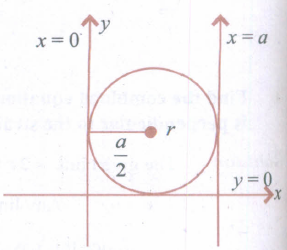
above X-axis and other below X-axis.
Equation of the circle lying above the X-axis is
\({ \left( x-\frac { a }{ 2 } \right) }^{ 2 }+{ \left( y+\frac { a }{ 2 } \right) }^{ 2 }={ \left( \frac { a }{ 2 } \right) }^{ 2 }\)
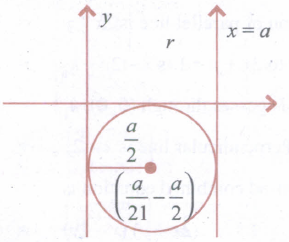
Equation of the circle lying below the X-axis is \({ \left( x-\frac { a }{ 2 } \right) }^{ 2 }+{ \left( y+\frac { a }{ 2 } \right) }^{ 2 }={ \left( \frac { a }{ 2 } \right) }^{ 2 }\)
4.
y= cos3x
\(\frac{d y}{d x}=-3 \cos ^2 x \sin x=\frac{-3}{2} \cos x(2 \sin x \cos x)\)
\(=\frac{-3}{2} \cos x \sin 2 x\)
5.
Let y = \(\frac { { e }^{ x } }{ 1+x } \)
\(\frac{d y}{d x}=\frac{(1+x) e^x-e^x(1)}{(1+x)^2}=\frac{e^x+x e^x-e^x}{(1+x)^2}=\frac{x e^x}{(1+x)^2}\)
6.
Let y = (ax2 + bx + c)n
dy/dx = n(ax2 + bx + c)n-1(2ax + b)
7.
Given equations are 2x + 5y = 1; 3x + 2y = 7
This system of equations can be written in matrix form as \(\begin{pmatrix}2 & 5 \\3 & 2 \end{pmatrix}\begin{pmatrix} x \\ y \end{pmatrix}=\begin{pmatrix} 1\\7 \end{pmatrix}\Rightarrow Ax=B\)
where A = \(\begin{pmatrix} 2 & 5 \\3 & 2 \end{pmatrix},X=\begin{pmatrix} x\\y \end{pmatrix}\) and B = \(\begin{pmatrix} 1 \\ 7 \end{pmatrix}\)
\(\therefore\) X = A-1 B.
\(|A|=\begin{vmatrix} 2 &5 \\3 & 2 \end{vmatrix}=4-15=-11\)
A11 = 2, A12 = -3, A21 = -5, A22 = 2
\(\therefore\) adj A = \(\begin{bmatrix} 2 & -3 \\ -5 & 2 \end{bmatrix}^{T}=\begin{bmatrix} 2 & -5 \\-3 & 2 \end{bmatrix}\)
\(\therefore\) \({A}^{-1}={{1}\over{|A|}}\) . adj A = \({{-1}\over{11}}\begin{bmatrix} 2 & -5\\ -3& 2 \end{bmatrix}\)
X = A- 1 B \(={{-1}\over{11}}\begin{bmatrix} 2 & -5\\ -3&2 \end{bmatrix}\begin{bmatrix} 1\\7 \end{bmatrix}\)
\(=\frac { 1 }{ 11 } \left[ \begin{matrix} +2-35 \\ -3+14 \end{matrix} \right] ={{-1}\over{11}}\begin{bmatrix} -33\\11 \end{bmatrix}=\begin{bmatrix} 3\\-1 \end{bmatrix}\)
\(\therefore\) x = 3.and y = -1.
8.
\(\left(x+\frac{1}{y}\right)^7 =7 C_0 x^7+7 C_1 x^6\left(\frac{1}{y}\right)+7 C_2 x^5\left(\frac{1}{y}\right)^2 +7 C_4 x^3\left(\frac{1}{y}\right)^4+7 C_5 x^2\left(\frac{1}{y}\right)^5 +7 C_6 x\left(\frac{1}{y}\right)^6+7 C_7\left(\frac{1}{y}\right)^7\)
\(=x^7+\frac{7 x^6}{y}+\frac{21 x^5}{y^2}+\frac{35 x^4}{y^3} +\frac{35 x^3}{y^4}+\frac{21 x^2}{y^5}+\frac{7 x}{y^6}+\frac{1}{y^7}\)
9.
\(\frac{d y}{d x}=1, \frac{d z}{d x}=\frac{-1}{x^2} \quad \frac{d y}{d z}=-x^2\)
10.
(a)
1
11.
(c)
(0,1)
12.
(a)
Parallel to x-axis
13.
\(f(x+1) =(x+1)^2-(x+1)+1 \)
\(=x^2+2 x+1-x-1+1 \)
\(=x^2+x+1 \)
14.
\(p =\frac{\tan 50^{\circ}}{\sec 50^{\circ}}=\frac{\sin 50^{\circ} / \cos 50^{\circ}}{1 / \cos 50^{\circ}} =\sin 50^{\circ}\)
15.
\(\sin15^o = \sin(45^o - 30^o) = \sin45^o \cos 30^o - \cos 45^o \sin 30^o\)
\(= \frac{\sqrt{3}}{2\sqrt{2}} - \frac{1}{2\sqrt{2}}\)
16.
(b)
latus rectum
17.
\(h^2-a b=0\)
\(4-2 a=0 \Rightarrow a=2\)
18.
(parallel line)
19.
(c)
20.
(c)
8!
21.
The ninth digit cannot be filled with zero
Ninth place can be filled in 9 ways
Eighth place can be filled in 9 ways
Seventh place can be filled in 8 ways and so on No. of ways
= 9 x 9 x 8 x 7 x 6 x 5 x 4 x 3 x 2
= 9 x 9!
22.
The number of parallelograms = 4C2 x 3C2
23.
\(n P_r =720(\mathrm{nCr}) \)
\(\frac{n !}{(n-r) !} =720\left(\frac{n !}{r !(n-r) !}\right) \)
\(r ! =720 \)
\(r ! =6 ! \)
r = 6
24.
\(|A|=\cos ^2 \theta+\sin ^2 \theta=1\)
\(|2 A|=2^2(1)=4\)
25.
(Since \(\mathrm{X}=\mathrm{A}^{-1} \mathrm{~B}\) is the correct answer)
26.
(d)
2
27.
(c)
a2b2c2
28.
\(\left|\begin{array}{lll} 0 & 1 & 0 \\ x & 2 & x \\ 1 & 3 & x \end{array}\right|=0 \Rightarrow-1\left[x^2-x\right]=0\)
\(\Rightarrow x(x-1)=0 \Rightarrow x=0,1\)
29.
Let f(x) = \({ x }^{ \frac { 2 }{ 3 } }\)
f(x+h) = (x+h)\(^{ \frac { 2 }{ 3 } }\)
\(\frac { d }{ dx } (f(x))=\underset { h\rightarrow 0 }{ lim } \frac { f(x+h)-f(x) }{ h } \)
= \(\underset { h\rightarrow 0 }{ lim } \frac { (x+h)^{ \frac { 2 }{ 3 } }-x^{ \frac { 2 }{ 3 } } }{ x+h-x } \) [adding and subtracting x in the denominator]
= \(\frac { 2 }{ 3 } .x^{ \frac { 2 }{ 3 } -1 }\)
\(\left[ \therefore \underset { x\rightarrow a }{ Lt } \frac { { x }^{ n }-{ a }^{ n } }{ x-a } =n-a^{ n-1 } \right] =\frac { 2 }{ 3 } { x }^{ \frac { -1 }{ 3 } }\)
\(\therefore \frac { d }{ dx } \left( x^{ \frac { 2 }{ 3 } } \right) -\frac { 2 }{ 3 } .x^{ \frac { -1 }{ 3 } }\)
30.
\(\cos\left(\frac{5\pi}{12}\right)=\cos\left(\frac{\pi}{4}+\frac{\pi}{6}\right)\)
\(=\cos\frac{\pi}{4}\cos\frac{\pi}{6}-\sin\frac{\pi}{4}\sin\frac{\pi}{6}[\therefore \cos(A+B)=\cos A\cos B-\sin A\sin B]\)
\(=\frac{1}{\sqrt2}\times\frac{\sqrt3}{2}-\frac{1}{\sqrt2}\times\frac{1}{2}=\frac{\sqrt3-1}{2\sqrt2}\)
31.
Given pair of lines is
3x2+10xy+8y2+14x+22y+15=0
2h=10
Here a=3, h=5, b=8,
Let \(\theta\) be the angle between the pair of lines
Then \(tan\quad \theta =\frac { \pm 2\sqrt { { h }^{ 2 }-ab } }{ a+b } =\frac { \pm 2\sqrt { 25-3(8) } }{ 3+8 } =\frac { \pm 2\sqrt { 1 } }{ 11 } =\frac { \pm 2 }{ 11 } \)
\(\therefore \quad tan\quad \theta =\frac { 2 }{ 11 } \Rightarrow \theta ={ tan }^{ -1 }\left( \frac { 2 }{ 11 } \right) \)
32.
Given f(x) = 5x - \(\left| x \right| \)
\(\therefore f(x)=\begin{cases} 5x-x\quad if\quad x\ge 0 \\ 5x-(-x)\quad if\quad x>0 \end{cases}=\begin{cases} 4x\quad ifx\ge 0 \\ 6x\quad if\quad x<0 \end{cases}\)
\(L\left[ f\left( x \right) \right] _{ x=0 }=\underset { x\rightarrow 0 }{ lim }f\left( x \right) =\underset { h\rightarrow 0- }{ lim } \quad f(o-h)\)
\(=\underset { h\rightarrow 0 }{ lim } f(-h)=\underset { h\rightarrow 0 }{ lim } 6(-h)\quad \quad \left[ \therefore f(x)=6x\quad ifx\ge 0 \right] \)
= 0
\(R\left[ f\left( x \right) \right] _{ x=0 }=\underset { x\rightarrow 0 }{ lim } lif\left( x \right) =\underset { h\rightarrow 0 }{ lim } \quad f(o+h)\)
\(\underset { h\rightarrow 0 }{ lim } f(h)=\underset { h\rightarrow 0 }{ lim } 4(h)\quad \left[ \therefore f(x)=4xi\quad fx\ge 0 \right] \)
=0
∴ \(L\left[ f\left( x \right) \right] _{ x=0 }=R\left[ f\left( x \right) \right] _{ x=0 }\)
∴ f(x) is continuous at x = 0
33.
Let |A| = \(\begin{vmatrix} 6 &5 &12 \\ 2 & 4 &4 \\2 & 1 & 4 \end{vmatrix}\)
Taking 2 common from C1 and 4 common from C3, we get,
\(|A|=2\times4\begin{vmatrix} 3 & 5&3 \\ 1 & 4 & 1\\1 &1 &1\end{vmatrix}=8\times 0\ [\because C_1\equiv C_3]=0\)
34.
The technology matrix is
\(B=\begin{bmatrix} 0.50 & 0.25 \\ 0.40 & 0.67 \end{bmatrix}\)
I - B =\(\begin{bmatrix} 1 & 0 \\ 0 & 1 \end{bmatrix}-\begin{bmatrix} 0.50 & 0.25 \\ 0.40 & 0.67 \end{bmatrix}=\begin{bmatrix} 0.50 & -0.25 \\ -0.40 & 0.33 \end{bmatrix}\)
\(|\mathrm{I}-\mathrm{B}|\) = 0.165 - 0.1 = 0.065 > 0
Since the diagonal elements of (I - B) are positive and |I - B| is positive, Hawkins-Simon conditions are satisfied.
Therefore the given system is viable.
35.
Let \(y=\sqrt { \cfrac { \left( x-3 \right) \left( { x }^{ 2 }+4 \right) }{ { 3x }^{ 2 }+4x+5 } } \)
= \(\left| \cfrac { \left( x-3 \right) \left( { x }^{ 2 }+4 \right) }{ { 3x }^{ 2 }+4x+5 } \right| ^{ \frac { 1 }{ 2 } }\)
Taking logarithm on both sides,
\(logy=\cfrac { 1 }{ 2 } \left[ log\left( x-3 \right) +log\left( { x }^{ 2 }+4 \right) -log\left( { 3x }^{ 2 }+4x+5 \right) \right] \)\({[\because \log a b} =\log a+\log b \text { and } \log \frac{a}{b} =\log a-\log b]\)
Differentiating with respect to x
\(\cfrac { 1 }{ y } .\cfrac { dy }{ dx } =\cfrac { 1 }{ 2 } \left[ \cfrac { 1 }{ x-3 } +\cfrac { 2x }{ { x }^{ 2 }+4 } -\cfrac { 6x+4 }{ { 3x }^{ 2 }+4x+5 } \right] \)
\(\cfrac { dy }{ dx } =\cfrac { 1 }{ 2 } \sqrt { \cfrac { \left( x-3 \right) \left( { x }^{ 2 }+4 \right) }{ { 3x }^{ 2 }+4x+5 } } \)\( \left[ \cfrac { 1 }{ x-3 } +\cfrac { 2x }{ { x }^{ 2 }+4 } -\cfrac { 6x+4 }{ { 3x }^{ 2 }+4x+5 } \right] \)
36.
cosec A + sec A = cosec B + sec B
cosec A - cosec B = sec B - sec A
\(\frac{1}{\sin A}-\frac{1}{\sin B}=\frac{1}{\cos B}-\frac{1}{\cos A}\)
\(\frac{\sin B-\sin A}{\sin A \sin B}=\frac{\cos A-\cos B}{\cos B \cos A}\)
\(\frac{\sin B-\sin A}{\cos A-\cos B}=\frac{\sin A \sin B}{\cos A \cdot \cos B}\)
\(\frac{2 \sin \frac{B-A}{2} \cos \frac{B+A}{2}}{-2 \sin \frac{A-B}{2} \sin \frac{A+B}{2}}=\tan A \tan B\)
\(\cot \left(\frac{A+B}{2}\right)=\tan A \tan B\)
37.
Taking vertex of the parabola as reflector at origin, x-axis along the axis of the parabola, equation of the parabola is y2 = 4ax
Given depth = 5 cm, diameter = 20 cm
\(\therefore\) (5, 10) lies on the parabola
\(\therefore\) 102 = 4a(5) ⇒ 100 = 20a ⇒ a = \(\frac{100}{20}\) = 5
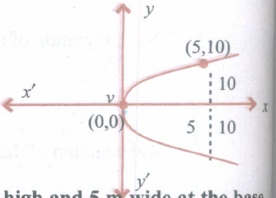
\(\therefore\) Focus is (a, 0) = (5, 0) which is the mid-point of the given diameter
38.
Let \(y=\frac { sinx+cosx }{ sinx-cosx } \)
Differentiating with respect to 'x' we get,
\(\frac { dy }{ dx } =\frac { (sinx-cosx).\frac { d }{ dx } (sinx+cosx)-(sinx+cosx).\frac { d }{ dx } (sinx-cosx) }{ { (sinx-cosx) }^{ 2 } } \)
\(=\frac { (sinx-cosx)(cosx-sinx)-(sinx+cosx)(cosx+sinx) }{ { (sinx-cosx) }^{ 2 } } \)
\(=\frac { (sinxcosx-{ sin }^{ 2 }x-cos^{ 2 }x+sinx.cosx)-({ sin }^{ 2 }x+cos^{ 2 }x+2sinxcosx) }{ { (sinx-cosx) }^{ 2 } } \)
\(=\frac { 2sinxcox-1-1-2sinxcox }{ { (sinx-cosx) }^{ 2 } } \)
\(=\frac { -2 }{ { (sinx-cosx) }^{ 2 } } \left[ \therefore sin^{ 2 }x+cos^{ 2 }x=1 \right] \)
39.
Step-1 : Let P (n) denote the statement a - b is divisible by a - b for all \(n\in N\)
∴ a1 - b1 = a - b is divisible by a - b
Put n = 1
P(1) : a - b is divisible by a - b
∴ P(1) is true.
Step-2:
Let us assume that P(k) is true.
∴ ak - bk is divisible by a - b
⇒ ak - bk = C(a - b) where C is a constant ...(1)
Step-3:
To prove that P(k+1) is true
P(k + 1) = ak+1 - bk+1
= ak+1 - akb + akb - bk+1 [Adding and subtracting ak b]
= ak (a - b) + b (ak - bk)
= ak (a - b) + b.c. (a - b) [using (1)]
= (a - b) (ak + bc) which is divisible by a - b.
∴ P (k + 1) is true whenever P(k) is true
∴ P(n) is true for all \(n\in N\).
40.
\(|A|=\left| \begin{matrix}1 & tan\quad x \\ -tan\quad x & 1 \end{matrix} \right| =1+{ tan }^{ 2 }x={ sec }^{ 2 }x\neq 0\)
\(\Rightarrow\) A-1 exists
Let Cij be the cofactor of aij in A
C11 = (-1)1+1 M11 = (-1)2(1) = 1
C12 = (-1)1+2 (-tan x) = tan x
C21 = (-1)2+2(1) = 1
\(\therefore \quad adj\quad A={ \left[ \begin{matrix} 1 & tan\quad x \\ -tan\quad x & 1 \end{matrix} \right] }^{ T }=\left[ \begin{matrix} 1 & -tan\quad x \\ tan\quad x & 1 \end{matrix} \right] \)
\({ A }^{ -1 }=\frac { 1 }{ |A| } adjA=\frac { 1 }{ 1+{ tan }^{ 2 }x } \left[ \begin{matrix} 1 & -tan\quad x \\ tan\quad x & 1 \end{matrix} \right] =\left[ \begin{matrix} \frac { 1 }{ 1+{ tan }^{ 2 }x } & \frac { -tan\quad x }{ 1+{ tan }^{ 2 }x } \\ \frac { tan\quad x }{ 1+{ tan }^{ 2 }x } & \frac { 1 }{ 1+{ tan }^{ 2 }x } \end{matrix} \right] \)
\(\therefore \quad { A }^{ T }{ A }^{ -1 }=\left[ \begin{matrix} 1 & -tan\quad x \\ tan\quad x & 1 \end{matrix} \right] \left[ \begin{matrix} \frac { 1 }{ 1+{ tan }^{ 2 }x } & \frac { -tan\quad x }{ 1+{ tan }^{ 2 }x } \\ \frac { tan\quad x }{ 1+{ tan }^{ 2 }x } & \frac { 1 }{ 1+{ tan }^{ 2 }x } \end{matrix} \right] =\left[ \begin{matrix} \frac { 1 }{ 1+{ tan }^{ 2 }x } \frac { -tan\quad x }{ 1+{ tan }^{ 2 }x } & \frac { -tan\quad x }{ 1+{ tan }^{ 2 }x } \frac { -tan\quad x }{ 1+{ tan }^{ 2 }x } \\ \frac { tan\quad x }{ 1+{ tan }^{ 2 }x } +\frac { tan\quad x }{ 1+{ tan }^{ 2 }x } & \frac { -{ tan }^{ 2 }x }{ 1+{ tan }^{ 2 }x } \frac { 1 }{ 1+{ tan }^{ 2 }x } \end{matrix} \right] \)
\(=\left[ \begin{matrix} \frac { 1-tan\quad x }{ 1+{ tan }^{ 2 }x } & \frac { -2tan\quad x }{ 1+{ tan }^{ 2 }x } \\ \frac { 2tan\quad x }{ 1+{ tan }^{ 2 }x } & \frac { 1-{ tan }^{ 2 }x }{ 1+{ tan }^{ 2 }x } \end{matrix} \right] =\left[ \begin{matrix} cos\quad 2x & -sin2x \\ sin\quad 2x & cos\quad 2x \end{matrix} \right] \) (Using multiple angle formula)
41.
Let A \(=\begin{vmatrix} 1 & a&a^2&-bc \\1 &b&{b}^{2}&-ca\\1&c&c^2&-ab \end{vmatrix}\)
\(=\left|\begin{array}{lll} 1 & a & a^2 \\ 1 & b & b^2 \\ 1 & c & c^2 \end{array}\right|+\left|\begin{array}{ccc} 1 & a & -b c \\ 1 & b & -c a \\ 1 & c & -a b \end{array}\right|\)
\(A=\begin{vmatrix} 1 & a&{a}^{2} \\ 1 &b&b^2\\1&c&c^2 \end{vmatrix}-\begin{vmatrix} 1 & a&bc \\1 &b&ca\\1&c&ab \end{vmatrix}\)
\(=\left|\begin{array}{lll} 1 & a & a^2 \\ 1 & b & b^2 \\ 1 & c & c^2 \end{array}\right|-\frac{1}{a b c}\left|\begin{array}{ccc} a & a^2 & a b c \\ b & b^2 & a b c \\ c & c^2 & a b c \end{array}\right|\)
(Multiplying R1, R2 and R3 of the determinant by a, b, c respectively)
\(=\left|\begin{array}{lll} 1 & a & a^2 \\ 1 & b & b^2 \\ 1 & c & c^2 \end{array}\right|-\frac{a b c}{a b c}\left|\begin{array}{lll} a & a^2 & 1 \\ b & b^2 & 1 \\ c & c^2 & 1 \end{array}\right|\)
\(\left|\begin{array}{lll} 1 & a & a^2 \\ 1 & b & b^2 \\ 1 & c & c^2 \end{array}\right|-\left|\begin{array}{lll} 1 & a & a^2 \\ 1 & b & b^2 \\ 1 & c & c^2 \end{array}\right|=0\)

11th Standard Syllabus & Materials
11th Standard
TN 11th Tamil பீடு பெற நில் - செய்யுள் - காவடிச்சிந்து Important Questions And Answers Study Material - QB365 Set A
NEW11th Standard
TN 11th Tamil பீடு பெற நில் - உரைநடை - மலை இடப்பெயர்கள் : ஓர் ஆய்வு Important Questions And Answers Study Material - QB365 Set A
NEW11th Standard
TN 11th Tamil மாமழை போற்றுதும் - துணைப்பாடம் - யானை டாக்டர் Important Questions And Answers Study Material - QB365 Set A
NEW11th Standard
TN 11th Tamil மாமழை போற்றுதும் - செய்யுள் - ஐங்குறுநூறு Important Questions And Answers Study Material - QB365 Set A



Tamilnadu Stateboard 11th Standard Subjects

Maths

Commerce

Economics

Biology
Business Maths and Statistics

Accountancy

Computer Science

Physics

Chemistry
Maths
Biology
Economics
Physics
Chemistry

History
Business Maths and Statistics

Computer Science
Accountancy

Computer Applications
History
Computer Technology
Commerce
Computer Applications
Computer Technology

Tamil

English

French
Tamilnadu Stateboard Standards
