
 100% FREE ACCESS
11th Standard Syllabus & Materials
11th Standard
TN 11th Tamil இயற்கை வேளாண்மை,சுற்றுச்சூழல் -செய்யுள் - மனோன்மணீயம் Important Questions And Answers Study Material - QB365 Set A
NEW11th Standard
TN 11th Tamil என்னுயிர் என்பேன் -துணைப்பாடம் - இசைத்தமிழர் இருவர் Important Questions And Answers Study Material - QB365 Set A
NEW11th Standard
TN 11th Tamil மொழி கலை -செய்யுள் - ஒவ்வொரு புல்லையும் Important Questions And Answers Study Material - QB365 Set A
NEW11th Standard
TN 11th Tamil பீடு பெற நில் - இலக்கணம் - பகுபத உறுப்புகள் Important Questions And Answers Study Material - QB365 Set A
NEW11th Standard
TN 11th Tamil பீடு பெற நில் - துணைப்பாடம் - வாடிவாசல் Important Questions And Answers Study Material - QB365 Set A
NEW11th Standard
TN 11th Tamil பீடு பெற நில் - செய்யுள் - குறுந்தொகை Important Questions And Answers Study Material - QB365 Set A

Published on: 17/01/2020
Download Tamil Nadu 11th Standard Business Maths and Statistics question papers, model tests, one-mark questions, important questions, and public exam papers in PDF format. Free study materials and answer keys for TN State Board students.
Questions + Answers key
Take MCQ Business Maths and Statistics Test
1.
If median = 45 and its coefficient is 0.25, then the mean deviation about median is _________.
11.25
180
0.0056
45
2.
The geometric mean of two numbers 8 and 18 shall be _________.
12
13
15
11.08
3.
The person suggested a mathematical method for measuring the magnitude of linear relationship between two variables say X and Y is ________.
Karl Pearson
Spearman
Croxton and Cowden
Ya Lun Chou
4.
The % Income on 7 % stock at Rs. 80 is _______.
9%
8.75%
8%
7%
5.
A man purchases a stock of Rs. 20,000 of face value Rs. 100 at a premium of 20%, then investment is ________.
Rs. 20,000
Rs. 25,000
Rs. 24,000
Rs. 30,000
6.
Correlation co-efficient lies between ______.
0 to ∞
-1 to +1
-1 to 0
-1 to ∞
7.
8.
Marginal revenue of the demand function p = 20–3x is _______.
20–6x
20–3x
20+6x
20+3x
9.
The minimum value of the objective function Z = x + 3y subject to the constraints 2x + y ≤ 20, x + 2y ≤ 20, x > 0 and y > 0 is ______.
10
20
0
5
10.
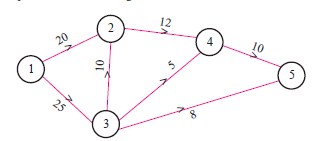
The critical path of the following network is________.
1 – 2 – 4 – 5
1 – 3 – 5
1 – 2 – 3 – 5
1 – 2 – 3 – 4 – 5
11.
\(\frac{d}{dx}(\frac{1}{x})\) is equal to ________.
\(-\frac{1}{x^2}\)
\(-\frac{1}{x}\)
log x
\(\frac{1}{x^2}\)
12.
The graph of f(x) = ex is identical to that of ________.
f(x) = ax, a > 1
f(x) = ax, a < 1
f(x) = ax, 0 < a < 1
y = ax +b, a \(\ne\) 0
13.
If p sec 50o = tan 50o then p is _______.
cos 50o
sin 50o
tan 50o
sec 50o
14.
The value of sin 15o cos 15o is ______.
1
\(\frac{1}{2}\)
\(\frac{\sqrt3}{2}\)
\(\frac{1}{4}\)
15.
Length of the latus rectum of the parabola y2 = - 25x is _______.
25
-5
5
-25
16.
The slope of the line 7x + 5y - 8 = 0 is _______.
7/5
-7/5
5/7
-9/7
17.
The term containing x3 in the expansion of (x - 2y)7 is _________.
3rd
4th
5th
6th
18.
If nPr = 720 (nCr), then r is equal to ______.
4
5
6
7
19.
If \(\begin{vmatrix} x & 2 \\ 8 &5 \end{vmatrix}=0\) then the value of x is ________.
\({{-5}\over{6}}\)
\({{5}\over{6}}\)
\({{-16}\over{5}}\)
\({{16}\over{5}}\)
20.
The inventor of input-output analysis is ________.
Sir Francis Galton
Fisher
Prof. Wassily W. Leontief
Arthur Cayley
21.
For the total revenue function R = - 90 + 6x2 - x3 find when R is increasing and when it is decreasing. Also, discuss the behaviour of marginal revenue.
22.
A computer while calculating the correlation co-efficient between two variables x and y from 25 pairs of observations, obtained the following results. \(\sum\)x=125, \(\sum\)x2=650, \(\sum\)y=100, \(\sum\)y2=460, xy=508. It was later found out that it had copied down two pairs as while the correct values are
| x | y |
| 6 | 14 |
| 8 | 6 |
| x | y |
| 8 | 12 |
| 6 | 8 |
Obtain the correlation co-efficient for the correct value.
23.
Three coins are tossed simultaneously. Consider the events A ‘three heads or three tails’, B ‘atleast two heads’ and C ‘at most two heads’ of the pairs (A, B), (A, C) and (B, C), which are independent? Which are dependent?
24.
A man sells 2000 ordinary shares (par value Rs. 10) of a tea company which pays a dividend of 25% at Rs. 33 per share. He invests the proceeds in cotton textiles (par value Rs. 25) ordinary shares at 44 per share which pays a dividend of 15%. Find
(i) the number of cotton textiles shares purchased and
(ii) change in his dividend income.
25.
The demand for a commodity A is q = 80 - \({ p }_{ 1 }^{ 2}\) + 5p2 - p1p2. Find the partial elasticities \(\frac { { E }q }{ { E }p_{ 1 } } \) and \(\frac { { E }q }{ { E }p_{ 2 } } \) when p1 = 2, p2 = 1.
26.
Solve the following linear programming problem graphically.
Maximise Z = 4x1 + x2 subject to the constraints x1 + x2 ≤ 50; 3x1 + x2 ≤ 90 and x1 ≥ 0, x2 ≥ 0.
27.
An arch is in the form of a parabola with its axis vertical. The arch is 10 m high and 5 m wide at the base. How high is the arch 2 m from the vertex of the parabola?
28.
Prove that the tangents to the circle x2 + y2 = 169 at (5,12) and (12,-5) are perpendicular to each other.
29.
As the number of units manufactured increases from 6000 to 8000, the total cost of production increases from Rs. 33,000 to Rs. 40,000. Find the relationship between the cost (y) and the number of units made (x) if the relationship is linear.
30.
Prove that : cos20°cos40°cos80° = \(\frac { 1 }{ 8 } \)
31.
If the function \(f\left( x \right) =\begin{cases} 6ax+3b\quad if\quad x>1 \\ ax-2b\quad if\quad x<1\quad is\quad continuous\quad at\quad x=1 \\ 15\quad if\quad x=1 \end{cases}\) Find the value of a and b.
32.
Verify the continuity and differentiability of \(f(x)= \begin{cases}1-x & \text { if } x<1 \\ (1-x)(2-x) & \text { if } 1 \leq x \leq 2 \\ 3-x & \text { if } x>2\end{cases}\) at x = 1 and x = 2
33.
Two types of radio valves A, B are available and two types of radios P and Q are assembled in a small factory. The factory uses 2 valves of type A and 3 valves of type B for the type of radio P, and for the radio Q it uses 3 valves of type A and 4 valves of type B. If the number of valves of type A and B used by the factory are 130 and 180 respectively, find out the number of radios assembled use matrix method.
34.
Show that the middle term in the expansion of (1 + x)2n is \(\frac { 1.3.5....(2n-1){ 2 }^{ n }.{ x }^{ n } }{ n! } \)
35.
If \(A=\left[ \begin{matrix} 2 & 4 \\ -3 & 2 \end{matrix} \right] \)then, find A -1.
36.
Find Q2 for 37, 32, 45, 36, 39, 37, 46, 57, 27, 34, 28, 30, 21
37.
Find the regression co-efficient of x on y from the following data. \(\sum\)X=20, \(\sum\)Y=40, \(\sum\)XY=300, \(\sum\)X2=150, \(\sum\)Y2=345, N=5. Find the value of x when y=5
38.
Which is better investment? 7% of Rs. 100 shares at Rs. 120 (or) 8% of Rs. 100 shares at Rs. 135.
39.
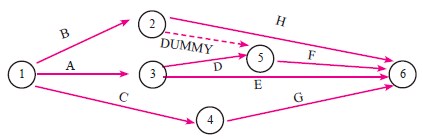
Construct a network diagram for the following situation:
A < D, E; B, D < F; C < G and B < H.
40.
Find the equilibrium price and equilibrium quantity for the following functions. Demand: x = 100 – 2p and supply: x = 3p – 50
41.
Differentiate the following with respect to x. \(\sqrt { 1+{ x }^{ 2 } } \)
42.
Find the equation of the parabola whose focus is the point F(-1, -2) and the directrix is the line 4x - 3y + 2 = 0
43.
Prove that \(\left| \begin{matrix} x & sin\theta & cos\theta \\ -sin\theta & -x & 1 \\ cos\theta & 1 & x \end{matrix} \right| \) is independent of \(\theta\)
44.
Find x if \(\frac { 1 }{ 6! } +\frac { 1 }{ 7! } =\frac { x }{ 8! } \).
45.
A point in the plane moves so that its distance from the origin is thrice its distance from the y- axis. Find its locus.
46.
Evaluate: \(\left| \begin{matrix} 1 & 2 & 4 \\ -1 & 3 & 0 \\ 4 & 1 & 0 \end{matrix} \right| \)
47.
From a pack of 52 cards, two cards are drawn at random. Find the probability that one is a king and the other is a queen.
48.
Find the amount of annuity of Rs. 2000 payable at the end of each year for 4 years of money is worth 10% compounded annually [(1.1)4 = 1.4641]
49.
From the following data calculate the correlation coefficient Σxy = 120, Σx2 = 90, Σy2 = 640
50.
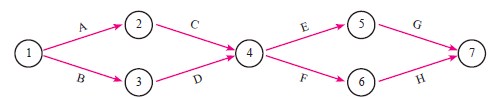
Develop a network based on the following information:
| Activity: | A | B | C | D | E | F | G | H |
| Immediate predecessor: | - | - | A | B | C, D | C, D | E | F |
51.
The demand function for a commodity is \(p={4\over x}\), where p is unit price. Find the instantaneous rate of change of demand with respect to price at p = 4. Also interpret your result.
52.
If \(\tan^2x=2\tan^2\phi+1\), prove that \(\cos2x+sin^2\phi=0\)
53.
For what value of k, the following function is continuous at x =0?
f(x) = \(\begin{cases} \frac { 1-cos4x }{ 8{ x }^{ 2 } } \quad ifx\neq 0 \\ k\quad \quad \quad ifx=0 \end{cases}\)
54.
Resolve into partial fractions :\(\frac { 12x-17 }{ (x-2)(x-1) } \)
1.
Mean deviation about median = co-eficient of mean deviation about median x Median
= 0.25 x 45
= 11.25
2.
GM = \(\sqrt{8 \times 18} = \sqrt{144} = 12\)
3.
(a)
Karl Pearson
4.
Investment = 80, Income = 7
Investment = 100,
Income \(= \frac{ 7 \times 100}{80} = 8.75 \%\)
5.
If FV 100, Investment = 120
FV = 20,000,
Investment = \(\frac{120\times 20,000}{100} \) = Rs. 24000
6.
(b)
-1 to +1
7.
(b)
8.
R = px = 20x- 3x2
M.R = dR/dx = 20 - 6x
9.
| 2x | + | y | = | 20 | x | + | y | = | 20 | |
| x | 0 | 10 | x | 0 | 20 | |||||
| y | 20 | 0 | y | 20 | 0 |
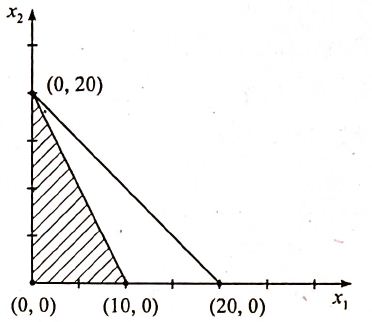
| Corner points | Z = x + 3y |
| (0, 0) | 0 |
| (0, 20) | 60 |
| (10, 0) | 10 |
10.
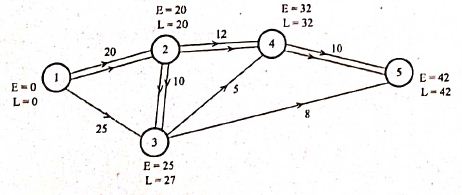
11.
(a)
\(-\frac{1}{x^2}\)
12.
(a)
f(x) = ax, a > 1
13.
\(p =\frac{\tan 50^{\circ}}{\sec 50^{\circ}}=\frac{\sin 50^{\circ} / \cos 50^{\circ}}{1 / \cos 50^{\circ}} =\sin 50^{\circ}\)
14.
\(\frac{1}{2}\left(2 \sin 15^{\circ} \cos 15^{\circ}\right) =\frac{1}{2} \sin 2\left(15^{\circ}\right)=\frac{1}{2} \sin 30^{\circ} =\frac{1}{2} \times \frac{1}{2}=\frac{1}{4}\)
15.
4a = 5
16.
\(m=\frac{-a}{b}=\frac{-7}{5}\)
17.
(c)
5th
18.
\(n P_r =720(\mathrm{nCr}) \)
\(\frac{n !}{(n-r) !} =720\left(\frac{n !}{r !(n-r) !}\right) \)
\(r ! =720 \)
\(r ! =6 ! \)
r = 6
19.
5x - 16 = 0
5x = 16
\(x=\frac{16}{5}\)
20.
(c)
Prof. Wassily W. Leontief
21.
Given R = - 90 + 6x2 - x3
For Revenue Function: \({dR\over dx}=12x-3x^2\)
\({dR\over dx}=0⇒12x-3x^2=0\)
⇒ 4x-x2 = 0 ⇒ x(4 - x) = 0

The possible intervals are (-∞,0), (0, 4) and (4, ∞)
| Intervals | Sign of \({dy\over dx}\) | Nature of Function |
|---|---|---|
| In (-∞, 0) say x =-1 | 12(-1) - 3(-1)2 =.-15 (Negative) | Decreasing |
| In (0,4) say x = 1 | 12(1) - 3(1)2 = 9 (Positive) | Increasing |
| In (4, ∞) say x = 5 | 12(5) - 3(5)2 = -15 (Negative) | Decreasing |
∴ Revenue function is increasing in (0, 4) and decreasing in (-∞, 0) and (4, ∞).
For Marginal Revenue Function:
\(MR={dR\over dx}={d\over dx}(-90+6x^2-3x^3)=12x-3x^2\)
Let y = 12x - 3x2
\({dy\over dx}=0⇒12-6x=0⇒x=2\)
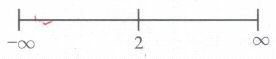
The possible intervals are (-∞, 2) and (2, ∞).
| Intervals | Sign of \({dy\over dx}\) | Nature of Function |
|---|---|---|
| In (-∞,2) say x =0 | 12- 6(0) = 12 (Positive) | Increasing |
| In (2, ∞) say x = 3 | 12- 6(3) = - 6 (Negative) | Decreasing |
Hence, Marginal Revenue function is increasing in (-∞, 2) and decreasing in (2, ∞).
22.
We will find the correct values of \(\sum\)x, \(\sum\)x2, \(\sum\)y2, and \(\sum\)xy by delecting the old values and adding new ones.
\(\therefore\)\(\sum\)x=125-(6+8)+(6+8)=125
\(\sum\)y=100-(14+6)+(12+8)=100
x2=650-(62+82)+(82+62)=650
y2=460-(142+62)+(122+82)=436
and xy =508-(14x6+8x6)+(12x8+6x8)=520
\(\therefore\) Correlation Co-efficient
r(x,y)=\(\frac { N\sum { xy } -(\sum { x } )(\sum { y } ) }{ \sqrt { N{ \sum { x } }^{ 2 }-{ (\sum { x } ) }^{ 2 } } \sqrt { N{ \sum { y } }^{ 2 }-{ (\sum { y } ) }^{ 2 } } } \)
\(\Rightarrow\)\(\frac { 25(520)-125(100) }{ \sqrt { 25(650)-{ (125) }^{ 2 } } \sqrt { 25(436)-{ (100) }^{ 2 } } } \)
\(\Rightarrow\) r(x,y)=0.66
23.
Here the sample space of the experiment is
S = {HHH, HHT, HTH, HTT, THH, TTH, THT, TTT}
A = {Three heads or Three tails}
= {HHH, TTT}
B = {at least two heads}
= {HHH, HHT, HTH, THH} and
C = {at most two heads} = {HHT, HTH, HTT, THH, TTH, THT, TTT}
Also (A∩B) = {HHH}; (A∩C) = {TTT} and (B∩C) ={HHT, HTH, THH}
∴ P(A) = \(\frac { 2 }{ 8 } =\frac { 1 }{ 4 } \); P(B) =\(\frac{1}{2}\); P(C) = \(\frac{7}{8}\) and
P(A∩B)= \(\frac{1}{8}\), P(A∩C)=\(\frac{1}{8}\), P(B∩C)=\(\frac{3}{8}\)
Also P(A). P(B)=\(\frac { 1 }{ 4 } .\frac { 1 }{ 2 } =\frac { 1 }{ 8 } \)
P(A). P(C) =\(\frac { 1 }{ 4 } .\frac { 7 }{ 8 } =\frac { 7 }{ 32 } \)
and P(B). P(C) =\(\frac { 1 }{ 2 } .\frac { 7 }{ 8 } =\frac { 7 }{ 16 } \)
Thus, P(A∩B) = P(A). P(B)
P(A∩C) ≠ P(A) P(C) and
P(B∩C) ≠ P(B). P(C)
Hence, the events (A and B) are independent, and the events (A and C) and (B and C) are dependent.
24.
Shares of tea company
No.of shares = 2000
FV = Rs.10
MV = Rs.33
Rate of dividend = 25%
S.P of a share = Rs.33
S.P of 2000 shares = 2000 x 33 = Rs. 66,000
Shares of cotton textiles
Investment = Rs. 66,000
FV = Rs. 25
MV = Rs. 44
Dividend =15%
(i) Number of cotton textile shares
= \(\frac {\text{ Investment} }{ M.V } \)
= \(\frac { 66,000 }{ 44 } =1500\)
(ii) Income from tea company shares
= 2000 x 10 x \(\frac { 25 }{ 100 } \) = Rs. 5000
Income from cotton textiles shares
= 1 500 x 25 x \(\frac { 15 }{ 100 } \) = Rs. 5625
Change in his dividend income = 5625 - 5000 = Rs. 625
25.
q = 80 - \({ p }_{ 1 }^{ 2 }\) + 5p2 - p1p2
\({\partial q\over \partial p_1}=-2p_1-p_2\)
\({\partial q\over \partial p_2}=5 - p_1\)
\(\frac{E q}{E p_1}=\frac{-p_1}{q} \frac{\partial q}{\partial p_1}=-\frac{p_1\left(-2 p_1-p_2\right)}{80-p_1^2+5 p_2-p_1 p_2}=\frac{2 p_1^2+p_1 p_2}{80-p_1^2+5 p_2-p_1 p_2}\)
\(\frac{E q}{E p_2}=\frac{-p_2}{q} \frac{\partial q}{\partial p_2}\)
\(=\frac{-p_2\left(5-p_1\right)}{80-p_1^2+5 p_2-p_1 p_2} \)
\(={-5p_2+p_1p_2\over 80-p^2_1+5p_2-p_1p_2}\)
\(\frac { { E }q }{ { E }p_{ 1 } } ={8+2\over 80-4+5-2}={10\over 79}\)
\(\frac { { E }q }{ { E }p_{ 2 } } ={-5+2\over 80-4+5-2}={-3\over 79}\)
26.
First we have to find the feasible region using the given conditions.
Since both the decision variables x1 and x2 are non-negative, the solution lies in the first quadrant write all the inequalities of the constraints in the form of equations.
∴ We have the lines \(x_1+x_2 \leq 50; 3 x_1+x_2 \leq 90\)
x1 + x2 = 50 is a line passing through the points (0,50) and (50,0).
[(0,50) is obtained by taking x1 = 0 in x1 + x2 = 50, (50,0) is obtained by taking x2 = 0 in \(\left.x_1+x_2=50\right]\)
Any point lying on or below the line x1 + x2 = 50. Satisfies the constraint \(x_1+x_2 \leq 50\)
We follow the same steps for the following
x1 + x2 = 50
| x1 | 0 | 50 |
| x2 | 50 | 0 |
\({ 3x }_{ 1 }+{ x }_{ 2 }=90\)
| x1 | 0 | 30 |
| x2 | 90 | 0 |
Now we draw the graph
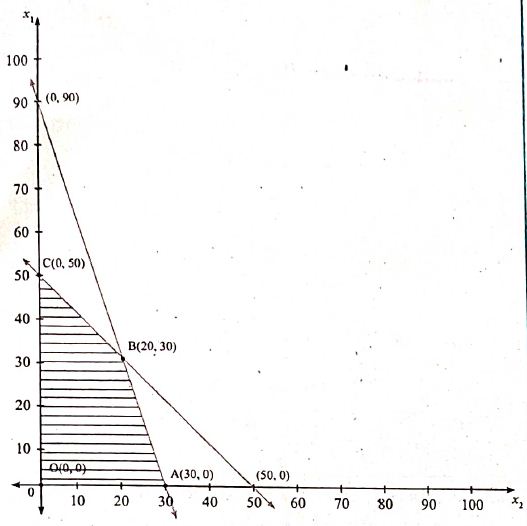
The feasible region satisfying all the conditions is OABC. The co-ordinates of the points are O(0,0), A(30, 0), B(20,30), C(0,50).
| Corner points | \( Z=4{ x }_{ 1 }+{ x }_{ 2 }\) |
| O(0,0) | 0 |
| A(30,0) | 120 |
| B(20,30) | 80 + 30 = 110 |
| C(0,50) | 50 |
Optimal solution is at A(30,0)
x1 = 30, x2 = 0 and Zmax = 120.
Verification
\(3 x_1+x_2 =90 \)
\(x_1+x_2 =50 \)
\(2 x_1 =40 \)
\(x_1 =20 x_2 =50-20=30 \)
B(20,30)
27.
Since the axis of the parabola is vertical, its equation will be x2 = 4ay.
Arch is 10 m high and 5 m wide at base.
\(\therefore\) Point \((\frac{5}{2},10)\) lies on the parabola
\(\therefore\) \(\frac{25}{4}\) = 4a(10)⇒ 4a = \(\frac{25}{40}\) = \(\frac{5}{8}\)(y)
\(\therefore\) Equation of the parabola becomes x2 = \(\frac{5}{8}\)(y)
Let the width of the arch 2 m from the vertex is 2b, then point (b, 2) lies on the parabola
\(\therefore\) b2 = \(\frac { 5(2) }{ 8 } =\frac { 10 }{ 8 } =\frac { 5 }{ 4 } \Rightarrow b=\frac { \sqrt { 5 } }{ 2 } \)
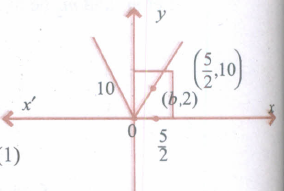
\(\therefore\) width of arch is 2b = 2.\(\frac{\sqrt{5}}{2}\) = √5m = 2.23m(app)
28.
Given equation of the circle is x2 + y2 = 169...(1)
Equation of the tangent at (x1, y1) to circle (1) is xx1 + yy1 = 169
Now, Equation of the tangent at (5,12) to circle (1) is
x(5) + y(12) = 169 ⇒ 5x + 12y - 169 = 0...(2)
and equation of the tangent at (12,-5) to circle (1) is
x(12) + y(-5) = 169 ⇒ 12x - 5y - 169 = 0...(3)
Let m1 and m2 be the slopes of the tangents (2) and (3)
ஃ m1=\(\frac { -Co-efficient\quad of\quad x }{ Co-efficient\quad of\quad y } =\frac { -5 }{ 12 } \)
Similarly m2 = \(\frac { -12 }{ -5 } =\frac { 12 }{ 5 } \)
Consider m1m2 = \(\left( \frac { -5 }{ 12 } \right) \left( \frac { 12 }{ 5 } \right) =-1\)
Since m1m2 = -1, the tangents at (5,12) and (12,-5) to the circle x2 + y2 = 169 are perpendicular to each other.
29.
Let x represent the number of units and y its cost.
By the given data,
x1(6000) y1(33,000)
x2(8000) y2(40,000)
Using two point form, \(\frac { y-{ y }_{ 1 } }{ { y }_{ 2 }-{ y }_{ 1 } } =\frac { x-{ x }_{ 1 } }{ { x }_{ 2 }-{ x }_{ 1 } } \)
⇒ \(\frac { y-33000 }{ 40,000-33000 } =\frac { x-6000 }{ 8000-6000 } \)
⇒ \(\frac { y-33000 }{ 7000 } =\frac { x-6000 }{ 2000 } \)
⇒ \(\frac { y-33000 }{ 7 } =\frac { x-6000 }{ 2 } \)
⇒ 2y - 66000 = 7x - 42000
⇒ 2y = 7x - 42000 + 66000
2y = 7x + 24000, which is the required linear function.
30.
\(\cos 20^{\circ} \cos 40^{\circ} \cos 80^{\circ}=\frac{1}{8}\)
\(\text {LHS }=\cos 20^{\circ} \cos 40^{\circ} \cos 80^{\circ}\)
\(=\cos 20^{\circ} {\left[\cos \left(60^{\circ}-20^{\circ}\right)\right.} \left.\cos \left(60^{\circ} \div 20^{\circ}\right)\right]\)
\(=\cos 20^{\circ}\left[\cos ^2 60^{\circ}-\sin ^2 20^{\circ}\right]\)
\(=\cos 20^{\circ}\left[\left(\frac{1}{2}\right)^2-\left(1-\cos ^2 20^{\circ}\right)\right]\)
\(=\cos 20\left[\frac{1-4+4 \cos ^2 20^{\circ}}{4}\right]\)
\(=\frac{1}{4}\left[4 \cos ^3 20^{\circ}-3 \cos 20^{\circ}\right]\)
\(=\frac{1}{4} \cos 3(20)=\frac{1}{4} \cos 60^{\circ}\)
\(=\frac{1}{4}\left(\frac{1}{2}\right)=1 / 8=\mathrm{RHS}\)
Hence proved.
31.
Given \(f(x)=\left\{ \begin{matrix} 6ax+3b & if\quad x>1 \\ ax-2b & if\quad x<1 \\ 15 & if\quad x=1 \end{matrix} \right\} \)
\(L[{ f(x)] }_{ x=1 }=\lim _{ x\rightarrow { 1 }^{ - } }{ f(x)
=\lim _{ h\rightarrow 0 }{ f(1-h)=\lim _{ h\rightarrow 0 }{ a(1-h)-2b\quad [\because f(x)=ax-2b\quad if\quad x<1] } } } \)
\(=\lim _{ h\rightarrow 0 }{ a-ah-2b=a-2b } \) .....(1)
R[f(x)]x=1=\(\lim _{ x\rightarrow { 1 }^{ + } }{ f(x)=\lim _{ h\rightarrow 0 }{ f(1+h) } } \)
\(=\lim _{ x\rightarrow { 1 }^{ + } }{ 6a(1+h)+3b\quad [\because f(x)=6ax+3b\quad if\quad x>1] } \)
= 6(91+0) + 3b = 6a + 3b ....(2)
Also, f(1) = 15 ....(3)
Since f(X) is continuous at x =1,
L[f(x)]x=1=R[f(x)]x=1=f(1)
\(\Rightarrow\) a - 2b = 6a + 3b = 15 [using (1), (2) and (3)]
\(\Rightarrow\) a - 2b = 15 ....(4)
and 6a+3b=15 \(\Rightarrow\) 2a + b =5 ..(5)
(4) \(\times\) 2 \(\rightarrow \) 2a - 4b = 30
- - -
(5) \(\rightarrow \) 2a + b = 5
____________________
-5b = 25 \(\Rightarrow\) b = -5
Substituting b = -5 in (4) we get,
a - 2(-5) = 15
\(\Rightarrow\) a + 10 = 15
\(\Rightarrow\) a = 15 - 10 = 5
\(\therefore\) a = 5 and b = -5.
32.
\(L H L=\lim _{x \rightarrow 1^{-}} f(x)=\lim _{x \rightarrow 1} 1-x=0\)
\(R H L=\lim _{x \rightarrow 1^{+}} f(x)=\lim _{x \rightarrow 1}(1-x)(2-x)=0\)
LHL = RHL
\(\therefore\) f is continuous at x = 1
\(L H D=\lim _{h \rightarrow 0} \frac{f(1-h)-f(1)}{1-h-1}\)
\(=\lim _{h \rightarrow 0} \frac{(1-1-h)(2-1-h)}{h}\)
\(R H D=\lim _{h \rightarrow 0} \frac{f(1+h)-f(1)}{1+h-1}\)
\(=\lim _{h \rightarrow 0} \frac{-h(1-h)}{h}=-1\)
LHD = RHD
\(\therefore\) f is differentiable at x = 1
\(L H L=\lim _{x \rightarrow 2^{-}} f(x)=\lim _{x \rightarrow 2}(1-x)(2-x)=0\)
\(R H L=\lim _{x \rightarrow 2^{+}} f(x)=\lim _{x \rightarrow 2} 3-2=1\)
\(L H L \neq R H L\)
\(\therefore\) f is not continuous at x = 2 and hence not differentiable at x = 2
33.
Let the number of radios of type P be x and the radios of type Q be y.
Given 2x + 3y = 130 and 3x + 4y = 180
\(\Rightarrow \left( \begin{matrix} 2 & 3 \\ 3 & 4 \end{matrix} \right) \left( \begin{matrix} x \\ y \end{matrix} \right) =\left( \begin{matrix} 130 \\ 180 \end{matrix} \right) \)
AX = B where A = \(\left( \begin{matrix} 2 & 3 \\ 3 & 4 \end{matrix} \right) ,X=\left( \begin{matrix} x \\ y \end{matrix} \right) and\quad B=\left( \begin{matrix} 130 \\ 180 \end{matrix} \right) \)
|A|=\(\left| \begin{matrix} 2 & 3 \\ 3 & 4 \end{matrix} \right| =8-9=-1\neq 0\Rightarrow { A }^{ -1 }\) exists adj A=\(\left( \begin{matrix} 4 & -3 \\ -3 & 2 \end{matrix} \right) \) [\(\because\) A11 = 4, A12 = -3 A21 = -3, A22 = 2]
\(\therefore \ { A }^{ -1 }=\frac { 1 }{ |A| } adj\quad A=\frac { 1 }{ -1 } \left( \begin{matrix} 4 & -3 \\ -3 & 2 \end{matrix} \right) =\left( \begin{matrix} -4 & 3 \\ 3 & -2 \end{matrix} \right) \)
\(\therefore \ X={ A }^{ -1 }B=\left( \begin{matrix} -4 & 3 \\ 3 & -2 \end{matrix} \right) \left( \begin{matrix} 130 \\ 180 \end{matrix} \right) =\left( \begin{matrix} -520 & +540 \\ 390 & -360 \end{matrix} \right) =\left( \begin{matrix} 20 \\ 30 \end{matrix} \right) \)
\(\therefore\) Number of radios of Type P is 20.
Number of radios of Type Q is 30.
34.
(1 + x)2n
2n is even
Middle term is \(t_{\frac{n}{2}+1}=t_{\frac{2 n}{2}+1}=t_{n+1}\)
\(r=n\)
\(t_{r+1}=n C_r x^{n-r} a^r\)
\(t_{n+1}=2 n C_n(1)^{2 n-n} x^n\)
\(=2 n C_n \cdot x^n\)
\(n C_r=\frac{n !}{r !(n-r) !}\)
\(=\frac{(2 n) !}{n !(2 n-n) !} x^n\)
\(=\frac{(2 n)(2 n-1)(2 n-2)(2 n-3) \ldots 5 \cdot 4 \cdot 3 \cdot 2.1}{n ! n !} x^n\)
\(=\frac{(2 n)(2 n-2) \ldots 4.2(2 n-1)(2 n-3) \ldots 5.3 .1}{n ! n !} x^n\)
\(=\frac{2^n(n(n-1) \ldots 2.1)(2 n-1)(2 n-3) \ldots 5.3 .1}{n ! n !} x^n\)
\(=\frac{2^n \cdot n !(2 n-1)(2 n-3) \ldots 5 \cdot 3 \cdot 1}{n ! n !} x^n\)
\(=\frac{1.3 .5 \ldots(2 n-3)(2 n-1) 2^n x^n}{n !}\)
35.
\(A=\left[ \begin{matrix} 2 & 4 \\ -3 & 2 \end{matrix} \right] \)
\(|A|=\left[ \begin{matrix} 2 & 4 \\ -3 & 2 \end{matrix} \right] \)
=16 ≠ 0
Since A is a nonsingular matrix, A -1 exists
Now adj \(A=\left[ \begin{matrix} 2 & -4 \\3 & 2 \end{matrix} \right] \)
\({ A }^{ -1 }=\frac { 1 }{ \left| A \right| } adjA\)
\(=\frac { 1 }{ 16 } \left[ \begin{matrix} 2 & -4 \\ 3 & 2 \end{matrix} \right] \)
36.
Given data in ascending order are
21, 27, 28, 30, 31, 32, 34, 36, 37, 39, 45, 46, 57 and n = 13
Q2 = size of \({ 2\left( \frac { N+1 }{ 4 } \right) }^{ th }\) value = Size of \(2{ \left( \frac { 13+1 }{ 4 } \right) }^{ th }\) value
= Size of 7th value
Q2 = 34
37.
The regression co-efficient of X on Y is
bxy= \(\frac { N\sum { XY-(\sum { X)(\sum { Y) } } } }{ N.\sum { { Y }^{ 2 }-(\sum { { Y) }^{ 2 } } } } =\frac { 5(300)-(20)(40) }{ 5(345)-({ 40) }^{ 2 } } \)=5.6
Also, \(\bar {X}\) =\(\frac { \sum { X } }{ N } =\frac { 20 }{ 5 } \)=4
and \(\bar {Y}\)=\(\frac { \sum { Y } }{ N } =\frac { 40 }{ 5 } \)=8
\(\therefore\)The regression equation of X on Y is
X- \(\bar {X}\)=bxy(Y-\(\bar {Y}\) )
X-4=5.6(Y-8)
X-4=5.6Y-44.8
X=5.6Y-40.8
When Y=6, X=5.6(6)-40.8=33.6-40.8
\(\therefore\)X=-7.2
38.
Let Investment in each stock be 120 x 135
At 7% stock
Investment = 120, Income = 7
Investment = 120 x 135
Income = \(\cfrac { 7\times120\times135 }{ 120 }=Rs.945\)
At 8% stock
Investment = 135, Income = 8
Investment = 120 x 135
Income =\(\cfrac { 8 \times 120 \times135 }{ 135 }=Rs.960\)
\(\therefore\) 8% of Rs.100 shares at Rs.135 is a better investment .
39.
Using the precedence relationships and following the rules of network construction, the required network is shown in following figure.
40.
At equilibrium, demand = Supply
\(\Rightarrow\) 100 - 2p = 3p - 50
\(\Rightarrow\) 150 = 5p
\(\Rightarrow\) p = 30
Equilibrium price is PE = 30
x = 100 - 2p
= 100 - 60 = 40
x = 40
\(\therefore\) Equilibrium quantity is xE = 40 units.
41.
y = \(\sqrt { 1+{ x }^{ 2 } } =(1+{ x }^{ 2 })^{ \frac { 1 }{ 2 } }\)
\(\frac{d y}{d x}=\left(1+x^2\right)^{\frac{1}{2}}=\frac{1}{2}\left(1+x^2\right)^{\frac{1}{2}-1}\)
\(=\frac{1}{2 \sqrt{1+x^2}}(2 x)=\frac{x}{\sqrt{1+x^2}}\)
42.
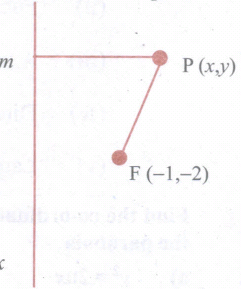
F is (-1, -2) and directrix is 4x - 3y + 2 = 0
Let P (x, y) be any point on the parabola
for the parabola, \(\frac { FP }{ Pm } =1\)
FP = PM
\(\Rightarrow\) FP2 = PM2
\(\Rightarrow\) (x + 1)2 + (y + 2)2 = \(\left[ \frac { 4x-3y + 2 }{ \sqrt { { 4 }^{ 2 }+(-3)^{ 2 } } } \right] ^{ 2 }\)
\(\Rightarrow\) x2 + 2x +1 +y2 + 4y + 4 = 16x2 +9y2 + 4 -24xy - 12y + 16x
\(\Rightarrow\) 25x2 + 50x + 25y2 +50x +100y + 125 - 16x2 - 9y2 - 4 + 24xy + 16x - 12y = 0
\(\Rightarrow\) 9x2 + 16y2 + 24xy + 34x + 112y + 121 = 0
43.
Let A = \(\left| \begin{matrix} x & sin\theta & cos\theta \\ -sin\theta & -x & 1 \\ cos\theta & 1 & x \end{matrix} \right| \)
Expanding along R1 we get
|A| = x\(\left| \begin{matrix} -x & 1 \\ 1 & x \end{matrix} \right| -sin\theta \left| \begin{matrix} -sin\theta & 1 \\ cos\theta & x \end{matrix} \right| +cos\theta \begin{vmatrix} -sin\theta & -x \\ cos\theta & 1 \end{vmatrix}\)
= x(-x2 - 1) - sin \(\theta\) (-x sin \(\theta\) - cos \(\theta\)) + cos \(\theta\) (-sin \(\theta\) + x cos \(\theta\))
\(=-x^{ 3 }-x+xsin^{ 2 }\theta +sin\theta cos\theta +xcos^{ 2 }\theta \)
= -x3 - x + x(sin2\(\theta\) + cos2\(\theta\))
= -x3 - x + x(1) [\(\because\) sin2\(\theta\) + cos2\(\theta\) ] = -1
= -x3 which is independent of \(\theta\)
44.
\(\frac { 1 }{ 6! } +\frac { 1 }{ 7! } =\frac { x }{ 8! } \)
\(\frac { 1 }{ 6! } +\frac { 1 }{ 7\times 6! } =\frac { x }{ 8\times 7\times 6! } \)
\(\frac{1}{6 !}+\left(1+\frac{1}{7}\right)=\frac{x}{8 \times 7 \times 6 !}\)
\(\frac{8}{7}=\frac{6 ! x}{8 \times 7 \times 6 !}\)
\(x=\frac{8 \times 8 \times 7}{7}=64\)
45.
Let \(P\left( { x }_{ 1 },{ y }_{ 1 } \right) \) be any point on the locus and A be the foot of the perpendicular from \(P\left( { x }_{ 1 },{ y }_{ 1 } \right) \) to the y-axis.
Given that OP = 3 AP
\({ OP }^{ 2 }=9{ AP }^{ 2 }\)
\(\left( { x }_{ 1 }-0 \right) ^{ 2 }+\left( { y }_{ 1 }-0 \right) ^{ 2 }=9x_{ 1 }^{ 2 }\)
\({ x }_{ 1 }^{ 2 }+{ y }_{ 1 }^{ 2 }={ 9x }_{ 1 }^{ 2 }\)
\({ 8x }_{ 1 }^{ 2 }-{ y }_{ 1 }^{ 2 }=0\)
\(\therefore\) The locus of \(P({ x }_{ 1 },{ y }_{ 1 })\) is \(8 x^2-y^2=0\)
46.
\(\left| \begin{matrix} 1 & 2 & 4 \\ -1 & 3 & 0 \\ 4 & 1 & 0 \end{matrix} \right| \) = 1 (Minor of 1) –2 (Minor of 2) + 4 (Minor of 4)
\(=1\left| \begin{matrix} 3 & 0 \\ 1 & 0 \end{matrix} \right| -2\left| \begin{matrix} -1 & 0 \\ 4 & 0 \end{matrix} \right| +4\left| \begin{matrix} -1 & 3 \\ 4 & 1 \end{matrix} \right| \)
= 0 – 0 – 52 = –52.
47.
\(n(S)=52{ C }_{ 2 }=\frac { 52\times 51 }{ 2\times 1 } =1326\)
Let A be the event that one king and one queen card is drawn
n(A) = 4C1 \(\times\) 4C1 = 16
\(P(A)=\frac { 16 }{ 1326 } =0.012\)
48.
a = Rs. 2000; i =10% = 0.1 n = 4
A = \(\cfrac { a }{ i } \left[ \left( 1+i \right) ^{ n }-1 \right] \)
\(=\frac { 2000 }{ 0.1 } \left[ (1+0.1)^{ 4 }-1 \right] \)
= 20,000[ 1.464-1]
= 20,000 (0.464)
A = Rs. 9280
49.
Given Σxy = 120, Σx2 = 90, Σy2 = 640
Then r = \(\frac { \Sigma xy }{ \sqrt { \Sigma { x }^{ 2 }\Sigma { y }^{ 2 } } } =\frac { 120 }{ \sqrt { 90(640) } } =\frac { 120 }{ \sqrt { 57600 } } =\frac { 120 }{ 240 } \) = 0.5
50.
Using the immediate precedence relationships and following the rules of network construction, the required network is shown in following figure.
51.
\(p={{4\over x}}\)
\(⇒\ x={4\over p}\)
∴ \({dx\over dp}=-{4\over p^2}\)
At p = 4, \({dx\over dp}=-{1\over 4}=-0.25\)
∴ Rate of change of demand with respect to the price at p = Rs.4 is -0.25
Interpretation:
When the price increases by 1% from the level of p = Rs. 4, the demand decreases (falls) by 0.25%.
52.
We have \(\cos 2x=\frac{1-\tan^2x}{1+\tan^2x}\)
\(\therefore LHS=\cos2x+\sin^2\phi=\frac{1-\tan^2x}{1+\tan^2x}+\sin^2\phi\)
\(=\frac{1-\left(2\tan^\phi+1\right)}{1+(2\tan^2\phi)+1}+\sin^2\phi\) \([\because tan^{ 2 }x=2tan^{ 2 }\phi +1]\)
\(=\frac{-2\tan^2\phi}{2(1+\tan^2\phi)}+\sin^2\phi=\frac{-\tan^2\phi}{\sec^2\phi}+\sin^2\phi\)
\(=\frac{-\sin^2\phi}{\cos^2\phi.\frac{1}{\cos^2\phi}}+\sin^2\phi=-\sin^2\phi+\sin^2\phi=0=RHS\)
Hence Proved.
53.
Given \(f(x) =\begin{cases} \frac { 1-cos4x }{ 8{ x }^{ 2 } } \quad ifx\neq 0 \\ k\quad \quad \quad ifx=0 \end{cases}\)
\(\neq \underset { x\rightarrow 0 }{ lim } \quad f(x)=\underset { x\rightarrow 0 }{ lim } \frac { 1-cos4x }{ { 8x }^{ 2 } } =\underset { x\rightarrow 0 }{ lim } \frac { 2sin^{ 2 }2x }{ { 8x }^{ 2 } } \) [ஃ 1-cos2z =sin2x]
= \(\underset { x\rightarrow 0 }{ lim } \frac { sin^{ 2 }2x }{ { 4x }^{ 2 } } =\underset { x\rightarrow 0 }{ lim } \left( \frac { sin2x }{ 2x } \right) ^{ 2 }\)
= (1)2 ....(1)
Given f(0) = k ...(2)
Since f(x) is continuous at x = 0,
\(\underset { x\rightarrow 0 }{ lim } \) f(x) = f(0)
1 = k [using (1) and (2)
k = 1
54.
\(\frac { 12x-17 }{ (x-2)(x-1) } =\frac { A }{ x+2 } +\frac { B }{ x-1 } \)
\(\Rightarrow \frac { 12x-17 }{ (x-2)(x-1) } =\frac { A(x-1)+B(x-2) }{ (x-2)(x-1) } \)
\(\Rightarrow 12x-17=A(x-1)+B(x-2)\)
Putting x=1 in (1) we get,
\(12-17= B(1-2) \Rightarrow -5=-B \Rightarrow \boxed { B=5 } \)
Putting x=2 in (1) we get,
\(24-17=A(2-1) \Rightarrow 7=A(1) \Rightarrow \boxed { A=7 } \)
\(\therefore \frac { 12x-17 }{ (x-2)(x-1) } =\frac { 7 }{ x+2 } +\frac { 5 }{ x-1 } \)

11th Standard Syllabus & Materials
11th Standard
TN 11th Tamil பீடு பெற நில் - செய்யுள் - காவடிச்சிந்து Important Questions And Answers Study Material - QB365 Set A
NEW11th Standard
TN 11th Tamil பீடு பெற நில் - உரைநடை - மலை இடப்பெயர்கள் : ஓர் ஆய்வு Important Questions And Answers Study Material - QB365 Set A
NEW11th Standard
TN 11th Tamil மாமழை போற்றுதும் - துணைப்பாடம் - யானை டாக்டர் Important Questions And Answers Study Material - QB365 Set A
NEW11th Standard
TN 11th Tamil மாமழை போற்றுதும் - செய்யுள் - ஐங்குறுநூறு Important Questions And Answers Study Material - QB365 Set A



Tamilnadu Stateboard 11th Standard Subjects

Maths

Commerce

Economics

Biology
Business Maths and Statistics

Accountancy

Computer Science

Physics

Chemistry
Maths
Biology
Economics
Physics
Chemistry

History
Business Maths and Statistics

Computer Science
Accountancy

Computer Applications
History
Computer Technology
Commerce
Computer Applications
Computer Technology

Tamil

English

French
Tamilnadu Stateboard Standards
