
 100% FREE ACCESS
11th Standard Syllabus & Materials
11th Standard
TN 11th Tamil இயற்கை வேளாண்மை,சுற்றுச்சூழல் -செய்யுள் - மனோன்மணீயம் Important Questions And Answers Study Material - QB365 Set A
NEW11th Standard
TN 11th Tamil என்னுயிர் என்பேன் -துணைப்பாடம் - இசைத்தமிழர் இருவர் Important Questions And Answers Study Material - QB365 Set A
NEW11th Standard
TN 11th Tamil மொழி கலை -செய்யுள் - ஒவ்வொரு புல்லையும் Important Questions And Answers Study Material - QB365 Set A
NEW11th Standard
TN 11th Tamil பீடு பெற நில் - இலக்கணம் - பகுபத உறுப்புகள் Important Questions And Answers Study Material - QB365 Set A
NEW11th Standard
TN 11th Tamil பீடு பெற நில் - துணைப்பாடம் - வாடிவாசல் Important Questions And Answers Study Material - QB365 Set A
NEW11th Standard
TN 11th Tamil பீடு பெற நில் - செய்யுள் - குறுந்தொகை Important Questions And Answers Study Material - QB365 Set A

Published on: 27/12/2018
+1 First Revision Test Model
Download Tamil Nadu 11th Standard Chemistry question papers, model tests, one-mark questions, important questions, and public exam papers in PDF format. Free study materials and answer keys for TN State Board students.
Questions + Answers key
Take MCQ Chemistry Test
1.
In the formation of ethylene molecule, the carbon atom makes use of___________ hybridisation.
sp
Sp2
sp3
dsp2
2.
How many structural isomers are possible for the molecular formula C4H8 which can undergo ozonolysis?
2
4
3
1
3.
\(A+B\rightleftharpoons C+D,{ k }_{ c }\)for this reaction is 10. If c 1, 2, 3, 4 mole/litre of A, B, C and D respectively are present in a container at 25°C, the direction of reaction will be ____________
From left to right
From right to left
Reaction is at equilibrium
Unpredictable
4.
Which of the following does not form grignard reagent on reaction with Mg in the presence of ether?
Chloro ethane
1 - Chluro propane
Vinyl chloride.
Bromo benzene
5.
Bhopal Gas Tragedy is a case of _____________.
thermal pollution
air pollution
nuclear pollution
land pollution
6.
Hyper Conjugation is also known as ___________.
no bond resonance
Baker - nathan effect
both (a)and (b)
none of these
7.
Structure of the compound whose IUPAC name is 5,6 - dimethylhept - 2 - ene is ___________

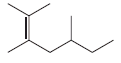
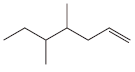
None of these
8.
Which of the following aqueous solutions has the highest boiling point ?
0.1 M KNO3
0.1 M Na3PO4
0.1 BaCl2
0.1 M K2SO4
9.
Which of the following N3-, O2-, F- is largest in size?
N3-
O2-
F-
All of these
10.
One 'U' stands for the mass of ______________.
An atom of carbon-12
1/12th of the carbon-12
1/12th of a hydrogen atom
One atom of any of the element
11.
Molar heat of vaporization of a liquid is 4.8 kJ mol-1. If the entropy change is 16 J mol -1 K-1, the boiling point of the liquid is ____________
323 K
27° C
164 K
0.3 K
12.
Which of the following statements is in correct ?
Li+ has minimum degree of hydration among alkali metal cations
The oxidation state of K in KO2 is +1
Sodium is used to make Na / Pb alloy
MgSO4 is readily soluble in water
13.
How many electrons in an atom with atomic number 105 can have (n + 1) = 8 ?
30
17
15
unpredictable
14.
A bottle of ammonia and a bottle of HCI connected through a long tube are opened simultaneously at both ends. The white ammonium chloride ring first formed will be ___________
At the center of the tube
Near the hydrogen chloride bottle
Near the ammonia bottle
Throughout the length of the tube
15.
A commercial sample of hydrogen peroxide marked as 100 volume H2O2, it means that _____________
1 ml of H2O2 will give 100 ml O2 at STP
1 L of H2O2 will give 100 ml O2 at STP
1 L of H2O2 will give 22.4 L O2
1 ml of H2O2 will give 1 mole of O2 at STP
16.
Indicate the \(\sigma\) and \(\pi\) bonds in the following molecules.
C6H6, CH2CI2, CH3NO2, CH2 = C = CH2
17.
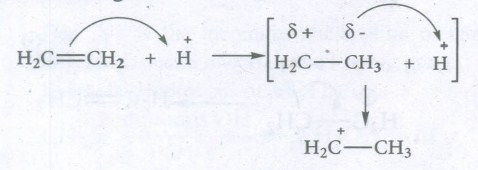
When does the carbon in an alkene molecule acquires a positive charge ? Explain.
18.
From where does ozone come in the photo chemical smog ?
19.
What is the mass of glucose (C6 H12O6) in it one litre solution which is isotonic with 6 g L-1 of urea (NH2 CO NH2) ?
20.
The atmospheric oxidation of NO
2NO(g) + O2(g) ⇌ 2NO2(g)
was studied with initial pressure of 1 atm of NO and 1 atm of O2. At equilibrium, partial pressure of oxygen is 0.52 atm calculate Kp of the reaction.
21.
Explain about the factors that affect electronegativity.
22.
Calculate the equivalent masses of the following - HNO3
23.
Mention the postulates of kinetic theory of gases which do not explain the behaviour of real gases.
24.
The stabilisation of a half filled d - orbital is more pronounced than that of the p-orbital why?
25.
Explain crystallisation giving the different steps.
26.
Explain the mechanism involved in bimolecular nucleophilic substitution reaction.
27.
0.24g of an organic compound gave 0.287 g of silver chloride in the carius method. Calculate the percentage of chlorine in the compound.
28.
Balance the following equation by ion electron method.
Zn + NO3- ⟶ Zn + NH4+2
29.
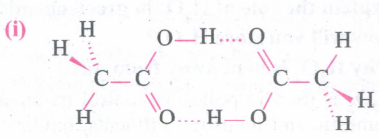
Draw the hydrogen bonding existing following compounds.
(i) Acetic acid
(ii) Methanol water
(iii) Ammonia in water
(iv) HF and (v) Water.
30.
Give a detailed account on compressibility factor
31.
Define the following terms
(a) isothermal process (b) adiabatic process
(c) isobaric process (d) isochoric process
32.
33.
Explain the following, give appropriate reasons.
(i) Ionisation potential of N is greater than that of O.
(ii) First ionisation potential of C-atom is greater than that of B atom, where as the reverse is true is for second ionisation potential.
(iii) The electron affinity values of Be, Mg and noble gases are zero and those of N (0.02 eV) and P (0.80 eV) are very low.
(iv) The formation of F-(g) from F(g) is exothermic while that of O2-(g) from O (g) is endothermic.
34.
How do you convert para hydrogen into ortho hydrogen?
35.
Write about the main responsibility of the functional group in an organic compound.
36.
Listout the uses of alkanes.
37.
Mention the standards prescribed by BIS for quality of drinking water.
38.
What happens when acetyl chloride is treated with excess of CH3MgI?
39.
For a gaseous homogeneous reaction at equilibrium, number of moles of products are greater than the number of moles of reactants. Is KC is larger or smaller than KP.
40.
How many moles of hydrogen is required to produce 10 moles of ammonia ?
41.
Which of the following pairs of elements would have more negative electron gain enthalpy?
(i) O or F
(ii) For Cl.
42.
Give reason for the following statements. U is an extensive property
43.
A sample of gas has a volume of 8.5 dm3 at an unknown temperature. When the sample is submerged in ice water at 0 °C, its volume gets reduced to 6.37 dm3. What is its initial temperature ?
1.
(b)
Sp2
2.
(c)
3
3.
(a)
From left to right
4.
(d)
Bromo benzene
5.
(b)
air pollution
6.
(c)
both (a)and (b)
7.
(a)
8.
(b)
0.1 M Na3PO4
9.
(a)
N3-
10.
(b)
1/12th of the carbon-12
11.
(b)
27° C
12.
(a)
Li+ has minimum degree of hydration among alkali metal cations
13.
(b)
17
14.
(b)
Near the hydrogen chloride bottle
15.
(a)
1 ml of H2O2 will give 100 ml O2 at STP
16.
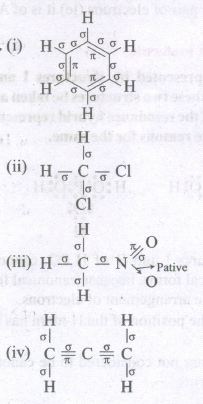
17.
When an electrophile such as H+ approaches an alkene molecule, the π electrons are instantaneously shifted to the electrophile and a new bond is formed between carbon and hydrogen. is makes the other carbon electron decient and· hence it acquires a positive charge.
18.
Ozone is formed by a series of reactions that occur from the sun shines
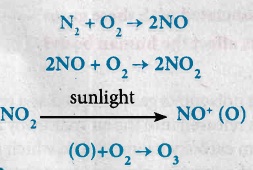
19.
Osmotic pressure of urea solution (\(\pi_1\)) = CRT
\(={W_2\over M_2V}RT\)
\(={6\over 60\times 1}\times RT\)
Osmotic pressure of glucose solution \((\pi_2)={W_2\over 180\times 1}\times RT\) For isotonic solution,
\(\pi_1=\pi_2\)
\({6\over 60}RT={W_2\over 180}RT\)
\(\Rightarrow W_2={6\over 60}\times 180\)
\(W_2=18\ g\)
20.
2 NO(g) + O2 (g) ⇌ 2NO2(g)
| NO2 | O2 | NO2 | |
| Initila Partial Pressure | 1 | 1 | - |
| Reacted | 0.96 | 0.96 | - |
| Equilibrium Partial Pressure | 0.04 | 0.52 | 0.96 |
\(K_p={P^2_{NO_2}\over P^2_{NO_2}.Po_2}\)
\(={0.96\times 0.96\over 0.04\times 0.04\times 0.52}\)
= 11.07 x 10² (atm)-1
Keq = 41.6 x 10² M-1.
21.
(i) Effective nuclear charge: As the nuclear charge increases, electronegativity also increases along the periods.
(ii) Atomic radius: The atoms in smaller size will have larger electronegativity.
22.
Molar mass of HNO3 = 1 + 14 + 3 x 16 = 63
Basicity of HNO3 = 1
Equivalent mass of HNO3 = \(\frac { 63 }{ 1 } =63g\) eq-1
23.
The assumption that molecules in the gas phase occupy negligible volume (1) and that they do not exert any force on one another either attractive or repulsive (2) do not account for the behaviour of real gas.
24.
Energy electrons symmetry
This is due to the symmetrical distribution and exchange energy of given d- electrons. Symmetry leads to stability.
Exchange energy:
If two or more electrons with the same spin are present in degenerate orbitals, there is a possibility for exchanging their positions. During exchange process, the energy is released and the released energy is called exchange energy. If more number of exchanges are possible, more exchange energy in released. More number of exchanges are possible only in case of half filled and fully filled configurations.
For example, in chromium the electronic configuration is [Ar]3d5 4s1. The 3d orbital is half filled and there are ten possible exchanges as shown in figure. On the other hand only six exchanges are possible for [Ar]3d4 4s2 configuration. Hence, exchange energy for the half filled configuration is more. This increases the stability of half filled 3d orbitals.
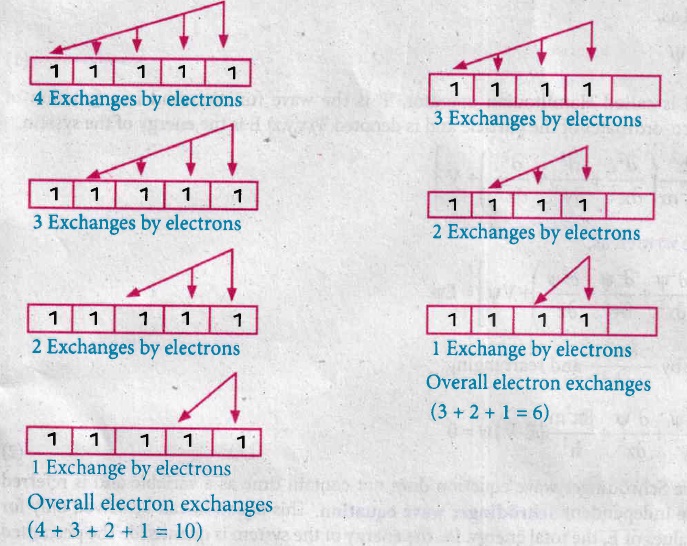
The exchange energy is the basis for Hund's rule, which allows maximum multiplicity, that is electron pairing is possible only when all the degenerate orbitals contain one electron each.
25.
It is the most widely used method for the purification of solid organic compound. This process is carried out in by the following steps:
(i) Selection of Solvent :
Most of the organic substances being covalent do not dissolve in polar solvents like water, hence selection of solvent (suitable) becomes necessary. Hence the powdered organic substance is taken in a test tube and the solvent is added little by little with constant stirring and heating, till the amount added is just sucient to dissolve the solute(ie) organic compound. If the solid dissolves upon heating and throws out maximum crystals on cooling, then the solvent is suitable. This process is repeated with other solvents like benzene, ether, acetone and alcohol till the most suitably one is sorted out.
(ii) Preparation of solution: The organic substance is dissolved in a minimum quantity of suitable solvent. Small amount of animal charcoal can be added to decolorize any colored substance. The heating may be done over a wire gauze or water bath depending upon the nature of liquid (ie) whether the solvent is low boiling or high boiling.
(iii) Filtration of hot solution: The hot solution so obtained is filtered through a fluted filter paper placed in a funnel.
(iv) Crystafhzation: The hot filtrate is then allowed to cool. Most of the impurities are removed on the Iter paper, the pure solid substance separate as crystal. When copious amount of crystal has been obtained, then the crystallization is complete. If the rate of crystallization is slow, it is induced either by scratching the walls of the beaker with a glass rod or by adding a few crystals of the pure compounds to the solution.
(v) solation and drying crystals: The crystals are separated from the mother liquor by filtration. Filtration is done under reduced pressure using a Bucher funnel. When the whole of the mother liquor has been drained into the filtration flask, the crystals are washed with small quantities of the pure cold solvent and then dried.
26.
SN2 Mechanism :
(i) The rate of SN2 reaction depends upon the . concentration of both alkyl halide and the nucleophile.
(ii) Rate of reaction = is [alkylhalide] [nucleophile]. It follows second order kinetics and occurs in one step.
(iii) This reaction involves the formation of a transition state in which both the reactant molecules are partially bonded to each other. The attack of nucleophile occurs from the back side (i.e opposite to the side in which the halogen is attacked).
(iv) The carbon at which substitution occurs has inverted configuration during the course of reaction just as an umbrella has tendency to invert in a wind stonri. is inversion of configuration is called Walden inversion; after paul walden who 1st discovered the inversion of configuration of a compound in SN2reaction.
(v) SN2reaction of an optically active haloalkane . is always accompanied by inversion of configuration at the asymmetric centre.
(vi) When 2 - Bromooctane is heated with sodium hydroxide, 2 - octanol is formed with invesion of configuration. (-) - 2 - Bromo octane is heated with sodium hydroxide (+) - 2 - Octanol is formed in which - OR group occupies a position opposite to what bromine had occupied,
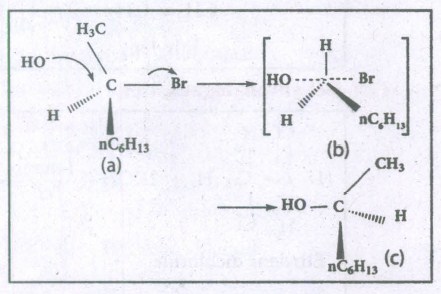
(a) (-).2 - Bromo octane
(b) Transition State
(c) (+) 2 - Octanol (product)
27.
w = 0.24g and a = 0.287 g
\(
\% \mathrm{Cl} =\frac{35.5}{143.5} \times \frac{\mathrm{a}}{\mathrm{w}} \times 100
\)
\(=\frac{35.5}{143.5} \times \frac{0.287}{0.24} \times 100=.29 .42 \%\)
28.
Zn + NO3- ⟶ Zn + NH4+2 in basic medium
Zn ⟶ Zn+2 + 2e (oxidation) NO3- ⟶ NH4+ (Reduction)
Step-1: Balance all atoms other than hydrogen and oxygen.
Zn ⟶ Zn+2 NO3- ⟶ NH4+
Step-2: For balancing oxygen atom in alkaline medium, add H20 molecules on the side deficient of oxygen atom.
Then balance hydrogen atom, add H20 molecule to the side deficient in hydrogen and equal number of OH- on the other side.
Zn ⟶ Zn+2 NO3- ⟶ NH4-+3H2O
NO3- + 10H2O ⟶ NH4+ + 3H2O
NO3- + 10H2O ⟶ NH4+ + 3H2O + 10OH-
Step-3: Add electrons to balance charge
Zn ⟶ Zn+2 +2e
NO3- + 7H2O + 8e ⟶ NH4+ +10OH-
Zn ⟶ Zn+2 + 2e x 8
NO3- + 7H2O + 8e ⟶ NH4+ + 10OH-
___________________________________
8Zn + NO3- + 7H2O ⟶ 8Zn+2 + NH4+ + 10OH-
This is the balanced equation.
29.
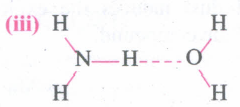
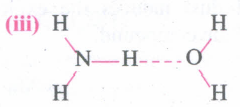
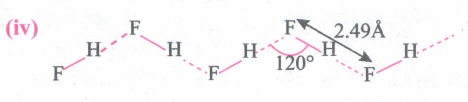
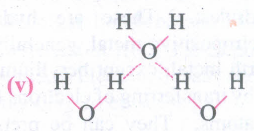
30.
(i) The deviation of real gases from ideal behaviour is measured in terms of a ratio of PV to nRT. This is termed as compression factor. Mathematically,
\(Z=\frac { PV }{ nRT } \)
For ideal gases Z=1 at all temperatures and pressures, because PV = nRT.
(ii) When a gas deviates from ideal behaviour, its Z value deviates from unity.
(iii) At high pressure these gases have Z > 1 and are difficult to compress. At intermediate pressures, Z< 1.
(iv) Above the Boyle point, Z > 1 for real gases, ie., the real gases show positive deviation.
(v) Below the Boyle point, the real gases first show a decrease for Z, reaches a minimum and then increase with the increase in pressure.
Hence, the compressibility factor Z can be rewritten as
\(Z=\frac { { PV }_{ real } }{ nRT } \)
\({ V }_{ ideal }=\frac { nRT }{ P } \)
Substituting b in a
\(Z=\frac { { V }_{ real } }{ { V }_{ ideal } } \)
(vi) Where Vreal is the molar volume of the real gas and Videal is the molar volume of it when it behaves ideally.
31.
(a) Isothermal process: An isothermal process is defined as one in which the temperature of the system remains constant, during the change from its initial to final state. The system exchanges heat with its surroundings and the temperature of the system remains constant.
For an isothermal process dT = 0
(b) Adiabatic process: An adiabatic process is defined as one in which there is no exchange of heat (q) between the system and surrounding during the process. For an adiabatic process q = 0
(c) Isobaric process: An isobaric process is defined as one in which the pressure of the system remains constant during its change from the initial to final state. For an isobaric process dP = 0 .
(d) Isochoric process: An isochoric process IS defined as the one in which the volume of system remains constant during its change from initial to final state. For an isochoric process, dV= 0.
32.
33.
(i) Electron configuration of nitrogen
(Z = 7) 1s2 2s2 2p3.
Electron configuration of oxygen
(2= 8) 1s2 2s2 2p4.
Nitrogen has a half filled electronic configuration which is much more stable than an incomplete p-orbital of oxygen which would need to give up one of it's electrons to attain the stability of nitrogen. Hence nitrogen would require more ionization energy to remove an electron from it's outer shell than oxygen.
(ii) Electron configuration of carbon
(Z = 6) 1s22s22p2.
Electron configuration of Boron
(Z = 5) Is22s22p1
The size of a carbon atom is smaller than boron So the valence electron of carbon has greater nuclear charge than that of boron. Hence the first I.E of carbon is greater than that of boron. However, the second ionization enthalpy of boron is higher than that of carbon. This is because after losing electron, Boron has a fully filled orbital (2s2) than carbon (2p1). Fully filled orbitals have more stability than partially filled orbitals so greater amount of energy will be needed to remove an electron from boron. So in this case, the second I.E of boron is higher than that of carbon.
(iii) The electron affinities of Be, Mg and noble gases are almost zero because both Be (Z = 4; 1s22s2) and Mg (Z = 12; Is22s22p63s2) are having s orbital fully filled in their valence shell. Fully filled orbitals are most stable due to symmetry. Therefore, these elements would be having least tendency to accept electron. Hence, Be and Mg would be having zero electron affinity. Whereas N (Z = 7; 1s22s22px12py12pz1 and P (Z = 15) Is2 2s2 2p6 3s2 3p3 is having half filled 2p-subshell. Half filled sub shells are most stable due to symmetry (Hund's rule). Thus, nitrogen and phosphorous are having least tendency to accept electron. Hence, have low electron affinity.
(iv) Fluorine is highly electro negative in nature therefore as it gains the electron its octet become stable and releases the energy so exothermic. while in oxygen the addition of first electron is exothermic in nature but addition of second electron experiences high repulsive force. So needs extra external energy to enter outer shell, hence endothermic in nature.
34.
(i) By treatment with catalyst like Pt or Fe.
(ii) By passing an electric discharge
(iii) By heating to 800°C or more.
(iv) By mixing with paramagnetic molecules like O2,NO,NO2·
(v) By mixing with nascent hydrogen or atomic hydrogen.
35.
An atom or a group of atoms present in an organic compound, which is responsible for the chemical properties of the compound is called the functional group.
36.
The exothermic nature of alkane combustion reaction explains the extensive use of alkanes as fuels. Methane present in natural gas is used in home heating. Mixture of propane and butane are known, as LPG gas which is used for domestic cooking purpose. GASOLINE is a complex mixture of many hydrocarbons used as a fuel for internal-combustion engines.
Carbon black is used in the manufacture of ink, printer ink and black pigments. .It is also used as fillers.
| No of Carbon Atoms | State at room temperature | Major uses |
|---|---|---|
| 1-4 | Gas | Heating fuel, Cooking fuel |
| 5-7 | Low boiling liquid | Solvents, Gasoline |
| 6-12 | Liquid | Gasoline |
| 12-24 | Liquid | Jet fuel- portable stove fuel |
| 18-50 | High boiling liquid | Diesel fuel, lubricant, heating oil |
| 50+ | Solid | Petroleum jelly and paran wax |
37.
Standard characteristics of drinking water.
| S.No | Characteristics | Desirable limit |
|---|---|---|
| I | Physico-chemical Characteristics | |
| i) | pH | 6.5 to 8.5 |
| ii) | Total Dissolved Solids (TDS) | 500ppm |
| iii) | Total Hardness (as CaCO3) | 300 ppm |
| iv) | Nitrate | 45ppm |
| v) | Chloride | 250ppm |
| vi) | Sulphate | 200ppm |
| vii) | Fluoride | 1 ppm |
| II | Biological Characteristics | |
| i) | Escherichia Coli (E.Coil) | Not at all |
| ii) | Coliforms | Not to exceed 10 (In 100 ml water sample) |
38.
With acetyl chloride, CH3MgI given first acetone.
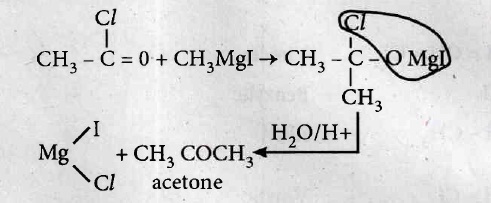
The acetone formed will react with excess CH3MgI to give a tertiary alcohol, t - butyl alcohol.

39.
\(\Delta n_{g}=\sum n p_{(g)}-\sum n R_{(g)}\)
As \(\Delta n_{p}(g)\) is greater \(\Delta n_{g}=+v e\)
\( \therefore K_{p}=K_{c}(R T)^{+v e} \)
\(\therefore K_{p}>K_{c} \)
So K is smaller than Kp.
40.
The balanced stoichiometric equation for the formation of ammonia is
N2(g) + 3H2 (g) \(\rightarrow\) 2NH3 (g)
As per the stoichiometric equation,
To produce 2 moles of ammonia, 3 moles of hydrogen are required.
\(\therefore\) to produce 10 moles of ammonia,
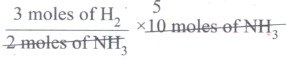
= 15 moles of hydrogen are required.
41.
(i) O or F. Both O and F lie in 2nd period. As we move from O to F the atomic size decreases. Due to smaller size of F nuclear charge increases.
Further, gain of one electron by
\(F\rightarrow F^-\)
ion has inert gas configuration, While tile gain of one electron by
\(O\rightarrow O^-\)
gives O- ion which does not have stable inert gas configuration. Consequently, the energy released is much higher in going from
\(F\rightarrow F^-\)
than going from\(O\rightarrow O^-\). In other words electron gain enthalpy of F is much more negative than that of oxygen.
(ii) The negative electron gain enthalpy of CI \((e.g.\triangle H=-349\ kJ\ mol^{-1})\) is more than that of \(F(e.g.\triangle H=-328\ kJ\ mol^{-1})\)
The reason for the deviation is due to the smaller size of F. Due to its small size, the electron repulsions in the relatively compact 2p-subshell are comparatively large and hence the attraction for incoming electron is less as in the case of Cl.
42.
'U' is an extensive property because its magnitude depends on the quantity of material in the system.
43.
V1 = 8.5 dm3 V2 = 6.37 dm3
T1 = ? T2 = 0o C = 273 K
\(\frac { { V }_{ 1 } }{ { T }_{ 1 } } =\frac { { V }_{ 2 } }{ { T }_{ 2 } } \)
\({ V }_{ 1 }\times \left( \frac { { T }_{ 2 } }{ { V }_{ 2 } } \right) ={ T }_{ 1 }\)
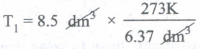
T1 = 364.28 K

11th Standard Syllabus & Materials
11th Standard
TN 11th Tamil பீடு பெற நில் - செய்யுள் - காவடிச்சிந்து Important Questions And Answers Study Material - QB365 Set A
NEW11th Standard
TN 11th Tamil பீடு பெற நில் - உரைநடை - மலை இடப்பெயர்கள் : ஓர் ஆய்வு Important Questions And Answers Study Material - QB365 Set A
NEW11th Standard
TN 11th Tamil மாமழை போற்றுதும் - துணைப்பாடம் - யானை டாக்டர் Important Questions And Answers Study Material - QB365 Set A
NEW11th Standard
TN 11th Tamil மாமழை போற்றுதும் - செய்யுள் - ஐங்குறுநூறு Important Questions And Answers Study Material - QB365 Set A



Tamilnadu Stateboard 11th Standard Subjects

Maths

Commerce

Economics

Biology

Business Maths and Statistics

Accountancy

Computer Science

Physics
Chemistry
Maths
Biology
Economics
Physics
Chemistry

History
Business Maths and Statistics

Computer Science
Accountancy

Computer Applications
History
Computer Technology
Commerce
Computer Applications
Computer Technology

Tamil

English

French
Tamilnadu Stateboard Standards
