
 100% FREE ACCESS
11th Standard Syllabus & Materials
11th Standard
TN 11th Tamil இயற்கை வேளாண்மை,சுற்றுச்சூழல் -செய்யுள் - மனோன்மணீயம் Important Questions And Answers Study Material - QB365 Set A
NEW11th Standard
TN 11th Tamil என்னுயிர் என்பேன் -துணைப்பாடம் - இசைத்தமிழர் இருவர் Important Questions And Answers Study Material - QB365 Set A
NEW11th Standard
TN 11th Tamil மொழி கலை -செய்யுள் - ஒவ்வொரு புல்லையும் Important Questions And Answers Study Material - QB365 Set A
NEW11th Standard
TN 11th Tamil பீடு பெற நில் - இலக்கணம் - பகுபத உறுப்புகள் Important Questions And Answers Study Material - QB365 Set A
NEW11th Standard
TN 11th Tamil பீடு பெற நில் - துணைப்பாடம் - வாடிவாசல் Important Questions And Answers Study Material - QB365 Set A
NEW11th Standard
TN 11th Tamil பீடு பெற நில் - செய்யுள் - குறுந்தொகை Important Questions And Answers Study Material - QB365 Set A

Published on: 14/12/2018
HSC Board Exams are fast approaching and students are getting anxious about how to prepare for their HSC Board Exams. The latest sample papers have been designed as per the latest syllabus and examination trends. Students can make use of this question paper since all the questions are taken from the book back and creative question papers. Our aim is to bring out the best scores on board exams. By practicing with this important model question paper student can gain more knowledge and confidence to crack the exams.
In this question paper, all the important questions from 11th Chemistry Chapter Haloalkanes and Haloarenes are included for practice. Not only with book back questions, but also included creative questions. It's nearing the examination and right time to grab the model question papers and practice for the board exams. Everyone has the same aim that is to reach the top rank list. We are paving the way for you to reach your goal.
Practice with important questions from all chapters and get set ready to crack your exams with confidence. Concentrate on making small improvements and importantly keep practicing model question papers. This question paper exclusively designed for the chapter Haloalkanes and Haloarenes from plus two Chemistry. Since board exams are very important for your upcoming career, you should pay attention to practice and score good marks. The best way to prepare exams is to simply do one thing at a time. Now you can use this model question paper for practice on your own to score more on your board exams.
Download Tamil Nadu 11th Standard Chemistry question papers, model tests, one-mark questions, important questions, and public exam papers in PDF format. Free study materials and answer keys for TN State Board students.
Questions + Answers key
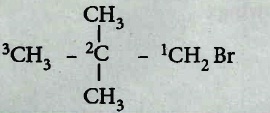
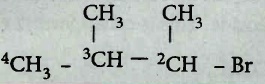
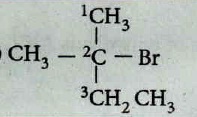
Take MCQ Chemistry Test
1.
Chloropicrin is prepared by adding nitric acid to______________,
CCl4
CH3CI
CH3CI3
None
2.
Mild oxidation of benzyl chloride with Cu(NO3)Z gives __________
Benzoic acid
Benzene
benzaldehyde
Benzyl alcohol
3.
For reacting with HCI, the alcohol which does not require ZnCl2 is ____________
CH3 CH2 OH
CH3-CH2 CH2 OH
CH3-CH OH
(CH3)3 C - OH
4.
Ethyl bromide reacts with sodium lead alloy to form_____________.
Chloro ethane
1 - Chluro propane
Vinyl chloride.
Bromo benze
5.
The best reagent for converting an alcohol into the corresponding chloride is
PCl3
PCl5
SOCl2
HCl/ZnCl2
6.
Silverpropionate when refluxed with Bromine in carbontetrachloride gives ______
propionic acid
chloro ethane
bromo ethane
chloro propane
7.
Freon-12 is manufactured from tetrachloro methane by ____________
Wurtz reaction
Swarts reaction
Haloform reaction
Gattermann reaction
8.
The name of C2F4Cl2 is ___________
Freon – 112
Freon – 113
Freon – 114
Freon – 115
9.
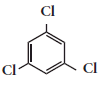
In the reaction 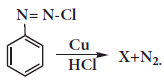 X is ________.


10.
Of the following compounds, which has the highest boiling point?
n-Butyl chloride
Isobutyl chloride
t-Butyl chloride
n-propyl chloride
11.
Write the isomers of the compound whose molcular formula is C4H9Br.
12.
Write a note on carbylamine reaction.
13.
Explain the preparation of the following compounds
i) DDT
ii) Chloroform
iii) Biphenyl
iv) Chloropicrin
v) Freon-12
14.
Why chlorination of methane is not possible in dark?
15.
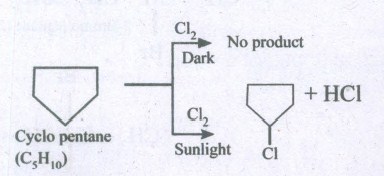
Ahydroarbon C5H10 does not react with chlorine In dark but gives C5H9CI in bright sunlight. Identify the hydrocarbon.
16.
Among ortho, meta and para substituted diahalobenzenes which has high melting point? Give reason with example.
17.
Haloalkanes produce mixture of olefins- say true or false and justify yoyr answer,
18.
Two isomers (A) and (B) have the same molecular formula C2H4Cl2. Compound (A) reacts with aqueous KOH gives compound (C) of molecular formula C2H4O. Compound (B) reacts with aqueous KOH gives compound(D) of molecular formula C2H6O2. Identify (A), (B), (C) and (D).
19.
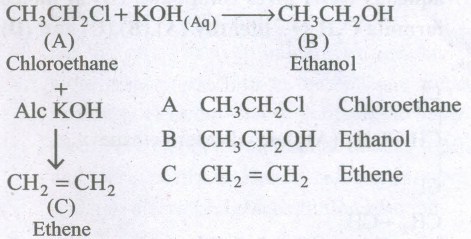
An organic compound (A) with molecular formula C2H5Cl reacts with KOH gives compounds (B) and with alcoholic KOH gives compound (C). Identify (A),(B), and (C)
20.
Write down the possible isomers of C5H11Br and give their IUPAC and common names.
21.
Answer the following.
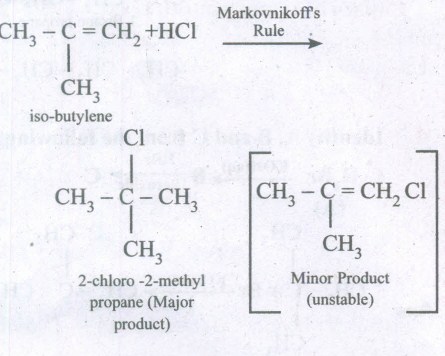
(i) Predict the major product formed when HCI is added to iso-butylene,
(ii) What happens when CH3-Br is treated with KCN?
(iii) Identify the chiral molecule in the following pair.
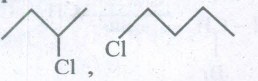
(iv) Arrange the compounds in the order of I reactivity towards SN2 displacement. 2-Bromo-2-methylbutane, I-Bromopentane, 2-Bromo pentane.
22.
How will you convert t-butyl bromide into t-butyl alcohol? Explain the process through the mechanism in stepwise manner.
23.
Explain the mechanism involved in bimolecular nucleophilic substitution reaction.
1.
(c)
CH3CI3
2.
(c)
benzaldehyde
3.
(d)
(CH3)3 C - OH
4.
(c)
Vinyl chloride.
5.
(c)
SOCl2
6.
(c)
bromo ethane
7.
(b)
Swarts reaction
8.
(c)
Freon – 114
9.
(b)
10.
(a)
n-Butyl chloride
11.
| POSITION ISOMERS | CHAIN ISOMERS |
| CH3 -CH 2-CH2 -CH2-Br 1 - Bromo butane \({ CH }_{ 3 }-{ CH }_{ 2 }-\underset { \overset { | }{ Br } }{ CH } -{ CH }_{ 3 }\) 2 - Bromobutane |
\({ CH }_{ 3 }-\overset { \underset { | }{ { CH }_{ 3 } } }{ CH } -{ CH }_{ 2 }-Br\) 1- Bromo - 2- methly propane \({ CH }_{ 3 }-\overset { \underset { | }{ { CH }_{ 3 } } }{ \underset { \overset { | }{ { CH }_{ 3 } } }{ C } } -Br\) 2 - Bromo- 2-methyl propane. |
12.
Carbylamine reaction:
Chloroform reacts with aliphatic or aromatic primary amine and alcoholic caustic potash, to give foul smelling alkyl isocyanide (carbylamines).
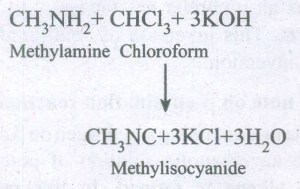
This reaction is used to test primary amine.
13.
i) DDT: DDT can be prepared by heating a mixture of chlorobenzene with chloral (Trichloro acetaldehyde) in the presence of con. H2SO4,
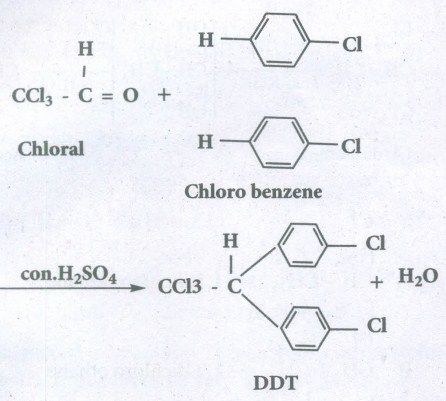
ii) Chloroform :The reaction of methane with excess of chlorine in the presence of sunlight will give carbon tetrachloride as the major product.
\(\underset { Methane }{ { CH }_{ 4 }+4C{ l }_{ 2 }\overset { h\gamma }{ \longrightarrow } } +\underset { Carbon \ tetrachloride }{ 4HCl } \)
iii) Bipheenyl :
\(\underset { Chlorobenzene }{ { C }_{ 6 }{ H }_{ 5 }Cl } +2Na+Cl-{ C }_{ 6 }{ H }_{ 5 }\overset { Ether }{ \longrightarrow } \underset { Biphenyl }{ { C }_{ 6 }{ H }_{ 5 }-{ C }_{ 6 }{ H }_{ 5 }+2NaCl } \)
iv) Chloropicrin : Chloroform reacts with nitric acid to form chloropicrin.(Trichloro nitro methane)
\(\underset { Chloroform }{ { CH }_{ 3 }+HN{ O }_{ 3 }\overset { \triangle }{ \longrightarrow } } \underset { Chloropicrin }{ C{ Cl }_{ 3 }N{ O }_{ 2 }+{ H }_{ 2 }O } \)
v) Freon-12 :Freon - 12 is prepared by the action of hydrogen fluoride on carbon tetrachloride in . the presence of catalylic amount of antimony pentachloride. is is called swartz reaction
\(\underset { Carbontetrachloridew }{ { CCl }_{ 3 }+2HF\overset { SbC{ l }_{ 5 } }{ \longrightarrow } } \underset { Freon-12 }{ 2HC{ l }+CCl_{ 2 }F_{ 2 } } \)
14.
The Chlorination of methane is carried out by free radical mechanism. The initiation step to form free radical needs high energy which is supplied by light energy.
\(\mathrm{Cl}-\mathrm{Cl} \stackrel{h \nu}{\longrightarrow} 2 \mathrm{Cl}\)
So this reaction is not possible in dark.
15.
(i) C5H10 can be either alkene or cyclo alkane.
(ii) Since, the hydrocarbon does not react with CI in dark, hence it is not an alkene, it may be cyclopentane.
(iii) Since, it forms only single monochloro derivative in bright sunlight, all the H-atoms should be identical. Hence it is cyclopentane
16.
The boiling points of isomeric dihalobenzene are pearly the same. The melting point of para isomer is generally higher than the melting points of ortho and meta isomers. The higher melting point of p-isomer is due to its symmetry which leads to more close packing of its molecules in the crystal lattice and consequently strong intermolecular attractive force which requires more energy for melting. p-Dihalobenzene> o-Dichlorobenzene> m-Dichloro benzene.
17.
True.
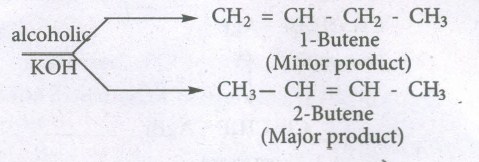
Some haloalkanes yield a mixture of olefins in different amounts. It is explained by Saytzeff's Rule, which states that 'In a dehydrohalogenation reaction, the preferred product is that alkene which has more number of alkyl groups attached to the doubly bonded carbon (more substituted double bond is formed).
\({ CH }_{ 3 }-\underset { \overset { | }{ Br } }{ CH } -{ CH }_{ 2 }-{ CH }_{ 3 }\)
2-Bromopropane
18.
\(\overset { \underset { | }{ Cl } }{ \underset { \overset { | }{ Cl } }{ CH } } -{ CH }_{ 3 }\quad (A)\) 1, 1,-dichloro ethane
\(\underset { \overset { | }{ Cl } }{ { CH }_{ 2 } } -\underset { \overset { | }{ Cl } }{ { CH }_{ 2 } } \) (B) 1, 2, dichloro ethane
\(\overset { \underset { | }{ Cl } }{ \underset { \overset { | }{ Cl } }{ CH } } -{ CH }_{ 3 }\underset { aq\quad KOH }{ \longrightarrow } \left[ \overset { \underset { | }{ OH } }{ \underset { \overset { | }{ OH } }{ CH } } -{ CH }_{ 3 } \right] \underset { -{ H }_{ 2 }) }{ \longrightarrow } { CH }_{ 3 }CHO\)
(A) (C)
1, 1, dichloro ethane Acetaldhyde
\(A \ \ \overset { \underset { | }{ Cl } }{ \underset { \overset { | }{ Cl } }{ CH } } -{ CH }_{ 3 }\) -1,1 dichloro ethane
B \(\underset { \overset { | }{ Cl } }{ { CH }_{ 2 } } -\underset { \overset { | }{ Cl } }{ { CH }_{ 2 } } \)-1, 2 dichloro ethane
C CH3CHO -Acetaldehyde
D \(\underset { \overset { | }{ OH } }{ { CH }_{ 2 } } -\underset { \overset { | }{ OH } }{ { CH }_{ 2 } } \)-Ethyleneglycol
19.
20.
| Isomer | IUPAC name | common name |
| \({ }^5 \mathrm{CH}_3{ }^4 \mathrm{CH}_2{ }^3 \mathrm{CH}_2{ }^2 \mathrm{CH}_2{ }^1 \mathrm{CH}_2 \mathrm{Br}\) | 1 - bromopentane | n - pentyl bromide (or) n - amyl bromide |
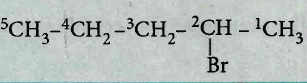 |
2 - bromopentane | Sec - pentyl bromide (or) Sec - amyl bromide |
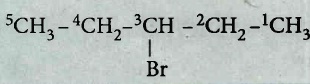 |
3 - bromopentane | - |
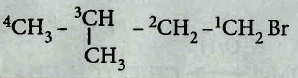 |
1 -bromo- 3 -methylbutane | Isopentyl bromide (or) Iso amylbromide |
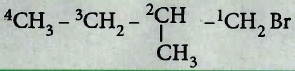 |
1 -bromo- 2-methylbutane | - |
 |
l-bromo -2,2-dimethyl propane |
Neopenryl bromide (or) Neo amyl bromide |
 |
2-bromo- 3 -methylbutane | - |
 |
2-bromo- 2 -methylbutane | t - pentyl bromide (or) t - amyl bromide |
21.
Reaction between iso-butylene and HCI are as follows:
(ii) When CH3- Br is treated with KCN, methyl cyanide is formed.
\(\underset { Methyl\\ Bromide }{ { CH }_{ 3 } } -Br+\underset { Potcyanide }{ KCN } \longrightarrow \underset { Methyl\\ Cyanide }{ { CH }_{ 3 } } -CN+\underset { Pot\\ Bromide }{ KBr } \)
(iii) 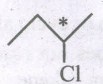 is a chiral molecule, as four atoms attached to *C - atom are different
(iv) 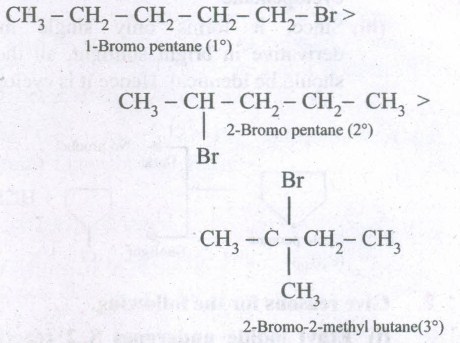
This order is due to steric reasons, the order of reactivity in SN2 follows the order: 1°>2°> s 3°.
22.
SN1stands for unimolecular nucleophilic substitution
(i) Hence rate ofthe reaction = k(alkyl halide. This SN1 reaction follows first order kinetics and occurs in two steps.
(ii) We understand ~l reaction-mechanism by taking a reaction between tertiary butyl bromide with aqueous KOH.
\({ CH }_{ 3 }-\overset { \underset { | }{ { CH }_{ 3 } } }{ \underset { \overset { | }{ { CH }_{ 3 } } }{ C } } -Br\overset { OH(aq) }{ \underset { -Br }{ \longrightarrow } } { CH }_{ 3 }-\overset { \underset { | }{ { CH }_{ 3 } } }{ \underset { \overset { | }{ { CH }_{ 3 } } }{ C } } -OH\)
Tert-Butyl bromide Tert-Butyl alcohol
This reaction takes place in two steps as shown below
Step - 1 Formation of carbocation :
(i) The polar C - Br bond breaks forming a carbocation and bromide ion. This step is slow and hence it is the rate determining step.
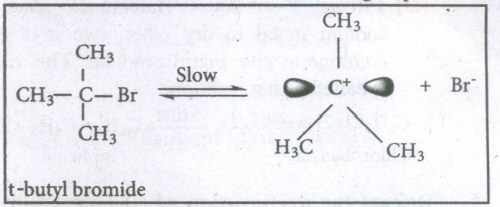
(ii) The carbocation has 2 equivalent lobes of the vacant 2p orbital, so it can react equally rapidly from either face.
Step - 2 :
(i) The nucleophile immediately reacts with the carbocation. This step is fast and hence does not affect the rate of the reactions.
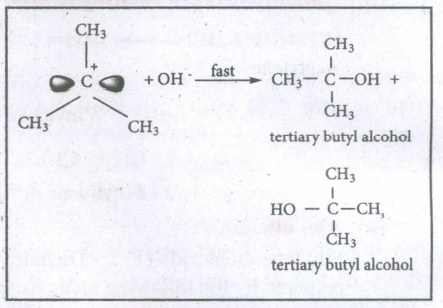
(ii) As shown above, the nucleophilic reagent OHcan attack carbocation from both the sides.
(iii) In the above example the substrate tert-butyl bromide is not optically active, hence the obtained product is optically inactive. If halo alkane substrate is optically active then, the product obtained will be optically inactive racemic mixture. As nucleophilic reagent OR- can attack carbocation from both the sides, to form equal proportion of dextro and levorotatory optically active isomers which results in optically inactive racemic mixture
23.
SN2 Mechanism :
(i) The rate of SN2 reaction depends upon the . concentration of both alkyl halide and the nucleophile.
(ii) Rate of reaction = is [alkylhalide] [nucleophile]. It follows second order kinetics and occurs in one step.
(iii) This reaction involves the formation of a transition state in which both the reactant molecules are partially bonded to each other. The attack of nucleophile occurs from the back side (i.e opposite to the side in which the halogen is attacked).
(iv) The carbon at which substitution occurs has inverted configuration during the course of reaction just as an umbrella has tendency to invert in a wind stonri. is inversion of configuration is called Walden inversion; after paul walden who 1st discovered the inversion of configuration of a compound in SN2reaction.
(v) SN2reaction of an optically active haloalkane . is always accompanied by inversion of configuration at the asymmetric centre.
(vi) When 2 - Bromooctane is heated with sodium hydroxide, 2 - octanol is formed with invesion of configuration. (-) - 2 - Bromo octane is heated with sodium hydroxide (+) - 2 - Octanol is formed in which - OR group occupies a position opposite to what bromine had occupied,
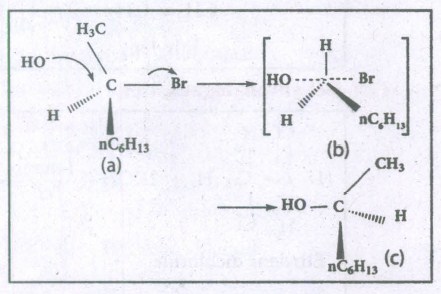
(a) (-).2 - Bromo octane
(b) Transition State
(c) (+) 2 - Octanol (product)

11th Standard Syllabus & Materials
11th Standard
TN 11th Tamil பீடு பெற நில் - செய்யுள் - காவடிச்சிந்து Important Questions And Answers Study Material - QB365 Set A
NEW11th Standard
TN 11th Tamil பீடு பெற நில் - உரைநடை - மலை இடப்பெயர்கள் : ஓர் ஆய்வு Important Questions And Answers Study Material - QB365 Set A
NEW11th Standard
TN 11th Tamil மாமழை போற்றுதும் - துணைப்பாடம் - யானை டாக்டர் Important Questions And Answers Study Material - QB365 Set A
NEW11th Standard
TN 11th Tamil மாமழை போற்றுதும் - செய்யுள் - ஐங்குறுநூறு Important Questions And Answers Study Material - QB365 Set A



Tamilnadu Stateboard 11th Standard Subjects

Maths

Commerce

Economics

Biology

Business Maths and Statistics

Accountancy

Computer Science

Physics
Chemistry
Maths
Biology
Economics
Physics
Chemistry

History
Business Maths and Statistics

Computer Science
Accountancy

Computer Applications
History
Computer Technology
Commerce
Computer Applications
Computer Technology

Tamil

English

French
Tamilnadu Stateboard Standards
