
 100% FREE ACCESS
11th Standard Syllabus & Materials
11th Standard
TN 11th Tamil இயற்கை வேளாண்மை,சுற்றுச்சூழல் -செய்யுள் - மனோன்மணீயம் Important Questions And Answers Study Material - QB365 Set A
NEW11th Standard
TN 11th Tamil என்னுயிர் என்பேன் -துணைப்பாடம் - இசைத்தமிழர் இருவர் Important Questions And Answers Study Material - QB365 Set A
NEW11th Standard
TN 11th Tamil மொழி கலை -செய்யுள் - ஒவ்வொரு புல்லையும் Important Questions And Answers Study Material - QB365 Set A
NEW11th Standard
TN 11th Tamil பீடு பெற நில் - இலக்கணம் - பகுபத உறுப்புகள் Important Questions And Answers Study Material - QB365 Set A
NEW11th Standard
TN 11th Tamil பீடு பெற நில் - துணைப்பாடம் - வாடிவாசல் Important Questions And Answers Study Material - QB365 Set A
NEW11th Standard
TN 11th Tamil பீடு பெற நில் - செய்யுள் - குறுந்தொகை Important Questions And Answers Study Material - QB365 Set A

Published on: 21/11/2019
Basic Concepts of Chemistry and Chemical Calculations
Download Tamil Nadu 11th Standard Chemistry question papers, model tests, one-mark questions, important questions, and public exam papers in PDF format. Free study materials and answer keys for TN State Board students.
Questions + Answers key
Take MCQ Chemistry Test
1.
Among the three metals, zinc, copper and silver, the electron releasing tendency decreases in the following order.
zinc > silver > copper
zinc > copper > silver
silver > copper > zinc
copper > silver > zinc
2.
7.5 g of a gas occupies a volume of 5.6 litres at 0° C and 1 atm pressure. The gas is ________.
NO
N2O
CO
CO2
3.
Fe2 + \(\longrightarrow\) Fe3+ + e- is a ________ reaction.
redox
reduction
oxidation
decomposition
4.
When 6.3 g of sodium bicarbonate is added to 30 g of the acetic acid solution, the residual solution is found to weigh 33 g. The number of moles of carbon dioxide released in the reaction is _____.
3
0.75
0.075
0.3
5.
An element X has the following isotopic Composition 200X = 90%, 199X = 8% and 202X = 2%. The Weighted average atomic mass of the element X is closest to _________.
201 u
202 u
199 u
200 u
6.
Calculate the oxidation number of underlined atoms of the following:
Na2[Fe(CN)6]
7.
Calculate the equivalent masses of the following - HNO3
8.
Give a brief account of classification of matter.
9.
What do you understand by the term mole ?
10.
Calculate the mass of the following : 1 atom of silver
11.
Mixture of salt and water is a solution while that of oil and water is not. Explain
12.
What is the most essential conditions that must be satisfied in a redox reaction?
13.
Distinguish between oxidation and reduction.
14.
An organic compound was found to contain carbon = 40.65%, hydrogen = 8.55% and Nitrogen = 23.7%. Its vapour density was found to be 29.5.
What is the molecular formula of the compound?
15.
Balance the following equations by oxidation number method.
P + HNO3 ⟶ HPO3 + NO + H2O
16.
Write note on decomposition reaction
17.
A Compound on analysis gave Na = 14.31% S = 9.97% H = 6.22% and 0 = 69.5%.
Calculate the molecular formula of the compound if all the hydrogen in the compound is present in combination with oxygen as a water of crystallization. (molecular mass of the compound is 322).
18.
Calculate the empirical and molecular formula of a compound containing 76.6% carbon, 6.38 % hydrogen and rest oxygen its vapour density is 47.
19.
Mass of one atom of an element is 6.645 x 10⁻²³g. How many moles of element are there in 0.320 kg.
1.
(b)
zinc > copper > silver
2.
(a)
NO
3.
(c)
oxidation
4.
(c)
0.075
5.
(d)
200 u
6.
Na2[Fe(CN)6]
This compound contains a cation and a complex anion [Fe(CN)6]-4
Let the oxidation number of Iron = x
Each cyanide ion has charge = - 1
The sum of the oxidation number of the metal ion and the charges carried'by negative ions should be equal to the charge as the ion.
They x - 6 = - 4 or x = + 2.
Hence, Fe is in +2, oxidation state in this compound.
7.
Molar mass of HNO3 = 1 + 14 + 3 x 16 = 63
Basicity of HNO3 = 1
Equivalent mass of HNO3 = \(\frac { 63 }{ 1 } =63g\) eq-1
8.
(i) Matter can be classified as solids, liquids and gases based on their physical state.
(ii) Matter can also be classified into mixtures and pure substances based on chemical composition.
9.
One mole is the amount of substance of a system, which contains as many elementary particles as there are atoms in 12 g of carbon -12 isotope.
10.
Molecular mass of silver (Ag) = 107.87 u
Molar mass of Ag = 107.87 g mol-1
\(\therefore\) Mass of 1 atom of Ag = \(\frac { Molar\ mass }{ Avogadro's\ number } \)
= \(\frac { 107.87g\ { mol }^{ -1 } }{ 6.023\times { 10 }^{ 23 }\ { mol }^{ -1 } } \)
= 17.91 x 10⁻²³g
Mass of 1 atom of Ag = 17.91 x 10⁻²³ g.
11.
The solution is a homogeneous mixture of two or more components. Salt in water is homogeneous and therefore it is a solution. Whereas oil in water is heterogeneous or immiscible mixture and so is not a solution
12.
In a redox reaction, the total number of electrons lost by the reducing agent must be equal to the number of electrons gained by the oxidising agent.
13.
| Oxidation | Reduction | |
| 1. | Addition of oxygen | Addition of Hydrogen |
| 2. | Removal of Hydrogen | Removal of oxygen |
| 3. | Addition of an electronegative element. | Addition of an electro positive element |
| 4. | Removal of an electro positive element | Removal of an electro negative element |
| 5. | Loss of electron | Gain of electron |
| 6. | Increase in oxidation state / number | Decrease in oxidation state/ number. |
14.
| Elements | Percentage | Atomic mass | Relative No. of atoms | Simple ratio of atoms | Simplest whole number ratio |
|---|---|---|---|---|---|
| Carbon (C) | 40.65% | 12 | \({40.65\over 12}=3.3875\) | \({3.387\over1.693}=2.0\) | 2 |
| Hydrogen (H) | 8.55% | 1 | \({8.55\over1}=8.55\) | \({8.55\over1.693}=5.0\) | 5 |
| Nitrogen (N) | 23.7% | 14 | \({23.7\over 14}=1.693\) | \({1.693\over1.693}=1.0\) | 1 |
| Oxygen (O) | 27.1% | 16 | \({27.1\over16}=1.693\) | \({1.693\over1.693}=1.0\) | 1 |
Empirical formula = C2H5NO
Molecular mass = 2 x vapour density
= 2 x 29.5 = 59.0
Empirical formula mass of C2H5NO = 24 + 5 + 14 +16
= 59
n = \({Molecular \ mass \over Empirical \ formula \ mass }={59\over 59}=1\)
\(\therefore\) Molecular formula = (Empirical formula)n
= (C2H5NO)1
Molecular formula = C2H5NO
15.
Step-1: To find atoms undergoing change in O.N
\(\overset { 0 }{ P } +\overset { +1\quad +5 }{ HNO_{ 3 } } \rightarrow \overset { +1+5-2 }{ HPO_{ 3 } } +\overset { +1-2 }{ NO } +\overset { +1-2 }{ { H }_{ 2 }O } \)
Step-2: To find total decrease and increase in O.N.
P ⟶ HPO3 (increase in O.N. of 5 units per atom)
HNO3 ⟶ NO (decrease in O.N. of3 units per atom)
Total decrease 5 x 3 = 15
Total increase 3 x 5 = 15
Step-3: To balance the total increase and decrease in the equation, by multiplying P by 3 and HNO3 by 5.
3P + 5HNO3 ⟶ HPO3 + NO + H2O
Step-4: To balance all atoms other than 'O' and 'H'
3P + 5HNO3 ⟶ 3HPO3 + 5NO + H2O
Step-5: To balance by oxygen atoms
Oxygen and hydrogen atoms balance by themselves.
Hence the balanced equation is 3P + 5HNO3 ⟶ 3HPO3 + 5 NO + H2O
16.
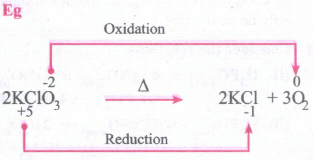
Decomposition reaction: Redox reactions in which a compound breaks down into two or more components are called decomposition reactions. These reactions are opposite to combination reactions. In these reactions, the oxidation number of the different elements in the same substance is changed.
17.
| Element | % | Relative number of atoms | Simple Ratio |
| Na | 14.31 | \(\frac { 14.31 }{ 23 } =0.62\) | \(\frac { 0.62 }{ 0.31 } =2\) |
| S | 9.97 | \(\frac { 9.97 }{ 32 } =0.31\) | \(\frac { 0.31 }{ 0.31 } =1\) |
| H | 6.22 | \(\frac { 6.22 }{ 1 } =6.22\) | \(\frac { 6.22 }{ 0.31 } =20\) |
| O | 69.5 | \(\frac { 69.5 }{ 16 } =4.34\) | \(\frac { 4.34 }{ 0.31 } =14\) |
Empirical formula = Na2 SH20 O14
\(\left[ \begin{matrix} { Na }_{ 2 }{ SH }_{ 20 }{ O }_{ 14 } \\ =(2\times 23)+(1\times 32)+(20\times 1)+14(16) \\ =46+32+20+234 \\ =322 \end{matrix} \right] \)
n = \(\frac { molar\quad mass }{ caluclated\quad empirical\quad formula\quad mass } =\frac { 322 }{ 322 } =1\)
Molecular formula = Na2 SH20O14
Since all the hydrogen in the compound are present as water
\(\therefore \) The molecular formula is Na2 SO4 10H2O.
18.
| Element | Percentage | Atomic mass | Relative number of atoms | simple ratio | Whole no |
| C | 76.6 | 12 | \(\frac { 76.6 }{ 12 } =6.38\) | \(\frac { 6.38 }{ 1.06 } =6\) | 6 |
| H | 6.38 | 1 | \(\frac { 6.38 }{ 1 } =6.38\) | \(\frac { 6.38 }{ 1.06 } =6\) | 6 |
| 0 | 17.02 | 16 | \(\frac { 17.02 }{ 16 } =1.06\) | \(1.06\frac { 1.06 }{ 1.06 } =1\) | 1 |
Empirical Formula = C6 H6O
n = \(\frac { molar\ mass }{ calculated\ eprirical\ formula\ mass } \)
= \(\frac { 2\times \ vapour\ density }{ 94 } \frac { 2\times 47 }{ 94 } =1,\)
Molecular formula (C6H6O) x 1 = C6H6O.
19.
mass of one atom = 6.645 x 10⁻²³ g
\(\therefore\) mass of 1 mole of an atom = 6.645 x 10-23 g x 6.022 x 1023 = 40 g
\(\therefore\) number of moles of element in 0.320 kg = \(\frac { 1\quad mole }{ 40g } \times 0.320kg\)
= \(\frac { 1mol\times 320g }{ 40g } \)
= 8 mol

11th Standard Syllabus & Materials
11th Standard
TN 11th Tamil பீடு பெற நில் - செய்யுள் - காவடிச்சிந்து Important Questions And Answers Study Material - QB365 Set A
NEW11th Standard
TN 11th Tamil பீடு பெற நில் - உரைநடை - மலை இடப்பெயர்கள் : ஓர் ஆய்வு Important Questions And Answers Study Material - QB365 Set A
NEW11th Standard
TN 11th Tamil மாமழை போற்றுதும் - துணைப்பாடம் - யானை டாக்டர் Important Questions And Answers Study Material - QB365 Set A
NEW11th Standard
TN 11th Tamil மாமழை போற்றுதும் - செய்யுள் - ஐங்குறுநூறு Important Questions And Answers Study Material - QB365 Set A



Tamilnadu Stateboard 11th Standard Subjects

Maths

Commerce

Economics

Biology

Business Maths and Statistics

Accountancy

Computer Science

Physics
Chemistry
Maths
Biology
Economics
Physics
Chemistry

History
Business Maths and Statistics

Computer Science
Accountancy

Computer Applications
History
Computer Technology
Commerce
Computer Applications
Computer Technology

Tamil

English

French
Tamilnadu Stateboard Standards
