
 100% FREE ACCESS
11th Standard Syllabus & Materials
11th Standard
TN 11th Tamil இயற்கை வேளாண்மை,சுற்றுச்சூழல் -செய்யுள் - மனோன்மணீயம் Important Questions And Answers Study Material - QB365 Set A
NEW11th Standard
TN 11th Tamil என்னுயிர் என்பேன் -துணைப்பாடம் - இசைத்தமிழர் இருவர் Important Questions And Answers Study Material - QB365 Set A
NEW11th Standard
TN 11th Tamil மொழி கலை -செய்யுள் - ஒவ்வொரு புல்லையும் Important Questions And Answers Study Material - QB365 Set A
NEW11th Standard
TN 11th Tamil பீடு பெற நில் - இலக்கணம் - பகுபத உறுப்புகள் Important Questions And Answers Study Material - QB365 Set A
NEW11th Standard
TN 11th Tamil பீடு பெற நில் - துணைப்பாடம் - வாடிவாசல் Important Questions And Answers Study Material - QB365 Set A
NEW11th Standard
TN 11th Tamil பீடு பெற நில் - செய்யுள் - குறுந்தொகை Important Questions And Answers Study Material - QB365 Set A

Published on: 04/10/2019
Basic Concepts of Chemistry and Chemical Calculations
Download Tamil Nadu 11th Standard Chemistry question papers, model tests, one-mark questions, important questions, and public exam papers in PDF format. Free study materials and answer keys for TN State Board students.
Questions + Answers key
Take MCQ Chemistry Test
1.
How much volume of chlorine is required to form 11.2 L of HCI at 273 K and 1 atm pressure?
2.
How much volume of carbon dioxide is produced when 50 g of calcium carbonate is heated completely under standard conditions ?
3.
How many moles of hydrogen is required to produce 10 moles of ammonia ?
4.
Calculate the amount of water produced by the combustion of 32 g of methane.
5.
How many moles of ethane is required to produce 44 g of CO2(g) after combustion.
6.
What is the difference between molecular mass and molar mass ? Calculate the molecular mass and molar mass for carbon monoxide.
7.
In a reaction x + y + z2 \(\longrightarrow \) xyz2 identify the Limiting reagent if any, in the following reaction mixtures.
i) 200 atoms of x + 200 atoms of y + 50 molecules of z2
ii) 1 mol of x + 1 mol of y + 3 mol of z2
iii) 50 atoms of x + 25 atoms of y + 50 molecules of z2
iv) 2.5 mol of x + 5 mol of y + 5 mol of z2
8.
Calculate the empirical and molecular formula of a compound containing 76.6% carbon, 6.38 % hydrogen and rest oxygen its vapour density is 47.
9.
What is the empirical formula of the following?
i) Fructose (C6 H12 O6) Found in honey
ii) Caffeine (C8 H10 N4 O2) a substance found in tea and Coffee
10.
Mass of one atom of an element is 6.645 x 10⁻²³g. How many moles of element are there in 0.320 kg.
1.
The balanced equation for the formation of HCI is,
H2(g) + CI2(g) \(\rightarrow\) 2 HCI (g)
As per the stoichiometric equation, under given conditions,
To produce 2 moles of HCI, 1 mole of chlorine gas is required.
To produce 44.8 litres of HCI, 22.4 litres of chlorine gas are required.
\(\therefore\) To produce 11.2 litres of HCI,
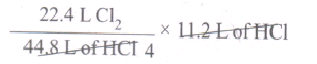
= 5.6 litres of chlorine are required.
2.
The balanced chemical equation is,
\({ CaCO }_{ 3 }\left( s \right) \overset { \triangle }{ \longrightarrow } { CaO }_{ (s) }+{ CO }_{ 2 }(g)\)
As per the stoichiometric equation,
1 mole (100g) CaC03 on heating produces 1 mole CO2
.png)
At STP, 1 mole of CO2 occupies a volume of 22.7 liters
At STP, 50 g of CaCO3 on heating produces,
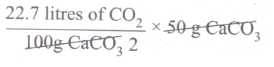
= 11.35 liters of CO2
3.
The balanced stoichiometric equation for the formation of ammonia is
N2(g) + 3H2 (g) \(\rightarrow\) 2NH3 (g)
As per the stoichiometric equation,
To produce 2 moles of ammonia, 3 moles of hydrogen are required.
\(\therefore\) to produce 10 moles of ammonia,
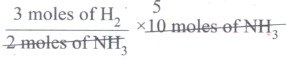
= 15 moles of hydrogen are required.
4.
CH4(g) + 2O2 \(\rightarrow\) CO2 + 2H2O
16g (2x18)g
As per stoichiometric equation,
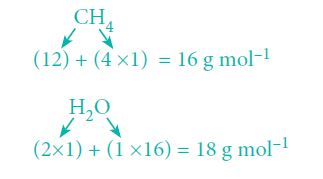
16 g of methane produces 36 g of H2O
\(\therefore\) 32 g of methane will produce = \(\frac { 36 }{ 16 } \times 32=72\) g of water.
5.
The balanced equation for the combustion of ethane
C2H6 + \(\frac { 7 }{ 2 } \)O2 \(\longrightarrow \) 2CO2 +3H2O
2C2H6 + 7O2 \(\longrightarrow \) 4CO2 + 6H2O
To produce 4 moles of CO2, 2 moles of ethane is required
To produce 1 moles (44 g) of CO2 required
Number of moles of ethane
\(=\frac{2 \mathrm{~mol} \text { ethane }}{4 \not \mathrm{molCO}_{2}} \times 1 \not \mathrm{molCO}_{2}\)
= \(\frac { 1 }{ 2 } mole\quad of\quad ethane\)
= 0.5 mole of ethane
6.
1) The unit of molecular mass is atomic mass unit [amu]. The unit of molar mass is gram per mole.
2) Molecular mass is the mass of one molecule while molar mass is the mass of one mole of molecules (6.022 x 10²³)
(i) Molecular mass of CO2 = 1(C) + 2(0) = 12 + 32 = 44 amu
or 7.304 x 10⁻²³ g
(ii) Molar mass of CO2 = 44 g mol-1.
7.
| Question | Number of moles of reactants allowed to react | Number of moles reactants consumed during reaction | Limiting reagent | ||||
|---|---|---|---|---|---|---|---|
| x | y | z2 | x | y | z2 | ||
| (a) | 200 atoms | 200 atoms | 50 molecules | 50 atoms | 50 atoms | 50 molecules | z2 |
ii) 1 mol of x + 1 mol of y + 3 mol of z2
| Question | Number of moles of reactants allowed to react | Number of moles reactants consumed during reaction | Limiting reagent | ||||
|---|---|---|---|---|---|---|---|
| x | y | z2 | x | y | z2 | ||
| (a) | 1 mol | 1 mol | 3 mol | 1 mol | 1 mol | 1 mol | x and y |
ii) 50 atoms of x + 25 atoms of y + 50 molecules of z2
| Question | Number of moles of reactants allowed to react | Number of moles reactants consumed during reaction | Limiting reagent | ||||
|---|---|---|---|---|---|---|---|
| x | y | z2 | x | y | z2 | ||
| (a) | 50 atom | 25 atom | 50 molecules | 25 atom | 25 atom | 25 molecules | y |
| Question | Number of moles of reactants allowed to react | Number of moles reactants consumed during reaction | Limiting reagent | ||||
|---|---|---|---|---|---|---|---|
| x | y | z2 | x | y | z2 | ||
| (a) | 2.5 mol | 5 mol | 5 mol | 2.5 mol | 2.5 mol | 2.5 mol | x |
8.
| Element | Percentage | Atomic mass | Relative number of atoms | simple ratio | Whole no |
| C | 76.6 | 12 | \(\frac { 76.6 }{ 12 } =6.38\) | \(\frac { 6.38 }{ 1.06 } =6\) | 6 |
| H | 6.38 | 1 | \(\frac { 6.38 }{ 1 } =6.38\) | \(\frac { 6.38 }{ 1.06 } =6\) | 6 |
| 0 | 17.02 | 16 | \(\frac { 17.02 }{ 16 } =1.06\) | \(1.06\frac { 1.06 }{ 1.06 } =1\) | 1 |
Empirical Formula = C6 H6O
n = \(\frac { molar\ mass }{ calculated\ eprirical\ formula\ mass } \)
= \(\frac { 2\times \ vapour\ density }{ 94 } \frac { 2\times 47 }{ 94 } =1,\)
Molecular formula (C6H6O) x 1 = C6H6O.
9.
| Compound | Molecular formula | Empirical Formula |
|---|---|---|
| Fructose | C6 H12O6 | C H2O |
| Caffeine | C8 H10 N4 O2 | C4 H5 N2O |
10.
mass of one atom = 6.645 x 10⁻²³ g
\(\therefore\) mass of 1 mole of an atom = 6.645 x 10-23 g x 6.022 x 1023 = 40 g
\(\therefore\) number of moles of element in 0.320 kg = \(\frac { 1\quad mole }{ 40g } \times 0.320kg\)
= \(\frac { 1mol\times 320g }{ 40g } \)
= 8 mol

11th Standard Syllabus & Materials
11th Standard
TN 11th Tamil பீடு பெற நில் - செய்யுள் - காவடிச்சிந்து Important Questions And Answers Study Material - QB365 Set A
NEW11th Standard
TN 11th Tamil பீடு பெற நில் - உரைநடை - மலை இடப்பெயர்கள் : ஓர் ஆய்வு Important Questions And Answers Study Material - QB365 Set A
NEW11th Standard
TN 11th Tamil மாமழை போற்றுதும் - துணைப்பாடம் - யானை டாக்டர் Important Questions And Answers Study Material - QB365 Set A
NEW11th Standard
TN 11th Tamil மாமழை போற்றுதும் - செய்யுள் - ஐங்குறுநூறு Important Questions And Answers Study Material - QB365 Set A



Tamilnadu Stateboard 11th Standard Subjects

Maths

Commerce

Economics

Biology

Business Maths and Statistics

Accountancy

Computer Science

Physics
Chemistry
Maths
Biology
Economics
Physics
Chemistry

History
Business Maths and Statistics

Computer Science
Accountancy

Computer Applications
History
Computer Technology
Commerce
Computer Applications
Computer Technology

Tamil

English

French
Tamilnadu Stateboard Standards
