
 100% FREE ACCESS
11th Standard Syllabus & Materials
11th Standard
TN 11th Tamil இயற்கை வேளாண்மை,சுற்றுச்சூழல் -செய்யுள் - மனோன்மணீயம் Important Questions And Answers Study Material - QB365 Set A
NEW11th Standard
TN 11th Tamil என்னுயிர் என்பேன் -துணைப்பாடம் - இசைத்தமிழர் இருவர் Important Questions And Answers Study Material - QB365 Set A
NEW11th Standard
TN 11th Tamil மொழி கலை -செய்யுள் - ஒவ்வொரு புல்லையும் Important Questions And Answers Study Material - QB365 Set A
NEW11th Standard
TN 11th Tamil பீடு பெற நில் - இலக்கணம் - பகுபத உறுப்புகள் Important Questions And Answers Study Material - QB365 Set A
NEW11th Standard
TN 11th Tamil பீடு பெற நில் - துணைப்பாடம் - வாடிவாசல் Important Questions And Answers Study Material - QB365 Set A
NEW11th Standard
TN 11th Tamil பீடு பெற நில் - செய்யுள் - குறுந்தொகை Important Questions And Answers Study Material - QB365 Set A

Published on: 07/09/2019
Haloalkanes and Haloarenes
Download Tamil Nadu 11th Standard Chemistry question papers, model tests, one-mark questions, important questions, and public exam papers in PDF format. Free study materials and answer keys for TN State Board students.
Questions + Answers key
Take MCQ Chemistry Test
1.
Which of the following reagent is helpful to differentiate ethylene dichloride and ethylidene chloride?
Zn / methanol
KOH / ethanol
aqueous KOH
ZnCl2 / Con HCl
2.
Benzene reacts with Cl2 in the presence of FeCl3 and in absence of sunlight to form ________
Chlorobenzene
Benzyl chloride
Benzal chloride
Benzene hexachloride
3.
What should be the correct IUPAC name of diethyl chloromethane?
3 – Chloro pentane
1-Chloropentane
1-Chloro-1, 1, diethyl methane
1 –Chloro-1-ethyl propane
4.
Of the following compounds, which has the highest boiling point?
n-Butyl chloride
Isobutyl chloride
t-Butyl chloride
n-propyl chloride
5.
The IUPAC name of  is ____________
2-Bromo pent – 3 – ene
4-Bromo pent – 2 – ene
2-Bromo pent – 4 – ene
4-Bromo pent – 1 – ene
6.
Explain the preparation of the following compounds
i) DDT
ii) Chloroform
iii) Biphenyl
iv) Chloropicrin
v) Freon-12
7.
Explain the mechanism of SN1 reaction by highlighting the stereochemistry behind it
8.
Write a chemical reaction useful to prepare the following:
i) Freon-12 from Carbon tetrachloride
ii) Carbon tetrachloride from carbon disulphide
9.
Why is it necessary to avoid even traces of moisture during the use of Grignard reagent?
10.
Give reasons for polarity of C-X bond in halo alkane.
11.
Why chlorination of methane is not possible in dark?
12.
Two isomers (A) and (B) have the same molecular formula C2H4Cl2. Compound (A) reacts with aqueous KOH gives compound (C) of molecular formula C2H4O. Compound (B) reacts with aqueous KOH gives compound(D) of molecular formula C2H6O2. Identify (A), (B), (C) and (D).
13.
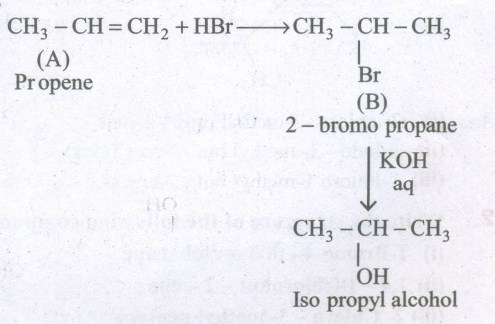
A hydrocarbon C3H6 (A) reacts with HBr to form compound (B). Compound (B) reacts with aqueous potassium hydroxide to give (C) of molecular formula C3H6O.what are (A) (B) and (C). Explain the reactions.
14.
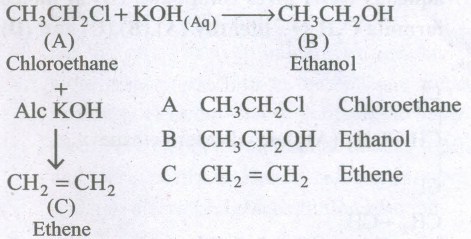
An organic compound (A) with molecular formula C2H5Cl reacts with KOH gives compounds (B) and with alcoholic KOH gives compound (C). Identify (A),(B), and (C)
15.
What happens when acetyl chloride is treated with excess of CH3MgI?
16.
How will you prepare n propyl iodide from n-propyl bromide?
1.
(c)
aqueous KOH
2.
(a)
Chlorobenzene
3.
(a)
3 – Chloro pentane
4.
(a)
n-Butyl chloride
5.
(b)
4-Bromo pent – 2 – ene
6.
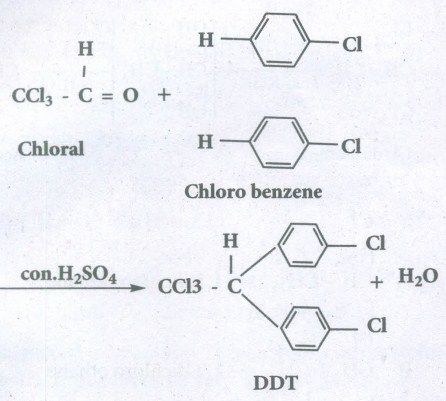
i) DDT: DDT can be prepared by heating a mixture of chlorobenzene with chloral (Trichloro acetaldehyde) in the presence of con. H2SO4,
ii) Chloroform :The reaction of methane with excess of chlorine in the presence of sunlight will give carbon tetrachloride as the major product.
\(\underset { Methane }{ { CH }_{ 4 }+4C{ l }_{ 2 }\overset { h\gamma }{ \longrightarrow } } +\underset { Carbon \ tetrachloride }{ 4HCl } \)
iii) Bipheenyl :
\(\underset { Chlorobenzene }{ { C }_{ 6 }{ H }_{ 5 }Cl } +2Na+Cl-{ C }_{ 6 }{ H }_{ 5 }\overset { Ether }{ \longrightarrow } \underset { Biphenyl }{ { C }_{ 6 }{ H }_{ 5 }-{ C }_{ 6 }{ H }_{ 5 }+2NaCl } \)
iv) Chloropicrin : Chloroform reacts with nitric acid to form chloropicrin.(Trichloro nitro methane)
\(\underset { Chloroform }{ { CH }_{ 3 }+HN{ O }_{ 3 }\overset { \triangle }{ \longrightarrow } } \underset { Chloropicrin }{ C{ Cl }_{ 3 }N{ O }_{ 2 }+{ H }_{ 2 }O } \)
v) Freon-12 :Freon - 12 is prepared by the action of hydrogen fluoride on carbon tetrachloride in . the presence of catalylic amount of antimony pentachloride. is is called swartz reaction
\(\underset { Carbontetrachloridew }{ { CCl }_{ 3 }+2HF\overset { SbC{ l }_{ 5 } }{ \longrightarrow } } \underset { Freon-12 }{ 2HC{ l }+CCl_{ 2 }F_{ 2 } } \)
7.
The rate of the following SN1 reaction depends upon the concentration of alkyl halide (RX) and is independent of the concentration of the nucleophile (OH-).
Hence Rate of the reaction = k [alkyl halide]
SN1 reaction mechanism by taking a reaction between tertiary butyl bromide with aqueous KOH.
\({ CH }_{ 3 }-\overset { \underset { | }{ { CH }_{ 3 } } }{ \underset { \overset { | }{ { CH }_{ 3 } } }{ C } } -Br\overset { { OH }^{ - }(aq) }{ \underset { -Br }{ \longrightarrow } } { CH }_{ 3 }-\overset { \underset { | }{ { CH }_{ 3 } } }{ \underset { \overset { | }{ { CH }_{ 3 } } }{ C } } -OH\)
Tert-Butyl bromide Tert-Butyl alcohol
This reaction takes place in two steps as shown below
Step-1 Formation of carbocation :
The polar C - Br bond breaks forming a carbocation and bromide ion. is step is slow and hence it is the rate determining step
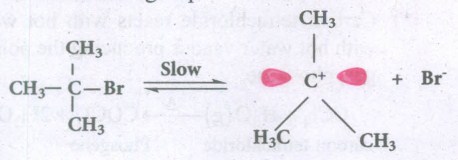
The carbocation has 2 equivalent lobes of the vacant 2p orbital, so it can react equally rapidly from either face
Ste - 2
The nucleophile immediately reacts with the carbocation. This step is fast and hence does not affect the rate of the reactions.
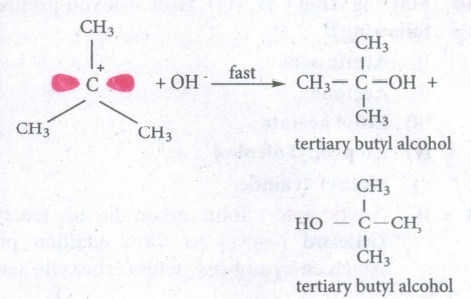
As shown above, the nucleophilic reagent OH- can attack carbocation from both the sides.
8.
(i) Freon - 12 is prepared by the action of hydrogen fluoride on carbon tetrachloride in the presence "of catalylic amount of antimony pentachloride. is is called swartz reaction.
\(\underset { Carbontetrachloride }{ C{ Cl }_{ 4 }+2HF } \overset { SbC{ l }_{ 5 } }{ \longrightarrow } \underset { Freon-12 }{ 2HCl } +CC{ l }_{ 2 }{ F }_{ 2 }\)
(ii) Carbon disulphide reacts with chlorine gas in the presence of anhydrous AICl3 as catalyst giving carbon tetrachloride
\(\underset { carbondisulphide }{ { CS }_{ 2 }+3C{ l }_{ 2 }\overset { anhydrous }{ \underset { Al{ Cl }_{ 3 } }{ \longrightarrow } } } \underset { Carbontetrachloride }{ { CCl }_{ 4 }+{ S }_{ 2 }{ Cl }_{ 2 } } \)
9.
If moisture is present, the Grignard reagent will react with water to give alkanes.
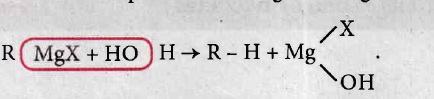
So. moisture should not be present
10.
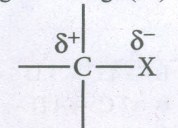
Carbon halogen bond is a polar bond as halogens are more electro negative than carbon. The carbon atom exhibits a partial positive charge (\(\delta \)+) and halogen atom a partial negative charge (\(\delta \)-)
The C -X bond is formed by overlap of sp3 orbital of carbon atom I with half filled p-orbitat of the halogen atom. The atomic size of halogen increases from fluorine to iodine, which increases the C - X bond length. Larger the size, greater is the bond length, and weaker is the bond formed. The bond strength of C - X decreases from C - F to C - I in CH3X
11.
The Chlorination of methane is carried out by free radical mechanism. The initiation step to form free radical needs high energy which is supplied by light energy.
\(\mathrm{Cl}-\mathrm{Cl} \stackrel{h \nu}{\longrightarrow} 2 \mathrm{Cl}\)
So this reaction is not possible in dark.
12.
\(\overset { \underset { | }{ Cl } }{ \underset { \overset { | }{ Cl } }{ CH } } -{ CH }_{ 3 }\quad (A)\) 1, 1,-dichloro ethane
\(\underset { \overset { | }{ Cl } }{ { CH }_{ 2 } } -\underset { \overset { | }{ Cl } }{ { CH }_{ 2 } } \) (B) 1, 2, dichloro ethane
\(\overset { \underset { | }{ Cl } }{ \underset { \overset { | }{ Cl } }{ CH } } -{ CH }_{ 3 }\underset { aq\quad KOH }{ \longrightarrow } \left[ \overset { \underset { | }{ OH } }{ \underset { \overset { | }{ OH } }{ CH } } -{ CH }_{ 3 } \right] \underset { -{ H }_{ 2 }) }{ \longrightarrow } { CH }_{ 3 }CHO\)
(A) (C)
1, 1, dichloro ethane Acetaldhyde
\(A \ \ \overset { \underset { | }{ Cl } }{ \underset { \overset { | }{ Cl } }{ CH } } -{ CH }_{ 3 }\) -1,1 dichloro ethane
B \(\underset { \overset { | }{ Cl } }{ { CH }_{ 2 } } -\underset { \overset { | }{ Cl } }{ { CH }_{ 2 } } \)-1, 2 dichloro ethane
C CH3CHO -Acetaldehyde
D \(\underset { \overset { | }{ OH } }{ { CH }_{ 2 } } -\underset { \overset { | }{ OH } }{ { CH }_{ 2 } } \)-Ethyleneglycol
13.
14.
15.
With acetyl chloride, CH3MgI given first acetone.
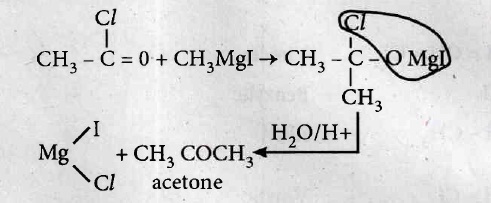
The acetone formed will react with excess CH3MgI to give a tertiary alcohol, t - butyl alcohol.

16.


11th Standard Syllabus & Materials
11th Standard
TN 11th Tamil பீடு பெற நில் - செய்யுள் - காவடிச்சிந்து Important Questions And Answers Study Material - QB365 Set A
NEW11th Standard
TN 11th Tamil பீடு பெற நில் - உரைநடை - மலை இடப்பெயர்கள் : ஓர் ஆய்வு Important Questions And Answers Study Material - QB365 Set A
NEW11th Standard
TN 11th Tamil மாமழை போற்றுதும் - துணைப்பாடம் - யானை டாக்டர் Important Questions And Answers Study Material - QB365 Set A
NEW11th Standard
TN 11th Tamil மாமழை போற்றுதும் - செய்யுள் - ஐங்குறுநூறு Important Questions And Answers Study Material - QB365 Set A



Tamilnadu Stateboard 11th Standard Subjects

Maths

Commerce

Economics

Biology

Business Maths and Statistics

Accountancy

Computer Science

Physics
Chemistry
Maths
Biology
Economics
Physics
Chemistry

History
Business Maths and Statistics

Computer Science
Accountancy

Computer Applications
History
Computer Technology
Commerce
Computer Applications
Computer Technology

Tamil

English

French
Tamilnadu Stateboard Standards
