
 100% FREE ACCESS
11th Standard Syllabus & Materials
11th Standard
TN 11th Tamil இயற்கை வேளாண்மை,சுற்றுச்சூழல் -செய்யுள் - மனோன்மணீயம் Important Questions And Answers Study Material - QB365 Set A
NEW11th Standard
TN 11th Tamil என்னுயிர் என்பேன் -துணைப்பாடம் - இசைத்தமிழர் இருவர் Important Questions And Answers Study Material - QB365 Set A
NEW11th Standard
TN 11th Tamil மொழி கலை -செய்யுள் - ஒவ்வொரு புல்லையும் Important Questions And Answers Study Material - QB365 Set A
NEW11th Standard
TN 11th Tamil பீடு பெற நில் - இலக்கணம் - பகுபத உறுப்புகள் Important Questions And Answers Study Material - QB365 Set A
NEW11th Standard
TN 11th Tamil பீடு பெற நில் - துணைப்பாடம் - வாடிவாசல் Important Questions And Answers Study Material - QB365 Set A
NEW11th Standard
TN 11th Tamil பீடு பெற நில் - செய்யுள் - குறுந்தொகை Important Questions And Answers Study Material - QB365 Set A

Published on: 31/07/2019
Hydrogen
Download Tamil Nadu 11th Standard Chemistry question papers, model tests, one-mark questions, important questions, and public exam papers in PDF format. Free study materials and answer keys for TN State Board students.
Questions + Answers key
Take MCQ Chemistry Test
1.
_____________ is known as heavy hydrogen.
protium
deuterium
tritium
both a and b
2.
The number of neutrons in hydrogen atom is ___________.
three
two
one
zero
3.
If a body of a fish contains 1.2 g hydrogen in its total body mass, if all the hydrogen is replaced with deuterium then the increase in body weight of the fish will be ______________
1.2 g
2.4 g
3.6 g
\(\sqrt{4.8}\)g
4.
Non-stoichiometric hydrides are formed by _____________
palladium, vanadium
carbon, nickel
manganese, lithium
nitrogen, chlorine
5.
Which of the following statements about hydrogen is incorrect?
Hydrogen ion, H3O+ exists freely in solution.
Dihydrogen acts as a reducing agent.
Hydrogen has three isotopes of which tritium is the most common.
Hydrogen never acts as cation in ionic salts.
6.
Name the salts that lead to the formation of permanent hardness in water? Can you remove permanent hardness by boiling?
7.
Mention any two biological effects of D2O.
8.
Distinguish between (ii) temporary hardness and permanent hardness.
9.
What is water-gas shift reaction?
10.
Hydrogen peroxide can function as an oxidising agent as well as reducing agent. Substantiate this statement with suitable examples.
11.
Explain why hydrogen is not placed with the halogen in the periodic table.
12.
Give two uses of Tritium.
13.
Which is the radio active isotope of Hydrogen? Write a note on it.
14.
Write short notes on Deuterium.
15.
An ice cube at 0° C is placed in some liquid water at 00C, the ice cube sinks - Why? What will happen to ice at 00C placed in liquid water at 00C?
16.
Conc. H2SO4 cannot be used for drying hydrogen gas. Why?
17.
Why hydrogen behaves both as a halogen and as an alkali metal?
18.
Compare the structures of H2O and H2O2 .
19.
An isotope of hydrogen (A) reacts with diatomic molecule of element which occupies group number 16 and period number 2 to give compound (B) is used as a moderator in nuclear reaction. (A) adds on to a compound ( C), which has the molecular formula C3H6 to give (D). Identify A, B, C and D.
1.
(b)
deuterium
2.
(d)
zero
3.
(a)
1.2 g
4.
(a)
palladium, vanadium
5.
(c)
Hydrogen has three isotopes of which tritium is the most common.
6.
Permanent hardness is due to the presence of soluble salts of magnesium and calcium in form of sulphates and chlorides. Permanent hardness is not removed by boiling.
7.
(a) D2O retards the growth of living organisms like plants and animals.
(b) Pure heavy water kills small fishes, tadpoles and mice when fed upon it.
8.
| TEMPORARY HARDNESS | PERMANENT HARDNESS |
| This is due to soluble bicarbonates of a Ca and Mg |
This is due to soluble salts in the form of Ca and Mg sulphates and chlorides. |
| It is easily removed by boiling | Removal of permanent hardness is a tedious process and involves certain chemical methods |
9.
The carbon monoxide of the water gas can be converted to carbon dioxide by mixing the gas mixture with more steam at 400oC and passed over a shift converter containing iron/copper catalyst. This reaction is called as water-gas shift reaction.
CO + H2O ➝ CO2 + H2
10.
a) Oxidation is performed in acidic medium:
Eg : H2O2 Oxidises FeSO4 to Fe (SO4)3
H2O2 + 2H++ 2e- ➝ 2H2O (E0 = +1.77 V)
2FeSO4 + H2SO4 + H2O2 ➝ Fe2(SO4)3 + 2H2O
b) Reduction is performed in basic medium:
Eg : H2O2 reduces KMnO4 to MnO2
HO2- + OH- ➝ H2O + 2e- (E0 = +0.08 V)
\(2 \mathrm{KMnO}_{4}+3 \mathrm{H}_{2} \mathrm{O}_{2} \rightarrow 2 \mathrm{MnO}_{2}+2 \mathrm{KOH}+2 \mathrm{H}_{2} \mathrm{O}+3 \mathrm{O}_{2}\)
11.
Hydrogen has electronic configuration 1s1. So it resembles ns1 general valence shell configuration of alkali metals.
Its similarity with alkali metals are:
1. Form uni positive (H+) ions like Na+, K+, Cs+
2. Form halides, (HX), oxides (H2O) peroxides (H2O2) and sulphides (H2S) like (Nax, Na2O, Na2O2, Na2S)
3. Acts as reducing agent.
4. Has +1 oxidation state.
5. If it is placed in the halogen family it should be the most electro negative element which is not true.
12.
(i) Used in emergency exit signs.
(ii) Used in illumination of wrist watches in place of radium.
13.
Tritium is the radio active isotope of Hydrogen with a half-life of 12.3 years. It's nucleus consists of one proton and two neutrons.
14.
1H2 or 1D2 . It occurs naturally in very small traces. It's nucleus consists of a proton, a neutron and one electron revolving around the nucleus. Its chemical properties are similar to those of protium but their reaction rates are different.
15.
NOTE:
At any condition ice cube does not sink in water.
At 00C, ice and liquid water will be in equilibrium and will coexist. Hence no freezing or melting will occur.
16.
When conc. H2SO4 absorbs H2O from moist H2 it produces so much of heat since its highly exothermic and so it may catch fire.
17.
(i) Resemblance with alkali metals :
Its electronic configuration is 1s1 which is similar to alkali metals.
It acts as a good reducing agent.
Like alkali metal, it loses one electron to form H+,
It is liberated at cathode when HCI is electrolysed.
It is electropositive in nature.
(ii) Resemblance with halogens :
It is a non-metal.
It is a gas like F2 and Cl2
It is slightly electronegative in nature
Like halogens it is ready to accept one electron and attain the stable inert gas configuration.
18.
| H2O | H2O2 | |
|---|---|---|
| Hybridisation of oxygen |
SP3 | Sp3 (each 0 - atom) |
| Structure | .jpg) |
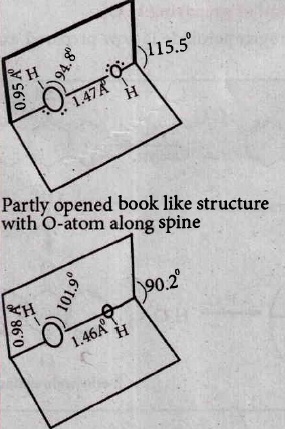 |
19.
The element which occupies group number (16) and period number (2) is oxygen. (B) is D2O which is used as a moderator in nuclear reactions.
So (A) must be deuterium, which is an isotope of hydrogen
\(2\underset { (A) }{ { D }_{ 2 } } +{ O }_{ 2 }\rightarrow 2\underset { (B) }{ { D }_{ 2 }O } \)
So (B) is D2O
(A) adds to (C) as follows :
\(3 \mathrm{D}_{2}+\mathrm{C}_{3} \mathrm{H}_{6} \rightarrow \mathrm{CH}_{3}-\mathrm{CH}-\mathrm{CH}_{2}\)
So (D) is 1,2 - dideutero propane.
| A | D2 | Deuterium |
| B | D2O | Heavy water or deuterium oxide |
| C | CH3-CH = CH2 | Propene |
| D | CH3 - CHD - CH2D | Propane deuteride |

11th Standard Syllabus & Materials
11th Standard
TN 11th Tamil பீடு பெற நில் - செய்யுள் - காவடிச்சிந்து Important Questions And Answers Study Material - QB365 Set A
NEW11th Standard
TN 11th Tamil பீடு பெற நில் - உரைநடை - மலை இடப்பெயர்கள் : ஓர் ஆய்வு Important Questions And Answers Study Material - QB365 Set A
NEW11th Standard
TN 11th Tamil மாமழை போற்றுதும் - துணைப்பாடம் - யானை டாக்டர் Important Questions And Answers Study Material - QB365 Set A
NEW11th Standard
TN 11th Tamil மாமழை போற்றுதும் - செய்யுள் - ஐங்குறுநூறு Important Questions And Answers Study Material - QB365 Set A



Tamilnadu Stateboard 11th Standard Subjects

Maths

Commerce

Economics

Biology

Business Maths and Statistics

Accountancy

Computer Science

Physics
Chemistry
Maths
Biology
Economics
Physics
Chemistry

History
Business Maths and Statistics

Computer Science
Accountancy

Computer Applications
History
Computer Technology
Commerce
Computer Applications
Computer Technology

Tamil

English

French
Tamilnadu Stateboard Standards
