
 100% FREE ACCESS
11th Standard Syllabus & Materials
11th Standard
TN 11th Tamil இயற்கை வேளாண்மை,சுற்றுச்சூழல் -செய்யுள் - மனோன்மணீயம் Important Questions And Answers Study Material - QB365 Set A
NEW11th Standard
TN 11th Tamil என்னுயிர் என்பேன் -துணைப்பாடம் - இசைத்தமிழர் இருவர் Important Questions And Answers Study Material - QB365 Set A
NEW11th Standard
TN 11th Tamil மொழி கலை -செய்யுள் - ஒவ்வொரு புல்லையும் Important Questions And Answers Study Material - QB365 Set A
NEW11th Standard
TN 11th Tamil பீடு பெற நில் - இலக்கணம் - பகுபத உறுப்புகள் Important Questions And Answers Study Material - QB365 Set A
NEW11th Standard
TN 11th Tamil பீடு பெற நில் - துணைப்பாடம் - வாடிவாசல் Important Questions And Answers Study Material - QB365 Set A
NEW11th Standard
TN 11th Tamil பீடு பெற நில் - செய்யுள் - குறுந்தொகை Important Questions And Answers Study Material - QB365 Set A

Published on: 14/12/2019
Chemical bonding
Download Tamil Nadu 11th Standard Chemistry question papers, model tests, one-mark questions, important questions, and public exam papers in PDF format. Free study materials and answer keys for TN State Board students.
Questions + Answers key
Take MCQ Chemistry Test
1.
Which of the following is a polar molecule?
BF3
SiF4
SF4
XeF4
2.
H2O is polar, whereas BeF2 is not It is because ___________
The electronegativity of F is greater than that of O.
H2O involves hydrogen bonding whereas BeF2 is a discrete molecule
H2O is linear and BeF2 is angular
H2O is angular and BeF2 is linear
3.
Which compound has planar structure?
XeF4
XeOF2
XeO2F2
XeO4
4.
The sharing of valence electrons between the atoms will lead to the formation of_____
Ionic bond
Covalent bond
Co-ordinate bond
Hydrogen bond
5.
Find out the most favourable condition for electrovalent bonding.
Low ionization potential of one atom and high electron affinity of the other atom.
High electron affinity and high ionisation potential of both the atoms.
Low electron affinity and low ionisation potential of both the atoms.
High ionisation potential of one atom and low electron affinity of the other atom.
6.
Identify tbe paramagnetic species among following using molecular orbital theory.
7.
Give reasons for the following:
(i) Covalent bonds are directional while ionic bonds are non-directional.
(ii) Water molecule has bent structure where as CO2 has linear structure.
(iii) Ethyne molecule is linear
8.
Comment on the following statements. .
(i) BF3 is planar but NH3 is not.
(ii) SiF4 and C/O-4 are tetrahedral
(iii) HSH bond angle in H2S is 92° and HOH bond angle in H20 is 104.5.
9.
Define co-ordinate covalent bond.
10.
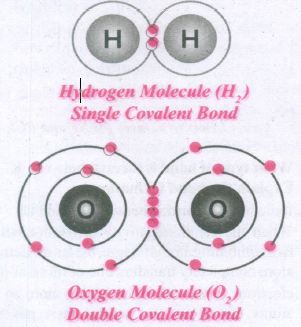
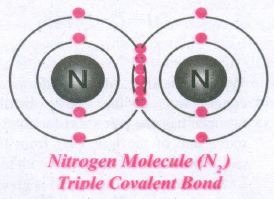
What is covalent bond? Give suitable examples to represent single, double and triple covalent bonds.
11.
Arrange the following in the decreasing order of Bond angle
C2H2, BF3, CCl4
12.
Does H2O and H2S possess same bond, angle ? Explain
13.
Write the resonance structures for N2O.
14.
Draw the Lewis structure of N, C,O and He
15.
Give two examples of molecules undergoing sp3d2 hybridisation and predict their shapes.
16.
Explain about valence bond theory for the formation of H2 molecule.
17.
Explain about Kossel-Lewis approach to chemical bonding.
18.
Draw the Lewis dot structure for the following.
(i) SO3
(ii) NH3
(iii) CH4
(iv) N2O5
19.
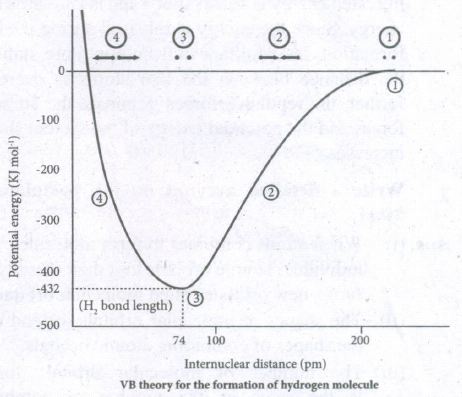
Comment and explain your observation obtained from the above graph.
1.
(c)
SF4
2.
(c)
H2O is linear and BeF2 is angular
3.
(a)
XeF4
4.
(b)
Covalent bond
5.
(d)
High ionisation potential of one atom and low electron affinity of the other atom.
6.
\(O^{2-},N_2,C^+_2\)
| Molecule | No.of electrons | Electonic configuration | Bond order |
| \(O^{2-}\) | 18 | \((\sigma_{1s})^2(\sigma^*_{1s})^2(\sigma_{2s})^2(\sigma^*_{2s})^2(\sigma_2p_z)^2(p_2p_x)^2=(p_2p_y)^2(p^*_2p_x)^1=(p^*_2p_y)^1\) | Diamagnetic |
| N2 | 14 | \((\sigma_{1s})^2(\sigma^*_{1s})^2(\sigma_{2s})^2(\sigma^*_{2s})^2(p_2p_x)^2(p_2p_y)^1(\sigma_2p_z)^2\) | Diamagnetic |
| \(C^+_2\) | 11 | \((\sigma_{1s})^2(\sigma^*_{1s})^2(\sigma_{2s})^2(\sigma^*_{2s})^2(p_2p_x)^2(p_2p_y)^1\) | Paramagnetic |
\(C^+_2\) is paramagnetic.
7.
(i) In covalent bonds, the shared pair of electrons are localized between two atoms and also covalent bonds are formed by overlap of half covalent bonds are formed by the overlap of atomic orbitals. Since atomic orbitals are directional in nature, covalent bonds are also directional. In ionic bonds, only a network of cations are anions are tightly held together by electrostatic forces. The electrostatic field of an ion is nondirectional, hence ionic compounds are also non-directional.
(ii) Oxygen atom is H2O is sp3 hybridised with two lone pairs. Due to greater repulsive force between lone-pair-lone-pair, the bond angle is reduced from 109.50 to 104.50 and hence H2O molecule acquires a bent structure.

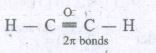
In CO2 molecule, carbon atom is sp-hybridised. There is no free electron in CO2 molecule. The two sp hybrid orbitals are oriented in opposite direction forming an angle of 1800 .Hence H20 has a bent structure and CO2 has \(O\overset { \pi }{ \underset { O- }{ = } } C\overset { \pi }{ \underset { O- }{ = } } O\) linear structure.
(iii) Ethyne molecule is linear because both the f carbon atoms in it are sp hybridized having two unhybridised orbitals (2px and 2py). The two sp hybrid orbitals of both the carbon atoms are oriented in opposite direction forming an angleof 1800.
8.
(i) The B-in BF3 undergoes sp2 hybridisation and has a triangular planar geometry. The N-in NH3 undergoes sp3 hybridisation and has pyramidal shape with one lone pair on N-atom.
(ii) Both S in SiF4 and CI in ClO; undergo sp3 hybridisation.
(iii) Since the electronegativity of s is less than 0, H2S possess a lower bond angle then H20.
9.
In certain bond formation, one of the combining atoms donates a pair of electrons (i.e.) two electrons which are necessary for the covalent bond formation, and these electrons are shared by both the combining atoms.
These type of bonds are called co-ordinate covalent bond or co-ordinate bond. The combining atom which donates the pair of electron is called a donor atom and the other atom an acceptor atom. This bond is denoted by an arrow starting from the donor atom pointing towards the acceptor atom.
10.
The type of mutual sharing of one or more pairs of electrons between two combining atoms results in the formation of a chemical bond called a covalent bond. If two atoms share just one pair of electron a single covalent bond is formed as in the case of hydrogen molecule. If two or three electron pairs are shared between the two combining atoms, then the covalent bond is called a double bond or a triple bond, respectively
11.
C2H2, BF3, CCl4
.jpg)
12.
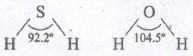
'The bond angle of HSH is 92.2° and that of H20 is 104.5°
The higher bond angle in water molecule is due to the higher electronegativity of oxygen (in H20) than sulphur (in H2S).
13.
N2O

14.

Lewis Structure of Nitrogen atom
Similarly, Lewis dot structure of carbon, oxygen can be drawn as shown below.

Lewis Structures of C & O atoms
Only exception to this is helium which has only two electrons in its valence shell which is represented as a pair of dots (duet).
\(\overset{..}He\)
Lewis Structures of He atoms
15.
Examples : SF6, XeF4
Shapes :
SF6 - Octahedral
XeF4 - Square planar
16.
(i) Two hydrogen atoms Ha and Hb are separated by infinite distance. At this stage, there is no interaction between these two atoms and the potential energy of this system is arbitrarly taken as zero.
(ii) As these two atoms approach each other, in addition to electrostatic attractive forces between the nucleus and its own electrons, the following new forces begins to operate.
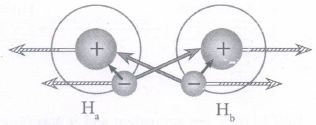
(iii) The new attractive forces (. arrows) arise between:
(a) nucleus of Ha,and valence electron of Hb (b) nucleus of Hb and the valence electron of Ha.
(iv) The new repulsive forces ( arrows) arise between:
(a) the nucleus of Ha and Hb
(b) the valence electrons of Ha and Hb.
(v) The attractive forces tend to bring Ha and Hb together whereas the repulsive forces tends to push them apart.
(vi) At the initial stage, as the two hydrogen atoms approach each other, the attractive forces are stronger than repulsive forces and the potential energy decreases.
(vii) A stage is reached where the net attractive forces are exactly balanced by repulsive forces and the potential energy of the system acquires a minimum energy.
(viii) At this stage, there is a maximum overlap between the atomic orbitals of Ha, and Hb and atoms Ha and Hb are now said to be bonded together by a covalent bond.
17.
(i) Kossel and Lewis approach to chemical bonding is based on the inertness of the noble gases which have little or no tendency to combine with other atoms.
(ii) They proposed that noble gases are stable due to their completely filled outer electronic configuration.
(iii) Elements other than noble gases try to attain the completely filled outer electronic configuration by losing, gaining or sharing one or more electrons from their outer shell.
(iv) For e.g., sodium loses one electron to form Na+ ion and chlorine accepts that electron to give chloride ion, ClrThese two ions are held together by electrostatic attractive forces, a bond known as an electrovalent bond.
\(\underset { \left[ Ne \right] { 3s }^{ ' } }{ Na } \longrightarrow { \underset { [Ne] }{ Na } }^{ + }+{ e }^{ - }\)
\(\underset { [Ne]3{ s }^{ 2 }{ 3p }^{ 2 } }{ Cl } +{ e }^{ - }\longrightarrow { \underset { [Ar] }{ Cl } }^{ - }\)
\({ Na }^{ + }+{ Cl }^{ - }\longrightarrow Nacl\)
(v) In diatomic molecules such as nitrogen and oxygen, they achieve the stable noble gas electronic configuration by mutual sharing of electrons.
(vi) Lewis introduced a scheme to represent the chemical bond and the electrons present in the outer shell of the atom called Lewis dot structure.
(vii) For example, the electronic configuration of nitrogen is 1s22s22p3. It has 5 electrons in its outer shell. The lewis structure of nitrogen is \(\cdot \overset { \cdot }{ N\cdot } \)
(viii) In N2 molecule, equal sharing of 3 electrons from each nitrogen atom takes place as follows: or N≡N
18.
| S.No | Molecule | Lewis Structure | |
|---|---|---|---|
| (i) | Sulphur trioxide (SO3) | ||
| (ii) | Ammonia(NH3) | \(\overset{H}{\underset{..}{\overset{..}{H:N:H}}}\) | |
| (iii) | Methane | \(\underset{H}{\overset{H}{\underset{..}{\overset{..}{H:C:H}}}}\) | |
| (iv) | Dinitrogen Pentoxide (N2O5) | ||
| (v) | Nitric acid (HNO3) | ||
19.
Consider a situation wherein two hydrogen atoms (Ha and Hb) are separated by infinite distance. At this stage there is no interaction between these two atoms and the potential energy of this system is arbitrarily taken as zero. As these two atoms approach each other, in addition to the electrostatic attractive force between the nucleus and its own electron (purple arrows), the following new forces begins to operate. The new attractive forces (green arrows) arise between
(i) Nucleus of Ha and valence electron of Hb
(ii) Nucleus of Hb and the valence electron of Ha.
The new repulsive forces (red arrows) arise between
(i) The nucleus of Ha and Hb
(ii) Valence electrons of Ha and Hb.
The attractive forces tend to bring Ha and Hb together whereas the repulsive forces tends to push them apart. At the initial stage, as the two hydrogen atoms approach each other, the attractive forces are stronger than the repulsive forces and the potential energy decreases.
A stage is reached where the net attractive forces are exactly balanced by repulsive forces and the potential energy of the system acquires a minimum energy. At this stage, there is a maximum overlap between the atomic orbitals of Ha and Hb and the atoms Ha and Hb are now said to be bonded together by a covalent bond. The internuclear distance at this stage gives the H-H bond length and is equal to 74 pm. The liberated energy is 436 kJ mol-1 and is known as bond energy. Since the energy is released during the bond formation, the resultant molecule is more stable. If the distance between the two atoms is decreased further, the repulsive forces dominate the attractive forces and the potential energy of the system sharply increases.

11th Standard Syllabus & Materials
11th Standard
TN 11th Tamil பீடு பெற நில் - செய்யுள் - காவடிச்சிந்து Important Questions And Answers Study Material - QB365 Set A
NEW11th Standard
TN 11th Tamil பீடு பெற நில் - உரைநடை - மலை இடப்பெயர்கள் : ஓர் ஆய்வு Important Questions And Answers Study Material - QB365 Set A
NEW11th Standard
TN 11th Tamil மாமழை போற்றுதும் - துணைப்பாடம் - யானை டாக்டர் Important Questions And Answers Study Material - QB365 Set A
NEW11th Standard
TN 11th Tamil மாமழை போற்றுதும் - செய்யுள் - ஐங்குறுநூறு Important Questions And Answers Study Material - QB365 Set A



Tamilnadu Stateboard 11th Standard Subjects

Maths

Commerce

Economics

Biology

Business Maths and Statistics

Accountancy

Computer Science

Physics
Chemistry
Maths
Biology
Economics
Physics
Chemistry

History
Business Maths and Statistics

Computer Science
Accountancy

Computer Applications
History
Computer Technology
Commerce
Computer Applications
Computer Technology

Tamil

English

French
Tamilnadu Stateboard Standards
