
 100% FREE ACCESS
11th Standard Syllabus & Materials
11th Standard
TN 11th Tamil இயற்கை வேளாண்மை,சுற்றுச்சூழல் -செய்யுள் - மனோன்மணீயம் Important Questions And Answers Study Material - QB365 Set A
NEW11th Standard
TN 11th Tamil என்னுயிர் என்பேன் -துணைப்பாடம் - இசைத்தமிழர் இருவர் Important Questions And Answers Study Material - QB365 Set A
NEW11th Standard
TN 11th Tamil மொழி கலை -செய்யுள் - ஒவ்வொரு புல்லையும் Important Questions And Answers Study Material - QB365 Set A
NEW11th Standard
TN 11th Tamil பீடு பெற நில் - இலக்கணம் - பகுபத உறுப்புகள் Important Questions And Answers Study Material - QB365 Set A
NEW11th Standard
TN 11th Tamil பீடு பெற நில் - துணைப்பாடம் - வாடிவாசல் Important Questions And Answers Study Material - QB365 Set A
NEW11th Standard
TN 11th Tamil பீடு பெற நில் - செய்யுள் - குறுந்தொகை Important Questions And Answers Study Material - QB365 Set A

Published on: 09/10/2019
Chemical Bonding
Download Tamil Nadu 11th Standard Chemistry question papers, model tests, one-mark questions, important questions, and public exam papers in PDF format. Free study materials and answer keys for TN State Board students.
Questions + Answers key
Take MCQ Chemistry Test
1.
Apart from tetrahedral geometry, another possible geometry for CH4 is square planar with four H atoms at the corners of the square and C atom at its centre. Explain why CH4 is not square planar ?
2.
Write Lewis dot symbols for atoms of the following elements: Mg, Na, B, 0, N, Br.
3.
Explain how the ionic character in a covalent bond is related to electronegativity?
4.
Calculate the bond enthalpy of OH bond in water.
5.
Draw the lewis structure of
(i) Ammonia
(ii) Methane
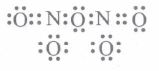
(iil) Dinitrogen pentoxide.
6.
Identify tbe paramagnetic species among following using molecular orbital theory.
7.
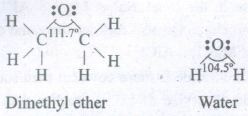
Compare the bond angles of water and dimethyl ether and identify which one has the greater bond angle? Give appropriate reason for your answer
8.
Bond angle in PH+4 is higher than in PH3. Why ?
9.
Define co-ordinate covalent bond.
10.
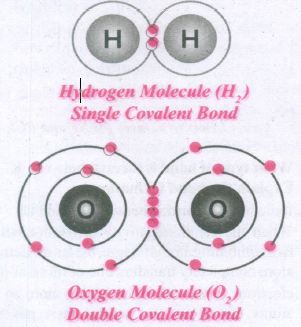
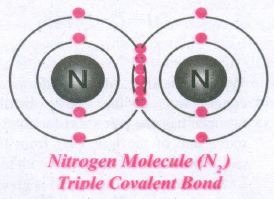
What is covalent bond? Give suitable examples to represent single, double and triple covalent bonds.
1.
Electronic configuration of carbon atom : C : σ1s22s2p2.
In the excited state, the orbital picture of carbon can be represented as:
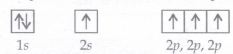
Hence, carbon atom undergoes sp3 hybridisation in CH4 molecule and takes tetrahedral shape.
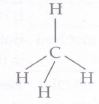
For a square planar shape, the hybridisation of the central atom has to be dsp3, However, an atom of carbon does not have d-orbitals to undergo dsp3 hybridisation. Hence, the structure of CH4 is tetrahedral.
2.
12Mg = 2,8, 2\(\therefore Lewis\ symbol=\overset { . }{ Mg. } \)
11Na = 2,8, 1\(\therefore Lewis\ symbol=\overset { . }{ Na } \)
5B = 2, 3 \(\therefore Lewis\ symbol=.\overset { . }{ B } .\)
8O = 2,6 \(\therefore Lewis\ symbol=:\overset { .. }{ B } :\)
7N = 2,5 \(\therefore Lewis\ symbol=:\overset { .. }{ N } :\)
3sBr = 2,8,18,7 \(\therefore Lewis\ symbol=:\overset { .. }{ Br } .\)
3.
(i) The extent of ionic character in a covalent bond can be related to the electronegativity difference of the bonded atoms.
(ii) In a typical polar molecule Aઠ- - Bઠ++, the electronegativity difference (XA - XB) can be used to predict the percentage of the ionic character as follows:
(iii) If the electronegativity difference XA - XB is equal to 1.7, then the bond A - B has 50% ionic character.
(iv) If it is greater than 1.7, then the bond A - B has more than 50% ionic character.
(v) If it is lesser than 1.7, then the bond A - B has less than 50% ionic character.
4.
(i) In the case of polyatomic molecules with two or more same bond types, the arithmetic mean of the bond energy value of the same type of bonds is considered as average bond enthalpy.
(ii) For e.g., in water, there are two OH bonds present and the energy needed to break them are not same
(iii) \({ H }_{ 2 }O_{ (g) }\longrightarrow H\left( g \right) +OH\left( g \right) \Delta { H }_{ 1 }=502kJ{ mol }^{ -1 }\)
\(OH(g)\longrightarrow H(g)+O(g)\Delta H=427KJmol\)
The average bond enthalpy of OH bond in water
=\(\cfrac { 502+427 }{ 2 } =464.5KJmol^{ -1 }\)
5.
| S.No. | Molecule | Lewis structures | |
| 1 | Ammonia (NH3) | 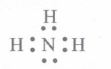 |
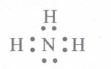 |
| 2. | Methane (CH4) | 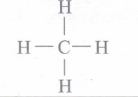 |
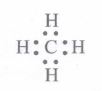 |
| 3. | Dinitrogen pentoxide (N2OS) | 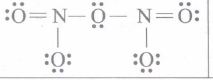 |
 |
6.
\(O^{2-},N_2,C^+_2\)
| Molecule | No.of electrons | Electonic configuration | Bond order |
| \(O^{2-}\) | 18 | \((\sigma_{1s})^2(\sigma^*_{1s})^2(\sigma_{2s})^2(\sigma^*_{2s})^2(\sigma_2p_z)^2(p_2p_x)^2=(p_2p_y)^2(p^*_2p_x)^1=(p^*_2p_y)^1\) | Diamagnetic |
| N2 | 14 | \((\sigma_{1s})^2(\sigma^*_{1s})^2(\sigma_{2s})^2(\sigma^*_{2s})^2(p_2p_x)^2(p_2p_y)^1(\sigma_2p_z)^2\) | Diamagnetic |
| \(C^+_2\) | 11 | \((\sigma_{1s})^2(\sigma^*_{1s})^2(\sigma_{2s})^2(\sigma^*_{2s})^2(p_2p_x)^2(p_2p_y)^1\) | Paramagnetic |
\(C^+_2\) is paramagnetic.
7.
(i) Though the central oxygen atom in both the molecules is sp3 hybridised with two lone pairs, : dimethyl ether has greater bond angle than water molecule.
(ii) The repulsive interaction between the two bulky methyl groups in diethyl ether increases its bond angle.
(iii) Since no such bulky groups are present in water molecule, it does not show such repulsive interaction and hence its bond angle is shorter than dimethyl ether.
8.
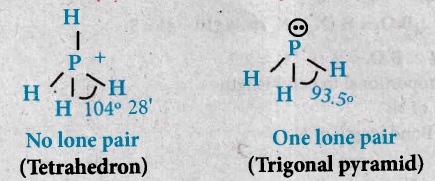
Due to the presence one lone p'air of elctrons on 'p' of PH3 the bond angle is less than 109o28' which is for a tetrahedron. The lone pair occupies more space.
9.
In certain bond formation, one of the combining atoms donates a pair of electrons (i.e.) two electrons which are necessary for the covalent bond formation, and these electrons are shared by both the combining atoms.
These type of bonds are called co-ordinate covalent bond or co-ordinate bond. The combining atom which donates the pair of electron is called a donor atom and the other atom an acceptor atom. This bond is denoted by an arrow starting from the donor atom pointing towards the acceptor atom.
10.
The type of mutual sharing of one or more pairs of electrons between two combining atoms results in the formation of a chemical bond called a covalent bond. If two atoms share just one pair of electron a single covalent bond is formed as in the case of hydrogen molecule. If two or three electron pairs are shared between the two combining atoms, then the covalent bond is called a double bond or a triple bond, respectively

11th Standard Syllabus & Materials
11th Standard
TN 11th Tamil பீடு பெற நில் - செய்யுள் - காவடிச்சிந்து Important Questions And Answers Study Material - QB365 Set A
NEW11th Standard
TN 11th Tamil பீடு பெற நில் - உரைநடை - மலை இடப்பெயர்கள் : ஓர் ஆய்வு Important Questions And Answers Study Material - QB365 Set A
NEW11th Standard
TN 11th Tamil மாமழை போற்றுதும் - துணைப்பாடம் - யானை டாக்டர் Important Questions And Answers Study Material - QB365 Set A
NEW11th Standard
TN 11th Tamil மாமழை போற்றுதும் - செய்யுள் - ஐங்குறுநூறு Important Questions And Answers Study Material - QB365 Set A



Tamilnadu Stateboard 11th Standard Subjects

Maths

Commerce

Economics

Biology

Business Maths and Statistics

Accountancy

Computer Science

Physics
Chemistry
Maths
Biology
Economics
Physics
Chemistry

History
Business Maths and Statistics

Computer Science
Accountancy

Computer Applications
History
Computer Technology
Commerce
Computer Applications
Computer Technology

Tamil

English

French
Tamilnadu Stateboard Standards
