
 100% FREE ACCESS
11th Standard Syllabus & Materials
11th Standard
TN 11th Tamil இயற்கை வேளாண்மை,சுற்றுச்சூழல் -செய்யுள் - மனோன்மணீயம் Important Questions And Answers Study Material - QB365 Set A
NEW11th Standard
TN 11th Tamil என்னுயிர் என்பேன் -துணைப்பாடம் - இசைத்தமிழர் இருவர் Important Questions And Answers Study Material - QB365 Set A
NEW11th Standard
TN 11th Tamil மொழி கலை -செய்யுள் - ஒவ்வொரு புல்லையும் Important Questions And Answers Study Material - QB365 Set A
NEW11th Standard
TN 11th Tamil பீடு பெற நில் - இலக்கணம் - பகுபத உறுப்புகள் Important Questions And Answers Study Material - QB365 Set A
NEW11th Standard
TN 11th Tamil பீடு பெற நில் - துணைப்பாடம் - வாடிவாசல் Important Questions And Answers Study Material - QB365 Set A
NEW11th Standard
TN 11th Tamil பீடு பெற நில் - செய்யுள் - குறுந்தொகை Important Questions And Answers Study Material - QB365 Set A

Published on: 27/12/2018
11th Half Yearly Important Questions
Download Tamil Nadu 11th Standard Chemistry question papers, model tests, one-mark questions, important questions, and public exam papers in PDF format. Free study materials and answer keys for TN State Board students.
Questions + Answers key
Take MCQ Chemistry Test
1.
Two moles of N2 and two moles of H2 are taken in a closed vessel of 5 litre capacity and suitable conditions are provided for the reaction. When the equilibrium is reached, it is found that a half mole of N2 is used up. The equilibrium concentration of NH3 is
0.2
0.4
0.3.
0.1
2.
The formula of the compound is A2B3. The number of electrons in the outermost orbits of A and B respectively are ________
3 and 6
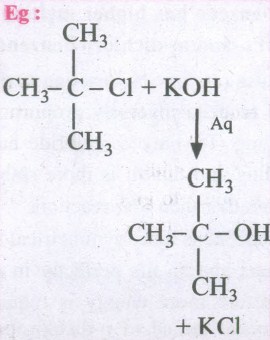
3 and 2
2 and 3
5 and 2
3.
\({ CH }_{ 3 }-{ CH }_{ 3 }-Br\overset { KCN }{ \longrightarrow } X\overset { dil.HCl }{ \underset { \triangle }{ \longrightarrow } } Z\) Z is
CH3CH2COOH
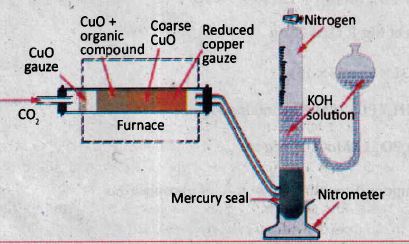
CH3COOH
CH3COCI
CH3CONH2
4.
Which of the following has maximum angle strain?
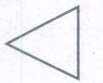


5.
Identify the wrong statement in the following __________.
The clean water would have a BOD value of more than 5 ppm
Greenhouse effect is also called as Global warming
Minute solid particles in air is known as particulate pollutants
Biosphere is the protective blanket of gases surrounding the earth
6.
Which of the following carbocation will be most stable ?
Ph3C-+
\({ C }{ H }_{ 3 }-\overset { + }{ C } { H }_{ 2 }\)
\(\left( { CH }_{ 3 } \right) _{ 2 }-\overset { + }{ C } { H }\)
\(CH_{ 2 }=CH-\overset { + }{ C } { { H }_{ 2 } }\)
7.
The IUPAC name of the compound CH3 – CH = CH – C ≡ CH is _________
Pent - 4 - yn-2-ene
Pent -3-en-l-yne
pent – 2– en – 4 – yne
Pent – 1 – yn –3 –ene
8.
Stomach acid, a dilute solution of HCl can be neutralised by reaction with Aluminium hydroxide
Al (OH)3 + 3HCl (aq) → AlCl3 + 3 H2O
How many millilitres of 0.1 M Al(OH)3 solution are needed to neutralise 21 mL of 0.1 M HCl ?
14 mL
7 mL
21 mL
none of these
9.
Match the list-I and list-II using the code given below the list
| List-I | List-II |
| A.Law of triads | 1.Chancourtois |
| B.Law of octaves | 2.Henry Moseley |
| C.First periodic law | 3.Newland |
| D.Modem periodic law | 4.Johann Dobereiner |
| A | B | C | D |
| 4 | 3 | 1 | 2 |
| A | B | C | D |
| 3 | 4 | 2 | 1 |
| A | B | C | D |
| 1 | 3 | 4 | 2 |
| A | B | C | D |
| 2 | 3 | 1 | 4 |
10.
The bond dissociation energy of methane and ethane are 360 kJ mol-1 and 620 kJ mol-1 respectively. Then, the bond dissociation energy of C-C bond is ______________.
170 kJ mol-1
50 kJ mol-1
80 kJ mol-1
220 kJ mol-1
11.
What is the maximum numbers of electrons that can be associated with the following set of quantum numbers? n = 3, I = 1 and m =-1
4
6
2
= 10
12.
Identify the correct statement(s) with respect to the following reaction :
Zn + 2HCl \(\longrightarrow\) ZnCl2 + H2
(i) Zinc is acting as an oxidant
(ii) Chlorine is acting as a reductant
(iii) Hydrogen is not acting as an oxidant
(iv) Zn is acting as a reductant
only (ii)
only (iv)
both (ii) and (iii)
both (ii) and (i)
13.
The value of the gas constant R is ____________
0.082 dm3 atm.
0.987 cal mol-1K-1
8.3 J mol-1 K-1
8 erg mol-1 K-1
14.
Which of the following statements about hydrogen is incorrect?
Hydrogen ion, H3O+ exists freely in solution.
Dihydrogen acts as a reducing agent.
Hydrogen has three isotopes of which tritium is the most common.
Hydrogen never acts as cation in ionic salts.
15.
Assertion : BeSO4 is soluble in water while BaSO4 is not
Reason : Hydration energy decreases down the group from Be to Ba and lattice energy remains almost constant.
(a) both assertion and reason are true and reason is the correct explanation of assertion
(b) both assertion and reason are true but reason is not the correct explanation of assertion
(c) both assertion and reason are false.
(d) Both assertion and reason are false
both assertion and reason are true and reason is the correct explanation of assertion
both assertion and reason are true but reason is not the correct explanation of assertion
assertion is true but reason is false
both assertion and reason are false.
16.
Complete the following reactions:
(i) \(({ CH }_{ 3 }COO)_{ 2 }pb+Na_{ 2 }S\rightarrow ?\)
(ii) \({ Na }_{ 2 }[(Fe(CN)_{ 5 }NO]+{ Na }_{ 2 }S\rightarrow ?\)
(iii) \(NaCNS+FeCI_{ 3 }\rightarrow ?\)
(iv) \(Na_{ 2 }S+AgNO_{ 3 }\rightarrow ?\)
(v) \(BaCI_{ 2 }+{ Na }_{ 2 }{ SO }_{ 4 }\rightarrow ?\)
(vi) \({ Na }_{ 4 }[Fe(CN)_{ 6 }]+{ FeCI }_{ 3 }\rightarrow ?\)
17.
Explain the isomerism exhibited by alkenes.
18.
Dissolved oxygen in water is responsible for aquatic life. What processes are responsible for the reduction in dissolved oxygen in water ?
19.
Vapour pressure of a pure liquid A is 10.0 torr at 27°C. The vapour pressure is lowered to 9.0 torr on dissolving one gram of B in 20 g of A. If the molar mass of A is 200 then calculate the molar mass of B.
20.
How much volume of chlorine is required to form 11.2 L of HCI at 273 K and 1 atm pressure?
21.
Why there is a need for classification of elements?
22.
Give reason for the following statements. U is an extensive property
23.
Suggest why there is no hydrogen (H2) in our atmosphere. Why does the moon have no atmosphere?
24.
Hydrogen peroxide can function as an oxidising agent as well as reducing agent. Substantiate this statement with suitable examples.
25.
Why is benzylic free radical more stable than allylic free radical ?
26.
How may lone pairs and bond pairs are present in \({ SO }_{ 4 }^{ 2- }\) and H3O+ ?
27.
What are particulate pollutants ? Explain any three.
28.
Compare SN1 and SN2 reaction mechanisms.
29.
What is meant by a functional group ? Identify the functional group in the following compounds.
Acetaldehyde
30.
If 10 volumes of H2 gas react with 5 volumes of O2 gas, how many volumes of water vapour would be produced?
31.
Deep sea divers ascend slowly and breath continuously by time they reach the surface. Give reason.
32.
On the basis of quantum numbers, justify that the sixth period of the periodic table should have 32 elements.
33.
How many orbitals are possible for n = 4?
34.
How is nitrogen estimated by Dumas method?
35.
Give a detailed account on the different mechanisms followed in elimination reaction.
36.
The equilibrium constant KP for the reaction
N2(g) + 3H2(g) ⇌ 2NH3(g) is 8.19 x 10² at 298 K and 4.6 x 10⁻¹ at 498 K. Calculate ΔHo for the reaction
37.
Write the steps to be followed while balancing redox equation by oxidation number method.
38.
When the temperature of a gas increases from 0°C the volume of the gas increases by a factor of 1.25.what is the final temperature ?
39.
List the characteristics of internal energy.
40.
Why does hydrogen occur in a diatomic form rather than in a monoatomic form under normal conditions?
41.
Alkaline earth metal (A), belongs to 3rd period reacts with oxygen and nitrogen to form compound (B) and (C) respectively. It undergo metal displacement reaction with AgNO3 solution to form compound (D).
42.
By using paulings method calculate the ionic radii of K+ and CI- ions in the potassium chloride crystal. Given that dk+-cl-=3.14 Å.
1.
(a)
0.2
2.
(a)
3 and 6
3.
(a)
CH3CH2COOH
4.
(a)
5.
(a)
The clean water would have a BOD value of more than 5 ppm
6.
(a)
Ph3C-+
7.
(b)
Pent -3-en-l-yne
8.
(b)
7 mL
9.
(a)
| A | B | C | D |
| 4 | 3 | 1 | 2 |
10.
(c)
80 kJ mol-1
11.
(c)
2
12.
(b)
only (iv)
13.
(c)
8.3 J mol-1 K-1
14.
(c)
Hydrogen has three isotopes of which tritium is the most common.
15.
(a) both assertion and reason are true and reason is the correct explanation of assertion
16.
| (i) | \(({ CH }_{ 3 }COO)_{ 2 }pb+Na_{ 2 }S\rightarrow ?\) Lead acetate |
\(PbS\downarrow +2CH_{ 3 }COONa\) Lead Sulphide |
| (ii) | \({ Na }_{ 2 }[(Fe(CN)_{ 5 }NO]+{ Na }_{ 2 }S\rightarrow ?\) Sod.nitro prusside |
\({ Na }_{ 4 }[(Fe(CN)_{ 5 }NOS]\) |
| (iii) | \(NaCNS+FeCI_{ 3 }\rightarrow ?\) | Fe(CNS)3+3NaCI Ferric sulpho cyanide |
| (iv) | \(Na_{ 2 }S+AgNO_{ 3 }\rightarrow ?\) Sodium sulphide silver Nitrate |
\(Ag_{ 2 }S\downarrow +NaNO_{ 3 }\) Silver sulphide |
| (v) | \(BaCI_{ 2 }+{ Na }_{ 2 }{ SO }_{ 4 }\rightarrow ?\) Barium chloride soddium sulphate |
BaSO4+2NaCI Barium sulphate |
| (vi) | \({ Na }_{ 4 }[Fe(CN)_{ 6 }]+{ FeCI }_{ 3 }\rightarrow ?\) Sod. Ferrocyanide Ferric chloride |
\({ Fe }_{ 4 }[Fe(CN)_{ 6 }]_{ 3 }+12NaCI\) Ferric Ferro cyanide |
17.
Isomerism:
Presence of double bond in alkene provides the possibility of both structural and geometrical isomerism.
Structural Isomerism:
The first two member's ethene C2H4 and propene C3H6 do not have isomers because the carbon atoms in the molecules can be arranged only one distinct way.
However from the third member of alkene family butene C4H10 structural isomerism exists.
(i) CH3-CH = CH-CH3 1-Butene
(ii) CH2=CH-CH2-CH3 2-Butene
(iii) \({ CH }_{ 2 }=\overset { \underset { | }{ { CH }_{ 3 } } }{ C } -{ CH }_{ 3 }\) 2-Methyl-1-propene
structures (i) & (ii) are position isomers. structures (i) & (iii), (ii) & (iii) are chain isomers.
Geometrical isomerism:
It is a type of stereoisomerism and it is also called cis-trans isomerism. Such type of isomerism results due to the restricted rotation of doubly bounded carbon atoms.
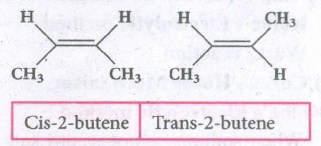
if the similar groups lie on the same side, then the geometrical isomers are called C is-isomers. When the similar groups lie on the opposite side, it is called a Trans isomer.
for example: the geometrical isomers of 2-Butane is expressed as follow
18.
a) The growth of algae in extreme abundance covers the water surface and reduces the oxygen concentration in water. Thus, bloom-infested water inhibits the growth of other living organisms in the water body. This process in which the nutrient rich water bodies support a dense plant population, kills animal life by depriving it of orygen and results in loss of biodiversity is known as eutrophication.
b) Chemicals from industries
c) Toxic pesticides
d) Detergents and oil floats
e) Acids from mine drianage and salts from various sources.
19.
\(P_A^o\) = 10 torr, Psolution = 9 torr
WA = 20 g WB = 1 g
MA = 200 g mol-1 MB = ?
\({\Delta P\over P_A^o}={W_B\times M_A\over M_B\times W_A}\)
\({10-9\over 10}={1\times 200\over M_B\times 20}\)
\(M_B={200\over 20}\times 10=100\ g\ mol^{-1}\)
20.
The balanced equation for the formation of HCI is,
H2(g) + CI2(g) \(\rightarrow\) 2 HCI (g)
As per the stoichiometric equation, under given conditions,
To produce 2 moles of HCI, 1 mole of chlorine gas is required.
To produce 44.8 litres of HCI, 22.4 litres of chlorine gas are required.
\(\therefore\) To produce 11.2 litres of HCI,
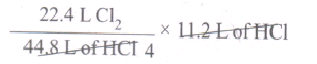
= 5.6 litres of chlorine are required.
21.
(i) Classification is a fundamental and essential process in our day-to-day life for the effective utilization of resources, daily events and materials
(ii) In such a way, for the effective utilization of discovered elements becomes fundamentally essential process.
(iii) The periodic classification of the elements is one of the outstanding contributions to the progress of chemistry.
22.
'U' is an extensive property because its magnitude depends on the quantity of material in the system.
23.
a) Hydrogen is the lightest gas in the atmosphere. So it rises up and other gases which are heavier like O2 & N2 come down towards the surface of the earth according to Graham's law of diffusions \(\mathrm{r} \alpha \sqrt{\frac{1}{M}}\). Hydrogen diffuses very fast. Its mean speed in greater than the escape velocity from the earth. As a consequence, H2 would have escaped from the atmosphere long time ago.
b) The acceleration due to gravity 'g' on moon surface is small. The value of escape velocity is also small. The molecules of the atmospheric gases on the moon's surface have thermal velocities greater than the escape velocity.
All the molecules have escaped. So the atmosphere is so thin.
24.
a) Oxidation is performed in acidic medium:
Eg : H2O2 Oxidises FeSO4 to Fe (SO4)3
H2O2 + 2H++ 2e- ➝ 2H2O (E0 = +1.77 V)
2FeSO4 + H2SO4 + H2O2 ➝ Fe2(SO4)3 + 2H2O
b) Reduction is performed in basic medium:
Eg : H2O2 reduces KMnO4 to MnO2
HO2- + OH- ➝ H2O + 2e- (E0 = +0.08 V)
\(2 \mathrm{KMnO}_{4}+3 \mathrm{H}_{2} \mathrm{O}_{2} \rightarrow 2 \mathrm{MnO}_{2}+2 \mathrm{KOH}+2 \mathrm{H}_{2} \mathrm{O}+3 \mathrm{O}_{2}\)
25.
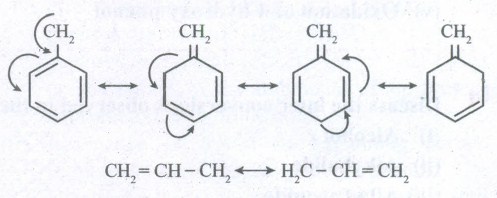
(i) The benzylic free radical is resonance stabilised. It possess more resonance structures.
(ii) Allylic free radical has only two resonating structures, so it has less delocalisation.
26.
\({ SO }_{ 4 }^{ 2- }\)contains 6 bond pairs and 10 lone pairs
H3O+ contains 3 bond pairs and 1 lone pair.
27.
Particulate pollutants are small solid particles and liquid droplets suspended in air. Many of particulate pollutants are hazardous.
Examples : dust, pollen, smoke, soot and liquid droplets (aerosols) etc,.
They are blown into the atmosphere by volcanic eruption, blowing of dust, incomplete combustion of fossil fuels induces soot. Combustion of high ash fossil fuels creates fly ash and finishing of metals throws metallic particles into the atmosphere.
The non- viable particulates are small solid particles and liquid droplets suspended in air. They help in the transportation of viable particles. There are four types of non-viable particulates in the atmosphere. They are classified according to their nature and size as follows.
(i) Smoke : Smoke particulate consists of solid particles (or) mixture of solid and liquid particles formed by combustion of organic matter.
For example, cigarette smoke, oil smoke, smokes from burning of fossil fuel, garbage and dry leaves.
(ii) Dust: Dust composed of fine solid particles produced during crushing and grinding of solid materials.
For example, sand from sand blasting, saw dust from wood works, cement dust from cement factories and fly ash from power generating units.
(iii) Mists : They are formed by particles of spray liquids and condensation of vapours in air.
For example, sulphuric acid mist, herbicides and insecticides sprays can form mists.
(iv) Fumes : Fumes are obtained by condensation of vapours released during sublimation, distillation, boiling and calcination and by several other chemical reactions.
For example : organic solvents, metals and metallic oxides form fume particles.
28.
| SN1 Reaction | SN2 product |
| It is unimolecular reaction | It is a bimolecular reaction. |
| Its mechanism occurs in two steps | It is a one step process |
| It involves the formation of an intermediate (Carbocation) | It involves the formation of transition sate. |
| Rate = k[Alkyl halide] | Rate = k[Alkyl halide] [Nuclophile] |
| Products have both retained and inverted configuration | Products have inverted configuration. |
| Carbocation rearrangement occurs. | No carbocation rearrangement occurs. |
| Reactirity : Methyl <1 ° < 2° < 3° |
IReactirity : Methyl >1° > 2° > 3° |
 |
Eg: \(CH_{ 3 }Cl+KOH\overset { Aq }{ \rightarrow } { CH }_{ 3 }OH+KCl\) |
29.
Functional group :
A functional group is an'atom or a specific combination of bonded atoms that react in a characteristic way, irrespective of the organic molecule in which it is present.
Acetaldehyde - CHO.
30.
\(\underset { 2\ volumes }{ { 2H }_{ { 2 }_{ (g) } } } +\underset { 1\ volumes }{ { O }_{ { 2 }_{ (g) } } } \rightarrow \underset { 2\ volumes }{ { 2H }_{ 2 }{ O }_{ (g) } } \)
Thus 2 volumes of H2 reacts with 1 volume of O2 to produce 2 volumes of H2O (g)
\(\therefore\) 10 volumes of H2 would react with 5 volumes of O2 to produce 10 volumes of H2O(g).
Thus 10 volumes of H2O will be produced.
31.
(i) For every 10 m of depth, a diver experiences an additional 1 atm of pressure due to the weight of water surrounding him.
(ii) At 20 m, the diver experiences a total pressure on atm. So the most important rule in diving is never hold breath.
(iii) Divers must ascend slowly and breath continuously allowing the regulator to bring the air pressure in their lungs to 1 atm by the time they reach the surface.
32.
The sixth period corresponds to sixth shell. The orbitals present in this shell are 6s, 4f, 5p and 6d. The maximum number of electrons which can be present in these sub-shell is 2 + 14 + 6 + 10 = 32. Since the number of elements in a period corresponds to the number of electrons in the shells, the sixth period should have a maximum of 32 elements.
33.
| n | l | m | orbitals | Total no of orbitals |
| 0 | 0 | 1 | (1- 4s +3 - 4P orbital +5 - 4d orbital +7 - 4f orbital) =16 |
|
| 4 | 1 | -1 0 +1 |
3 | |
| 2 |
-2 |
5 | ||
| 3 |
-3 |
7 |
34.
This method is based upon the fact that nitrogenous compound when heated with cupric oxide in an atmosphere of CO2 yields free nitrogen. Thus
\({ C }_{ x }{ H }_{ y }{ N }_{ z }+\left( 2x+\frac { y }{ 2 } \right) CuO\longrightarrow xCO_{ 2 }+\frac { y }{ 2 } H_{ 2 }O+\frac { Z }{ 2 } { N }_{ 2 }+\left( 2x+\frac { y }{ 2 } \right) Cu\)
Traces of oxide of nitrogen, which may be formed in some cases, are reduced to elemental nitrogen by passing over heated copper spiral. The apparatus used in Dumas method consists of CO2 generator, combustion tube, Schiffs nitrometer.
CO2 generator:
CO2 needed in this process is prepared by heating magnetite or sodium bicarbonate contained in a hard glass tube or by the action of dil. HCI on marble in a Kipps apparatus. The gas is passed through the combustion tube after being dried-by bubbling through cone. H2SO4,
Combustion Tube:
The combustion tube is heated in a furnace is charged with a) a roll of oxidized copper gauze to prevent the back diffusion of the products of combustion and to heat the organic substance mixed with CuO by radiation b) a weighed amount of the organic substance mixed with excess of CuO, c) a layer of course CuO packed in about 2/3 of the entire length of the tube and kept in position by loose asbestos plug on either side; this oxidizes the organic vapors passing through it, and d) a reduced copper spiral which reduces any oxides of nitrogen formed during combustion to nitrogen.
Schiff's nitro meter:
The nitrogen gas obtained by the decomposition of the substance in the combustion tube is mixed with considerable excess of CO2 It is estimated by passing nitrometer when CO2 is absorbed by KOH and the nitrogen gets collected in the upper part of graduated tube.
Procedure:
To start with the tap of nitrometer is left open CO2 is passed through the combustion tube to expel the air in it. When the gas bubbles risin through, the potash solution fails to reach the top of it and is completely absorbed it shows that only CO2 is coming and that all air has been expelled from the combustion tube. The nitrometer is then and the tap is closed. The combustion tube is now heated in the furnace and the temperature rises gradually. The nitrogen set free from the compound collects in the nitrometer. When the combustion is complete a strong current of CO2 is sent through, the apparatus in order to sweep the last trace of nitrogen from it. The volume of the gas gets collected is noted after adjusting the reservoir so that the solution in it and the graduated tube is the same. The atmospheric pressure and the temperature are also recorded.
Calulations:
Weight of the substance taken = wg
Volume of nitrogen = V1L
Room temperature =T1K
Atmospheric pressure = P mm of Hg
Agueen tension at
room temperature = p1 mm ofHg
Pressure of dry nitrogen = (P - p1) = PI mm of Hg.
Let Po Vo and To be the pressure, Volume and temperature respectively of dry nitrogen at STP,
Then, \(\frac { { P }_{ 0 }{ V }_{ 0 } }{ { T }_{ 0 } } =\frac { { P }_{ 1 }{ V }_{ 1 } }{ { T }_{ 1 } } \)
\(\therefore { V }_{ 0 }=\frac { { P }_{ 1 }{ V }_{ 1 } }{ { T }_{ 1 } } \times \frac { { T }_{ 0 } }{ { P }_{ 0 } } \)
\({ V }_{ 0 }=\left( \frac { { P }_{ 1 }{ V }_{ 1 } }{ { T }_{ 1 } } \times \frac { 273K }{ 760 } \right) \)
Calculation of percentage of nitrogen. 22.4 L of N2 at STP weigh 28g of N2
\(\therefore \) V0 L of N2 at S.T.P weigh \(\frac { 28 }{ 22.4 } \times { V }_{ 0 }\)
wg of organic compound contain \(\left( \frac { 28 }{ 22.4 } \times \frac { { V }_{ 0 } }{ W } \right) \)
\(\therefore \) Percentage of nitrogen= \(\left( \frac { 28 }{ 22.4 } \times \frac { { V }_{ 0 } }{ W } \right) \times 100\)
35.
Elimination reactions may proceed through two different mechanisms namely E1 and E2
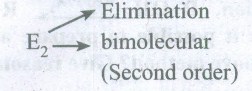
(i) The rate of E2 reaction depends on the concentration of alkyl halide and base Rate = k [alkyl halide] [base]
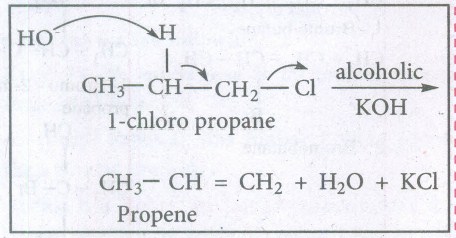
(ii) It is therefore, a second order reaction. Generally primary alkyl halide undergoes this reaction in the presence of alcoholic KOH. It is a one step process in which the abstraction of the proton from the . p carbon and expulsion of halide from the a carbon occur simultaneously. The mechanism is shown below.
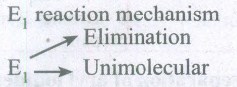
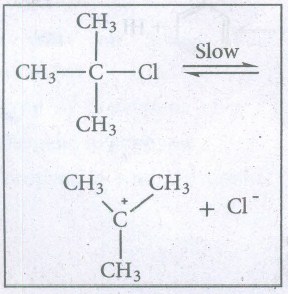
(iii) Generally, tertiary alkyl halide which undergoes elimination reaction by this mechanism in the presence of alcoholic KOH. It follows first order kinetics. Let us. consider the following elimination reaction.
Step - 1: Heterolytic fission to yield a carbocation
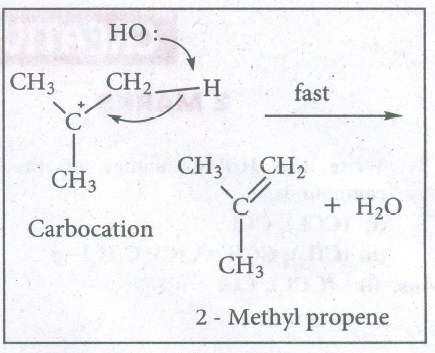
Step - 2 Elimination of a proton from the \(\beta\)- carbon to produce an alkene.
36.
Kp1 = 8.19 x 10² T1 = 298K
Kp2 = 4.6 x 10⁻¹ T2 = 498K
\(\log({K_{p_2}\over K_{P_1}})={\Delta H^o\over 2.303\times 8.314}({T_2-T_1\over T_1T_2})\)
\(\log({4.6\times 10^{-1}\over 8.19\times 10^2})={\Delta H^o\over 2.303\times 8.314}({498-298\over 498\times 298})\)
\({-3.2505\times 2.303\times 8.314\times 498\times 298\over 200}=\Delta H^o\)
\(\Delta H^o=\) -46181 J mol-1
\(\Delta H^o=\) -46.18 J mol-1.
37.
Oxidation number method:
This method is based on the fact that
Number of electrons lost by atoms = Number of electrons gained by atoms
Steps to be followed while balancing Redox reactions by Oxidation Number method:
1. Write skeleton equation representing redox reaction
2. Write the oxidation number of atoms undergoing oxidation and reduction.
3. Calculate the increase or decrease in oxidation numbers per atom.
4, Make increase in oxidation number equal to decrease in oxidation number by multiplying the formula of oxidant and reductant by suitable numbers.
5. Balance the equation atomically on both sides except O and H atoms.
6. Balance oxygen atoms by adding required number of water molecules to the side deficient in oxygen atoms.
7. Add required number of H+ ions to the side deficient in hydrogen atom if the reaction is in acidic medium.
8. For reactions in basic medium, add H2O molecules to the side deficient in hydrogen atoms and simultaneously add equal number of OH- ions on the other side of the equation.
9. Finally, balance the equation by cancelling common species present on both sides of the equation.
38.
Initial temperature T1 of the gas = 0°C = 0 + 273
= 273°C
Let the Initial volume of the gas V1 = x ml
The final volume V2 of the gas = 1.25 \(\times\) xml
According to Charles' law
\(\frac { { V }_{ 1 } }{ { T }_{ 1 } } =\frac { { V }_{ 2 } }{ { T }_{ 2 } } \)
\(\frac { x }{ 273 } =\frac { 1.25\times x }{ { T }_{ 2 } } \)
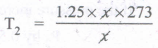
= 341.25 K
The final temperature = 341.25 K
39.
Characteristics of internal energy (U) :
40.
Hydrogen atom has only one electron in its valence shell. So, to achieve the stable noble gas configuration of helium, it requires only one electron. For this it shares its one electron with another hydrogen atom to form a stable diatomic molecule.
41.
(i) Alkaline earth metal (A) belonging to 3rd period is magnesium.
(ii) So A is Magnesium. Magnesium reacts with oxygen and nitrogen as follows.
\(2Mg+O_2⟶\underset{(B)}{2MgO}\)
\(3Mg+N_2⟶\underset{(C)}{Mg_3N_2}\)
So B is Magnesium oxide and C is magnesium nitride.
(iii) Magnesium undergoes metal displacement reaction with AgNO3 as follow to give D as follows :
\(Mg+2AgNO_3⟶\underset{D}{Mg(NO_3)_2}+2Ag\)
So D is Magnesium nitrate.
Result :
| Compound or Element | Symbol or Formula | Name |
|---|---|---|
| A | Mg | Magnesium |
| B | MgO | Magnesium oxide |
| C | Mg3N2 | Magnesium nitride |
| D | Mg(NO3)2 | Magnesium nitrate |
42.
r(K+)+r(Cl-) = d(K+-Cl-) = 3.14 Å.
The effective nuclear charge for K+ and CI- can be calculated as follows.
K+ = (1s2) (2s22p6) (3s23p6)
inner shell (n-1)th shell nth shell
Z*(K-) = Z-S
= 19 - [(0.35 x 7) + (0.85 x 8) + (1 x 2)]
= 19 - 11.25 = 7.75
Z*(Cl-) = 17- [(0.35 x 7) + (0.85 x 8) + (1 x 2)]
= 17-11.25 = 5.75
∴ \(\frac { r({ K }^{ + }) }{ r(Cl^{ - }) } =\frac { Z*(Cl^{ - }) }{ Z*(K^{ + }) } =\frac { 5.75 }{ 7.75 } \)=0.74
∴ r(K+) = 0.74 r(Cl-)
Substitute (2) in (1)
0.74 r(Cl-) + r(Cl-) = 3.14 Å.
1.74 r(Cl-) = 3.14 Å
r(Cl-) = \(\frac { 3.14\overset { 0 }{ A } }{ 1.74 } \)=1.81.Å.

11th Standard Syllabus & Materials
11th Standard
TN 11th Tamil பீடு பெற நில் - செய்யுள் - காவடிச்சிந்து Important Questions And Answers Study Material - QB365 Set A
NEW11th Standard
TN 11th Tamil பீடு பெற நில் - உரைநடை - மலை இடப்பெயர்கள் : ஓர் ஆய்வு Important Questions And Answers Study Material - QB365 Set A
NEW11th Standard
TN 11th Tamil மாமழை போற்றுதும் - துணைப்பாடம் - யானை டாக்டர் Important Questions And Answers Study Material - QB365 Set A
NEW11th Standard
TN 11th Tamil மாமழை போற்றுதும் - செய்யுள் - ஐங்குறுநூறு Important Questions And Answers Study Material - QB365 Set A



Tamilnadu Stateboard 11th Standard Subjects

Maths

Commerce

Economics

Biology

Business Maths and Statistics

Accountancy

Computer Science

Physics
Chemistry
Maths
Biology
Economics
Physics
Chemistry

History
Business Maths and Statistics

Computer Science
Accountancy

Computer Applications
History
Computer Technology
Commerce
Computer Applications
Computer Technology

Tamil

English

French
Tamilnadu Stateboard Standards
