
 100% FREE ACCESS
11th Standard Syllabus & Materials
11th Standard
TN 11th Tamil இயற்கை வேளாண்மை,சுற்றுச்சூழல் -செய்யுள் - மனோன்மணீயம் Important Questions And Answers Study Material - QB365 Set A
NEW11th Standard
TN 11th Tamil என்னுயிர் என்பேன் -துணைப்பாடம் - இசைத்தமிழர் இருவர் Important Questions And Answers Study Material - QB365 Set A
NEW11th Standard
TN 11th Tamil மொழி கலை -செய்யுள் - ஒவ்வொரு புல்லையும் Important Questions And Answers Study Material - QB365 Set A
NEW11th Standard
TN 11th Tamil பீடு பெற நில் - இலக்கணம் - பகுபத உறுப்புகள் Important Questions And Answers Study Material - QB365 Set A
NEW11th Standard
TN 11th Tamil பீடு பெற நில் - துணைப்பாடம் - வாடிவாசல் Important Questions And Answers Study Material - QB365 Set A
NEW11th Standard
TN 11th Tamil பீடு பெற நில் - செய்யுள் - குறுந்தொகை Important Questions And Answers Study Material - QB365 Set A

Published on: 21/01/2020
Download Tamil Nadu 11th Standard Chemistry question papers, model tests, one-mark questions, important questions, and public exam papers in PDF format. Free study materials and answer keys for TN State Board students.
Questions + Answers key
Take MCQ Chemistry Test
1.
Starting from methyl magnesium iodide, how would you prepare
(i) Ethyl methyl ether
(ii) methyl cyanide
(iii) methane
2.
Explain the structure of benzene.
3.
What are the health effects of particulate pollutants?
4.
Define ionic bond. Give suitable examples and distinguish between covalent bond and ionic bond.
5.
Calculate the volume of 1.5N H2SO4 is completely neturalized by 35.8 mL of
(a) 2.5N NaOH
(b) 2.5M NaOH
(c) 2.5N Ba(OH)2
(d) 2.5M Ba(OH)2
6.
(i) How does pollutants vary from contaminants?
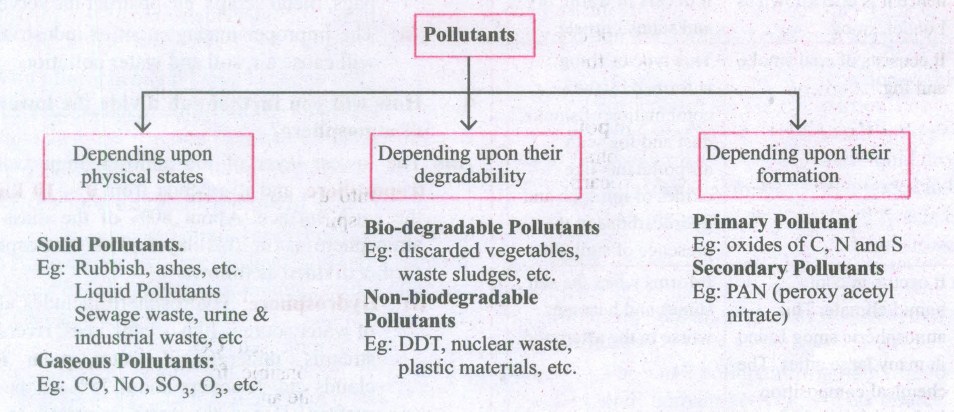
(ii) Classify the pollutants on the following basis & give examples.
Depending on their physical state
Depending upon their degradability.
Depending on their formation and existence in nature.
7.
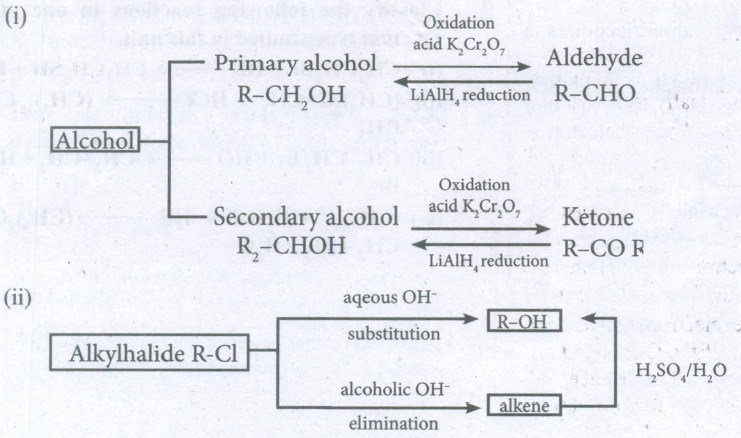
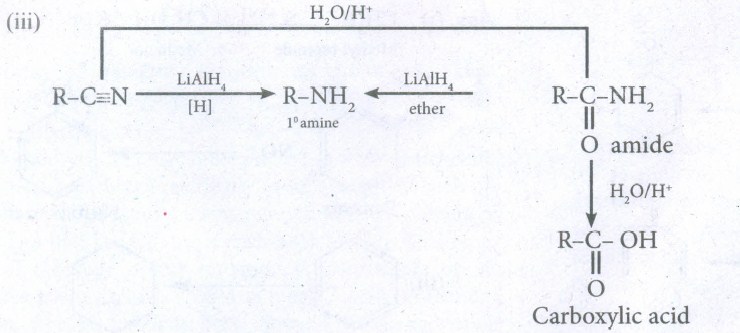
Discuss the inter conversions observed in the following functional groups.
(i) Alcohol
(ii) Alkyhalide
(iii) Alkyl cyanide
8.
0.26g of an organic compound gave 0.039 g of water and 0.245 g of carbon dioxide on combustion. Calculate the percentage of C & H.
9.
Explain the steps involved in ion-electron method for balancing redox reaction.
10.
Explain Andrew's isotherm of carbon dioxide.
11.
Distinguish between reversible and irreversible process
12.
A gas has a volume of 6.85 dm3 at a pressure of 0.650 atm. When pressure is Increased by 0.5 atm. what will be its volume?
13.
What are the factors influencing ionization enthalpy.
14.
Calculate the standard heat of formation of propane, if its heat of combustion is -2220.2 kJ mol-1.. The heats of formation of CO2(g) and H2O(l) are -393.5 and -285.8 kJ mol-1 respectively
15.
What is the de Broglie wave length of an electron, which is accelerated from the rest, through a potential difference of 100 V ?
16.
What is the de Broglie wavelength (in cm) of a 160 g cricket ball travelling at 140 Km hr -1.
17.
18.
The reaction between aluminium and ferric oxide can generate temperatures up to 3273 K and is used in welding metals. (Atomic mass of Al = 27 u atomic mass of O = 16 u )
2Al + Fe2O3 \(\longrightarrow \) Al2O3 + 2Fe; If in this process, 324 g of aluminum is allowed to react with 1.12 kg of ferric oxide
i) Calculate the mass of Al2O3 formed
ii) How much of the excess reagent is left at the end of the reaction ?
19.
Write the Van der Waals equation for a real gas. Explain the correction term for pressure and volume.
20.
1 mol of CH4, 1 mole of CS2 and 2 mol of H2S are 2 mol of H2 are mixed in a 500 ml flask. The equilibrium constant for the reaction KC = 4 x 10⁻² mol2 lit–2. In which direction will the reaction proceed to reach equilibrium ?
1.
(i) Ethyl methyl ether: Lower halogenated ether reacts with grignard reagent to form higher ether.
\(\underset { Chloro\quad dim\quad ether }{ { CH }_{ 3 }O-{ CH }_{ 2 }Cl } +\underset { Methyl\quad magnesium\\ iodide }{ { CH }_{ 3 }Mgl } \longrightarrow \underset { Ethyl\quad methyl\quad ether }{ { CH }_{ 3 }-O-{ CH }_{ 2 }-{ CH }_{ 3 } } \)
(ii) Methyl cyanide: Grignard reagent reacts with cyanogen chloride to form alkyl cyanide.

(iii) Methane: Grignard reagent reacts with water to give methane as product.

2.
1. Molecular formula: Elemental analysis and molecular weight determination have proved that the molecular formula of benzene is C6H6. This indicates that benzene is a highly unsaturated compound.
2. Straight chain structure is not possible: Benzene could be constructed as a straight chain but it not feasible since it does not show the properties of alkenes or alkynes. For example, it does not decolorise the bromine water in CCI4.
3. Evidence of cyclic structure:
(i) In the presence of Nickel, benzene reacts with hydrogen to give cyclohexane, a six membered ring. This proves that benzene is a hexagonal molecule with three double bonds.
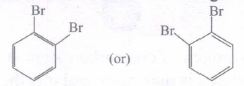
(ii) Benzene reacts with bromine in the presence of iron to give substituted C6H5Br. No isomers of C6H5Br was identified. On further reaction with bromine three isomeric disubstituted products C6H4Br2 are formed. On this basis Kekule proposed that benzene consists of ring of carbon atoms with alternate single and double bonds.
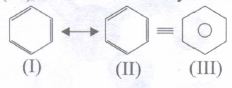
4. Resonance description of benzene: The phenomenon in which two or more structures can be written for a substance which has identical position of atoms is called resonance. The actual structure of the molecule is said to be a resonance hybrid of various possible alternative structures. In benzene, Kekule's structure (I) and (II) represented the resonance structures and structure (III) is the resonance hybrid of structure I and II.
5. Spectroscopic measurements: X-ray and electron diffraction studies indicated that all carbon-carbon bonds are of equal length which is in between that of a single bond
(1.45Å) and that of a double bond (1.34Å).
6. Molecular orbital structure: (i) Benzene is a flat hexagonal molecule with all carbons and hydrogen lying in the same plane with a bond angle of 120°. Each carbon atom has Sp2 hybrid orbitals of carbon, overlap with each other and with s-orbitals of six hydrogen atoms forming six sigma (σ) C-H bonds and six sigma (σ) C - C bonds.
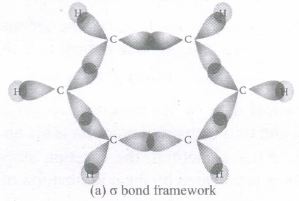
(ii) All the a-bonds in benzene lies in one plane with bond angle of 120°. Each C-atom in benzene possess an unhybridised p-orbital containing one electron. The lateral overlap of their p-orbitals produces 3π-bond, the six electrons of the p-orbitals cover all the six C-atoms and are said to be delocalised. Due to this delocalisation, strong re-bond is formed which makes the molecule stable.
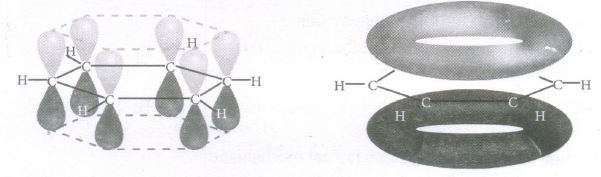
7. Representation of benzene: Hence, there are three ways is which benzene can be represented.
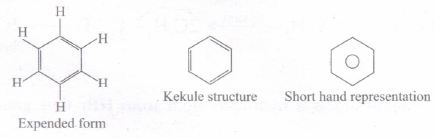
3.
(i) Dust, mist, fumes etc. are air borne particles which are dangerous for human health. Particulate pollutants bigger than 5 microns are likely to settle in the nasal passage whereas particles of about 10 microns enter the lungs easily and causes scaring or fibrosis of lung lining. They irritate the lungs causes cancer and asthma. This disease is called pneumoconiosis. Coal miners may suffer from black lung disease. Textile workers may suffer from white lung disease.
(ii) Lead particulates affect children's brain, interferes with the maturation of RBC's and even causes cancer.
(iii) Particulates in the atmosphere reduces the visibility by scattering and absorption of sunlight. It is dangerous for aircraft and motor vechiles.
(iv) Particulates provide nuclei for cloud formation and increase fog and rain.
(v) Particulates deposit on plant leaves and hinder the intake of CO2 from the air and affect photosynthesis.
4.
Ionic bond:
The electrostatic force of attraction existing between the cation and anion produced by electron transfer from one atom to other is known as the ionic bond.
| IONIC BOND | COVALENT BOND | |
| 1. | The electrostatic force of attraction existing between the sharcation & anion produced by electron transfer from one atom to other is known as ionic bond. |
The bond formed between two atoms of by mutual sharing of electrons between them is called covalent bond. |
| 2. | Eg: \(\underset { [Ne]{ 3s }^{ 1 } }{ Na } \rightarrow \underset { [Ne] }{ { Na }^{ + } } +{ e }^{ - }\) \(\underset { [Ne]{ 3s }^{ 2 } 3p^5}{ cl } +e^-\rightarrow \underset { [Ne]{ 3s }^{ 2 } 3p^6}{ cl ^-} \) \({ Na }^+ cl^-\rightarrow Na cl\) |
eg: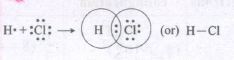 |
| 3. | It is non-directional and extends in all the directions. | It is directional. |
| 4. | Ionic compounds possess high melting and boiling points. | Covalent compounds exhibit low melting and boiling points. |
| 5. | Highly soluble in water. | Mostly insoluble in water but soluble in non-polar solvent |
5.
(a) V1N1 = V2N2
Volume of H2SO4(V1) = x ml
Normality of H2SO4(N1) = 1.5 N
Volume of NaoH(V2) = 35.8 ml
Normality of NaOH(N2) = 2.5 N
According to Volumetric law
V1N1 = V2N2
x \(\times\) 1.5 = 35.8\(\times\)2.5
x = \(\frac { 35.8\times \quad 2.5 }{ 1.5 } \)
x = 59.66 ml
(b) 2.5 m NaOH
Normality = Molality x Acidily
= 25\(\times\)1 = 2.5
Volume of H2SO4(V1) = x ml
Normality of H2SO4 (N1) = 1.5N
Volume of NaOH (V2) = 35.8 ml
Normality of NaOH(N2) = 25 N
V1N1 = V2N2
x\(\times\)1.5 = 35.8 \(\times\)2.5
x = \(\frac { 35.8\times \ 2.5 }{ 1.5 } \)
x = 59.66 ml
(c) 2.5 N Ba(OH)2
Volume of H2SO4(V1) = x ml
Normality of H2SO4(N1) = 1.5 N
Volume of Ba (OH)2(V2) = 35.8 ml
Normality of NaOH(N2) = 2.5 N
According to volumetric New
V1N1= V2N2
x x 1.5 = 35.8 x 2.5
x = \(\frac { 35.8\times \quad 2.5 }{ 1.5 } \)
x = 59.66ml
(d)2.5 M Ba(OH)2
Normality = molality x Acidily
= 2.5\(\times\)2 = 5N
Volume of H2SO4(V1) = x ml
Normality of H2SO4(N1) = 1.5 N
Volume of Ba (OH)2(V2) = 35.8 ml
Normality of NaOH(N2) = 5 N
According to volumetric Law
V1N1 = V2N2
x\(\times\)1.5 = 35.8\(\times\)5
x = \(\frac { 35.8\times \ 5 }{ 1.5 } \)
x = 119.3
6.
| Pollutants | Contaminants |
|---|---|
| A substance which causes pollution are called pollutants. Eg: Fertilizers | The pollutants that do not occur in nature and are introduced into the environment by human activity are called contaminants. Eg: pyrosulphuric acid (H2S2O7). |
7.
8.
Weight of organic compound = 0.26g
Weight of water = 0.039g
Weight of CO2 = 0.245g
Percentage of hydrogen
\(
\% =\frac{2}{18} \times \frac{x}{\mathrm{w}} \times 100
\)
\(=\frac{2}{18} \times \frac{0.039}{0.26} \times 100
\)
\(=1.66 \%\)
Percentage of carbon
\(\% \mathrm{C} =\frac{12}{44} \times \frac{\mathrm{y}}{\mathrm{w}} \times 100
\)
\(=\frac{12}{44} \times \frac{0.245}{0.26} \times 100=25.69 \%
\)
9.
Ion-electron method makes use of the Half reactions. Steps involved in this method are,
1. Write the equation in the net ionic form without attempting to balance it.
2. Write and locate the oxidation number of atoms undergoing oxidation and reduction from the knowledge of calculation of oxidation number.
3. Write two half reactions showing oxidation and reduction separately.
4. Balance oxygen atoms by adding required number of water molecules to the side deficient in oxygen atoms.
5. Add required number of H+ ions to the side deficient in hydrogen atom if the reaction is in acidic medium
6. Add electrons to whichever side is necessary to make up the difference in oxidation number.
7. Add the two half reactions. The resulting equation is a net balanced equation.
8. For reactions in basic medium, add H2O and hydrogen ion to balance H and O.
9. Finally, balance the equation by cancelling common species present on both sides of the equation.
10.
The isotherms of carbon dioxide at different temperatures which is shown.in figure.
From the plots we can infer the following:
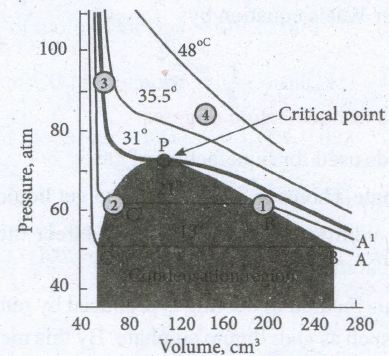
At low temperature isotherms, for example, at 13°C as the pressure increases, the volume decreases along AB and is a gas until the point B is reached. At B, a liquid separates along the line BC, both the liquid and gas co-exist and the pressure remains constant. At C, the gas is completely converted into liquid. If the pressure is higher than at C, only the liquid is compressed so, there is no significant change in the volume. The successive isotherms shows similar trend with the shorter flat region. i.e. The volume range in which the liquid and gas coexist becomes shorter. At the temperature of 31.1°C the length of the shorter portion is reduced to zero at point P. In other words, the CO2 gas is liquefied completely at this point. This temperature is known as the liquefaction temperature or critical temperature of CO2, At this point the pressure is 73 atm. Above this temperature CO2 remains as a gas at all pressure values. It is then proved that many real gases behave in a similar manner to carbon dioxide.
11.
| S.No | REVERSIBLE PROCESS | IRREVERSIBLE PROCESS |
| 1 | It takes place in both forward and backward direction | It takes place in one direction only |
| 2 | The driving force for reversible process is small. | There is a definite driving force required |
| 3 | Work done in a reversible process is greater. | Work done in a irreversible process is always lower |
12.
Volume of gas V 1 = 6.85 dm3
at a pressure P1 = 0.650 atm
If the pressure increased
P2 by 0.5 atm = P1 + 0.5
= 0.650 + 0.5
= 1.15 atm
Volume of the gas V2 = ?
According to Boyle's law
P1 V1 = P2 V2,
6.85 \(\times\) 0.650 = V2 \(\times\) 1.15
V2 = \(\frac { 6.85\times 0.650 }{ 1.15 } \)
\(=\frac { 4.4525 }{ 1.15 } \)
= 3.871 dm3
13.
Factors influencing ionization enthalpy:
(i) Size of the atom:
(ii) Magnitude of nuclear charge:
(iii) Screening or shielding effect of the inner electrons:
Ionization enthalpy decreases when the shielding effect of inner electrons increases. This is because when the inner electron shells increases, the attraction between the nucleus and the outermost electron decreases.
(iv) Penetrating power of subshells s, p, d & f:
The penetration power of the electrons in various orbitals decreases in a given shell in the order: s > p > d > f.
(v) Electronic configuration:
If an atom has half-filled or completely filled sub-levels, its ionization enthalpy is higher. This is because such atoms have extra stability and hence it is difficult to remove electrons from these stable configuration.
14.
C3H8+5O2\(\rightarrow \)3CO2+4H2O
\(\triangle { H }_{ C }^{ 0 }=-2220.2KJ\quad mo{ l }^{ -1 }\)....(1)
C+O 2\(\rightarrow \)3CO2
\(\triangle { H }_{F}^{0 }=-393.5KJ\quad mo{ l }^{ -1 }\)....(2)
\({ H }_{ 2 }+\frac { 1 }{ 2 } { O }_{ 2 }\rightarrow { H }_{ 2 }O\)
\(\triangle { H }_{F}^{0 }=-285.8KJ\quad mo{ l }^{ -1 }\)...(3)
3C+4H2\(\rightarrow \)C3H8
\(\triangle { H }_{ C }^{ 0 }\)=?
(2) X3 \(\Rightarrow \)3C+3O2 \(\rightarrow \)3CO2
\(\triangle { H }_{F}^{0 }= \) -1180.5 KJ ....(4)
(3)X4\(\Rightarrow \) 4H2 +2O2 \(\rightarrow \)4H2O
\(\triangle { H }_{F}^{0 }= \) -1143.2KJ ....(5)
(4)+(5)-(1)\(\Rightarrow \) 3C+3O2+4H2+2O2+3CO2 +4H2O\(\rightarrow \)3CO2+4H2O+C3H8+5O2
\(\triangle { H }_{F}^{0 }= \) -1180.5-1143.2-(-2220.2)KJ
3C+4H2\(\rightarrow \)C3H8
\(\triangle { H }_{F}^{0 }= \) -103.5KJ
Standard heat of formation of propane is
\(\triangle { H }_{ R }^{ 0 }\left( { C }_{ 3 }{ H }_{ 8 } \right) =-103.5KJ\)
15.
Potential difference = 100V
= 100 x 1.6 x 10-19J
\(\lambda=\frac{h}{\sqrt{2mev}}\)
\(=\frac { 6.626\times { 10 }^{ -34 }Kg{ m }^{ 2 }{ s }^{ -1 } }{ \sqrt { 2\times 9.1\times { 10 }^{ -31 }Kg\times 100\times 1.6\times { 10 }^{ -19 }J } } \)
\(\lambda=1.22\times10^{-10}m\)
16.
m 160 g = 160 x 10-3 kg
\(v=140 km hr^{-1}=\frac{104\times10^{3}}{60\times60}ms^{-1}\)
\(v=38.88ms^{-1}\)
\(\lambda=\frac{h}{mv}\)
\(=\frac{6.626\times^{-34}Kgm^{2}s^{-1}}{160\times10^{-3}Kg\times38.88ms^{-1}}\)
\(\lambda=1.065\times10^{-34}m\)
17.
18.
2Al + Fe2O3 \(\longrightarrow \) Al2O3 + 2Fe
| Reactants | Products | |||
| Al | Fe2O3 | Al2O3 | Fe | |
| Amount of reactant allowed to react | 324 g | 1.12 kg | - | - |
| Number of moles allowed to react | \(\frac { 324 }{ 27 } =12mol\) | \(\frac { 1.12\times { 10 }^{ 3 } }{ 160 } =7mol\) | - | - |
| Stoichiometric Co-efficient | 2 | 1 | 1 | 2 |
| Number of moles consumed during reaction | 12 mol | 6 mol | - | - |
| Number of moles of reactant unreacted and number of moles of product formed | - | 1 mol | 6 mol | 12 mol |
Molar mass of Al2O3 format = 6 mol x 102 g mol-1 = 612 g
[ Al2O3 : (2 x 27) + 3(16) = 54 + 48 = 102] = 612 g
Excess reagent = Fe2O3
Amount of excess reagent left at the end of the reaction = 1 mol x 160 g mol-1
= 160g [ Fe2O3 : (2 x 56) + (3 x 16) = 112 + 48 = 160] = 160 g
19.
The van der equation for a real gas is
\(\left( P+{{{am}^{2}}\over{{V}^{2}}} \right)(V-nb)=nRT\)
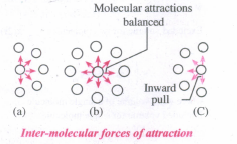
Pressure, Correction:
The pressure of a gas is directly proportional to the force created by the bombardment of molecules on the walls of the container. The speed of a molecule moving towards the wall of the container is reduced by the attractive forces exerted by its neighbours. Hence, the measured gas pressure is lower than the ideal pressure of the gas. Hence, van der Waals introduced a correction term to this effect.
Van der Waals found out the forces of attraction experienced by a molecule near the wall are directly proportional to the square of the density of the gas.
\(P^{\prime} \propto \rho^{2} ; \quad \rho=\frac{n}{v}\)
where n is the number of moles of gas and
V is the volume of the container
\( \Rightarrow p^{\prime} \alpha \frac{n^{2}}{V^{2}} \)
\(\Rightarrow p^{\prime}=a \frac{n^{2}}{V^{2}}\)
where a is proportionality constant and depends on the nature of gas
Therefore \(P_{\text {ideal }}=P+\frac{\operatorname{an}^{2}}{V^{2}}\)
Volume Correction
As every individual molecule of a gas occupies a certain volume, the actual volume is less than the volume of the container,
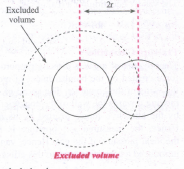
V. Van der Waals introduced a correction factor V' to this effect. Let us calculate the correction term by considering gas molecules as spheres.
V = excluded volume
Excluded volume for two molecules
\(=\frac{4}{3} \pi(2 r)^{3}=8\left(\frac{4}{3} \pi r^{3}\right)=8 V_{m}\)
Where Vm it a volume of a single molecule
Excluded volume for single molecule = \(\frac{8 \mathrm{~V}_{\mathrm{m}}}{2}=4 \mathrm{~V}_{\mathrm{m}}\)
Excluded volume for n molecule = n(4Vm) = nb
Where b is van der waals constant which is equal to 4Vm
\( \Rightarrow V^{\prime}=n b \)
\(V_{\text {ideal }}=V-n b\)
Replacing the corrected pressure and volume in the ideal gas equation PV = nRT we get the Van der Waals equation of state for real gases as below,
\(\left(p+\frac{a^{2}}{V^{2}}\right)(V-n b)=n R T\)
The constants a and b are van der Waals constants and their values vary with the nature of the gas. It is an approximate formula for the non-ideal gas.
20.
CH4(g) + 2H2S(g) ⇌ CS2(g) + 4H2(g)
KC = 4 x 10⁻² mol lit–2
Volume = 500 ml = 1/2 L
\(\left[\mathrm{CH}_{4}\right]_{\text {in }}=\frac{2 \mathrm{~mol}}{1 / 2 \mathrm{~L}} \)
= 2 mol L-1
\(\left[\mathrm{CS}_{2}\right]_{\text {in }}=\frac{1 \mathrm{~mol}}{1 / 2 \mathrm{~L}}\)
= 2 mol L-1
\( {\left[\mathrm{H}_{2} \mathrm{~S}\right]_{\text {in }}=\frac{2 \mathrm{~mol}}{1 / 2 \mathrm{~L}}=4 \mathrm{~mol} \mathrm{~L}^{-1} \quad\left[\mathrm{H}_{2}\right]=\frac{2 \mathrm{~mol}}{1 / 2 \mathrm{~L}}=4 \mathrm{~mol} \mathrm{~L}^{-1}} \)
\(\mathrm{Q}=\frac{\left[\mathrm{CS}_{2}\right]\left[\mathrm{H}_{2}\right]^{4}}{\left[\mathrm{CH}_{4}\right]\left[\mathrm{H}_{2} \mathrm{~S}\right]^{2}}=\frac{2 \times(4)^{4}}{(2) \times(4)^{2}}=16 \)
Q > Kc
\(\therefore \) The reaction will proceed in the reverse direction to reach the equilibrium.

11th Standard Syllabus & Materials
11th Standard
TN 11th Tamil பீடு பெற நில் - செய்யுள் - காவடிச்சிந்து Important Questions And Answers Study Material - QB365 Set A
NEW11th Standard
TN 11th Tamil பீடு பெற நில் - உரைநடை - மலை இடப்பெயர்கள் : ஓர் ஆய்வு Important Questions And Answers Study Material - QB365 Set A
NEW11th Standard
TN 11th Tamil மாமழை போற்றுதும் - துணைப்பாடம் - யானை டாக்டர் Important Questions And Answers Study Material - QB365 Set A
NEW11th Standard
TN 11th Tamil மாமழை போற்றுதும் - செய்யுள் - ஐங்குறுநூறு Important Questions And Answers Study Material - QB365 Set A



Tamilnadu Stateboard 11th Standard Subjects

Maths

Commerce

Economics

Biology

Business Maths and Statistics

Accountancy

Computer Science

Physics
Chemistry
Maths
Biology
Economics
Physics
Chemistry

History
Business Maths and Statistics

Computer Science
Accountancy

Computer Applications
History
Computer Technology
Commerce
Computer Applications
Computer Technology

Tamil

English

French
Tamilnadu Stateboard Standards
