
 100% FREE ACCESS
11th Standard Syllabus & Materials
11th Standard
TN 11th Tamil இயற்கை வேளாண்மை,சுற்றுச்சூழல் -செய்யுள் - மனோன்மணீயம் Important Questions And Answers Study Material - QB365 Set A
NEW11th Standard
TN 11th Tamil என்னுயிர் என்பேன் -துணைப்பாடம் - இசைத்தமிழர் இருவர் Important Questions And Answers Study Material - QB365 Set A
NEW11th Standard
TN 11th Tamil மொழி கலை -செய்யுள் - ஒவ்வொரு புல்லையும் Important Questions And Answers Study Material - QB365 Set A
NEW11th Standard
TN 11th Tamil பீடு பெற நில் - இலக்கணம் - பகுபத உறுப்புகள் Important Questions And Answers Study Material - QB365 Set A
NEW11th Standard
TN 11th Tamil பீடு பெற நில் - துணைப்பாடம் - வாடிவாசல் Important Questions And Answers Study Material - QB365 Set A
NEW11th Standard
TN 11th Tamil பீடு பெற நில் - செய்யுள் - குறுந்தொகை Important Questions And Answers Study Material - QB365 Set A

Published on: 21/01/2020
Download Tamil Nadu 11th Standard Chemistry question papers, model tests, one-mark questions, important questions, and public exam papers in PDF format. Free study materials and answer keys for TN State Board students.
Questions + Answers key
Take MCQ Chemistry Test
1.
Consider the reaction, N2(g) + 3H2(g) ⇌ 2NH3(g). Explain the effect of pressure on this equilibrium reaction.
2.
Do the following conversions:
3.
Explain the ozonolysis of
(a) Acetylene
(b) Propyne
4.
Describe about adsorption chromatography.
5.
What are polyhalogen compounds? Give its types with example.
6.
What do you mean by ozone hole? What are its consequences?
7.
Explain the effect of temperature gaseous solute in liquid solvent.
8.
(i) Calculate the bond order of H2 and B2
(ii) Show how the bond order is related to stability and bond length of the molecule.
9.
0.24 g of a gas dissolves in 1 L of water at 1.5 atm pressure. Calculate the amount of dissolved gas when the pressure is raised to 6.0 atm at constant temperature.
10.
For the reaction,
A2(g) + B2(g) ⇌ 2AB(g) ; ΔH is –ve.
the following molecular scenes represent different reaction mixture (A – green, B – blue)
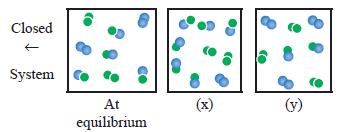
i) Calculate the equilibrium constant KP and (KC).
ii) For the reaction mixture represented by scene (x), (y) the reaction proceed in which directions?
iii) What is the effect of increase in pressure for the mixture at equilibrium.
11.
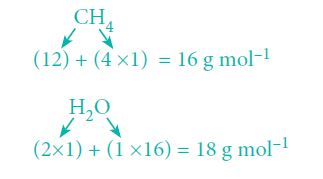
Calculate the amount of water produced by the combustion of 32 g of methane.
12.
Write a note about ortho water and para water.
13.
Derive an expression for the efficiency of a heat engine.
14.
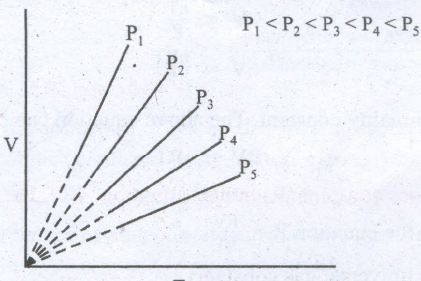
How does the volume of a gas vary with temperature at constant pressure? Explain with the help of a plot between volume is temperature.
15.
Alkali metals have low melting and boiling point. Density of alkali metals is very low. Give reason.
16.
A sample of gas has a volume of 8.5 dm3 at an unknown temperature. When the sample is submerged in ice water at 0 °C, its volume gets reduced to 6.37 dm3. What is its initial temperature?
17.
Show that the circumference of the Bohr orbit for the hydrogen atom is an integral multiple of the de Broglie wavelength associated with the electron revolving around the nucleus.
18.
Mention the uses of plaster of paris
19.
How do you expect the metallic hydrides to be useful for hydrogen storage?
20.
What is water-gas shift reaction?
1.
N2(g) + 3H2(g) ⇌ 2NH3(g)
In the above equilibrium, if the pressure is increased, the volume will decreases. The system responds to this effect by reducing the number of gas molecules. i.e., it favours the formation of ammonia.
If the pressure is reduced, the volume will increases. It favours the decomposition of ammonia.
2.
(i) Methyl bromide to acetone (ii) Benzyl alcohol to 2-phenylacetic acid.
\(CH_{ 3 }Br+Mg\overset { dry\quad ether }{ \longrightarrow } { CG }_{ 3 }MgBr\overset { { CH }_{ 3 }CHO }{ \longrightarrow } \overset { \underset { | }{ OMgBr } }{ \underset { \overset { | }{ { CH }_{ 3 } } }{ CH } } -{ CH }_{ 3 }\overset { { H }_{ 2 }O }{ \longrightarrow } { CH }_{ 3 }\underset { \overset { | }{ { CH }_{ 3 } } }{ C } HHOH\overset { Cu }{ \underset { { NH }_{ 3 } }{ \longrightarrow } } \left( { CH }_{ 3 } \right) _{ 2 }CO\)
(ii) C6H5CH2OH + SOCl2 \(\longrightarrow\) C6H5CH2CI + KCN \(\longrightarrow\) C6H5CH2CN \(\overset { { H }_{ 3 }O^{ + } }{ \longrightarrow } \) C6HsCH2COOH
3.
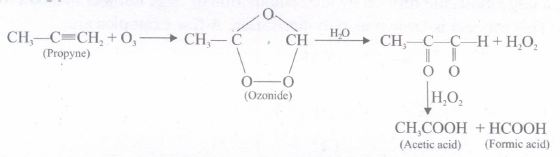
Ozone adds to carbon-carbon triple bond of alkynes to form ozonides. The ozonides are hydrolysed by water to form carbonyl compounds. The hydrogen peroxide formed in the reaction may oxidise the carbonyl compound to carboxylic acid.
(a) Acetylene
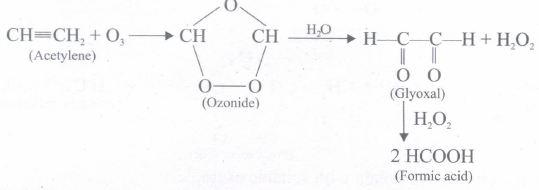
(b) Propyne:
4.
(i) The principle involved is different compounds are adsorbed on an adsorbent to different degree.
(ii) Silica gel and alumina are the commonly used adsorbent. The components of the mixture move by varying distances over the stationary phase.
5.
(i) Carbon compounds containing more than one halogen atom are called polyhalogen compounds.
(ii) They are classified as
(i) gem dihalides
(ii) Vicinal dihalides.
(a) Gem dihalide: In this compound, two halogen atoms are attached to one carbon atom
e.g, CH3CHCl2 ethylidene chloride.
(b) Vicinal dihalide: In this compound, two halogen atoms are attached to two adjacent carbon atoms.
\(\underset { \overset { | }{ Cl } }{ { CH }_{ 2 }- } \underset { \overset { | }{ Cl } }{ { CH }_{ 2 } } \) 1, 2-dichloro ethane
6.
Depletion of ozone layer creates some sort of holes in the blanket of ozone which surrounds us in the atmosphere and this is known as ozone hole
(i) With the depletion of the ozone layer, UV radiations filters into the troposphere which leads to ageing of skin, cataract, sunburn, skin cancer etc.
(ii) By killing many of the phytoplanktons, it can damage the fish productivity.
(iii) Evaporation rate increases through the surface and stomata ofleaves which can decrease the moisture content of the soil.
7.
1.In the case of gaseous solute in liquid solvent, the solubility decreases with increase in temperature.
2. When a gaseous solute dissolves in a liquid solvent, its molecules interact with solvent molecules with weak inter molecular forces when the temperature increases, the average kinetic energy of the molecules present in the solution also increases.
3. The increase in kinetic energy breaks the weak inter molecular forces between the gaseous solute and liquid solvent with results in the release of the dissolved gas molecules to gaseous state,
4. The dissolution of most of the gases in liquid solvents is an endothermic process, the increase in temperature decreases the dissolution of gaseous molecules
8.
| Molecule | No. of electrons | Electonic configuration | Bond order | Magnetic nature |
| Li2 | 6 | \((\sigma_{1s})^2(\sigma^*_{1s})^2(\sigma_{2s})^2\) | \({1\over2}(4-2)=1\) | Diamagnetic |
| B2 | 10 | \((\sigma_{1s})^1(\sigma^*_{1s})^2(\sigma_{2s})^2(\sigma^*_{2s})^1(\pi_2p_x)^1(\pi_2p_y)^1\) | \({1\over2}(6-4)=1\) | Paramagnetic |
(ii) Bond order \(\alpha\) Stability
Greater the bond order, more stable the molecule is
Eg: N2(B.O = 3) is much stable than O2(B.O = 2)
Bond order \(\alpha {1\over Bond \ length}\)
Greater the bond order shorter is the bond length.
Eg: Nitrogen: B.O. = 3; Bond length =110pm Oxygen: B.O. = 2; Bond length = 121pm.
9.
Psolute = KH Xsolute in solution
At pressure 1.5 atm,
p1 = KH x1 ------(1)
At pressure 6.0 atm,
p2 = KH x2 -----(2)
Dividing equation (1) by (2)
From equation p1/p2 = x1/x2
1.5/6.0 = 0.24/x2
Therefore x2 = 0.24 x 6.0/1.5 = 0.96 g/L.
10.
\(K_c={[AB]^2\over [A_2][B_2]}\)
A - green
B - blue
Given that 'V' is constant (closed system)
At equilibrium
\(K_c={({4\over V})^2\over ({2\over V})({2\over V})}={16\over 4}=4\)
KP = KC (RT)Δn
KP = 4(RT)o = 4
At Stage 'x'
\(Q={({6\over V})^2\over ({2\over V})({1\over V})}={36\over 2}=18\)
Q > KC ie., reverse reaction is favoured
At Stage 'y'
\(Q={({3\over V})^2\over ({3\over V})({3\over V})}={9\over 3\times 3}=1\)
KC > Q ie., forward reaction is favoured.
11.
CH4(g) + 2O2 \(\rightarrow\) CO2 + 2H2O
16g (2x18)g
As per stoichiometric equation,
16 g of methane produces 36 g of H2O
\(\therefore\) 32 g of methane will produce = \(\frac { 36 }{ 16 } \times 32=72\) g of water.
12.
(i) Water exists in space in the interstellar clouds, in proto-planetary disks, in the comets and icy satellites of the solar system, and on the Earth.
(ii) In particular, the ortho-to-para ratio (OPR) of water in space has recently received attention. Like hydrogen, water can also be classified into ortho-H2O and para-H2O), in which the directions are antiParallel.
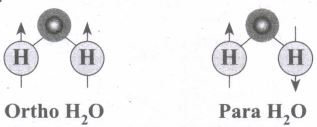
(iii) At the temperature conditions of the Earth (300 K), the OPR of H2O is 3.
(iv) At low temperatures below (<50 K) the amount of para-H2O) increases. It is known that the OPR of water in interstellar clouds and comets has more para-H2O) (OPR = 2.5) than on Earth.
13.
Efficiency = work performed / heat absorbed
\(\eta =\frac { |{ q }_{ h }|-|{ q }_{ c }| }{ |{ q }_{ h }| } \)
qh - heat absorbed from the hot reservoir
qc - heat transferred to cold reservoir
\(\eta =1-\frac { |{ q }_{ c }| }{ |{ q }_{ h }| } \) ....(1)
For a reversible cyclic process
\(\Delta\)S(universe) = \(\Delta\)S(system)+\(\Delta\)S(surroundings) = 0
\(\Delta\)S(system) = -\(\Delta\)S(surroundings)
\(\frac { qh }{ { T }_{ h } } =\frac { -{ q }_{ c } }{ { T }_{ c } } \)
\(\frac { -{ T }_{ c } }{ { T }_{ h } } =\frac { { q }_{ c } }{ { q }_{ h } } \)
\(\frac { { T }_{ c } }{ { T }_{ h } } =\frac { |{ q }_{ c }| }{ |{ q }_{ h }| } \) .....(2)
Substituting (2) in (1)
\(\Rightarrow \eta =1-\frac { { T }_{ c } }{ { T }_{ h } }...(3)\)
Th >> Tc
Hence, \(\eta \) < 1
14.
The volume of a gas increases with temperature at constant pressure. Each line (isobar) represents the variation of volume with temperature at certain pressure. The pressure increases from PI to P. i.e. P1 < P2 < P3 < P4 < P5 When these lines are extrapolated or extended to zero volume, they' intersect at a temperature of - 273.15°C. All the gases are becoming liquids if they are cooled to sufficiently low temperatures. In other words, all gases occupy zero volume at absolute zero
15.
It is due to weak metallic bonds and large atomic size.
16.
V1 = 8.5 dm3 V2 = 6.37 dm3
T1 = ? T2 = 0o C = 273 K
\(\frac { { V }_{ 1 } }{ { T }_{ 1 } } =\frac { { V }_{ 2 } }{ { T }_{ 2 } } \)
\({ V }_{ 1 }\times \left( \frac { { T }_{ 2 } }{ { V }_{ 2 } } \right) ={ T }_{ 1 }\)
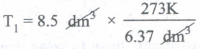
T1 = 364.28 K
17.
Circumference of the orbit - 2\(\pi\)r .... ...(1)
Circumference of the orbit of H - atom (n = 1) - n\(\lambda\), .........(2)
(1) = (2) \(2 \pi r=\lambda \text { (or) } 2 \pi r=\frac{\mathrm{h}}{\mathrm{mv}}\)
18.
The largest use of plaster of paris is in the building industry as well as plasters. It is used for immobilising the affected part of organ where there is a bone fracture or sprain. It is also employed in dentistry, in ornamental work and for making casts of statues and busts.
19.
Metal Hydride (Hydrogen Sponge):
The best studied binary hydrides are the palladium-hydrogen system. Hydrogen interacts with palladium in a unique way, and forms a limiting monohydride, PdH. Upon heating, H atoms diffuse through the metal to the surface and recombine to form molecular hydrogen. Since no other gas behaves this way with palladium, this process has been used to separate hydrogen gas from other gases.
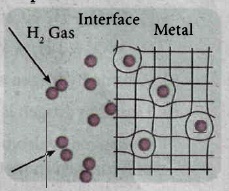
\(2 \mathrm{Pd}(\mathrm{s})+\mathrm{H}_{2}(\mathrm{~g}) \rightarrow 2 \mathrm{PdH}(\mathrm{s})\)
The hydrogen molecule readily adsorbs on the palladium surface, where it dissociates into atomic hydrogen. The dissociated atoms dissolve into the interstices or voids (octahedral/tetrahedral) of the crystal lattice.
Technically, the formation of metal hydride is by chemical reaction but it behaves like a physical storage method, i.e., it is absorbed and released like a water sponge. Such a reversible uptake of hydrogen in metals and alloys is also attractive for hydrogen storage and for rechargeable metal hydride battery applications.
20.
The carbon monoxide of the water gas can be converted to carbon dioxide by mixing the gas mixture with more steam at 400oC and passed over a shift converter containing iron/copper catalyst. This reaction is called as water-gas shift reaction.
CO + H2O ➝ CO2 + H2

11th Standard Syllabus & Materials
11th Standard
TN 11th Tamil பீடு பெற நில் - செய்யுள் - காவடிச்சிந்து Important Questions And Answers Study Material - QB365 Set A
NEW11th Standard
TN 11th Tamil பீடு பெற நில் - உரைநடை - மலை இடப்பெயர்கள் : ஓர் ஆய்வு Important Questions And Answers Study Material - QB365 Set A
NEW11th Standard
TN 11th Tamil மாமழை போற்றுதும் - துணைப்பாடம் - யானை டாக்டர் Important Questions And Answers Study Material - QB365 Set A
NEW11th Standard
TN 11th Tamil மாமழை போற்றுதும் - செய்யுள் - ஐங்குறுநூறு Important Questions And Answers Study Material - QB365 Set A



Tamilnadu Stateboard 11th Standard Subjects

Maths

Commerce

Economics

Biology

Business Maths and Statistics

Accountancy

Computer Science

Physics
Chemistry
Maths
Biology
Economics
Physics
Chemistry

History
Business Maths and Statistics

Computer Science
Accountancy

Computer Applications
History
Computer Technology
Commerce
Computer Applications
Computer Technology

Tamil

English

French
Tamilnadu Stateboard Standards
