
 100% FREE ACCESS
11th Standard Syllabus & Materials
11th Standard
TN 11th Tamil இயற்கை வேளாண்மை,சுற்றுச்சூழல் -செய்யுள் - மனோன்மணீயம் Important Questions And Answers Study Material - QB365 Set A
NEW11th Standard
TN 11th Tamil என்னுயிர் என்பேன் -துணைப்பாடம் - இசைத்தமிழர் இருவர் Important Questions And Answers Study Material - QB365 Set A
NEW11th Standard
TN 11th Tamil மொழி கலை -செய்யுள் - ஒவ்வொரு புல்லையும் Important Questions And Answers Study Material - QB365 Set A
NEW11th Standard
TN 11th Tamil பீடு பெற நில் - இலக்கணம் - பகுபத உறுப்புகள் Important Questions And Answers Study Material - QB365 Set A
NEW11th Standard
TN 11th Tamil பீடு பெற நில் - துணைப்பாடம் - வாடிவாசல் Important Questions And Answers Study Material - QB365 Set A
NEW11th Standard
TN 11th Tamil பீடு பெற நில் - செய்யுள் - குறுந்தொகை Important Questions And Answers Study Material - QB365 Set A

Published on: 21/01/2020
Download Tamil Nadu 11th Standard Chemistry question papers, model tests, one-mark questions, important questions, and public exam papers in PDF format. Free study materials and answer keys for TN State Board students.
Questions + Answers key
Take MCQ Chemistry Test
1.
What are all the sources for human body that produces free radicals ?
2.
Mention the uses of alkenes.
3.
Explain the action of Ethyl chloroformate with Methyl magnesium iodide.
Ethyl chloroformate reacts with Grignard reagent to form esters as follows
4.
Write the structural formula for the following compounds.
(i) cyclohexa-I, 3-diene
(ii) methyl cyclopentane
5.
A large number of fishes are suddenly found floating dead on a lake. There is no evidence of toxic dumping but you find an abundance of phytoplankton. Suggest a reason for the fish killing
6.
(i) Pick the acid odd out with respect to acid rain. H2SO4 , HCl, HNO3 , H2CO3 , CH3COOH, H2SO3
(ii) Name the regions of atmosphere were, the temperature increases and decreases with altitude.
7.
Define equilibrium constant.
8.
Explain the preparation of sodium fusion extract.
9.
Write a chemical reaction useful to prepare the following:
i) Freon-12 from Carbon tetrachloride
ii) Carbon tetrachloride from carbon disulphide
10.
Why chlorination of methane is not possible in dark?
11.
Write the chemical equations for combustion of propane.
12.
Define bond energy.
13.
Calculate the equivalent mass of the following - Sodium Hydroxide
14.
Balance the following equations by oxidation number method - \({ K }Mno_{ 4 }+{ Na }_{ 2 }{ So }_{ 3 }\longrightarrow { MnO }_{ 2 }+{ Na }_{ 2 }{ So }_{ 4 }+KOH\)
15.
Give the number of electrons in the following species. H2 , H2 , O2 and O2-
16.
Define Hess's law of constant heat summation.
17.
Explain what is meant by efflorescence.
18.
Give the mathematical expression that relates gas volume and moles.
19.
Define equivalent mass.
20.
What do you understand by the term mole ?
21.
What are electrophiles and nucleophiles ? Give suitable examples for each.
22.
State Raoult law and obtain expression for lowering of vapour pressure when nonvolatile solute is dissolved in solvent.
23.
What is the relation between KP and KC. Give one example for which KP is equal to KC.
24.
Write a note on homologous series.
1.
Sources for human body produces free radicals,
(i) Human body is exposed to X-rays.
(ii) Cigarette smoke.
(iii) Industrial chemicals.
(iv) Air pollutants.
2.
(i) Alkenes are used as starting material in the synthesis of alcohols, plastics, detergents and fuels.
(ii) Ethene is the most important organic feedstock in the polymer industry. Examples are, PVC, Sarans and Polythene. These polymers are used in the manufacture of floor tiles, shoe-soles, synthetic fibres, raincoats, pipes etc.
3.

4.
(i)

(ii)

5.
Excessive phytoplankton (organic pollutants such as leaves, grass trash etc.) growth which is present in water is biodegradable. Bacteria decomposes this organic matter in water. During this process when large number of bacteria decomposes the organic matter, they con ume the dissolved oxygen in water. When the level of dissolved oxygen falls below 6 ppm then the fishes cannot survive and they die.
6.
(i) CH3COOH-it is not present in acid rain.
(ii) In stratosphere and thermosphere temperature increases with attitude.
(iii) In troposphere and mesosphere - temperature decreases with attitude.
7.
Under equilibrium condition at a given temperature, the ratio of the product of active masses of reaction products raised to the respective stoichiometric coefficients in the balanced chemical equation to that of the reactants is a constant, known as equilibrium constant.
8.
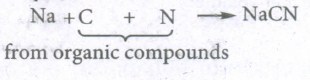
A small piece of Na dried by pressing between the folds Ofa filter paper is taken in a fusion-tube and it is gently heated. When it melts to a shining globule, put a pinch of the organic compound on it. Heat the tube till reaction ceases and becomes red hot. Plunge it in about 50 mL of distilled water taken in a china dish and break the bottom of the tube by striking against the dish. Boil the contents of the dish for about 10 mts and filter. This filtrate is known as Lassaignes extract or sodium fusion extract and it used for detection of nitrogen, sulfur and halogens present in organic compounds.
9.
(i) Freon - 12 is prepared by the action of hydrogen fluoride on carbon tetrachloride in the presence "of catalylic amount of antimony pentachloride. is is called swartz reaction.
\(\underset { Carbontetrachloride }{ C{ Cl }_{ 4 }+2HF } \overset { SbC{ l }_{ 5 } }{ \longrightarrow } \underset { Freon-12 }{ 2HCl } +CC{ l }_{ 2 }{ F }_{ 2 }\)
(ii) Carbon disulphide reacts with chlorine gas in the presence of anhydrous AICl3 as catalyst giving carbon tetrachloride
\(\underset { carbondisulphide }{ { CS }_{ 2 }+3C{ l }_{ 2 }\overset { anhydrous }{ \underset { Al{ Cl }_{ 3 } }{ \longrightarrow } } } \underset { Carbontetrachloride }{ { CCl }_{ 4 }+{ S }_{ 2 }{ Cl }_{ 2 } } \)
10.
The Chlorination of methane is carried out by free radical mechanism. The initiation step to form free radical needs high energy which is supplied by light energy.
\(\mathrm{Cl}-\mathrm{Cl} \stackrel{h \nu}{\longrightarrow} 2 \mathrm{Cl}\)
So this reaction is not possible in dark.
11.
Propane burns in excess of oxygen to form water and carbon di oxide.
CH2CH2CH3 + 502 \(\rightarrow\) 3CO2 + 4H2O
Propane
12.
The bond energy is defined as the minimum amount of energy required to break one mole of a particular bond in molecules in their gaseous state.
13.
Molar Mass of NaOH = 23 + 16 + 1 = 40
Acidity = 1
Equivalent Mass = \(\frac { Molar\ mass }{ acidity } =\frac { 40 }{ 1 } =40geq^{ -1 }\)
14.
(ii) \({ K }\overset { +7 }{ \underset { \underset { 3e^{ - } }{ \uparrow } }{ M } } n{ O }_{ 4 }+{ Na }_{ 2 }\overset { +4 }{ \underset { { 2e }^{ - } }{ \underset { \downarrow }{ S } } } { O }_{ 3 }\longrightarrow \overset { +4 }{ M } { nO }_{ 2 }+{ Na }_{ 2 }\overset { +6 }{ s } { O }_{ 4 }+KOH\)
\(\Rightarrow\) 2KMnO4 + 3Na2SO3 \(\longrightarrow \) MnO2 + Na2SO4 + KOH
\(\Rightarrow\) 2KMnO4 + 3Na2SO3 \(\longrightarrow \) 2MnO2 + 3Na2SO4 + KOH
\(\Rightarrow\) 2KMNO4 + 3NaSO3 + H2O \(\longrightarrow \) 2MnO2 + 3Na2SO4 +2KOH
15.
H2 = 1 + 1 = 2e-
H+2; = 2 - 1 = le-
\({O}_{2}\) = 8 + 8 = 16e-
\({O}_{2}^{-}\) = 8 + 8 + 1= 17e-
16.
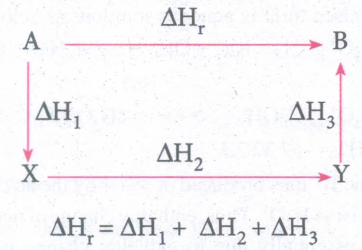
The enthalpy change of a reaction either at constant volume or constant pressure is the same whether it takes place in a single or multiple steps provided the initial and final states are same.
17.
Efflorescence is the spontaneous loss of water by a hydrated salt, which occurs when the aqueous vapor pressure of the hydrate is greater than the partial pressure of the water vapour in the air. This is the property of salts
Ex: Glauber's salt- Na2SO4·10H2O
Epsom salt - MgSO4·7H2O
18.
According to Avogadro's hypothesis: V \(\alpha\) n
\(\therefore \frac{V_{1}}{n_{1}}=\frac{V_{2}}{n_{2}}=\text { constant }\)
V1 & n2 are the volume and number of moles of a gas and V2 & n2 are a different set of values of volume and number of moles of the same gas at same temperature and pressure.
19.
Gram equivalent mass of an element, compound or ion is the mass that combines or displaces 1.008 g hydrogen or 8 g oxygen or 35.5 g chlorine.
20.
One mole is the amount of substance of a system, which contains as many elementary particles as there are atoms in 12 g of carbon -12 isotope.
21.
a) Electrophiles:
Electrophiles are reagents that are attracted towards negative charge or electron rich center. They are either positively charged ions or electron deficient neutral molecules. All Lewis acids act as electrophiles.
Neutral molecules like SnCl4 can also act as an electrophile, as it has vacant d-orbitals which can accommodate the electrons from others.
| Types | Examples | Electron deficiententity |
| Neutral electrophiles | Carbon dioxide (CO2), dichlorocarbene (CCl2) |
C |
| Aluminium chloride (AlCl3), boron trifluoride (BF3) and ferric chloride (FeCI3) | Metal (M) | |
| Positively charged electrophiles | Carbocations(R+) | C+ |
| Proton (H+) | H+ | |
| Alkyl halides (RX) | X+ | |
| Oxonium ion (H3O+) and nitrosonium ion (NO+) | O+ | |
| Nitronium ion (+NO2) | N+ |
b) Nucleophiles:
Nucleophiles are reagents that has high affinity for electro positive centers. They possess an atom has an unshared pair of electrons, and hence it is in search for an electro positive centre where it can have an opportunity to share its elections to form a covalent bond, and gets stabilised.
They are usually negatively charged ions or electron rich neutral molecules (contains one or more lone pair of electrons). AII Lewis bases act as nucleophiles.
| Types | Examples | Electron rich site |
| Neutral molecules having unshared pair of electron | Ammonia (NH3) and amines (RNH2) | N: |
| Water (H2O), alcohols(ROH) and ethers (R - O- R) |
:O: | |
| Hydrogen sulphide (H2S) and thiols (RSH) |
:S: | |
| Negatively, charged nucleophiles | Chlorides (Cl-), bromides (Br-) and iodides (I-) |
X- |
| Hydroxide ( HO-), alkoxide (RO-) and Carboxlate ions (RCOO-) |
O- | |
| Cyanide (CN-) | N- |
22.
Raoult law states that. "in the case of a solution of volatile liquids, the partial vapour pressure of each component (A & B) of the solution is directly proportional to its mole fraction.
According to Raoult's law,
PA \(\alpha\) XA
pA = K XA
When xA = 1, k = \({ p }_{ A }^{ 0 }\)
Where \({ p }_{ A }^{ 0 }\) is the vapour pressure of pure component 'A' at the same temperature
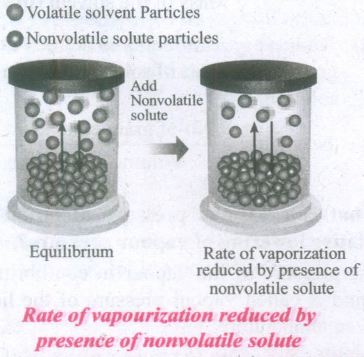
"The relative lowering of vapour pressure of an ideal solution containing the nonvolatile solute is equal to the mole fraction of the solute at a given temperature".
Derivation:
when sodium chloride is added to the water, the vapour pressure of the salt solution is lowered. The vapour Pressure of the solution is determined by the number of molecules of the solvent present in the surface at any time and is proportional to the mole fraction of the solvent.
Psolution \(\infty \) XA
Where XA is the mole fraction of the solvent
Psolution = K XA
When XA = 1, K = P0 solvent
\({ P }_{ solvent }^{ 0 }\) is the partial pressure of pure solvent
Psolution = \({ P }_{ solvent }^{ 0 }\) XA
\(\frac { { P }_{ solution } }{ { P }_{ solvent }^{ 0 } } ={ X }_{ A }\)
\(1-\frac { { P }_{ solution } }{ { P }_{ solvent }^{ 0 } } 1-{ X }_{ A }\)
\(\frac { { P }_{ solvent }^{ 0 }-{ P }_{ solution } }{ { P }_{ solvent }^{ 0 } } ={ x }_{ B }\)
Where XB the mole fraction of the solute
( \(\because\) XA + AB = 1, XB = 1 - XA)
The above expression gives the relative lowering of vapour pressure. Based on this expression, Raoult's law can also be stated as "the relative lowering of vapour pressure of an ideal solution containing, the nonvolatile solute is equal to the mole fraction of the solute at a given temperature".
23.
i) \(K_{p}=K_{c}(R T)^{\Delta n_{g}}\)
Kp = Equilibrium constant in term of partial Pressures.
Kc = Equilibrium constant in term of concentration.
R = Gas constant; T = Temperature
\(\Delta \mathrm{n}_{\mathrm{g}}\) = Difference between the sum of number of moles of products and the sum of number of moles of reactants in gas phases.
ii) Synthesis of HI:
\( \mathrm{H}_{2(\mathrm{~g})}+\mathrm{I}_{2(\mathrm{~g})} \rightleftharpoons 2 \mathrm{HI}_{(\mathrm{g})} \)
\(\Delta n_{g}=0 \therefore K_{p}=K_{c}(R T) \Delta n_{g}\)
\(K_{p}=K_{c}(R T)^{\circ} \)
\(K_{p}=K_{c} \text {. }\)
24.
Homologous series: A series of organic compounds each containing a characteric functional group and the successive' members differ from each other in molecular formula by a CH2 group is called homologous series. Eg.
Alkanes : Methane (CH4), Ethane (C2H6), Propane (C3Hg) etc .
Alcohols: Methanol (CH3OH), Ethanol (C2H5OH) Propanol (C3H7OH) etc ..)
Compounds of the homologous series are represented by a general formula Alkanes CnH2n+2' Alkenes CnH2n, Alkynes CnH2n-2 and can be prepared by general methods. They show regular gradation in physical properties but have almost similar chemical property.

11th Standard Syllabus & Materials
11th Standard
TN 11th Tamil பீடு பெற நில் - செய்யுள் - காவடிச்சிந்து Important Questions And Answers Study Material - QB365 Set A
NEW11th Standard
TN 11th Tamil பீடு பெற நில் - உரைநடை - மலை இடப்பெயர்கள் : ஓர் ஆய்வு Important Questions And Answers Study Material - QB365 Set A
NEW11th Standard
TN 11th Tamil மாமழை போற்றுதும் - துணைப்பாடம் - யானை டாக்டர் Important Questions And Answers Study Material - QB365 Set A
NEW11th Standard
TN 11th Tamil மாமழை போற்றுதும் - செய்யுள் - ஐங்குறுநூறு Important Questions And Answers Study Material - QB365 Set A



Tamilnadu Stateboard 11th Standard Subjects

Maths

Commerce

Economics

Biology

Business Maths and Statistics

Accountancy

Computer Science

Physics
Chemistry
Maths
Biology
Economics
Physics
Chemistry

History
Business Maths and Statistics

Computer Science
Accountancy

Computer Applications
History
Computer Technology
Commerce
Computer Applications
Computer Technology

Tamil

English

French
Tamilnadu Stateboard Standards
