
 100% FREE ACCESS
11th Standard Syllabus & Materials
11th Standard
TN 11th Tamil இயற்கை வேளாண்மை,சுற்றுச்சூழல் -செய்யுள் - மனோன்மணீயம் Important Questions And Answers Study Material - QB365 Set A
NEW11th Standard
TN 11th Tamil என்னுயிர் என்பேன் -துணைப்பாடம் - இசைத்தமிழர் இருவர் Important Questions And Answers Study Material - QB365 Set A
NEW11th Standard
TN 11th Tamil மொழி கலை -செய்யுள் - ஒவ்வொரு புல்லையும் Important Questions And Answers Study Material - QB365 Set A
NEW11th Standard
TN 11th Tamil பீடு பெற நில் - இலக்கணம் - பகுபத உறுப்புகள் Important Questions And Answers Study Material - QB365 Set A
NEW11th Standard
TN 11th Tamil பீடு பெற நில் - துணைப்பாடம் - வாடிவாசல் Important Questions And Answers Study Material - QB365 Set A
NEW11th Standard
TN 11th Tamil பீடு பெற நில் - செய்யுள் - குறுந்தொகை Important Questions And Answers Study Material - QB365 Set A

Published on: 01/10/2019
Fundamentals of Organic Chemistry
Download Tamil Nadu 11th Standard Chemistry question papers, model tests, one-mark questions, important questions, and public exam papers in PDF format. Free study materials and answer keys for TN State Board students.
Questions + Answers key
Take MCQ Chemistry Test
1.
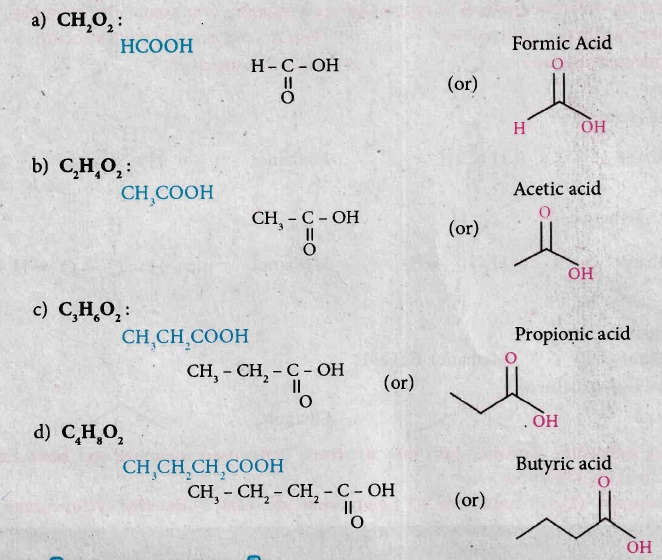
Write the molecular and possible structural formula of the first four members of homologous series of carboxylic acids.
2.
Give the general characteristics of organic compounds?
3.
0.24 g of organic compound containing phosphorous gave 0.66 g of Mg2P2O7 by the usual analysis. Calculate the percentage of phosphorous in the compound.
4.
0.185 g of an organic compound when treated with Conc. HNO3 and silver nitrate gave 0.320 g of silver bromide. Calculate the % of bromine in the compound. (Ag =108, Br = 80)
5.
0.284 g of an organic substance gave 0.287 g AgCl in a carius method for the estimation of halogen. Find the Percentage of Cl in the compound.
6.
Write all the possible isomers of molecular formula C4H10O and identify the isomerisms found in them.
7.
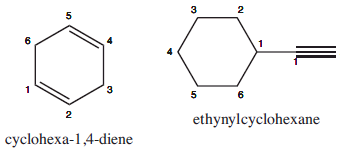
Write structural formula for the following compounds
(i) Cyclohexa-1, 4-diene
(ii) Ethynyl cyclohexane.
8.
The compound which has one isopropyl group is _________
2,2,3,3 - Tetramethyl pentane
2,2 - Dimethyl pentane
2,2,3 - Trimethyl pentane
2 - Methylpentane
9.
Tetravalency of carbon is possible in the case of ________
sp3-hybridisation
sp2-hybridisation
sp-hybridisation
All of these
10.
In an organic compound, phosphorus is estimated as ____________
Mg2P2O7
Mg3(PO4)2
H3PO4
P2O5
11.
Lassaigne’s test for the detection of nitrogen fails in ______________
H2N – CO– NH.NH2.HCl
NH2 – NH2. HCl
C6H5 – NH – NH2. HCl
C6H5 CONH2
12.
The number of stereoisomers of 1, 2 – dihydroxy cyclopentane ________
1
2
3
4
13.
Which one of the following names does not fit a real name?
3 – Methyl –3–hexanone
4–Methyl –3– hexanone
3– Methyl –3– hexanol
2– Methyl cyclo hexanone
14.
Select the molecule which has only one \(\pi\) bond.
CH3– CH = CH – CH3
CH3– CH = CH – CHO
CH3– CH = CH – COOH
All of these
15.
List down the characteristics possessed by the organic compounds.
16.
Explain paper chromatography.
17.
Give the principle involved in the estimation of halogen in an organic compound by carius method.
18.
Write a note on homologous series.
19.
Give the general formula for the following classes of organic compounds
Aliphatic monohydric alcohol
20.
n-propanol
21.
RNO2
22.
Ester
23.
CnH2n+2
24.
The mixture of diethyl ether and ethanol can be purified by____________
25.
The formula of ammonium phospho molybate is__________
26.
Copper oxide test is used to detect___________
27.
2-butenes an example of__________ compound
28.
The property catenation is possible in__________
1.
2.
They are covalent compounds of carbon and generally insoluble in water and readily soluble in organic solvent such as benzene, toluene, ether, chloroform etc...
Many of the organic compounds are inflammable (except CCI4). They possess low boiling and melting points due to their covalent nature
Organic compounds are characterised by functional groups. A functional group is an atom or a specific combination of bonded atoms that react in a characteristic way, irrespective of the organic molecule in which it is present. In almost all the cases, the reaction of an organic compound takes place at the functional group. They exhibit isomerism which is a unique phenomenon.
Homologous series: Aseries of organic compounds each containing a characteric functional group and the successive members differ from each other in molecular formula by a CH2 group is called homologous series. Eg.
Alkanes: Methane (CH4), Ethane (C2H6), Propane(C3H8) etc.Alcohols: Methanol (CH3OH), Ethanol (C2H5OH) Propanol (C3H7OH) etc..) Compounds of the homologous series are represented by a general formula Alkanes CnH2n+2, Alkenes CnH2n, Alkynes CnHr2n-2 and can be prepared by general methods. They show regular gradation in physicial properties but have almost similar chemical property.
3.
Weight of an organic compound = 0.24 g
Weight of Mg2P2O7 = 0.66 g = y
\(
\% \mathrm{P} =\frac{62}{222} \times \frac{\mathrm{y}}{\mathrm{w}} \times 100
\)
\(=\frac{62}{222} \times \frac{0.66}{0.24} \times 100=76.80 \%\)
4.
(w) = 0.185 g
(x) = 0.320 g
\(\% \mathrm{Br}=\frac{80}{188} \times \frac{b}{w} \times 100=\frac{80}{188} \times \frac{0.320}{0.185} \times 100=73.6 \%\)
5.
Weight of the organic substance = 0.284 g
Weight of AgCl is = 0.287 g = a
\( \% \mathrm{Cl} =\frac{35.5}{143.5} \times \frac{\mathrm{a}}{\mathrm{w}} \times 100 \)
\(=\frac{35.5}{143.5} \times \frac{0.287}{0.284} \times 100=24.98 \% \)
6.
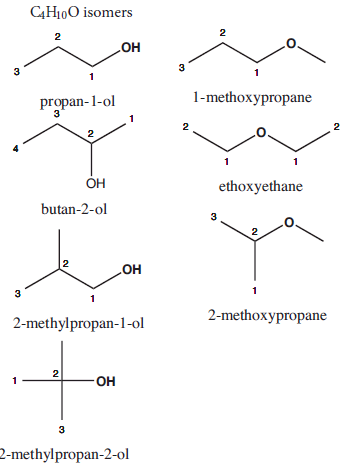
i) Butan.- I - ol & Butan - 2 -ol are position isomers. - Position isomerism
ii) Butan -I -ol & 2-methyl propan - I - ol are chain isomers - Chainisomerism
iii) Butan -I - ol and I - methoxy propane are functional isomers - Functional isomerism
iv) 1 - methoxy Propane and ethoxy ethane and 2 - methoxy Propane are metamers - Metamerism
7.
8.
(d)
2 - Methylpentane
9.
(d)
All of these
10.
(a)
Mg2P2O7
11.
(c)
C6H5 – NH – NH2. HCl
12.
(c)
3
13.
(a)
3 – Methyl –3–hexanone
14.
(a)
CH3– CH = CH – CH3
15.
(i) They are covalent compounds of carbon and generally insoluble in water and readily soluble in organic solvent such as benzene, toluene, ether, chloroform, etc ...
(ii) Many of the organic compounds are inflammable (except CCI4).They possess low boiling and melting points due to their covalent nature.
(iii) Organic compounds are characterised by functional groups. A functional group is an atom or a specific combination of bonded atoms that react in a characteristic way, irrespective of the organic molecule in which it is present. In
almost all the cases, the reaction of an organic compound takes place at the functional group. They exhibit isomerism which is a unique phenomenon.
(iv) Homologous series: A series of organic compounds each containing a characteristic functional group and the successive members differ from each other in molecular formula by a CH2 group is called homologous series.
Alkanes: Methane (CH4) Ethane (C2H6) Propane (C3H8) etc.
16.
Partition Chromatography:
Paper chromatography (PC) is an example of partition chromatography. The same procedure is followed as in thin layer chromatography except that a strip of paper acts as an adsorbent is method involves continues differential portioning of components of a mixture between stationary and mobile phase. In paper chromatography, a special quality paper known as chromatography paper is used. This paper act as a stationary phase.
A strip of chromatographic paper spotted at the base with the solution of the mixture is suspended in a suitable solvent which act as the mobile phase solvent rises up and flows over the spot. The paper selectively retains different components according to their different partition in the two phases where a chromatogram is developed. The spots of the separated colored compounds are visible at different heights from the position of initial spots on the chromatogram. The spots of the separated colorless compounds may be observed either under ultraviolent light or by the use of an appropriate spray reagent.
17.
A known mass of the organic compound is heated with fuming HNO3 and AgNO3. C, H & S get oxidized to CO2, H2O & SO2 and halogen combines with AgNO3 to form a precipitate of silver halide.
\(X=\xrightarrow [ fum.HNO_{ 3 } ]{ AgNO_{ 3 } } AgX\downarrow \)
The precipitate of AgX is filtered, washed, dried and weighed. From the mass of AgX and the mass of the organic compound taken, percentage of halogens are calculated.
A known mass of the substance istaken along with fuming HNO3 and AgNO, is taken in a clean carius tube. The open end of the Carius tube is sealed and placed in a irbn tube for 5 hours in the range at 530- 540 k Then the tube is allowed to cool and a small hole is made in the tube to allow gases produced to escape. The tube is broken and the ppt is filtered, washed, dried and weighed. From the mass of AgX obtained, percentage of halogen in the organic compound is calculated.
Weight of the organic compound : w g
Weight of AgCI precipitate = a g
Percentage of CI in w g = \(\left(\frac{35.5}{143.5} \times \frac{\mathrm{a}}{\mathrm{w}} \times 100\right) \%\)
organic compound
Let Weight of silver Bromide be 'b'g
Percentage of Br in w g = \(\left(\frac{80}{188} \times \frac{b}{w} \times 100\right) \%\) organic compound
Let Weight of silver Iodide be 'c'g
w g Organic compound gives c g AgI
Percentage of l in w g = \(\left(\frac{127}{235} \times \frac{c}{w} \times 100\right) \%\) organic compound.
18.
Homologous series: A series of organic compounds each containing a characteric functional group and the successive' members differ from each other in molecular formula by a CH2 group is called homologous series. Eg.
Alkanes : Methane (CH4), Ethane (C2H6), Propane (C3Hg) etc .
Alcohols: Methanol (CH3OH), Ethanol (C2H5OH) Propanol (C3H7OH) etc ..)
Compounds of the homologous series are represented by a general formula Alkanes CnH2n+2' Alkenes CnH2n, Alkynes CnH2n-2 and can be prepared by general methods. They show regular gradation in physical properties but have almost similar chemical property.
19.
Aliphatic monohydric alcohol : R - OH
20.

21.
Nitro alkane
22.
RCOOR1
23.
Alkane
24.
()
simple distillation
25.
()
(NH4)3·PO4· MoO3
26.
()
Carbon & Hydrogen
27.
()
unsaturated open chain
28.
()
Carbon

11th Standard Syllabus & Materials
11th Standard
TN 11th Tamil பீடு பெற நில் - செய்யுள் - காவடிச்சிந்து Important Questions And Answers Study Material - QB365 Set A
NEW11th Standard
TN 11th Tamil பீடு பெற நில் - உரைநடை - மலை இடப்பெயர்கள் : ஓர் ஆய்வு Important Questions And Answers Study Material - QB365 Set A
NEW11th Standard
TN 11th Tamil மாமழை போற்றுதும் - துணைப்பாடம் - யானை டாக்டர் Important Questions And Answers Study Material - QB365 Set A
NEW11th Standard
TN 11th Tamil மாமழை போற்றுதும் - செய்யுள் - ஐங்குறுநூறு Important Questions And Answers Study Material - QB365 Set A



Tamilnadu Stateboard 11th Standard Subjects

Maths

Commerce

Economics

Biology

Business Maths and Statistics

Accountancy

Computer Science

Physics
Chemistry
Maths
Biology
Economics
Physics
Chemistry

History
Business Maths and Statistics

Computer Science
Accountancy

Computer Applications
History
Computer Technology
Commerce
Computer Applications
Computer Technology

Tamil

English

French
Tamilnadu Stateboard Standards
