
 100% FREE ACCESS
11th Standard Syllabus & Materials
11th Standard
TN 11th Tamil இயற்கை வேளாண்மை,சுற்றுச்சூழல் -செய்யுள் - மனோன்மணீயம் Important Questions And Answers Study Material - QB365 Set A
NEW11th Standard
TN 11th Tamil என்னுயிர் என்பேன் -துணைப்பாடம் - இசைத்தமிழர் இருவர் Important Questions And Answers Study Material - QB365 Set A
NEW11th Standard
TN 11th Tamil மொழி கலை -செய்யுள் - ஒவ்வொரு புல்லையும் Important Questions And Answers Study Material - QB365 Set A
NEW11th Standard
TN 11th Tamil பீடு பெற நில் - இலக்கணம் - பகுபத உறுப்புகள் Important Questions And Answers Study Material - QB365 Set A
NEW11th Standard
TN 11th Tamil பீடு பெற நில் - துணைப்பாடம் - வாடிவாசல் Important Questions And Answers Study Material - QB365 Set A
NEW11th Standard
TN 11th Tamil பீடு பெற நில் - செய்யுள் - குறுந்தொகை Important Questions And Answers Study Material - QB365 Set A

Published on: 14/12/2019
Fundamentals of Organic Chemistry
Download Tamil Nadu 11th Standard Chemistry question papers, model tests, one-mark questions, important questions, and public exam papers in PDF format. Free study materials and answer keys for TN State Board students.
Questions + Answers key
Take MCQ Chemistry Test
1.
What is the method involved in purification of chloroform and aniline?
Sublimation
Crystallization
Distillation
Chromatography
2.
Principle behind crystallization is __________
solubility difference
boiling point difference
refractive index difference
difference in vapour pressure
3.
Number of structural isomers possible in C3H6O are ___________
9
6
5
3
4.
The number of chain isomers possible in C5 HI2 is ____________
2
3
4
5
5.
The compound which has one isopropyl group is _________
2,2,3,3 - Tetramethyl pentane
2,2 - Dimethyl pentane
2,2,3 - Trimethyl pentane
2 - Methylpentane
6.
Derive the structure of
(i) Pent-s-en-z-ol
(ii) Cyclohex-2-en-I-01
7.
Define optical isomerism.
8.
Generally the trans isomer is more stable than cis isomer. Why?
9.
Structures and IUPAC names of some hydrocarbons are given below. Explain why ,the names given in the parentheses .are incorrect.
(i)
\(CH_{ 3 }-\underset { \underset { OH }{ | } }{ CH } -{ CH }_{ 2 }-{ CH }_{ 2 }-\underset { \underset { { CH }_{ 3 } }{ | } }{ CH } -\underset { \underset { { CH }_{ 3 } }{ | } }{ CH } -{ CH }_{ 2 }-{ CH }_{ 3 }\)
2,5,6 - trimethyl octane and not
3,4,7 - trim ethyl octane
(ii) \(CH_{ 3 }-{ CH }_{ 2 }-\underset { \underset { { C_{ 2 }H }_{ 3 } }{ | } }{ CH } -{ CH }_{ 2 }-\underset { \underset { { CH }_{ 3 } }{ | } }{ CH } -{ CH }_{ 2 }-{ CH }_{ 3 }\)
3-ethyl-5-methylheptane and not
5-ethyl-3-methylheptane
10.
How many sigma and pi bonds are present in
(i) \({ CH }_{ 3 }-C\equiv N\)
(ii) \({ CH }_{ 3 }=C=N?\)
11.
Draw the structure
(i) l-(cyclo bytyl)-2 (cylopropyl) ethane
(ii) 2-carbamyl cyclobutane-I-carboxylic acid
12.
Write about the main responsibility of the functional group in an organic compound.
13.
Which among the following hybrid orbitals are highly electronegative? sp, sp2 , sp3 .
14.
Suggest and explain the method suitable to purify the organic compounds depending on their boiling points.
15.
Explain how benzoic acid (or Naphthalene or camphor) purified. (or) Explain how a substance is purified by sublimation.
16.
0.50 g of an organic compound was Kjeldahlished. The ammonia evolved was passed in 50 cm3 of IN H2S04, The residual acid required 60 cm3 of N/2 NaOH solution. Calculate the percentage of nitrogen in the compound.
17.
How would you estimate the percentage of sulphur in an organic compound by Carius method?
18.
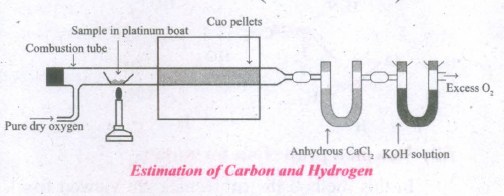
How would you estimate the percentage of carbon and hydrogen in an organic compound?
19.
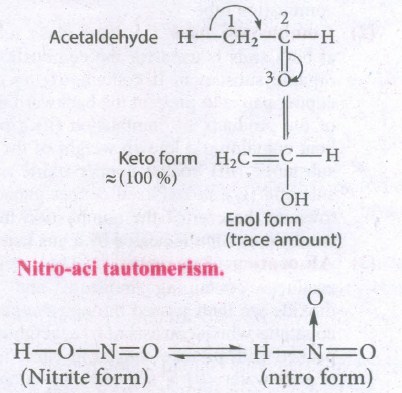
Describe tautomerism with relevant examples.
1.
(a)
Sublimation
2.
(a)
solubility difference
3.
(a)
9
4.
(b)
3
5.
(d)
2 - Methylpentane
6.
(i) Pent-a-ene-z-oli
'Pent' - parent hydrocarbon with 5 Ceatoms
4-ene - double bond attached to 4th carbon
2-o1 - -OH (alcohol) group attached to 2nd carbon
\(\therefore\)The strusture is, \(\overset { 5 }{ \underset { 2 }{ { CH }_{ 2 } } } =\overset { 4 }{ CH } -\overset { 3 }{ { CH }_{ 2 } } -\overset { 2 }{ \underset { \overset { | }{ OH } }{ CH } } -\overset { 1 }{ { CH }_{ 3 } } \)
(ii) Cyclohex-2-en-1-ol:
Cyclohex - Cyclic ring systemwith six carbon atoms.
2-ene - double bond attached to 2nd carbon atom.
1-01- -OH (alcohol) group present at 1st carbon atom.
\(\therefore\)The structure is 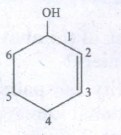
7.
Compounds having same physical and chemical property but differ only in the rotation of plane of the polarized light are known as optical isomers and the phenomenon is known as optical isomerism.
8.
Generally the trans isomer is more stable than the corresponding cis isomers. This is because in the cis isomer, the bulky groups are on the same side of the double bond. The steric repulsion ofthe groups makes the cis isomers less stable than the trans isomers in which bulky groups are on the opposite side.
9.
(i) Tbe locant number 2,5,6 is lower than 3,4,7
\(\overset { 1 }{ \underset { 7 }{ { CH }_{ 3 }- } } \overset { 2 }{ \underset { 6 }{ { CH }_{ 2 }- } } \overset { 3 }{ \underset { \underset { { C }_{ 2 }{ H }_{ 5 } }{ |5 } }{ { C }_{ 5 }H } } -\overset { 4 }{ \underset { 4 }{ { C }_{ 4 }{ H }_{ 2 } } } -\overset { 5 }{ \underset { \underset { { CH }_{ 3 } }{ |3 } }{ { C }_{ 3 }H } } -\overset { 6 }{ \underset { 2 }{ { C }_{ 2 }{ H }_{ 2 } } - } \overset { 7 }{ \underset { 1 }{ { CH }_{ 3 } } } \)
(ii) Substituents are in equivalent position from both the sides.
So lower number is given to ethyl which comes first in the name according to alphabetical order.
10.
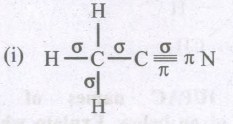 5 σ-bonds and 2π-bonds
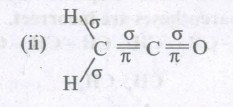 4 σ-bonds and 2π-bonds
11.
(i)
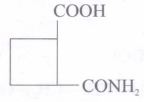
(ii)
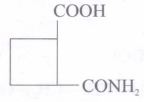
12.
An atom or a group of atoms present in an organic compound, which is responsible for the chemical properties of the compound is called the functional group.
13.
s-character & electronegativity,
\(\therefore\) sp hybrid orbitals are more electronegative among the three.
14.
This method is to purify liquids from non-volatile impurities, and used for separating the constituents of a liquid mixture which differ in their boiling points.
There are various methods of distillation depending upon the difference in the boiling points of the constituents. The methods are
(i) simple distillation
(ii) fractional distillation and
(iii) steam distillation.
The process of distillation involves the impure liquid when boiled gives out vapour and the vapour so formed is collected and condensed to give back the pure liquid in the receiver. is method is called simple distillation. Liquids with large difference in boiling point (about 40K) and do not decompose under ordinary pressure can be purified by simply distillation Eg. The mixture of C6H5NO2 (b.p 484K) & C6H6(354K) and mixture of diethyl ether (b.p 308K) and ethyl alcohol (b.p 351K)
15.
Few substances like benzoic acid, naphthalene and camphor when heated pass directly from solid to vapor without melting (ie liquid). On cooling the vapours will give back solids. Such phenomenon is called sublimation. It is a useful technique to separate volatile and non-volatile solid. It has limited application because only a few substance will sublime.
Substances to be purified is taken in a beaker. It is covered with a watch glass. The beaker is heated for a while and the resulting vapours condense on the bottom of the watch glass. Then the watch glass is removed and the crystals are collected. This method is applicable for organic substance which has high vapour pressure at temperature below their melting point. Substances like naphthalene, benzoic acid can be sublimed quickly. Substance which has very small vapour pressure will decompose upon heating are puried by sublimation under reduced pressure. This apparatus consists of large heating and large cooling surface with small distance in between because the amount of the substance in the vapour phase is much too small in case of a substance with low vapour pressure.
16.
Step 1. Calculation of volume of unused acid
Volume of NaOH solution required = 60 m3
Normality of NaOH solution = \(\cfrac { 1 }{ 2 } \)
Normality of H2S04 solution=\(\cfrac { 1 }{ N } \)
Volume of unused acid can be calculated by applying normality equation
\(\underset { Acid }{ \underbrace { { N }_{ 1 }{ V }_{ 1 } } } \times \underset { Base }{ \underbrace { { N }_{ 1 }{ V }_{ 1 } } } \)
\(1\times V=\cfrac { 1 }{ 2 } \times 60=30cm^{ 3 }\)
Step IlvCalculation of volume of acid used
Volume of acid added = 50 cm3'
Volume of unused acid = 30 cm''
Volume of acid used = (50 -30) = 20 m3
Step III. Calculation of percentage of nitrogen
Mass of compound = 0.50 g
Volume of acid used = 20 cm3
Normality of acid used = 1N
\(Percentage\ of\ N=\cfrac { 1.4\times Volume\ of\ acid\ used\ x\ Normality\ o \ facidused }{ Mass\ of \ the\ compound } \)
= \(\cfrac { 1.4\times 20\times 1 }{ 0.50 } =56\%\)
17.
Carius method: A known mass of the organic substance is heated strongly with fuming HN03. C & H get oxidized to CO2& H2O while sulphur is oxidized to sulphuric acid as per the following reaction.
\(C\overset { fum.HN{ O }_{ 3 } }{ \longrightarrow } { CO }_{ 2 }\)
\(2H\overset { fum.HN{ O }_{ 3 } }{ \longrightarrow } { H }_{ 2 }O\)
\(\\ S\longrightarrow { SO }_{ 2 }\overset { O+{ H }_{ 2 }O }{ \longrightarrow } { H }_{ 2 }SO_{ 4 }\)
The resulting solution is treated with excess of BaCI2 solution H2SO4 present in the solution in quantitatively converted into BaSO4, from the mass of BaSO4, the mass of sulphur and hence the percentage of sulphur in the compound can be calculated.
Procedure:
A known mass of the organic compound is taken in clean carius tube and added a few mL of fuming HNO3. The tube is the sealed. It is then placed in an iron tube and heated for about 5 hours. The tube is allowed to cool to temperature and a small hole is made to allow gases produced inside to escape. The carius tube is broken and the content collected in a beaker. Excess of BaCl2 is added to the beaker H2SO4 acid formed as a result of the reaction is converted to BaSO4. The precipitate of BaSO4 is filtered, washed, dried and weighed. From the mass of BaSO4, percentage of S is found.
Mass of the organic compound = w g
Mass of the BaSO4 formed = x g
233g of BaSO4 contains 32 g of sulphur
\(\therefore \) x g of BaSO4 contain \(\left( \frac { 32 }{ 233 } \times \frac { x }{ w } \right) \)
Percentage of sulphur = \(\left( \frac { 32 }{ 233 } \times \frac { x }{ w } \times 100 \right) \)%
18.
Both carbon and hydrogen are estimated by the same method. A known weight of the organic substance is burnt in excess of oxygen and the carbon and hydrogen present in it are oxidized to carbon dioxide and water, respectively.
The weight of carbon dioxide and water thus formed are determined and the amount of carbon and hydrogen in the organic substance is calculated. The apparatus employed for the purpose consists of three units
(1) oxygen supply
(2) combustion tube
(3) absorption apparatus.
(1) Oxygen supply: To remove the moisture from oxygen it is allowed to bubble through sulphuric acid and then passed through aV-tube containing soda lime to remove CO2. The oxygen gas free from moisture and carbondioxide enters the combustion tube.
(2) Combustion tube: A hard glass tube open at both ends is used for the combustion of the organic substance. It contains (i) an oxidized copper gauze to prevent the backward diffusion of the products of combustion (ii) a porcelain
boat containing a known weight of the organic substance (iii) coarse copper oxide on either side and (iv) an oxidized copper gauze placed towards the end of the combustion tube. The combustion tube is heated by a gas burner.
(3) Absorption Apparatus: The combustion products containing moisture and carbondioxide are then passed through the absorption apparatus which consists of (i) a weighed U'-tube packed with pumice soaked- in cone. H2SO4 to absorb water (ii) a set of bulbs containing a strong solution of KOH to absorb CO2 and finally (iii) a guard tube filled with anhydrous CaCI2 to prevent the entry of moisture from atmosphere. Procedure: The combustion tube is heated strongly to dry its content. It is then cooled slightly and connected to the absorption apparatus. The other end of the combustion tube is open for a while and the boat containing weighed organic substance is introduced. The tube is again heated strongly till the substance in the boat is burnt away. This takes about 2 hours. Finally, a strong current of oxygen is passed through the combustion tube to sweap away any traces of carbon dioxide or moisture which may be left in it. The If-tube and the potash bulbs are then detached and the increase in weight of each of them is determined.
Calculation:
Weight of the organic substance taken= w g
Increase in weight of H2O = xg
Increase in weight of CO2 =yg
18 g of H20 contain 2g of hydrogen
\(\therefore \) x g of H2O contain\(\left( \frac { 2 }{ 18 } \times \frac { x }{ w } \right) \) g of hydrogen
Percentage of hydrogen = \(\left( \frac { 2 }{ 18 } \times \frac { x }{ w } \times 100 \right) \)%
44g of CO2 contains 12g of carbon
\(\therefore \) y g of CO2 contain \(\left( \frac { 2 }{ 44 } \times \frac { y }{ w } \right) \) g of carbon
Percentage of carbon= \(\left( \frac { 2 }{ 44 } \times \frac { y }{ w } \times 100 \right) \)%
Note:
1. If the organic substance under investigation also contain N, it will produce oxides of nitrogen on combustion. A spiral of copper is introduced at the combustion tube, to reduce the oxides of nitrogen to nitrogen which escapes unabsorbed.
2. If the compound contains halogen a well, a spiral of silver is also introduced in the combustion tube. It converts halogen into dilver halide.
3. In case if the substance also contains sulphur, the copper oxide in the combustion tube is replaced by lead chromate. The SO2 formed during combustion is thus converted to lead sulphate and prevented from passing into the absorption unit.
19.
Tautomerism: It is a special type of functional isomerism in which a single compound exists in two readily inter convertible structures that differ markedly in the relative position of atleast one atomic nucleus, generally hydrogen. The two different structures are known as tautomers. ere are several types of tautomerism and the two important types are dyad and triad systems.
(a) Dyad system: In this system hydrogen atom oscillates between two directly linked polyvalent atoms.
In this example hydrogen atom oscillates between carbon and nitrogen atom
\(\underset { (hydrogencyanide) }{ H } -C\equiv N\longleftrightarrow \underset { (hydrogenisocyanide }{ H } -N\overset { \rightarrow }{ = } C\)
(b) Triad system: In this 'system hydrogen atom oscillates between three polyvalent atoms. It involves 1,3 migration of hydrogen atom from one polyvalent atom to other within the molecule. e most important type of triad system is keto-enol tautomerism and the two groups of tautomers are ketoform and enol-form. The polyvalent atoms involved are one oxygen and two carbon atoms. Enolisation is a process in which keto-form is converted to enol form. Both tautomeric forms are not equally stable. The less stable form is known as lable form
Example:
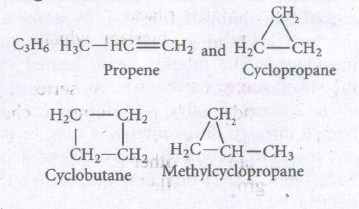
(c) Ring chain isomerism: In this type of isomerism, compounds having same molecular formula but differ in terms of bonding of carbon atom to form open chain and cyclic structures for eg:

11th Standard Syllabus & Materials
11th Standard
TN 11th Tamil பீடு பெற நில் - செய்யுள் - காவடிச்சிந்து Important Questions And Answers Study Material - QB365 Set A
NEW11th Standard
TN 11th Tamil பீடு பெற நில் - உரைநடை - மலை இடப்பெயர்கள் : ஓர் ஆய்வு Important Questions And Answers Study Material - QB365 Set A
NEW11th Standard
TN 11th Tamil மாமழை போற்றுதும் - துணைப்பாடம் - யானை டாக்டர் Important Questions And Answers Study Material - QB365 Set A
NEW11th Standard
TN 11th Tamil மாமழை போற்றுதும் - செய்யுள் - ஐங்குறுநூறு Important Questions And Answers Study Material - QB365 Set A



Tamilnadu Stateboard 11th Standard Subjects

Maths

Commerce

Economics

Biology

Business Maths and Statistics

Accountancy

Computer Science

Physics
Chemistry
Maths
Biology
Economics
Physics
Chemistry

History
Business Maths and Statistics

Computer Science
Accountancy

Computer Applications
History
Computer Technology
Commerce
Computer Applications
Computer Technology

Tamil

English

French
Tamilnadu Stateboard Standards
