
 100% FREE ACCESS
11th Standard Syllabus & Materials
11th Standard
TN 11th Tamil இயற்கை வேளாண்மை,சுற்றுச்சூழல் -செய்யுள் - மனோன்மணீயம் Important Questions And Answers Study Material - QB365 Set A
NEW11th Standard
TN 11th Tamil என்னுயிர் என்பேன் -துணைப்பாடம் - இசைத்தமிழர் இருவர் Important Questions And Answers Study Material - QB365 Set A
NEW11th Standard
TN 11th Tamil மொழி கலை -செய்யுள் - ஒவ்வொரு புல்லையும் Important Questions And Answers Study Material - QB365 Set A
NEW11th Standard
TN 11th Tamil பீடு பெற நில் - இலக்கணம் - பகுபத உறுப்புகள் Important Questions And Answers Study Material - QB365 Set A
NEW11th Standard
TN 11th Tamil பீடு பெற நில் - துணைப்பாடம் - வாடிவாசல் Important Questions And Answers Study Material - QB365 Set A
NEW11th Standard
TN 11th Tamil பீடு பெற நில் - செய்யுள் - குறுந்தொகை Important Questions And Answers Study Material - QB365 Set A

Published on: 14/12/2019
Hydrocarbons
Download Tamil Nadu 11th Standard Chemistry question papers, model tests, one-mark questions, important questions, and public exam papers in PDF format. Free study materials and answer keys for TN State Board students.
Questions + Answers key
Take MCQ Chemistry Test
1.
How many structural isomers are possible for the molecular formula C4H8 which can undergo ozonolysis?
2
4
3
1
2.
In E1, reaction, the intermediate formed is ___________
Carbanion
Carbocation
Carbon free radical
Carbene
3.
Torsion strain is the repulsive interaction between ___________
Electron cloud of two bonds
Electron cloud of two \(\sigma \)-bonds
Electron cloud of two \(\pi\)-bonds
Electron cloud of two \(\sigma \)-bonds on adjacent atoms
4.
The number of axial hydrogen atoms in chair form of cyclohexane is ______________
3
6
12
2
5.
C6H5CH2CH2CH3 is when oxidised in the presence of alke kMnO4, the product obtained is ____________
C6H5CHO
C6H5COOH
C6H5CH2CH2CHO
C6H5COCH3
6.
How will you prepare methane from grignard reagent?
7.
Convert bromo benzene to toluene and name the process.
8.
Write a note or Birch reduction.
9.
What is peroxide effect? Give example.
10.
Identify A and B from the following. \({ C }_{ 2 }{ H }_{ 6 }O\overset { con.{ H }_{ 2 }{ SO }_{ 4 } }{ \underset { 430-440K }{ \longrightarrow } } A\overset { { H }_{ 2 } }{ \underset { Ni,298K }{ \longrightarrow } } B\)
11.
Explain the molecular orbirtal structure of benzene.
12.
Among anthracene and cyclopentadiene which is aromatic? Give reason for your answer.
13.
Write a note on the following reactions.
(i) Dehydration of ethanol
(ii) Electrolysis of potassium succinate
(iii) Chlorination of ethene
14.
Explain the isomerism exhibited by alkenes.
15.
Listout the uses of alkanes.
16.
Write the mechanism of chlorination of benzene.
17.
Explain the acidic nature of alkynes.
18.
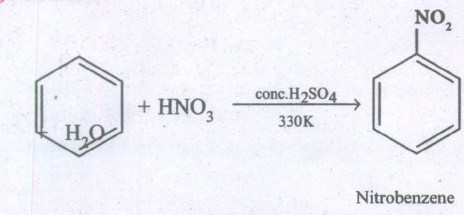
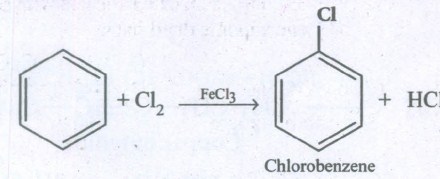
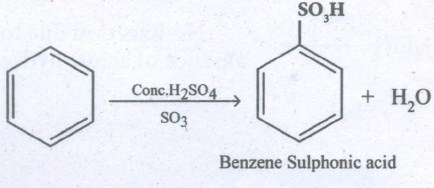
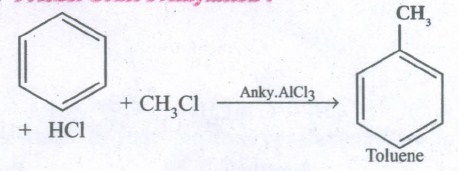
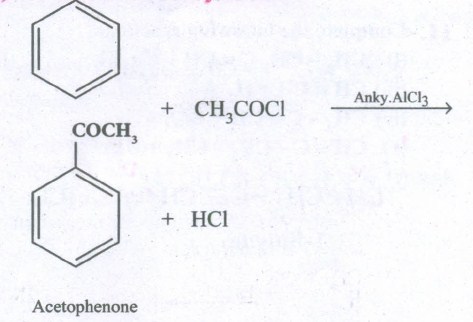
Write only the equations representing the electrophilic substitution in benzene.
19.
Explain the industrial and laboratory preparation of benzene and toluene.
1.
(c)
3
2.
(b)
Carbocation
3.
(d)
Electron cloud of two \(\sigma \)-bonds on adjacent atoms
4.
(b)
6
5.
(b)
C6H5COOH
6.
Methyl magnesium chloride reacts with water to give methane.
\(\underset { (Methylmagnesiumchloride) }{ { CH }_{ 3 }MgCl } +{ H }_{ 2 }O\rightarrow \underset { (Methane) }{ { CH }_{ 4 } } +MgCl(OH)\)
7.
When a solution of bromo benzene and iodo methane in dry ether is treated with metallic sodium, toluene is formed.
\({ C }_{ 6 }{ H }_{ 5 }Br+2Na+IC{ H }_{ 3 }\overset { ether }{ \longrightarrow } { C }_{ 6 }{ H }_{ 6 }{ CH }_{ 3 }+NaBr+NaI\)
Bromo benzene Iodo methane Toluene
The process is named as Wurtz-Fitting reaction.
8.
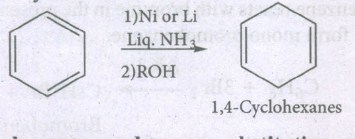
Benzene can be reduced to 1, 4-cyclohexadiene by treatment with Na or Li in a mixture of liquid ammonia and alcohol. It is the convenient method to prepare cyclic dienes.
9.
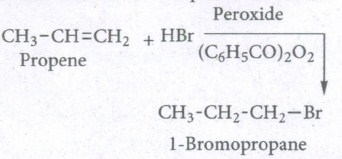
The addition of HBr to an alkene in the presence of organic peroxide, gives the anti Markovniko's product. This effect is called peroxide effect.
10.
\(\underset { Ethanol }{ { C }_{ 5 }{ H }_{ 5 }{ O }_{ 4 } } \overset { Conc.{ H }_{ 2 }{ SO }_{ 4 } }{ \underset { 430-440K }{ \longrightarrow } } \underset { \overset { (A) }{ Ethene } }{ { CH }_{ 2 }={ CH }_{ 2 } } \overset { { H }_{ 2 } }{ \underset { Ni,298K }{ \longrightarrow } } \underset { \overset { (B) }{ Ethane } }{ { CH }_{ 3 }-{ CH }_{ 3 } } \)
11.
The structure of benzene is best described in terms of the molecular orbital theory. All the six carbon atoms of benzene are sp2 hybridized. Six sp2 hybrid orbitals of carbon linearly overlap with six one is orbitals of hydrogen atoms to form six C - H sigma bonds. Overlap between the remaining Sp2 hybrid orbitals of carbon forms six C-C sigma bonds
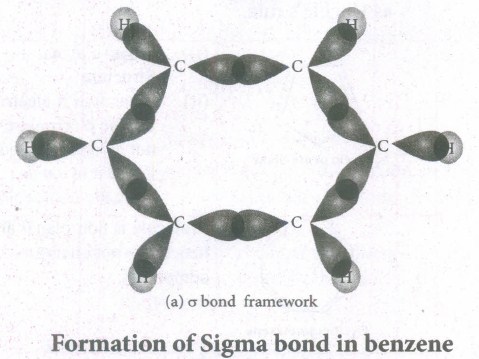
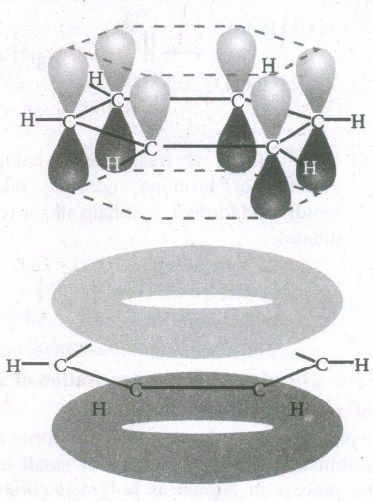
All the bonds in benzene lie in one plane with bond angle 120°. Each carbon atom in benzene possess an un hybridized p-orbital containing one electron. The lateral overlap of their p-orbital produces 3 \(\pi\)-bond The six electrons of the p-orbitals cover all the six carbon atoms and are said to be delocalised. Due to delocalization, strong -bond is formed which makes the molecule stable. Hence unlike alkenes and alkynes benzene undergoes substitution reactions rather addition reactions under normal conditions.
12.
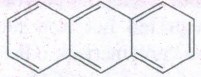
Among anthracene and cyclopentadiene - anthracene is aromatic in nature.
| Anthracene | Cyclopentadiene | |
|---|---|---|
 |
 |
|
| 1. | Planar structure | Planar structure |
| 2. | Contains 14 delocalised \(\pi\) electrons (4n + 2 = 14\(\pi\)e-) | Contains 4 non-delocalised \(\pi\) electrons |
| 3. | Hence aromatic | Hence non-aromatic |
13.
(i) Preparation of alkene by dehydration of alcohol:
When an alcohol is heated at 430-440 K with excess of concentrated sulphuric acid, a molecule of water from alcohol is removed and an alkene is formed. is reaction is called elimination reaction.
\({ C }_{ 2 }{ H }_{ 5 }OH\overset { Conc.{ H }_{ 2 }{ SO }_{ 4 } }{ \underset { 430-440K }{ \longrightarrow } } { CH }_{ 2 }={ CH }_{ 2 }\)
Ethanol Ethene
Ethene can also be prepared in laboratory by catalytic dehydration of alcohol.
\({ C }_{ 2 }{ H }_{ 5 }OH\overset { { A1 }_{ 2 }{ O }_{ 3 } }{ \underset { 623K-723K }{ \longrightarrow } } { CH }_{ 2 }={ CH }_{ 2 }\)
Ethanol Ethene
(ii) Preparation of ethene by Kolbe's electrolytic method:
When an aqueous solution of potassium succinate is electrolyzed between two platinum electrodes, ethene is produced at the anode.
\(\overset { { CH }_{ 2 }-COOK }{ \underset { { CH }_{ 2 }-COOK }{ | } } \overset { Electrolysis }{ \longrightarrow } \overset { { CH }_{ 2 }-{ COO }^{ - } }{ \underset { { CH }_{ 2 }-{ COO }^{ - } }{ | } +2 } { K }^{ + }\)
Potassium Succinate
At anode
\(\overset { { CH }_{ 2 }CO{ O }^{ - } }{ \underset { { CH }_{ 2 }CO{ O }^{ - } }{ | } \rightarrow } \overset { { CH }_{ 2 } }{ \underset { { CH }_{ 2 } }{ || } } +{ CO }_{ 2(g) }+{ 2e }^{ - }\)
Ethene
(iii) When alkene is treated with halogens like chlorine or bromine, addition takes place rapidly and forms 1,2- dihalo alkane (or) vicinal dihalide.
\({ CH }_{ 2 }={ CH }_{ 2 }\overset { { \\ CI }_{ 2 } }{ \longrightarrow } \overset { { CH }_{ 2 }- }{ \underset { CI }{ | } } \overset { { CH }_{ 2 } }{ \underset { CI }{ | } } \)
1,2 dichloroethane
14.
Isomerism:
Presence of double bond in alkene provides the possibility of both structural and geometrical isomerism.
Structural Isomerism:
The first two member's ethene C2H4 and propene C3H6 do not have isomers because the carbon atoms in the molecules can be arranged only one distinct way.
However from the third member of alkene family butene C4H10 structural isomerism exists.
(i) CH3-CH = CH-CH3 1-Butene
(ii) CH2=CH-CH2-CH3 2-Butene
(iii) \({ CH }_{ 2 }=\overset { \underset { | }{ { CH }_{ 3 } } }{ C } -{ CH }_{ 3 }\) 2-Methyl-1-propene
structures (i) & (ii) are position isomers. structures (i) & (iii), (ii) & (iii) are chain isomers.
Geometrical isomerism:
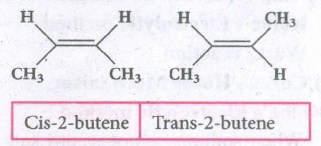
It is a type of stereoisomerism and it is also called cis-trans isomerism. Such type of isomerism results due to the restricted rotation of doubly bounded carbon atoms.
if the similar groups lie on the same side, then the geometrical isomers are called C is-isomers. When the similar groups lie on the opposite side, it is called a Trans isomer.
for example: the geometrical isomers of 2-Butane is expressed as follow
15.
The exothermic nature of alkane combustion reaction explains the extensive use of alkanes as fuels. Methane present in natural gas is used in home heating. Mixture of propane and butane are known, as LPG gas which is used for domestic cooking purpose. GASOLINE is a complex mixture of many hydrocarbons used as a fuel for internal-combustion engines.
Carbon black is used in the manufacture of ink, printer ink and black pigments. .It is also used as fillers.
| No of Carbon Atoms | State at room temperature | Major uses |
|---|---|---|
| 1-4 | Gas | Heating fuel, Cooking fuel |
| 5-7 | Low boiling liquid | Solvents, Gasoline |
| 6-12 | Liquid | Gasoline |
| 12-24 | Liquid | Jet fuel- portable stove fuel |
| 18-50 | High boiling liquid | Diesel fuel, lubricant, heating oil |
| 50+ | Solid | Petroleum jelly and paran wax |
16.
Step 1: Generation of CI+ electrophile.

Step 2: Attack of the electrophile on the benzene ring to form arenium ion:

Step 3: Rearomatisation of arenium ion:

17.
An alkyne shows acidic nature only if it contains terminal hydrogen atom. This can be explained by considering the sp hybrid orbitals of carbon atom in alkynes. The percentage of s-character of sp hybrid orbital (50%) is more than Sp2 hybrid orbital ofalkenes (33%) and sp3 hybrid orbital of alkanes (25%). Because of this, carbon atom becomes more electronegative, thus facilitating donation of H+ ions to bases. So hydrogen attached to triply bonded carbon atoms is acidic in nature.
(i) \(\underset { (1-Butyne) }{ CH_{ 3 }-{ CH }_{ 2 }-C } \equiv CH+{ CuCl }_{ 2 }+\underset { (Silver\quad bitynide) }{ { 2NH }_{ 4 }OH } \longrightarrow { CH }_{ 3 }-{ CH }_{ 2 }-C\equiv C-Cu\downarrow 2{ NH }_{ 4 }{ NO }_{ 3 }+2{ H }_{ 2 }O\)(ii) \({ CH }_{ 3 }-{ CH }_{ 2 }-C\equiv CH+{ CuCl }_{ 2 }+2{ NH }_{ 4 }\longrightarrow { CH }_{ 3 }-{ CH }_{ 2 }-C\equiv C-C\downarrow 2{ NH }_{ 4 }{ NO }_{ 3 }+2{ H }_{ 2 }O\)
(iii)
\(\underset { (2-Butyne) }{ { CH }_{ 3 }-C\equiv C-{ CH }_{ 3 } } +2Ag{ NO }_{ 3 }+2{ NH }_{ 4 }OH+2{ NH }_{ 4 }OH\longrightarrow No\quad reaction\quad due\quad to\quad absence\quad of\quad acidic\quad hydrogen\)
18.
(i) Nitration:
(ii) Halogenation:
(iii) Sulphonation:
(iv) Friedel Craft's Alkylation:
(v) Friedel Craft's Acylation:
19.
Preparation of benzene:
(i) Industrial preparation of benzene from coal tar:
Coal tar is a viscous liquid obtained by the pyrolysis of coal. During fractional distillation, coal tar is heated and distills away its volatile compounds namely benzene, toluene, xylene in the temperature range of 350 to 443 K. These vapours are collected at the upper part of the fractionating column
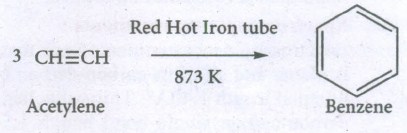
(ii) From acetylene:
Acetylene on passing through a red - hot tube trimerises to give benzene.
(iii) Laboratory methods of preparing benzene and toluence
(a) Decarboxylaation of aromatic acid.
When sodium benzoate in heated with sodalime, benzene vapours distil over.
C6H5COONa + NaOH \(\overset { CaO }{ \longrightarrow } \)C6H6 + Na2CO3
Sodium benzoate Benzene
(b) Preparation of benzene from phenol
When phenol vapours are passed over zinc dust, then it is reduced to benzene.
C6H5OH + Zn \(\rightarrow\) C6H6 + ZnO
Phenol Benzene
(c) Wurtz - Fittig reaction:
When a solution of bromobenzene and iodomethane in dry ether is treated with metallic sodium, toluene is formed.
C6H5Br + 2Na + ICH3 \(\overset { ether }{ \longrightarrow } \) C6H6CH3 + NaBr + Nal
Bromobenzene Iodo methane Toluene
(d) Friedel Craft's reaction:
When benzene is treated with methyl chloride in the presence of anhydrous aluminium chloride, toluene is formed.
C6H6 + CH3CI \(\overset { anhydrous\quad AICI_{ 3 } }{ \longrightarrow } \)C6H5CH3 + HCI
Benzene Chloromethane Toluene

11th Standard Syllabus & Materials
11th Standard
TN 11th Tamil பீடு பெற நில் - செய்யுள் - காவடிச்சிந்து Important Questions And Answers Study Material - QB365 Set A
NEW11th Standard
TN 11th Tamil பீடு பெற நில் - உரைநடை - மலை இடப்பெயர்கள் : ஓர் ஆய்வு Important Questions And Answers Study Material - QB365 Set A
NEW11th Standard
TN 11th Tamil மாமழை போற்றுதும் - துணைப்பாடம் - யானை டாக்டர் Important Questions And Answers Study Material - QB365 Set A
NEW11th Standard
TN 11th Tamil மாமழை போற்றுதும் - செய்யுள் - ஐங்குறுநூறு Important Questions And Answers Study Material - QB365 Set A



Tamilnadu Stateboard 11th Standard Subjects

Maths

Commerce

Economics

Biology

Business Maths and Statistics

Accountancy

Computer Science

Physics
Chemistry
Maths
Biology
Economics
Physics
Chemistry

History
Business Maths and Statistics

Computer Science
Accountancy

Computer Applications
History
Computer Technology
Commerce
Computer Applications
Computer Technology

Tamil

English

French
Tamilnadu Stateboard Standards
