
 100% FREE ACCESS
11th Standard Syllabus & Materials
11th Standard
TN 11th Tamil இயற்கை வேளாண்மை,சுற்றுச்சூழல் -செய்யுள் - மனோன்மணீயம் Important Questions And Answers Study Material - QB365 Set A
NEW11th Standard
TN 11th Tamil என்னுயிர் என்பேன் -துணைப்பாடம் - இசைத்தமிழர் இருவர் Important Questions And Answers Study Material - QB365 Set A
NEW11th Standard
TN 11th Tamil மொழி கலை -செய்யுள் - ஒவ்வொரு புல்லையும் Important Questions And Answers Study Material - QB365 Set A
NEW11th Standard
TN 11th Tamil பீடு பெற நில் - இலக்கணம் - பகுபத உறுப்புகள் Important Questions And Answers Study Material - QB365 Set A
NEW11th Standard
TN 11th Tamil பீடு பெற நில் - துணைப்பாடம் - வாடிவாசல் Important Questions And Answers Study Material - QB365 Set A
NEW11th Standard
TN 11th Tamil பீடு பெற நில் - செய்யுள் - குறுந்தொகை Important Questions And Answers Study Material - QB365 Set A

Published on: 09/10/2019
Hydrocarbons
Download Tamil Nadu 11th Standard Chemistry question papers, model tests, one-mark questions, important questions, and public exam papers in PDF format. Free study materials and answer keys for TN State Board students.
Questions + Answers key
Take MCQ Chemistry Test
1.
Arrange benzene, n-hexane and ethyne in decreasing order of acidic behavior. Also give reason for this behavior?
2.
In aryl halides, halogen group is a ortho-para director and a deactivator towards electrophilic substitution reactions, why?
3.
What is BHC? How will you prepare BHC? Mention its uses.
4.
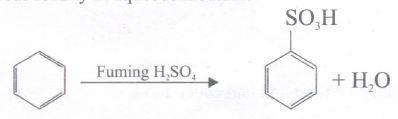
Explain the sulphonation of benzene.
5.
Explain the mechanism of addition of HBr to propene.
6.
What are vicinal dihalides? How will you prepane alkene from vicinal dihaldes?
7.
Among anthracene and cyclopentadiene which is aromatic? Give reason for your answer.
8.
State Huckel's rule of aromaticity and explain it interms of cyclopentadiene, cycloxtateraene and cyclopropenylcation.
9.
How many types of polymerisation are possible in alkynes?
10.
Why alkenes are more reactive than alkanes?
1.
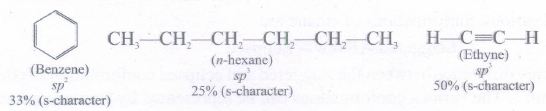
Since s-electrons are closer to the nucleus, therefore as the s-character of the orbital making the C-H bond increases the electrons of C-H bond lies closer and closer to the carbon atom. In other words, the partial +ve charge on the H-atom and hence the acidic character increases as the s-character of the orbital increases. Thus, the acidic character decreases in the order: Ethyne > Benzene> Hexane.
2.
(i) In aryl halides, the strong -/ effect of the halogens decreases the electron density of benzene ring, thereby deactivating it for electrophilic attack.
(ii) The presence of lone pair on halogens is involved in resonance with n-electrons of the benzene ring and it increases the electron density at ortho and para position. Hence the halogen group is an ortho-para director and a deactivator.
3.
(i) BHC is Benzene hexachloride.
(ii) Benzene reacts with three molecule of Cl2 in the presence of sunlight or UV light to yield BHC.
This is also called as gammaxane or Lindane
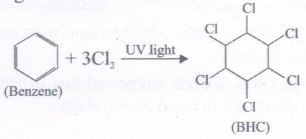
(iii) BHC is a powerful insecticide
4.
Benzene reacts with fuming sulphuric acid and give benzene sulphonic acid. Although S03 molecule it does not have positive charge, yet it is a strong electrophile. This is because the octet of electrons around the sulphur atom is not reacted. This reached is reversible and desulphonation occus readily in aqueous medium.
5.
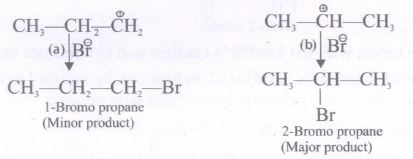
Step 1 : Formation of electrophile: In HBr, Br is more electronegative than H. When bonded electron move towards Br, polarity is developed and it creates electrophile H+ which attacks to the double bond to form a carbocation.
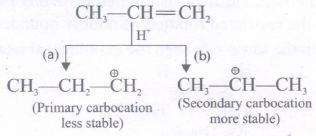
Step 2 : Secondary carbocation is more stable than primary carbocation and it predominates over the primary carbocation.
Step 3 : The Bra ion attack the 2°- carbocation to form 2-Bromo propane as the major product.
6.
(i) The compounds in which two halogen atoms are attached to adjacent carbon-atoms are called as vicinal dihalides.
(ii) When vicinal dihalides are warmed with granulated zinc in-methanol they lose a molecule of ZrtX, to form alkene
\(\underset { (1,2-dibromo\quad etane) }{ \underset { \overset { | }{ Br } }{ C } H_{ 2 }-\underset { \overset { | }{ Br } }{ C } { H }_{ 2 } } \overset { Zn|{ CH }_{ 3 }OH }{ \longrightarrow } \underset { \overset { | }{ Br } }{ C } { H }_{ 2 }-C{ H }_{ 2 }-ZnBr\longrightarrow \underset { (Ethylene) }{ { CH }_{ 2 }-{ CH }_{ 2 }+{ ZnBr }_{ 3 } } \)
7.
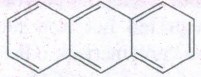
Among anthracene and cyclopentadiene - anthracene is aromatic in nature.
| Anthracene | Cyclopentadiene | |
|---|---|---|
 |
 |
|
| 1. | Planar structure | Planar structure |
| 2. | Contains 14 delocalised \(\pi\) electrons (4n + 2 = 14\(\pi\)e-) | Contains 4 non-delocalised \(\pi\) electrons |
| 3. | Hence aromatic | Hence non-aromatic |
8.
Huckel proposed that aromaticity is a function of electronic structure. A compound may be aromatic, if it obeys the following rules
(i) The molecule must be co-planar
(ii) Complete delocalization of \(\pi\) electron in the ring
(iii) Presence of (4n+2) \(\pi\) electrons in the ring where n is an integer (n=0,1,2 .... ) is known as Huckle's rule.
| 1. | 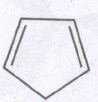 Cyclo penta diene |
(i) It has a planar Structure (ii) It has four \(\pi\) electron but the elecron are not delocalised and hence it is not an aromatic compound. |
| 2. | 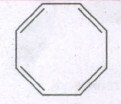 Cyclooctatetraene |
Molecule is non-planar and hence it is not an aromatic compound. |
| 3. | 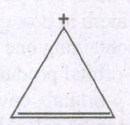 Cyclopropenylcation |
(i) Cyclopropenyl cation has planar structure. (ii) It has 2 delocalised \(\pi\) electron. (iii) 4n + 2 = 2 4n = 0 n = 0 (an interger) and hence it is aromatic compount. |
9.
Alkyne undergoes two types of polymerisation reaction
(i) Linear Polymerisation :
Ethyne forms linear polymer, when passed into a solution of cuprous chloride and ammonium chloride.
\(2CH\equiv CH\overset { { CI }_{ 2 }/{ NE }_{ 4 }CI }{ \longrightarrow } { CH }_{ 2 }=\underset { \overset { | }{ C\equiv CH } }{ CH } \)
Vinyl ethylene
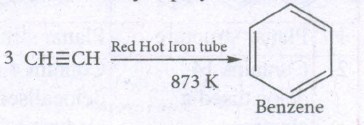
(ii) Cyclic polymerisation:
Ethyne undergoes cyclic polymerization on passing through red hot iron tube. Three molecules of ethyne polymerises to benzene.
10.
(i) Alkenes are more reactive than alkanes due to the presence of a double bond.
(ii) The o-bond is strong but the n-bond is weak. The typical reactions of alkenes involve the addition of an electrophile across the double bond proceeding through ionic mechanism. However addition reactions proceed through free-radical mechanism also. Ozonolysis and polymerisation are some of the characteristic reaction of alkenes.

11th Standard Syllabus & Materials
11th Standard
TN 11th Tamil பீடு பெற நில் - செய்யுள் - காவடிச்சிந்து Important Questions And Answers Study Material - QB365 Set A
NEW11th Standard
TN 11th Tamil பீடு பெற நில் - உரைநடை - மலை இடப்பெயர்கள் : ஓர் ஆய்வு Important Questions And Answers Study Material - QB365 Set A
NEW11th Standard
TN 11th Tamil மாமழை போற்றுதும் - துணைப்பாடம் - யானை டாக்டர் Important Questions And Answers Study Material - QB365 Set A
NEW11th Standard
TN 11th Tamil மாமழை போற்றுதும் - செய்யுள் - ஐங்குறுநூறு Important Questions And Answers Study Material - QB365 Set A



Tamilnadu Stateboard 11th Standard Subjects

Maths

Commerce

Economics

Biology

Business Maths and Statistics

Accountancy

Computer Science

Physics
Chemistry
Maths
Biology
Economics
Physics
Chemistry

History
Business Maths and Statistics

Computer Science
Accountancy

Computer Applications
History
Computer Technology
Commerce
Computer Applications
Computer Technology

Tamil

English

French
Tamilnadu Stateboard Standards
