 100% FREE ACCESS100% FREE ACCESS
11th Standard Syllabus & Materials
11th Standard
TN 11th Tamil இயற்கை வேளாண்மை,சுற்றுச்சூழல் -செய்யுள் - மனோன்மணீயம் Important Questions And Answers Study Material - QB365 Set A
NEW11th Standard
TN 11th Tamil என்னுயிர் என்பேன் -துணைப்பாடம் - இசைத்தமிழர் இருவர் Important Questions And Answers Study Material - QB365 Set A
NEW11th Standard
TN 11th Tamil மொழி கலை -செய்யுள் - ஒவ்வொரு புல்லையும் Important Questions And Answers Study Material - QB365 Set A
NEW11th Standard
TN 11th Tamil பீடு பெற நில் - இலக்கணம் - பகுபத உறுப்புகள் Important Questions And Answers Study Material - QB365 Set A
NEW11th Standard
TN 11th Tamil பீடு பெற நில் - துணைப்பாடம் - வாடிவாசல் Important Questions And Answers Study Material - QB365 Set A
NEW11th Standard
TN 11th Tamil பீடு பெற நில் - செய்யுள் - குறுந்தொகை Important Questions And Answers Study Material - QB365 Set A

Published on: 08/09/2018
BOOK BACK ONE MARK TEST
Download Tamil Nadu 11th Standard Chemistry question papers, model tests, one-mark questions, important questions, and public exam papers in PDF format. Free study materials and answer keys for TN State Board students.
Questions + Answers key
Take MCQ Chemistry Test

1.
Van't Hoff equation is ___________
\(\triangle G^0=-\triangle H^0-T\triangle S^0\)
G - H - TS
\(\triangle G^0\) = -2.303 RT log Keq
\(\triangle S-\triangle H/T\)
2.
Statement-I: Heavy water has been widely used as moderator in nuclear reactors.
Statement-II: Heavy water can lower the energies of fast moving neutrons.
Statements-I and II are correct and Statement-II is the correct explanation of statement-I.
Statements-land II are correct but Statement-II is not the correct explanation of statement-I.
Statement-I is correct but Statement-II is wrong.
Statement-I is wrong but Statement-II is correct.
3.
Statement-I: The magnetic moment of parahydrogen is zero.
Statement-II: The spins of two hydrogen atoms in para H2 molecule neutralise each other.
Statements-I and II are correct and Statement-II is the correct explanation of statement-I.
Statements-I and II are correct but Statement-II is not the correct explanation of statement- I.
Statement-I is correct but Statement-II is wrong.
Statement-I is wrong but Statement-II is correct.
4.
Statement-I: Hydrogen is placed at the top of the group which is in-line with the latest periodic table.
Statement-II: Hydrogen has a tendency to lose its electron to form H+, thus showing electropositive character like alkali metals. On the other hand, hydrogen has a tendency to gain an electron to yield H-, thus showing an electronegative character like halogens.
Statements-I and II are correct and Statement-Il is the correct explanation of statement-I.
Statements-land II are correct but Statement-II is not the correct explanation of statement- I.
Statement-I is correct but Statement-II is wrong.
Statement-I is wrong but Statement-II is correct.
5.
Assertion: Permanent hardness of water is removed by treatment with washing soda.
Reason: Washing soda reacts with soluble calcium and magnesium chlorides and sulphates in hard water to form insoluble carbonates
Both assertion and reason are true and reason is the correct explanation of assertion.
Both assertion and reason are true but reason is not the correct explanation of assertion.
Assertion is true but reason is false
Both assertion and reason are false
6.
Electronic configuration of species M2+ is 1s2 2s2 2p6 3s2 3p6 3d6 and its atomic weight is 56. The number of neutrons in the nucleus of species M is ________
26
22
30
24
7.
The equivalent mass of potassium permanganate in alkaline medium is:
MnO4- + 2H2O + 3e-\(\rightarrow\) MnO2 + 4OH-
31.6
52.7
79
None of these
8.
Assertion: Number of radial and angular nodes for 3p orbital are 1, 1 respectively.
Reason: Number of radial and angular nodes depends only on principal quantum number.
both assertion and reason are true and reason is the correct explanation of assertion.
both assertion and reason are true but reason is not the correct explanation of assertion.
assertion is true but reason is false
both assertion and reason are false
9.
Assertion: The spectrum of He+ is expected to be similar to that of hydrogen
Reason: He+ is also one electron system.
If both assertion and reason are true and reason is the correct explanation of assertion.
If both assertion and reason are true but reason is not the correct explanation of assertion
If assertion is true but reason is false
If both assertion and reason are false
10.
First law of thermodynamics does not give any information regarding _________
spontaneity
feasibility
both (a) & (b)
neither (a) nor (b)
11.
_________ is an intensive property
internal energy
volume
temperature
mass
12.
Identify the suitable condition(s) which helps the adiabatic process to occur?
(i) ΔT = 0
(ii)ΔP = 0
(iii) q = 0
(iv) w = 0
Only (i)
Only (iii)
(i) and (ii)
(i), (ii) and (iv)
13.
Pick out the true statement(s).
(i) q and w are path functions
(ii) q + w is a state function
Only (i)
Only (ii)
Both (i) and (ii)
Both are incorrect statements
14.
For the reaction PCl5(g) ⟶ PCl3(g) + Cl2(g)
ΔH>ΔU
ΔH<ΔU
ΔH=ΔU
Unpredictable
15.
Which of the following is a state function?
q
w
q + w
All of these
16.
The extensive and intensive properties respectively are ____________
entropy, enthalpy
entropy, temperature
enthalpy, entropy
temperature, entropy
17.
For a cyclic process involving isothermal expansion of an ideal gas.
∆U=qV
∆U=w
∆U= q + w
∆U=0
18.
In a compression process, Pext is ___________
(Pint+ dP)
(Pint- dP)
(dP-Pint)
(-Pint+dP)
19.
The gravitational work done by an object is __________
Qv
fx
PV
mgh
20.
1kJ = _________J
1000
100
50
20
21.
If the heat flows out of the system into the surrounding, the q value becomes _________
+Ve
-Ve
equal to zero
maximum
22.
The SI unit of heat is ____________
Joule
Calorie
mole
J mol-1
23.
For a cyclic process the volume of ΔU is ____________
maximum
minimum
zero
does not change
24.
Which among the following is a path function?
Enthalpy
Free energy
Internal energy
Work
25.
Which among the following is a state function?
Pressure
Enthalpy
Heat
Both (a) and (b)
26.
Match the list I with list II and select the correct answer using the code given below the list.
| List-I | List-II |
| A. isochoric | 1. dE = 0, dV = 0, dH = 0, dP= 0 |
| B. cyclic | 2. dT=0 |
| C. adiabatic | 3. dV=0 |
| D. isothermal | 4. q=0 |
| A | B | C | D |
| 3 | 1 | 4 | 2 |
| A | B | C | D |
| 1 | 3 | 4 | 2 |
| A | B | C | D |
| 3 | 1 | 2 | 4 |
| A | B | C | D |
| 1 | 2 | 3 | 4 |
27.
For an isochoric process, ΔU = _______________
w
q+w
qv
0
28.
Internal energy is denoted by the symbol_______
H
S
G
U
29.
Which among the following is not a state function?
Pressure
Volume
Temperature
Work
30.
The process in which volume of the system remains constant is called ___________ process
isobaric
cyclic
isothermal
isochoric
31.
For an isothermal process _____
q = 0
dV = 0
dT = 0
dP = 0
32.
The process in which temperature of the system remains constant is called __________ process
isobaric
isothermal
adiabatic
isochoric
33.
The process in which no heat can flow into or out of the system are called ___________ process.
isothermal
isobasic
isochoric
adiabatic
34.
All naturally occurring processes are _________ process
reversible
irreversible
cyclic process
isochoric process
35.
Which among the following is an intensive property?
free energy
heat capacity
volume
molar volume
36.
For an adiabatic process ____________
q = 0
dP = 0
dT = 0
dP = 0
37.
Which among the following is not an extensive property?
Volume
internal energy
Mass
temperature
38.
Match the list I with list II and select the answer using the code given below the list.
| List-I | List-II |
| A. Pressure | 1. intensive property |
| B. Number of moles | 2. Path function |
| C. Density | 3. Extensive property |
| D. Work | 4. State function |
| A | B | C | D |
| 1 | 2 | 3 | 4 |
| A | B | C | D |
| 4 | 3 | 1 | 2 |
| A | B | C | D |
| 4 | 3 | 2 | 1 |
| A | B | C | D |
| 3 | 4 | 1 | 2 |
39.
________ is an example for closed system.
Solution of CuSO4 in a beaker
A gas contained in a cylinder fitted with piston
Hot water contained in a thermos flask
Tea in a cup
40.
A portion of matter under consideration, which is separated from rest of universe by real or imaginary boundaries is called_____________
surroundings
system
boundary
Universe
41.
A fundamental goal of thermodynamics is the prediction of __________ of the process.
reversibility
rate
spontaneity
none of these
42.
The branch of science which deals the relation between energy, heat, work and accompanying changes around us is 'called' _____________
Thermodynamics
Chemical kinetics
Calorimetry
Potentiometer
43.
Electronic configuration of species M2+ is 1s2 2s2 2p6 3s2 3p6 3d6 and its atomic weight is 56. The number of neutrons in the nucleus of species M is _______________
26
22
30
24
44.
The values of ΔH and ΔS for a reaction are respectively 30 kJ mol-1 and 100 JK-1 mol-1. Then the temperature above which the reaction will become spontaneous is ______________
300 K
30 K
100 K
200 C
45.
ΔS is expected to be maximum for the reaction ____________
Ca(S)+ 1/2O2(g) ⟶ CaO(S)
C(S) + O2(g) ⟶ CO2(g)
N2(g) + O2(g) ⟶ 2NO(g)
CaCO3(S) ⟶ CaO(S) + CO2(g)
46.
Molar heat of vaporization of a liquid is 4.8 kJ mol-1. If the entropy change is 16 J mol -1 K-1, the boiling point of the liquid is ____________
323 K
27° C
164 K
0.3 K
47.
In an isothermal reversible compression of an ideal gas the sign of q, ΔS and w are respectively _______________
+, -, -
-, +, -
+, -, +
-, -, +
48.
The temperature of the system, decreases in an _____________
Isothermal expansion
Isothermal Compression
adiabatic expansion
adiabatic compression
49.
The correct thermodynamic conditions for the spontaneous reaction at all temperatures is ______________
ΔH < 0 and ΔS > 0
ΔH < 0 and ΔS < 0
ΔH > 0 and ΔS = 0
ΔH > 0 and ΔS > 0
50.
The bond dissociation energy of methane and ethane are 360 kJ mol-1 and 620 kJ mol-1 respectively. Then, the bond dissociation energy of C-C bond is ______________.
170 kJ mol-1
50 kJ mol-1
80 kJ mol-1
220 kJ mol-1
51.
When 15.68 litres of a gas mixture of methane and propane are fully combusted at 0° C and 1 atmosphere, 32 litres of oxygen at the same temperature and pressure are consumed. The amount of heat released from this combustion in KJ is _____________ (ΔHc (CH4) = - 890 KJ mol-1 and ΔHc (C3H8 = - 2220 KJ mol-1)
- 889 kJ mol-1
- 1390 kJ mol-1
- 3180 kJ mol-1
- 635.47 kJ mol-1
52.
Given that C(g)+ O2(g) ⟶ CO2(g)ΔHo =-akJ; 2CO(g)+O2(g) ⟶ 2CO2(g)ΔHo = -bkJ; Calculate the AHo for the reaction C(g)+ 1/2O2(g) ⟶ CO(g) ______________
\(\frac{b+2a}{2}\)
2a-b
\(\frac{2a-b}{2}\)
\(\frac{b-2a}{2}\)
53.
The value of ΔH for cooling 2 moles of an ideal monatomic gas from 125° C to 25° C at constant pressure will be [given Cp = \(\frac{5}{2}\)R] ____________.
- 250 R
- 500 R
500 R
+ 250 R
54.
The work done by the liberated gas when 55.85 g of iron (molar mass 55.85 g mol-1) reacts with hydrochloric acid in an open beaker at 25°C _____________
- 2.48 kJ
-2.22 kJ
+2.22 kJ
+ 2.48 kJ
55.
Change in internal energy, when 4 kJ of work is done on the system and 1 kJ of heat is given out by the system is ______________
+1 kJ
- 5 kJ
+3 kJ
- 3 kJ
56.
If one mole of ammonia and one mole of hydrogen chloride are mixed in a closed container to form ammonium chloride gas, then _____________
ΔH > ΔU
ΔH - ΔU = 0
ΔH + ΔU = 0
ΔH < ΔU
57.
Which of the following is not a thermodynamic function?
internal energy
enthalpy
entropy
frictional energy
58.
The enthalpies of formation of Al2O3 and Cr2O3 are -1596 kJ and -1134 kJ, respectively. ΔH for the reaction 2Al + Cr2O3 ⟶ 2Cr + Al2O3 is _______________
- 1365 kJ
2730 kJ
- 2730 kJ
- 462 kJ
59.
C(diamond) ⟶ C(graphite), ΔH = -ve, this indicates that ___________
graphite is more stable than diamond
graphite has more energy than diamond
both are equally stable
stability cannot be predicted
60.
The heat of formation of CO and CO2 are - 26.4 kcal and - 94 kcal, respectively. Heat of combustion of carbon monoxide will be ____________
+ 26.4 kcal
- 67.6 kcal
- 120.6 kcal
+ 52.8 kcal
61.
Heat of combustion is always ____________
positive
negative
zero
either positive or negative
62.
An ideal gas expands from the volume of 1 x 10⁻³ m3 to 1 x 10⁻² m3 at 300 K against a constant pressure at 1 x 10⁵ Nm-2. The work done is ______________
- 900 J
900 kJ
270 kJ
-900 kJ
63.
The intensive property among the quantities below is ____________
mass
volume
enthalpy
\(\frac { mass }{ volume } \)
64.
In an adiabatic expansion of an ideal gas ____________
w = -ΔU
w = ΔU + ΔH
ΔU = 0
w = 0
65.
In a reversible process, the change in entropy of the universe is ____.
> 0
> 0
< 0
= 0
66.
In an adiabatic process, which of the following is true ?
q = w
q = 0
ΔE = q
PΔV= 0
67.
All the naturally occurring processes proceed spontaneously in a direction which leads to _______________
decrease in entropy
increase in enthalpy
increase in free energy
decrease in free energy
68.
The amount of heat exchanged with surrounding at constant temperature pressure is given by the quantity ______________
ΔE
ΔH
ΔS
ΔG
69.
Identify the redox reaction taking place in a beaker.
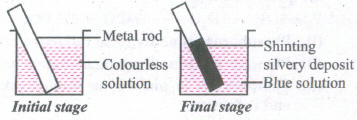
Zn(s)+ Cu2+(aq) \(\longrightarrow\) Zn2+(aq) + Cu(s)
Cu(s) + 2Ag+(aq) \(\longrightarrow\) Cu2+(aq) + 2Ag(s)
Cu(s) + Zn2+(aq) \(\longrightarrow\) Zn(s) + Cu2+ (aq)
2Ag(s) + cu2+(aq) \(\longrightarrow\) 2Ag+aq + Cu(s)
70.
In which of the following reactions, hydrogen peroxide acts as an oxidising agent?
I2+ H2O2 + 20H- \(\longrightarrow\) 21- + 2H2O + O2
PbS + 4H2O2 \(\longrightarrow\) PbSO4 + 4H2O
2MnO4-+ 3H2O2 \(\longrightarrow\) 2MnO2 + 3O2 + 2H2O + 2OH-
HOCl + H2O2 \(\longrightarrow\) H2O+ + Cl- + O2
71.
The change in the oxidation number of S in H2S and SO2,in the following industrial reaction:
2H2S(g) + SO2(g) \(\longrightarrow\) 3S(s) + H2O(g)
-2 to 0, +4 to 0
-2 to 0, +4 to -1
-2 to -1, +4 to 0
-2 to -1, +4 to -2
72.
Identify the correct statements with reference to the given reaction
P4 + 3OH- + 3H2O \(\longrightarrow\) PH3 + 3H2PO2-
(i) Phosphorus is undergoing reduction only
(ii) Phosphorus is undergoing oxidation only
(iii) Phosphorus is undergoing both oxidation and reduction.
(iv) Hydrogen is undergoing neither oxidation nor reduction.
only (iii)
both (iii) and (iv)
only (i)
None of these
73.
Maximum oxidation state is present in the central metal atom of which compound
CrO2Cl2
MnO2
[Fe(CN)6]3-
MnO
74.
25g of each of the following gases are taken at 27°C and 600 mm Hg pressure. Which of these will have the least volume?
HBr
HCl
HF
HI
75.
Which of the following diagrams correctly describes the behaviour of a fixed mass of an ideal gas? (T is measured in K)

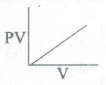

All of these
76.
What is the density of N2 gas at 227o C and 5.00 atm pressure? (R = 0.082 L atm K-1 mol-1 )
1.40 g/L
2.81 g/L
3.41 g/L
0.29 g/L
77.
Assertion: Critical temperature of CO2 is 304 K, it can be liquefied above 304 K.
Reason : For a given mass of gas, volume is directly proportional to pressure at constant temperature
both assertion and reason are true and reason is the correct explanation of assertion
both assertion and reason are true but reason is not the correct explanation of assertion
assertion is true but reason is false
both assertion and reason are false
78.
The units of Van der Waals constants 'b' and 'a' respectively ____________
mol L-1 and L atm2 mol-1
mol L and L atm mol2
mol-1L and L2 atm mol-2
none of these
79.
Among the following the least thermally stable is ___________
K2CO3
Na2CO3
BaCO3
Li2CO3
80.
When CaC2 is heated in atmospheric nitrogen in an electric furnace the compound formed is ___________
Ca(CN)2
CaNCN
CaC2N2
CaNC2
81.
Formula of Gypsum is _______________
CaSO4.2H2O
CaSO4·1/2 H2O.
3CaSO4.H2O
2CaSO4.2H2O
82.
The name 'Blue John' is given to which of the following compounds ?
CaH2
CaF2
Ca2(PO4)2
CaO
83.
Which of the following statement is false ?
Ca2+ ions are not important in maintaining the regular beating of the heart
Mg2+ ions are important in the green parts of the plants
Mg2+ ions form a complex with ATP
Ca2+ ions are important in blood clotting
84.
Which of the following does not represent the mathematical expression for the Heisenberg uncertainty principle?
\(\triangle x.\triangle p\ge \frac { h }{ 4\pi } \)
\(\triangle x.\triangle v\ge \frac { h }{ 4\pi m } \)
\(\triangle E.\triangle t\ge \frac { h }{ 4\pi } \)
\(\triangle E.\triangle x\ge \frac { h }{ 4\pi } \)
85.
Time independent Schrodinger wave equation is ______________
\(\overset { \wedge }{ H } \psi =E\psi \)
\({ \triangledown }^{ 2 }\psi +\frac { 8{ \pi }^{ 2 }m }{ { h }^{ 2 } } (E+V)\psi =0\)
\(\frac { { \partial }^{ 2 }\psi }{ { \partial x }^{ 2 } } +\frac { { \partial }^{ 2 }\psi }{ { \partial y }^{ 2 } } +\frac { { \partial }^{ 2 }\psi }{ { \partial z }^{ 2 } } +\frac { { 2m } }{ { h }^{ 2 } } (E-V)\Psi =0\)
All of these
86.
The energy of an electron in the 3rd orbit of hydrogen atom is -E. The energy of an electron in the first orbit will be ___________
-3E
\(\frac{-E}{3}\)
\(\frac{-E}{9}\)
-9E
87.
The ratio of de Broglie wavelengths of a deuterium atom to that of an \(\alpha\) - particle, when the velocity of the former is five times greater than that of the latter, is ____________
4
0.2
2.5
0.4
88.
A macroscopic particle of mass 100 g and moving at a velocity of 100 cm S-1 will have a de Broglie wavelength of ___________
6.6 x 10⁻²⁹ cm
6.6 x 10⁻³⁰ cm
6.6 x 10⁻³¹ cm
6.6 x 10⁻³² cm
89.
The compound (X) on heating gives a colourless gas and a residue that is dissolved in water to obtain (B). Excess of CO2 is bubbled through aqueous solution of B, C is formed. Solid (C) on heating gives back X. (B) is ____________
CaCO3
Ca(OH)2
Na2CO3
NaHCO3
90.
A colourless solid substance (A) on heating evolved CO2 and also gave a white residue, soluble in water. Residue also gave CO2 when treated with dilute HCl ___________
Na2CO3
NaHCO3
CaCO3
Ca(HCO3)2
91.
The suspension of slaked lime in water is known as ___________
lime water
quick lime
milk of lime
aqueous solution of slaked lime
92.
In context with beryllium, which one of the following statements is incorrect?
It is rendered passive by nitric acid
It forms Be2C
Its salts are rarely hydrolysed
Its hydride is electron deficient and polymeric
93.
Which is the correct sequence of solubility of carbonates of alkaline earth metals?
BaCO3 > SrCO3 > CaCO3 > MgCO3
MgCO3 > CaCO3 > SrCO3 > BaCO3
CaCO3 > BaCO3 > SrCO3 > BaCO3
BaCO3 > CaCO3 > SrCO3 > MgCO3
94.
Match the flame colours of the alkali and alkaline earth metal salts in the Bunsen burner
| (P) Sodium | (1) Brick red |
| (q) Calcium | (2) Yellow |
| (r) Barium | (3) Violet |
| (s) Strontium | (4) Apple green |
| (t) Cesium | (5) Crimson red |
| (u) Potassium | (6) Blue |
p - 2, q - 1, r - 4, s - 5, t - 6, u - 3
p - 1, q - 2, r - 4, s - 5, t - 6, u - 3
p - 4, q - 1, r - 2, s - 3, t - 5, u - 6
p - 6, q - 1, r - 2, s - 3, t - 5, u - 4
95.
Which of the following has highest hydration energy __________
MgCl2
CaCl2
BaCl2
SrCl2
96.
The product obtained as a result of a reaction of nitrogen with CaC2 is ___________
Ca(CN)3
CaN2
CaCN2
Ca3N2
97.
In which process, fused sodium hydroxide is electrolysed for extraction of sodium?
Castner's process
Cyanide process
Down process
All of these
98.
In case of alkali metal halides, the ionic character increases in the order____________
MF < MCl < MBr < MI
MI < MBr < MCl < MF
MI < MBr
none of these
99.
Lithium shows diagonal relationship with _____________
sodium
magnesium
calcium
aluminium
100.
Find the wrong statement
Sodium metal is used in organic qualitative analysis
Sodium carbonate is soluble in water and it is used in inorganic qualitative analysis
Potassium carbonate can be prepared by solvay process
Potassium bicarbonate is acidic salt
101.
RbO2 is _____________
superoxide and paramagnetic
peroxide and diamagnetic
superoxide and diamagnetic
peroxide and paramagnetic
102.
103.
Which of the following has the highest tendency to give the reaction \(M_{g}^{+}\xrightarrow[Medium]{Aqueous}M_{aq}^{+}\)
Na
Li
Rb
K
104.
Which of the following compounds will not evolve H2 gas on reaction with alkali metals?
ethanoic acid
ethanol
phenol
none of these
105.
Which of the following statements is incorrect?
Li+ has minimum degree of hydration among alkali metal cations
The oxidation state of K in KO2 is +1
Sodium is used to make Na / Pb alloy
MgSO4 is readily soluble in water
106.
For alkali metals, which one of the following trends is incorrect?
Hydration energy: Li > Na > K > Rb
Ionisation energy: Li > Na > K > Rb
Density: Li < Na < K < Rb
Atomic size: Li < Na < K < Rb
107.
Maximum deviation from ideal gas is expected from ______________
CH4(g)
NH3(g)
H2 (g)
N2(g)
108.
Four gases P, Q, R and S have almost same values of 'b' but their 'a' values (a, b are van der Waals constants) are in the order Q < R < S < P. At a particular temperature, among the four gases the most easily liquefiable one is __________
P
Q
R
S
109.
The variation of volume V, with temperature T, keeping pressure constant is called the coefficient of thermal expansion i.e. \(\alpha =\frac { 1 }{ V } { \left( \frac { \partial V }{ \partial T } \right) }_{ P }\) For an ideal gas a is equal to ___________
T
1/T
P
none of these
110.
Equal moles of hydrogen and oxygen gases are placed in a container, with a pin-hole through which both can escape what fraction of oxygen escapes in the time required for one-half of the hydrogen to escape.
\(\frac { 3 }{ 8 } \)
\(\frac { 1 }{ 2 } \)
\(\frac { 1 }{ 8 } \)
\(\frac { 1 }{ 4 } \)
111.
At identical temperature and pressure, the rate of diffusion of hydrogen gas is 3\(\sqrt { 3 } \) times that of a hydrocarbon having molecular formula CnH2n-2. What is the value of n?
8
4
3
1
112.
If temperature and volume of an ideal gas is increased to twice its values, the initial pressure P becomes _________
4P
2P
P
3P
113.
Consider the following statements
i) Atmospheric pressure is less at the top of a mountain than at sea level
ii) Gases are much more compressible than solids or liquids
iii) When the atmospheric pressure increases the height of the mercury column rises.
Select the correct statement
I and II
II and III
I and III
I, II and III
114.
The table indicates the value of van der Waals constant 'a' in (dm3)2 atm. mol-2.
| Gas | O2 | N2 | NH3 | CH4 |
| a | 1.360 | 1.390 | 4.170 | 2.253 |
The gas which can be most easily liquefied is ______________
O2
N2
NH3
CH4
115.
Use of hot air balloon in sports at meteorological observation is an application of __________________
Boyle's law
Newton's law
Kelvin's law
Brown's law
116.
Which one of the following is used as a standard for atomic mass?
6C12
7C12
6C13
6C14
117.
Which of the following is/are true with respect to carbon-12?
relative atomic mass is 12 u
the oxidation number of carbon is +4 in all its compounds.
1 mole of carbon-12 contains 6.022 x 10²² carbon atoms.
All of these
118.
119.
Which of the following contain same number of carbon atoms as in 6 g of carbon-12?
7.5 g ethane
8 g methane
both (a) and (b)
none of these
120.
The mass of a gas that occupies a volume of 612.5 ml at room temperature and pressure (25°C and 1 atm pressure) is 1.1 g. The molar mass of the gas is _______.
66.25 g mol-1
44 g mol-1
24.5 g mol-1
662.5 g mol-1
121.
What is the mass of precipitate formed when 50 ml of 8.5 % solution of AgNO3 is mixed with 100 ml of 1.865 % potassium chloride solution?
3.59 g
7g
14 g
28 g
122.
Two 22.4 litre containers A and B contain 8 g of O2 and 8 g of SO2 respectively at 273 K and 1 atm pressure, then ______.
Number of molecules in A and B are same
Number of molecules in B is more than that in A.
The ratio between the number of molecules in A to number of molecules in B is 2:1
Number of molecules in B is three times greater than the number of molecules in A
123.
If Avogadro number were changed from 6.022 x 10²³ to 6.022 x 10²⁰, this would change ______.
the ratio of chemical species to each other in a balanced equation
the ratio of elements to each other in a compound
the definition of mass in units of grams
the mass of one mole of carbon
124.
The equivalent mass of ferrous oxalate is __________.
\(\frac { molar\ mass\ of\ ferrous \ oxalate }{ 1 } \)
\(\frac { molar\ mass\ of\ ferrous \ oxalate }{ 2 } \)
\(\frac { molar\ mass\ of\ ferrous \ oxalate }{ 3 } \)
None of these
125.
The correct increasing order of the oxidation state of sulphur in the anions \({ SO }_{ 4 }^{ 2- },{ SO }_{ 3 }^{ 2- }{ , }{ { S }_{ 2 }{ O } }_{ 4 }^{ 2- },{ S }_{ 2 }{ O }_{ 6 }^{ 2- }\) is _________.
\({ SO }_{ 3 }^{ 2- }<{ SO }_{ 4 }^{ 2- }<{ { S }_{ 2 }{ O } }_{ 4 }^{ 2- }<{ S }_{ 2 }{ O }_{ 6 }^{ 2- }\)
\({ SO }_{ 4 }^{ 2- }<{ SO }_{ 4 }^{ 2- }<{ S }_{ 2 }{ O }_{ 6 }^{ 2- }<{ SO }_{ 3 }^{ 2- }\)
\({ { S }_{ 2 }{ O } }_{ 4 }^{ 2- }<{ SO }_{ 3 }^{ 2- }<{ S }_{ 2 }{ O }_{ 6 }^{ 2- }<{ SO }_{ 4 }^{ 2- }\)
\({ S }_{ 2 }{ O }_{ 6 }^{ 2- }<{ SO }_{ 4 }^{ 2- }<{ SO }_{ 4 }^{ 2- }<{ SO }_{ 3 }^{ 2- }\)
126.
Match the items in column list-I with relevant items in list-II.
| List-I | List-II | ||
| A | Ions having positive charge | 1 | anion |
| B | Ions having negative charge | 2 | -1 |
| C | Oxidation number of fluorine in NaF | 3 | 0 |
| D | The sum of oxidation number of all atoms in a neutral molecule | 4 | cation |
| A | B | C | D |
| 3 | 4 | 2 | 1 |
| A | B | C | D |
| 1 | 2 | 3 | 4 |
| A | B | C | D |
| 2 | 3 | 4 | 1 |
| A | B | C | D |
| 4 | 1 | 2 | 3 |
127.
Match the list-I with list-II and select the correct answer using the code given below the lists.
| List-I | List-II | ||
| A | Cr2O72- | 1 | +5 |
| B | MnO4- | 2 | +6 |
| C | VO3- | 3 | +3 |
| D | FeF63+ | 4 | +7 |
| A | B | C | D |
| 3 | 1 | 4 | 2 |
| A | B | C | D |
| 4 | 3 | 2 | 1 |
| A | B | C | D |
| 2 | 4 | 1 | 3 |
| A | B | C | D |
| 3 | 2 | 1 | 4 |
128.
If uncertainty in position and momentum are equal, then minimum uncertainty in velocity is _________
\(\frac { 1 }{ m } \sqrt { \frac { h }{ \pi } } \)
\( \sqrt { \frac { h }{ \pi } } \)
\(\frac { 1 }{ 2m } \sqrt { \frac { h }{ \pi } } \)
\( { \frac { h }{4\pi } } \)
129.
Electron density in the yz plane of 3dxy orbital is ___________
zero
0.50
0.75
0.90
130.
How many electrons in an atom with atomic number 105 can have (n + 1) = 8 ?
30
17
15
unpredictable
131.
Consider the following sets of quantum numbers:
| n | l | m | s | |
| (i) | 3 | 0 | 0 | +\(\frac { 1 }{ 2 } \) |
| (ii) | 2 | 2 | 1 | -\(\frac { 1 }{ 2 } \) |
| (iii) | 4 | 3 | -2 | +\(\frac { 1 }{ 2 } \) |
| (iv) | 1 | 0 | -1 | +\(\frac { 1 }{ 2 } \) |
| (v) | 3 | 4 | 3 | -\(\frac { 1 }{ 2 } \) |
Which of the following sets of quantum number is not possible?
(i), (ii), (iii) and (iv)
(ii), (iv) and (v)
(i) and (iii).
(ii), (iii) and (iv)
132.
If n = 6, the correct sequence for filling of electrons will be __________
ns \(\rightarrow\) (n-2)f \(\rightarrow\) (n - 1)d \(\rightarrow\) np
ns \(\rightarrow\) (n - 1) d \(\rightarrow\) (n - 2) f \(\rightarrow\) np
ns \(\rightarrow\) (n-2)f \(\rightarrow\)np \(\rightarrow\) (n-1)d
none of these are correct
133.
The total number of orbitals associated with the principal quantum number n = 3 is _________
9
8
5
7
134.
What is the maximum numbers of electrons that can be associated with the following set of quantum numbers? n = 3, I = 1 and m =-1
4
6
2
10
135.
Identify the correct statement(s) with respect to the following reaction :
Zn + 2HCl \(\longrightarrow\) ZnCl2 + H2
(i) Zinc is acting as an oxidant
(ii) Chlorine is acting as a reductant
(iii) Hydrogen is not acting as an oxidant
(iv) Zn is acting as a reductant
only (ii)
only (iv)
both (ii) and (iii)
both (ii) and (i)
136.
Which of the following statement(s) is/are not true about the following decomposition reaction.
2KClO3 \(\longrightarrow\) 2KCl + 3O2
(i) Potassium is undergoing oxidation
(ii) Chlorine is undergoing oxidation
(iii) Oxygen is reduced
(iv) None of the species are undergoing oxidation and reduction.
only (iv)
(i) and (iv)
(iv) and (iii)
All of these
137.
Identify disproportionation reaction
CH4 + 2O2 \(\longrightarrow\) CO2+ 2H2O
CH4 + 4Cl2 \(\longrightarrow\) CCl4 + 4HCl
2F2 + 2OH \(\longrightarrow\) 2F-+ OF2+ H2O
2NO2 + 2OH- \(\longrightarrow\) NO-2 + NO-3 + H2O
138.
Rusting of iron articles is an example of ___________ reaction
Combustion
decomposition
redox
hydrolysis
139.
Consider the following statements :
(i) Oxidation number of He = zero
(ii) Increase in oxidation number results in reduction.
(iii) The substance undergoing the increase in oxidation number is reducing agent.
Which among the above statement(s) is/are correct?
only (i)
(ii) and (iii)
(i) and (iii)
only (ii)
140.
Among the three metals, zinc, copper and silver, the electron releasing tendency decreases in the following order.
zinc > silver > copper
zinc > copper > silver
silver > copper > zinc
copper > silver > zinc
141.
The oxidation number of Cr in Cr2O72- _______ is
+6
-6
+7
-7
142.
The value of the gas constant R is ____________
0.082 dm3 atm.
0.987 cal mol-1K-1
8.3 J mol-1 K-1
8 erg mol-1 K-1
143.
The value of universal gas constant depends upon __________
Temperature of the gas
Volume of the gas
Number of moles of the gas
units of Pressure and volume.
144.
A bottle of ammonia and a bottle of HCl connected through a long tube are opened simultaneously at both ends. The white ammonium chloride ring first formed will be ___________
At the center of the tube
Near the hydrogen chloride bottle
Near the ammonia bottle
Throughout the length of the tube
145.
The temperatures at which real gases obey the ideal gas laws over a wide range of pressure is called ____________
Critical temperature
Boyle temperature
Inversion temperature
Reduced temperature
146.
Equal weights of methane and oxygen are mixed in an empty container at 298 K. The fraction of total pressure exerted by oxygen is ___________
\(\frac { 1 }{ 3 } \)
\(\frac { 1 }{ 2 } \)
\(\frac { 2 }{ 3 } \)
\(\frac { 1 }{ 3 } \times 273\times 298\)
147.
When an ideal gas undergoes unrestrained expansion, no cooling occurs because the molecules _____________
are above inversion temperature
exert no attractive forces on each other
do work equal to the loss in kinetic energy
collide without loss of energy
148.
Which of the following is the correct expression for the equation of state of van der Waals gas?
\(\left( P+\frac { a }{ { n }^{ 2 }{ V }^{ 2 } } \right) (V-nb)=nRT\)
\(\left( P+\frac { na }{ { n }^{ 2 }{ V }^{ 2 } } \right) (V-nb)=nRT\)
\(\left( P+\frac { { an }^{ 2 } }{ { V }^{ 2 } } \right) (V-nb)=nRT\)
\(\left( \frac { P+{ n }^{ 2 }{ a }^{ 2 } }{ { V }^{ 2 } } \right) (V-ab)=nRT\)
149.
Rate of diffusion of a gas is ________
directly proportional to its density
directly proportional to its molecular weight
directly proportional to its square root of its molecular weight
inversely proportional to the square root of its molecular weight
150.
Gases deviate from ideal behavior at high pressure. Which of the following statement(s) is correct for non-ideality?
at high pressure the collision between the gas molecules become enormous
at high pressure the gas molecules move only in one direction
at high pressure, the volume of gas becomes insignificant
at high pressure the intermolecular interactions become significant
151.
Total number of electrons present in 1.7 g of ammonia is _____.
6.022\(\times\)1023
\(\frac { 6.022\times { 10 }^{ 22 } }{ 1.7 } \quad \)
\(\frac { 6.022\times { 10 }^{ 24 } }{ 1.7 } \)
\(\frac { 6.022\times { 10 }^{ 23 } }{ 1.7 } \)
152.
7.5 g of a gas occupies a volume of 5.6 litres at 0° C and 1 atm pressure. The gas is ________.
NO
N2O
CO
CO2
153.
Which one of the following represents 180 g of water ?
5 Moles of water
90 moles of water
\(\frac { 6.022\times { 10 }^{ 23 } }{ 180 } \) molecules of water
6.022\(\times\)1024molecules of water
154.
Choose the disproportionation reaction among the following redox reactions.
3Mg(s) + N2(g) \(\longrightarrow \) Mg3N2(s)
P4(s) + 3NaOH + 3H2O \(\longrightarrow \) PH3(g) + 3NaH2 PO2(aq)
Cl2(g) + 2KI(aq) \(\longrightarrow \) 2KCl(aq) + I2
Cr2O3(s) + 2Al(s) \(\longrightarrow \) Al2O3(s) + 2Cr(s)
155.
Hot concentrated sulphuric acid is a moderately strong oxidizing agent. Which of the following reactions does not show oxidising behaviour ?
Cu + 2H2 SO4 \(\longrightarrow \) CuSO4 +SO2 + 2H2O
C + 2H2 + SO4 \(\longrightarrow \) CO2 + 2SO2 + 2H2O
BaCl2 + H2SO4 \(\longrightarrow \) BaSO4 + 2HCl
None of the above
156.
When 22.4 litres of H2(g) is mixed with 11.2 litres of Cl2(g), each at 273 K at 1 atm the moles of HCl (g), formed is equal to ______.
2 moles of HCl (g)
0.5 moles of HCl (g)
1.5 moles of HCl (g)
1 moles of HCl (g)
157.
When 6.3 g of sodium bicarbonate is added to 30 g of the acetic acid solution, the residual solution is found to weigh 33 g. The number of moles of carbon dioxide released in the reaction is _____.
3
0.75
0.075
0.3
158.
For d-electron, the orbital angular momentum is ___________
\(\frac { \sqrt { 2 } h }{ 2\pi } \)
\(\\ \frac { \sqrt { 2h } }{ 2\pi } \)
\(\frac { \sqrt { 2\times 4 } h }{ 2\pi } \)
\(\frac { \sqrt { 6 } h }{ 2\pi } \)
159.
The maximum number of electrons in a sub shell is given by the expression _____________
2n2
2l + 1
4l + 2
none of these
160.
Two electrons occupying the same orbital are distinguished by ___________
azimuthal quantum number
spin quantum number
magnetic quantum number
orbital quantum number
161.
Based on equation E = \(-2.178\times { 10 }^{ -18 }J\left( \frac { { Z }^{ 2 } }{ { n }^{ 2 } } \right) \)certain conclusions are written. Which of them is not correct?
Equation can be used to calculate the change in energy when the electron changes orbit
For n = 1, the electron has a more negative energy than it does for n = 6 which means that the electron is more loosely bound in the smallest allowed orbit
The negative sign in equation simply means that the energy of electron bound to the nucleus is lower than it would be if the electrons were at the infinite distance from the nucleus.
Larger the value of n, the larger is the orbit radius.
162.
The electronic configuration of Eu (Atomic no. 63) Gd (Atomic no. 64) and Tb (Atomic no. 65) are ____________
[Xe] 4f6 5d1 6s2, [Xe] 4f7 5d1 6s2 and [Xe] 4f8 5d1 6s2
[Xe] 4f7 , 6s2, [Xe] 4f7 5d1 6s2 and [Xe] 4f9 6s2
[Xe] 4f7 6s2, [Xe] 4f8 6s2 and [Xe] 4f8 5d1 6s2
[Xe] 4f6 5d1 6s2, [Xe] 4f7 5d1 6s2 and [Xe] 4f9 6s2
163.
Which of the following pairs of d-orbitals will have electron density along the axes ?
dz2, dxz
dxz, dyz
dz2, dx2-y2
dxy ,dx2-y2
164.
According to the Bohr Theory, which of the following transitions in the hydrogen atom will give rise to the least energetic photon?
n = 6 to n = 1
n = 5 to n = 4
n = 5 to n = 3
n = 6 to n = 5
165.
Water is a ___________
basic oxide
acidic oxide
amphoteric oxide
none of these
166.
Heavy water is used as _________
moderator in nuclear reactions
coolant in nuclear reactions
both (a) and (b)
none of these
167.
The type of H-bonding present in ortho-nitrophenol and p-nitrophenol are respectively ____________
intermolecular H-bonding and intramolecular H-bonding
intramolecular H-bonding and intermolecular H-bonding
intramolecular H-bonding and no H-bonding
intramolecular H-bonding and intramolecular H-bonding
168.
In solid ice, oxygen atom is surrounded _____________
tetrahedrally by 4 hydrogen atoms
octahedrally by 2 oxygen and 4 hydrogen atoms
tetrahedrally by 2 hydrogen and 2 oxygen atoms
octahedrally by 6 hydrogen atoms
169.
The reaction H3PO2 + D2O ➝ H2DPO2 + HDO indicates that hypophosphorus acid is _____________
tribasic acid
dibasic acid
monobasic acid
none of these
170.
The hybridisation of oxygen atom in H2O and H2O2 are, respectively __________
sp and sp3
sp and sp
sp and sp2
sp3 and sp3
171.
Volume strength of 1.5 N H2O2 is _____________
1.5
4.5
16.8
8.4
172.
For decolorisation of 1 mole of acidified KMnO4, the moles of H2O2 required is ___________
\(\frac{1}{2}\)
\(\frac{3}{2}\)
\(\frac{5}{2}\)
\(\frac{7}{2}\)
173.
When hydrogen peroxide is shaken with an acidified solution of potassium dichromate in presence of ether, the ethereal layer turns blue due to the formation of _____________
Cr2O3
\({ CrO }_{ 4 }^{ 2- }\)
CrO(O2)2
none of these
174.
A commercial sample of hydrogen peroxide marked as 100 volume H2O2, it means that _____________
1 ml of H2O2 will give 100 ml O2 at STP
1 L of H2O2 will give 100 ml O2 at STP
1 L of H2O2 will give 22.4 L O2
1 ml of H2O2 will give 1 mole of O2 at STP
175.
Zeolite used to soften hardness of water is hydrated _____________
Sodium aluminium silicate
Calcium aluminium silicate
Zinc aluminium borate
Lithium aluminium hydride
176.
The cause of permanent hardness of water is due to _____________
Ca(HCO3)2
Mg(HCO3)2
CaCl2
MgCO3
177.
The hardness of water can be determined by volumetrically using the reagent _____________
sodium thio sulphate
potassium permanganate
hydrogen peroxide
EDTA
178.
If a body of a fish contains 1.2 g hydrogen in its total body mass, if all the hydrogen is replaced with deuterium then the increase in body weight of the fish will be ______________
1.2 g
2.4 g
3.6 g
\(\sqrt{4.8}\)1.2 g
179.
Non-stoichiometric hydrides are formed by _____________
palladium, vanadium
carbon, nickel
manganese, lithium
nitrogen, chlorine
180.
Tritium nucleus contains _____________
1 p + 0 n
2 p + 1 n
1 p + 2 n
none of these
181.
Ionic hydrides are formed by _____________
halogens
halogens
inert gases
group one elements
182.
Which one of the following statements is incorrect with regard to ortho and para dihydrogen ?
They are nuclear spin isomers
Ortho isomer has zero nuclear spin whereas the para isomer has one nuclear spin
The para isomer is favoured at low temperatures
The thermal conductivity of the para isomer is 50% greater than that of the ortho isomer
183.
Water gas is _____.
H2O(g)
CO + H2O
CO + H2
CO + N2
184.
Which of the following statements about hydrogen is incorrect?
Hydrogen ion, H3O+ exists freely in solution.
Dihydrogen acts as a reducing agent.
Hydrogen has three isotopes of which protium is the most common.
Hydrogen never acts as cation in ionic salts.
185.
Which of the following elements will have the highest electronegativity ____________
Chlorine
Nitrogen
Cesium
Fluorine
186.
In which of the following options the order of arrangement does not agree with the variation of property indicated against it?
I< Br < Cl < F (increasing electron gain enthalpy)
Li < Na < K < Rb (increasing metallic radius)
Al3+< Mg2+ < Na+
B < C < O < N (increasing first ionisation enthalpy)
187.
The group of elements in which the differentiating electron enters the antepenultimate shell of atoms are called ___________
p-block elements
d-block elements
s-block elements
f-block elements
188.
The electronic configuration of the elements A and B are 1s2, 2s 2,2p6,3s2 and 1s2, 2s2,2p5 respectively. The formula of the ionic compound that can be formed between these elements is ___________
AB
AB2
A2B
none of the above
189.
What would be the IUPAC name for an element with atomic number 222?
bibibium
bididium
didibium
bibibium
190.
1 g of an impure sample of magnesium carbonate (containing no thermally decomposable impurities) on complete thermal decomposition gave 0.44 g of carbon dioxide gas. The percentage of impurity in the sample is ______________.
0%
4.4%
16%
8.4%
191.
The number of water molecules in a drop of water weighing 0.018 g is ________.
6.022\(\times\)1026
6.022\(\times\)1023
6.022\(\times\)1020
9.9 \(\times\)1022
192.
The equivalent mass of a trivalent metal element is 9 g eq-1 the molar mass of its anhydrous oxide is _____.
102 g
27 g
270 g
78 g
193.
Carbon forms two oxides, namely carbon monoxide and carbon dioxide. The equivalent mass of which element remains constant ?
Carbon
Oxygen
Both carbon and oxygen
Neither carbon nor oxygen
194.
An element X has the following isotopic composition 200X = 90%, 199X = 8% and 202X = 2%. The weighted average atomic mass of the element X is closest to _________.
201 u
202 u
199 u
200 u
195.
40 ml of methane is completely burnt using 80 ml of oxygen at room temperature The volume of gas left after cooling to room temperature is _______.
40 ml CO2 gas
40 ml CO2 gas and 80 ml H2O gas
60 ml CO2 gas and 60 ml H2O gas
120 ml CO2 gas
196.
Splitting of spectral lines in an electric field is called _____________
Zeeman effect
Shielding effect
Compton effect
Stark effect
197.
The energies E1and E2 of two radiations are 25 eV and 50 eV respectively. The relation between their wavelengths ie \(\lambda \)1 and\(\lambda \)2 will be ___________
\(\frac { { \lambda }_{ 1 } }{ { \lambda }_{ 2 } } =1\)
\({ \lambda }_{ 1 }=2{ \lambda }_{ 2 }\)
\({ \lambda }_{ 1 }=\sqrt { 25\times 50{ \lambda }_{ 2 } } \)
\(2{ \lambda }_{ 1 }={ \lambda }_{ 2 }\)
198.
The energy of light of wavelength 45 nm is _____________.
6.67 x 10¹⁵J
6.67 x 10¹¹J
4.42 x 10⁻¹⁸J
4.42 x 10⁻¹⁵J
199.
Assertion (A): In the reaction between potassium permanganate and potassium iodide, permanganate ions act as oxidising agent.
Reason (R): Oxidation state of manganese changes from +2 to +7 during the reaction.
Codes:
(a) Both A and R are true and R explains A
(b) Both A and R are true but R does not explain A
(c) A is true but R is false
(d) Both A and R are false
Both A and R are true and R explains A
Both A and R are true but R does not explain A
A is true but R is false
Both A and R are false
200.
Assertion (A): Among halogens fluorine is the best oxidant.
Reason (R): Fluorine is the most electronegative atom.
Codes:
(a) both assertion and reason are true and the reason is the correct explanation of assertion
(b) both assertion and reason are true but reason is not the correct explanation of assertion
(c) assertion is true but reason is false
(d) both assertion and reason are false
Both A and R are true and R explains A
Both A and R are true but R does not explain A
A is true but R is false
Both A and R are false
201.
Assertion : BeSO4 is soluble in water while BaSO4 is not
Reason : Hydration energy decreases down the group from Be to Ba and lattice energy remains almost constant.
(a) both assertion and reason are true and reason is the correct explanation of assertion
(b) both assertion and reason are true but reason is not the correct explanation of assertion
(c) both assertion and reason are false.
(d) Both assertion and reason are false
both assertion and reason are true and reason is the correct explanation of assertion
both assertion and reason are true but reason is not the correct explanation of assertion
assertion is true but reason is false
both assertion and reason are false.
202.
Assertion : Generally alkali and alkaline earth metals form superoxides
Reason : There is a single bond between O and O in superoxides
a) both assertion and reason are true and reason is the correct explanation of assertion
b) both assertion and reason are true but reason is not the correct explanation of assertion
c) assertion is true but reason is false
d) both assertion and reason are false
both assertion and reason are true and reason the correct explanation of assertion
both assertion and reason are true but reason is not the correct explanation of assertion
assertion is true but reason is false
both assertion and reason are false
203.
Assertion: Two mole of glucose contains 12.044 x 10²³ molecules of glucose
Reason: Total number of entities present in one mole of any substance is equal to 6.02 x 10²²
(a) both assertion and reason are true and the reason is the correct explanation of assertion
(b) both assertion and reason are true but reason is not the correct explanation of assertion
(c) assertion is true but reason is false
(d) both assertion and reason are false
both assertion and reason are true and the reason is the correct explanation of assertion
both assertion and reason are true but the reason is not the correct explanation of assertion
an assertion is true but reason is false
both assertion and reason are false
1.
(a)
\(\triangle G^0=-\triangle H^0-T\triangle S^0\)
(b)
G - H - TS
(c)
\(\triangle G^0\) = -2.303 RT log Keq
(d)
\(\triangle S-\triangle H/T\)
2.
(a)
Statements-I and II are correct and Statement-II is the correct explanation of statement-I.
(b)
Statements-land II are correct but Statement-II is not the correct explanation of statement-I.
(c)
Statement-I is correct but Statement-II is wrong.
(d)
Statement-I is wrong but Statement-II is correct.
3.
(a)
Statements-I and II are correct and Statement-II is the correct explanation of statement-I.
(b)
Statements-I and II are correct but Statement-II is not the correct explanation of statement- I.
(c)
Statement-I is correct but Statement-II is wrong.
(d)
Statement-I is wrong but Statement-II is correct.
4.
(a)
Statements-I and II are correct and Statement-Il is the correct explanation of statement-I.
(b)
Statements-land II are correct but Statement-II is not the correct explanation of statement- I.
(c)
Statement-I is correct but Statement-II is wrong.
(d)
Statement-I is wrong but Statement-II is correct.
5.
(a)
Both assertion and reason are true and reason is the correct explanation of assertion.
(b)
Both assertion and reason are true but reason is not the correct explanation of assertion.
(c)
Assertion is true but reason is false
(d)
Both assertion and reason are false
6.
(a)
26
(b)
22
(c)
30
(d)
24
7.
(a)
31.6
(b)
52.7
(c)
79
(d)
None of these
8.
(a)
both assertion and reason are true and reason is the correct explanation of assertion.
(b)
both assertion and reason are true but reason is not the correct explanation of assertion.
(c)
assertion is true but reason is false
(d)
both assertion and reason are false
9.
(a)
If both assertion and reason are true and reason is the correct explanation of assertion.
(b)
If both assertion and reason are true but reason is not the correct explanation of assertion
(c)
If assertion is true but reason is false
(d)
If both assertion and reason are false
10.
(a)
spontaneity
(b)
feasibility
(c)
both (a) & (b)
(d)
neither (a) nor (b)
11.
(a)
internal energy
(b)
volume
(c)
temperature
(d)
mass
12.
(a)
Only (i)
(b)
Only (iii)
(c)
(i) and (ii)
(d)
(i), (ii) and (iv)
13.
(a)
Only (i)
(b)
Only (ii)
(c)
Both (i) and (ii)
(d)
Both are incorrect statements
14.
(a)
ΔH>ΔU
(b)
ΔH<ΔU
(c)
ΔH=ΔU
(d)
Unpredictable
15.
(a)
q
(b)
w
(c)
q + w
(d)
All of these
16.
(a)
entropy, enthalpy
(b)
entropy, temperature
(c)
enthalpy, entropy
(d)
temperature, entropy
17.
(a)
∆U=qV
(b)
∆U=w
(c)
∆U= q + w
(d)
∆U=0
18.
(a)
(Pint+ dP)
(b)
(Pint- dP)
(c)
(dP-Pint)
(d)
(-Pint+dP)
19.
(a)
Qv
(b)
fx
(c)
PV
(d)
mgh
20.
(a)
1000
(b)
100
(c)
50
(d)
20
21.
(a)
+Ve
(b)
-Ve
(c)
equal to zero
(d)
maximum
22.
(a)
Joule
(b)
Calorie
(c)
mole
(d)
J mol-1
23.
(a)
maximum
(b)
minimum
(c)
zero
(d)
does not change
24.
(a)
Enthalpy
(b)
Free energy
(c)
Internal energy
(d)
Work
25.
(a)
Pressure
(b)
Enthalpy
(c)
Heat
(d)
Both (a) and (b)
26.
(a)
| A | B | C | D |
| 3 | 1 | 4 | 2 |
(b)
| A | B | C | D |
| 1 | 3 | 4 | 2 |
(c)
| A | B | C | D |
| 3 | 1 | 2 | 4 |
(d)
| A | B | C | D |
| 1 | 2 | 3 | 4 |
27.
(a)
w
(b)
q+w
(c)
qv
(d)
0
28.
(a)
H
(b)
S
(c)
G
(d)
U
29.
(a)
Pressure
(b)
Volume
(c)
Temperature
(d)
Work
30.
(a)
isobaric
(b)
cyclic
(c)
isothermal
(d)
isochoric
31.
(a)
q = 0
(b)
dV = 0
(c)
dT = 0
(d)
dP = 0
32.
(a)
isobaric
(b)
isothermal
(c)
adiabatic
(d)
isochoric
33.
(a)
isothermal
(b)
isobasic
(c)
isochoric
(d)
adiabatic
34.
(a)
reversible
(b)
irreversible
(c)
cyclic process
(d)
isochoric process
35.
(a)
free energy
(b)
heat capacity
(c)
volume
(d)
molar volume
36.
(a)
q = 0
(b)
dP = 0
(c)
dT = 0
(d)
dP = 0
37.
(a)
Volume
(b)
internal energy
(c)
Mass
(d)
temperature
38.
(a)
| A | B | C | D |
| 1 | 2 | 3 | 4 |
(b)
| A | B | C | D |
| 4 | 3 | 1 | 2 |
(c)
| A | B | C | D |
| 4 | 3 | 2 | 1 |
(d)
| A | B | C | D |
| 3 | 4 | 1 | 2 |
39.
(a)
Solution of CuSO4 in a beaker
(b)
A gas contained in a cylinder fitted with piston
(c)
Hot water contained in a thermos flask
(d)
Tea in a cup
40.
(a)
surroundings
(b)
system
(c)
boundary
(d)
Universe
41.
(a)
reversibility
(b)
rate
(c)
spontaneity
(d)
none of these
42.
(a)
Thermodynamics
(b)
Chemical kinetics
(c)
Calorimetry
(d)
Potentiometer
43.
(a)
26
(b)
22
(c)
30
(d)
24
44.
(a)
300 K
(b)
30 K
(c)
100 K
(d)
200 C
45.
(a)
Ca(S)+ 1/2O2(g) ⟶ CaO(S)
(b)
C(S) + O2(g) ⟶ CO2(g)
(c)
N2(g) + O2(g) ⟶ 2NO(g)
(d)
CaCO3(S) ⟶ CaO(S) + CO2(g)
46.
(a)
323 K
(b)
27° C
(c)
164 K
(d)
0.3 K
47.
(a)
+, -, -
(b)
-, +, -
(c)
+, -, +
(d)
-, -, +
48.
(a)
Isothermal expansion
(b)
Isothermal Compression
(c)
adiabatic expansion
(d)
adiabatic compression
49.
(a)
ΔH < 0 and ΔS > 0
(b)
ΔH < 0 and ΔS < 0
(c)
ΔH > 0 and ΔS = 0
(d)
ΔH > 0 and ΔS > 0
50.
(a)
170 kJ mol-1
(b)
50 kJ mol-1
(c)
80 kJ mol-1
(d)
220 kJ mol-1
51.
(a)
- 889 kJ mol-1
(b)
- 1390 kJ mol-1
(c)
- 3180 kJ mol-1
(d)
- 635.47 kJ mol-1
52.
(a)
\(\frac{b+2a}{2}\)
(b)
2a-b
(c)
\(\frac{2a-b}{2}\)
(d)
\(\frac{b-2a}{2}\)
53.
(a)
- 250 R
(b)
- 500 R
(c)
500 R
(d)
+ 250 R
54.
(a)
- 2.48 kJ
(b)
-2.22 kJ
(c)
+2.22 kJ
(d)
+ 2.48 kJ
55.
(a)
+1 kJ
(b)
- 5 kJ
(c)
+3 kJ
(d)
- 3 kJ
56.
(a)
ΔH > ΔU
(b)
ΔH - ΔU = 0
(c)
ΔH + ΔU = 0
(d)
ΔH < ΔU
57.
(a)
internal energy
(b)
enthalpy
(c)
entropy
(d)
frictional energy
58.
(a)
- 1365 kJ
(b)
2730 kJ
(c)
- 2730 kJ
(d)
- 462 kJ
59.
(a)
graphite is more stable than diamond
(b)
graphite has more energy than diamond
(c)
both are equally stable
(d)
stability cannot be predicted
60.
(a)
+ 26.4 kcal
(b)
- 67.6 kcal
(c)
- 120.6 kcal
(d)
+ 52.8 kcal
61.
(a)
positive
(b)
negative
(c)
zero
(d)
either positive or negative
62.
(a)
- 900 J
(b)
900 kJ
(c)
270 kJ
(d)
-900 kJ
63.
(a)
mass
(b)
volume
(c)
enthalpy
(d)
\(\frac { mass }{ volume } \)
64.
(a)
w = -ΔU
(b)
w = ΔU + ΔH
(c)
ΔU = 0
(d)
w = 0
65.
(a)
> 0
(b)
> 0
(c)
< 0
(d)
= 0
66.
(a)
q = w
(b)
q = 0
(c)
ΔE = q
(d)
PΔV= 0
67.
(a)
decrease in entropy
(b)
increase in enthalpy
(c)
increase in free energy
(d)
decrease in free energy
68.
(a)
ΔE
(b)
ΔH
(c)
ΔS
(d)
ΔG
69.
(a)
Zn(s)+ Cu2+(aq) \(\longrightarrow\) Zn2+(aq) + Cu(s)
(b)
Cu(s) + 2Ag+(aq) \(\longrightarrow\) Cu2+(aq) + 2Ag(s)
(c)
Cu(s) + Zn2+(aq) \(\longrightarrow\) Zn(s) + Cu2+ (aq)
(d)
2Ag(s) + cu2+(aq) \(\longrightarrow\) 2Ag+aq + Cu(s)
70.
(a)
I2+ H2O2 + 20H- \(\longrightarrow\) 21- + 2H2O + O2
(b)
PbS + 4H2O2 \(\longrightarrow\) PbSO4 + 4H2O
(c)
2MnO4-+ 3H2O2 \(\longrightarrow\) 2MnO2 + 3O2 + 2H2O + 2OH-
(d)
HOCl + H2O2 \(\longrightarrow\) H2O+ + Cl- + O2
71.
(a)
-2 to 0, +4 to 0
(b)
-2 to 0, +4 to -1
(c)
-2 to -1, +4 to 0
(d)
-2 to -1, +4 to -2
72.
(a)
only (iii)
(b)
both (iii) and (iv)
(c)
only (i)
(d)
None of these
73.
(a)
CrO2Cl2
(b)
MnO2
(c)
[Fe(CN)6]3-
(d)
MnO
74.
(a)
HBr
(b)
HCl
(c)
HF
(d)
HI
75.
(a)
(b)
(c)
(d)
All of these
76.
(a)
1.40 g/L
(b)
2.81 g/L
(c)
3.41 g/L
(d)
0.29 g/L
77.
(a)
both assertion and reason are true and reason is the correct explanation of assertion
(b)
both assertion and reason are true but reason is not the correct explanation of assertion
(c)
assertion is true but reason is false
(d)
both assertion and reason are false
78.
(a)
mol L-1 and L atm2 mol-1
(b)
mol L and L atm mol2
(c)
mol-1L and L2 atm mol-2
(d)
none of these
79.
(a)
K2CO3
(b)
Na2CO3
(c)
BaCO3
(d)
Li2CO3
80.
(a)
Ca(CN)2
(b)
CaNCN
(c)
CaC2N2
(d)
CaNC2
81.
(a)
CaSO4.2H2O
(b)
CaSO4·1/2 H2O.
(c)
3CaSO4.H2O
(d)
2CaSO4.2H2O
82.
(a)
CaH2
(b)
CaF2
(c)
Ca2(PO4)2
(d)
CaO
83.
(a)
Ca2+ ions are not important in maintaining the regular beating of the heart
(b)
Mg2+ ions are important in the green parts of the plants
(c)
Mg2+ ions form a complex with ATP
(d)
Ca2+ ions are important in blood clotting
84.
(a)
\(\triangle x.\triangle p\ge \frac { h }{ 4\pi } \)
(b)
\(\triangle x.\triangle v\ge \frac { h }{ 4\pi m } \)
(c)
\(\triangle E.\triangle t\ge \frac { h }{ 4\pi } \)
(d)
\(\triangle E.\triangle x\ge \frac { h }{ 4\pi } \)
85.
(a)
\(\overset { \wedge }{ H } \psi =E\psi \)
(b)
\({ \triangledown }^{ 2 }\psi +\frac { 8{ \pi }^{ 2 }m }{ { h }^{ 2 } } (E+V)\psi =0\)
(c)
\(\frac { { \partial }^{ 2 }\psi }{ { \partial x }^{ 2 } } +\frac { { \partial }^{ 2 }\psi }{ { \partial y }^{ 2 } } +\frac { { \partial }^{ 2 }\psi }{ { \partial z }^{ 2 } } +\frac { { 2m } }{ { h }^{ 2 } } (E-V)\Psi =0\)
(d)
All of these
86.
(a)
-3E
(b)
\(\frac{-E}{3}\)
(c)
\(\frac{-E}{9}\)
(d)
-9E
87.
(a)
4
(b)
0.2
(c)
2.5
(d)
0.4
88.
(a)
6.6 x 10⁻²⁹ cm
(b)
6.6 x 10⁻³⁰ cm
(c)
6.6 x 10⁻³¹ cm
(d)
6.6 x 10⁻³² cm
89.
(a)
CaCO3
(b)
Ca(OH)2
(c)
Na2CO3
(d)
NaHCO3
90.
(a)
Na2CO3
(b)
NaHCO3
(c)
CaCO3
(d)
Ca(HCO3)2
91.
(a)
lime water
(b)
quick lime
(c)
milk of lime
(d)
aqueous solution of slaked lime
92.
(a)
It is rendered passive by nitric acid
(b)
It forms Be2C
(c)
Its salts are rarely hydrolysed
(d)
Its hydride is electron deficient and polymeric
93.
(a)
BaCO3 > SrCO3 > CaCO3 > MgCO3
(b)
MgCO3 > CaCO3 > SrCO3 > BaCO3
(c)
CaCO3 > BaCO3 > SrCO3 > BaCO3
(d)
BaCO3 > CaCO3 > SrCO3 > MgCO3
94.
(a)
p - 2, q - 1, r - 4, s - 5, t - 6, u - 3
(b)
p - 1, q - 2, r - 4, s - 5, t - 6, u - 3
(c)
p - 4, q - 1, r - 2, s - 3, t - 5, u - 6
(d)
p - 6, q - 1, r - 2, s - 3, t - 5, u - 4
95.
(a)
MgCl2
(b)
CaCl2
(c)
BaCl2
(d)
SrCl2
96.
(a)
Ca(CN)3
(b)
CaN2
(c)
CaCN2
(d)
Ca3N2
97.
(a)
Castner's process
(b)
Cyanide process
(c)
Down process
(d)
All of these
98.
(a)
MF < MCl < MBr < MI
(b)
MI < MBr < MCl < MF
(c)
MI < MBr
(d)
none of these
99.
(a)
sodium
(b)
magnesium
(c)
calcium
(d)
aluminium
100.
(a)
Sodium metal is used in organic qualitative analysis
(b)
Sodium carbonate is soluble in water and it is used in inorganic qualitative analysis
(c)
Potassium carbonate can be prepared by solvay process
(d)
Potassium bicarbonate is acidic salt
101.
(a)
superoxide and paramagnetic
(b)
peroxide and diamagnetic
(c)
superoxide and diamagnetic
(d)
peroxide and paramagnetic
102.
(a)
(b)
(c)
(d)
103.
(a)
Na
(b)
Li
(c)
Rb
(d)
K
104.
(a)
ethanoic acid
(b)
ethanol
(c)
phenol
(d)
none of these
105.
(a)
Li+ has minimum degree of hydration among alkali metal cations
(b)
The oxidation state of K in KO2 is +1
(c)
Sodium is used to make Na / Pb alloy
(d)
MgSO4 is readily soluble in water
106.
(a)
Hydration energy: Li > Na > K > Rb
(b)
Ionisation energy: Li > Na > K > Rb
(c)
Density: Li < Na < K < Rb
(d)
Atomic size: Li < Na < K < Rb
107.
(a)
CH4(g)
(b)
NH3(g)
(c)
H2 (g)
(d)
N2(g)
108.
(a)
P
(b)
Q
(c)
R
(d)
S
109.
(a)
T
(b)
1/T
(c)
P
(d)
none of these
110.
(a)
\(\frac { 3 }{ 8 } \)
(b)
\(\frac { 1 }{ 2 } \)
(c)
\(\frac { 1 }{ 8 } \)
(d)
\(\frac { 1 }{ 4 } \)
111.
(a)
8
(b)
4
(c)
3
(d)
1
112.
(a)
4P
(b)
2P
(c)
P
(d)
3P
113.
(a)
I and II
(b)
II and III
(c)
I and III
(d)
I, II and III
114.
(a)
O2
(b)
N2
(c)
NH3
(d)
CH4
115.
(a)
Boyle's law
(b)
Newton's law
(c)
Kelvin's law
(d)
Brown's law
116.
(a)
6C12
(b)
7C12
(c)
6C13
(d)
6C14
117.
(a)
relative atomic mass is 12 u
(b)
the oxidation number of carbon is +4 in all its compounds.
(c)
1 mole of carbon-12 contains 6.022 x 10²² carbon atoms.
(d)
All of these
118.
(a)
(b)
(c)
(d)
119.
(a)
7.5 g ethane
(b)
8 g methane
(c)
both (a) and (b)
(d)
none of these
120.
(a)
66.25 g mol-1
(b)
44 g mol-1
(c)
24.5 g mol-1
(d)
662.5 g mol-1
121.
(a)
3.59 g
(b)
7g
(c)
14 g
(d)
28 g
122.
(a)
Number of molecules in A and B are same
(b)
Number of molecules in B is more than that in A.
(c)
The ratio between the number of molecules in A to number of molecules in B is 2:1
(d)
Number of molecules in B is three times greater than the number of molecules in A
123.
(a)
the ratio of chemical species to each other in a balanced equation
(b)
the ratio of elements to each other in a compound
(c)
the definition of mass in units of grams
(d)
the mass of one mole of carbon
124.
(a)
\(\frac { molar\ mass\ of\ ferrous \ oxalate }{ 1 } \)
(b)
\(\frac { molar\ mass\ of\ ferrous \ oxalate }{ 2 } \)
(c)
\(\frac { molar\ mass\ of\ ferrous \ oxalate }{ 3 } \)
(d)
None of these
125.
(a)
\({ SO }_{ 3 }^{ 2- }<{ SO }_{ 4 }^{ 2- }<{ { S }_{ 2 }{ O } }_{ 4 }^{ 2- }<{ S }_{ 2 }{ O }_{ 6 }^{ 2- }\)
(b)
\({ SO }_{ 4 }^{ 2- }<{ SO }_{ 4 }^{ 2- }<{ S }_{ 2 }{ O }_{ 6 }^{ 2- }<{ SO }_{ 3 }^{ 2- }\)
(c)
\({ { S }_{ 2 }{ O } }_{ 4 }^{ 2- }<{ SO }_{ 3 }^{ 2- }<{ S }_{ 2 }{ O }_{ 6 }^{ 2- }<{ SO }_{ 4 }^{ 2- }\)
(d)
\({ S }_{ 2 }{ O }_{ 6 }^{ 2- }<{ SO }_{ 4 }^{ 2- }<{ SO }_{ 4 }^{ 2- }<{ SO }_{ 3 }^{ 2- }\)
126.
(a)
| A | B | C | D |
| 3 | 4 | 2 | 1 |
(b)
| A | B | C | D |
| 1 | 2 | 3 | 4 |
(c)
| A | B | C | D |
| 2 | 3 | 4 | 1 |
(d)
| A | B | C | D |
| 4 | 1 | 2 | 3 |
127.
(a)
| A | B | C | D |
| 3 | 1 | 4 | 2 |
(b)
| A | B | C | D |
| 4 | 3 | 2 | 1 |
(c)
| A | B | C | D |
| 2 | 4 | 1 | 3 |
(d)
| A | B | C | D |
| 3 | 2 | 1 | 4 |
128.
(a)
\(\frac { 1 }{ m } \sqrt { \frac { h }{ \pi } } \)
(b)
\( \sqrt { \frac { h }{ \pi } } \)
(c)
\(\frac { 1 }{ 2m } \sqrt { \frac { h }{ \pi } } \)
(d)
\( { \frac { h }{4\pi } } \)
129.
(a)
zero
(b)
0.50
(c)
0.75
(d)
0.90
130.
(a)
30
(b)
17
(c)
15
(d)
unpredictable
131.
(a)
(i), (ii), (iii) and (iv)
(b)
(ii), (iv) and (v)
(c)
(i) and (iii).
(d)
(ii), (iii) and (iv)
132.
(a)
ns \(\rightarrow\) (n-2)f \(\rightarrow\) (n - 1)d \(\rightarrow\) np
(b)
ns \(\rightarrow\) (n - 1) d \(\rightarrow\) (n - 2) f \(\rightarrow\) np
(c)
ns \(\rightarrow\) (n-2)f \(\rightarrow\)np \(\rightarrow\) (n-1)d
(d)
none of these are correct
133.
(a)
9
(b)
8
(c)
5
(d)
7
134.
(a)
4
(b)
6
(c)
2
(d)
10
135.
(a)
only (ii)
(b)
only (iv)
(c)
both (ii) and (iii)
(d)
both (ii) and (i)
136.
(a)
only (iv)
(b)
(i) and (iv)
(c)
(iv) and (iii)
(d)
All of these
137.
(a)
CH4 + 2O2 \(\longrightarrow\) CO2+ 2H2O
(b)
CH4 + 4Cl2 \(\longrightarrow\) CCl4 + 4HCl
(c)
2F2 + 2OH \(\longrightarrow\) 2F-+ OF2+ H2O
(d)
2NO2 + 2OH- \(\longrightarrow\) NO-2 + NO-3 + H2O
138.
(a)
Combustion
(b)
decomposition
(c)
redox
(d)
hydrolysis
139.
(a)
only (i)
(b)
(ii) and (iii)
(c)
(i) and (iii)
(d)
only (ii)
140.
(a)
zinc > silver > copper
(b)
zinc > copper > silver
(c)
silver > copper > zinc
(d)
copper > silver > zinc
141.
(a)
+6
(b)
-6
(c)
+7
(d)
-7
142.
(a)
0.082 dm3 atm.
(b)
0.987 cal mol-1K-1
(c)
8.3 J mol-1 K-1
(d)
8 erg mol-1 K-1
143.
(a)
Temperature of the gas
(b)
Volume of the gas
(c)
Number of moles of the gas
(d)
units of Pressure and volume.
144.
(a)
At the center of the tube
(b)
Near the hydrogen chloride bottle
(c)
Near the ammonia bottle
(d)
Throughout the length of the tube
145.
(a)
Critical temperature
(b)
Boyle temperature
(c)
Inversion temperature
(d)
Reduced temperature
146.
(a)
\(\frac { 1 }{ 3 } \)
(b)
\(\frac { 1 }{ 2 } \)
(c)
\(\frac { 2 }{ 3 } \)
(d)
\(\frac { 1 }{ 3 } \times 273\times 298\)
147.
(a)
are above inversion temperature
(b)
exert no attractive forces on each other
(c)
do work equal to the loss in kinetic energy
(d)
collide without loss of energy
148.
(a)
\(\left( P+\frac { a }{ { n }^{ 2 }{ V }^{ 2 } } \right) (V-nb)=nRT\)
(b)
\(\left( P+\frac { na }{ { n }^{ 2 }{ V }^{ 2 } } \right) (V-nb)=nRT\)
(c)
\(\left( P+\frac { { an }^{ 2 } }{ { V }^{ 2 } } \right) (V-nb)=nRT\)
(d)
\(\left( \frac { P+{ n }^{ 2 }{ a }^{ 2 } }{ { V }^{ 2 } } \right) (V-ab)=nRT\)
149.
(a)
directly proportional to its density
(b)
directly proportional to its molecular weight
(c)
directly proportional to its square root of its molecular weight
(d)
inversely proportional to the square root of its molecular weight
150.
(a)
at high pressure the collision between the gas molecules become enormous
(b)
at high pressure the gas molecules move only in one direction
(c)
at high pressure, the volume of gas becomes insignificant
(d)
at high pressure the intermolecular interactions become significant
151.
(a)
6.022\(\times\)1023
(b)
\(\frac { 6.022\times { 10 }^{ 22 } }{ 1.7 } \quad \)
(c)
\(\frac { 6.022\times { 10 }^{ 24 } }{ 1.7 } \)
(d)
\(\frac { 6.022\times { 10 }^{ 23 } }{ 1.7 } \)
152.
(a)
NO
(b)
N2O
(c)
CO
(d)
CO2
153.
(a)
5 Moles of water
(b)
90 moles of water
(c)
\(\frac { 6.022\times { 10 }^{ 23 } }{ 180 } \) molecules of water
(d)
6.022\(\times\)1024molecules of water
154.
(a)
3Mg(s) + N2(g) \(\longrightarrow \) Mg3N2(s)
(b)
P4(s) + 3NaOH + 3H2O \(\longrightarrow \) PH3(g) + 3NaH2 PO2(aq)
(c)
Cl2(g) + 2KI(aq) \(\longrightarrow \) 2KCl(aq) + I2
(d)
Cr2O3(s) + 2Al(s) \(\longrightarrow \) Al2O3(s) + 2Cr(s)
155.
(a)
Cu + 2H2 SO4 \(\longrightarrow \) CuSO4 +SO2 + 2H2O
(b)
C + 2H2 + SO4 \(\longrightarrow \) CO2 + 2SO2 + 2H2O
(c)
BaCl2 + H2SO4 \(\longrightarrow \) BaSO4 + 2HCl
(d)
None of the above
156.
(a)
2 moles of HCl (g)
(b)
0.5 moles of HCl (g)
(c)
1.5 moles of HCl (g)
(d)
1 moles of HCl (g)
157.
(a)
3
(b)
0.75
(c)
0.075
(d)
0.3
158.
(a)
\(\frac { \sqrt { 2 } h }{ 2\pi } \)
(b)
\(\\ \frac { \sqrt { 2h } }{ 2\pi } \)
(c)
\(\frac { \sqrt { 2\times 4 } h }{ 2\pi } \)
(d)
\(\frac { \sqrt { 6 } h }{ 2\pi } \)
159.
(a)
2n2
(b)
2l + 1
(c)
4l + 2
(d)
none of these
160.
(a)
azimuthal quantum number
(b)
spin quantum number
(c)
magnetic quantum number
(d)
orbital quantum number
161.
(a)
Equation can be used to calculate the change in energy when the electron changes orbit
(b)
For n = 1, the electron has a more negative energy than it does for n = 6 which means that the electron is more loosely bound in the smallest allowed orbit
(c)
The negative sign in equation simply means that the energy of electron bound to the nucleus is lower than it would be if the electrons were at the infinite distance from the nucleus.
(d)
Larger the value of n, the larger is the orbit radius.
162.
(a)
[Xe] 4f6 5d1 6s2, [Xe] 4f7 5d1 6s2 and [Xe] 4f8 5d1 6s2
(b)
[Xe] 4f7 , 6s2, [Xe] 4f7 5d1 6s2 and [Xe] 4f9 6s2
(c)
[Xe] 4f7 6s2, [Xe] 4f8 6s2 and [Xe] 4f8 5d1 6s2
(d)
[Xe] 4f6 5d1 6s2, [Xe] 4f7 5d1 6s2 and [Xe] 4f9 6s2
163.
(a)
dz2, dxz
(b)
dxz, dyz
(c)
dz2, dx2-y2
(d)
dxy ,dx2-y2
164.
(a)
n = 6 to n = 1
(b)
n = 5 to n = 4
(c)
n = 5 to n = 3
(d)
n = 6 to n = 5
165.
(a)
basic oxide
(b)
acidic oxide
(c)
amphoteric oxide
(d)
none of these
166.
(a)
moderator in nuclear reactions
(b)
coolant in nuclear reactions
(c)
both (a) and (b)
(d)
none of these
167.
(a)
intermolecular H-bonding and intramolecular H-bonding
(b)
intramolecular H-bonding and intermolecular H-bonding
(c)
intramolecular H-bonding and no H-bonding
(d)
intramolecular H-bonding and intramolecular H-bonding
168.
(a)
tetrahedrally by 4 hydrogen atoms
(b)
octahedrally by 2 oxygen and 4 hydrogen atoms
(c)
tetrahedrally by 2 hydrogen and 2 oxygen atoms
(d)
octahedrally by 6 hydrogen atoms
169.
(a)
tribasic acid
(b)
dibasic acid
(c)
monobasic acid
(d)
none of these
170.
(a)
sp and sp3
(b)
sp and sp
(c)
sp and sp2
(d)
sp3 and sp3
171.
(a)
1.5
(b)
4.5
(c)
16.8
(d)
8.4
172.
(a)
\(\frac{1}{2}\)
(b)
\(\frac{3}{2}\)
(c)
\(\frac{5}{2}\)
(d)
\(\frac{7}{2}\)
173.
(a)
Cr2O3
(b)
\({ CrO }_{ 4 }^{ 2- }\)
(c)
CrO(O2)2
(d)
none of these
174.
(a)
1 ml of H2O2 will give 100 ml O2 at STP
(b)
1 L of H2O2 will give 100 ml O2 at STP
(c)
1 L of H2O2 will give 22.4 L O2
(d)
1 ml of H2O2 will give 1 mole of O2 at STP
175.
(a)
Sodium aluminium silicate
(b)
Calcium aluminium silicate
(c)
Zinc aluminium borate
(d)
Lithium aluminium hydride
176.
(a)
Ca(HCO3)2
(b)
Mg(HCO3)2
(c)
CaCl2
(d)
MgCO3
177.
(a)
sodium thio sulphate
(b)
potassium permanganate
(c)
hydrogen peroxide
(d)
EDTA
178.
(a)
1.2 g
(b)
2.4 g
(c)
3.6 g
(d)
\(\sqrt{4.8}\)1.2 g
179.
(a)
palladium, vanadium
(b)
carbon, nickel
(c)
manganese, lithium
(d)
nitrogen, chlorine
180.
(a)
1 p + 0 n
(b)
2 p + 1 n
(c)
1 p + 2 n
(d)
none of these
181.
(a)
halogens
(b)
halogens
(c)
inert gases
(d)
group one elements
182.
(a)
They are nuclear spin isomers
(b)
Ortho isomer has zero nuclear spin whereas the para isomer has one nuclear spin
(c)
The para isomer is favoured at low temperatures
(d)
The thermal conductivity of the para isomer is 50% greater than that of the ortho isomer
183.
(a)
H2O(g)
(b)
CO + H2O
(c)
CO + H2
(d)
CO + N2
184.
(a)
Hydrogen ion, H3O+ exists freely in solution.
(b)
Dihydrogen acts as a reducing agent.
(c)
Hydrogen has three isotopes of which protium is the most common.
(d)
Hydrogen never acts as cation in ionic salts.
185.
(a)
Chlorine
(b)
Nitrogen
(c)
Cesium
(d)
Fluorine
186.
(a)
I< Br < Cl < F (increasing electron gain enthalpy)
(b)
Li < Na < K < Rb (increasing metallic radius)
(c)
Al3+< Mg2+ < Na+
(d)
B < C < O < N (increasing first ionisation enthalpy)
187.
(a)
p-block elements
(b)
d-block elements
(c)
s-block elements
(d)
f-block elements
188.
(a)
AB
(b)
AB2
(c)
A2B
(d)
none of the above
189.
(a)
bibibium
(b)
bididium
(c)
didibium
(d)
bibibium
190.
(a)
0%
(b)
4.4%
(c)
16%
(d)
8.4%
191.
(a)
6.022\(\times\)1026
(b)
6.022\(\times\)1023
(c)
6.022\(\times\)1020
(d)
9.9 \(\times\)1022
192.
(a)
102 g
(b)
27 g
(c)
270 g
(d)
78 g
193.
(a)
Carbon
(b)
Oxygen
(c)
Both carbon and oxygen
(d)
Neither carbon nor oxygen
194.
(a)
201 u
(b)
202 u
(c)
199 u
(d)
200 u
195.
(a)
40 ml CO2 gas
(b)
40 ml CO2 gas and 80 ml H2O gas
(c)
60 ml CO2 gas and 60 ml H2O gas
(d)
120 ml CO2 gas
196.
(a)
Zeeman effect
(b)
Shielding effect
(c)
Compton effect
(d)
Stark effect
197.
(a)
\(\frac { { \lambda }_{ 1 } }{ { \lambda }_{ 2 } } =1\)
(b)
\({ \lambda }_{ 1 }=2{ \lambda }_{ 2 }\)
(c)
\({ \lambda }_{ 1 }=\sqrt { 25\times 50{ \lambda }_{ 2 } } \)
(d)
\(2{ \lambda }_{ 1 }={ \lambda }_{ 2 }\)
198.
(a)
6.67 x 10¹⁵J
(b)
6.67 x 10¹¹J
(c)
4.42 x 10⁻¹⁸J
(d)
4.42 x 10⁻¹⁵J
199.
(c) A is true but R is false
200.
(a) both assertion and reason are true and the reason is the correct explanation of assertion
201.
(a) both assertion and reason are true and reason is the correct explanation of assertion
202.
d) Both assertion and reason are false
203.
(c) assertion is true but reason is false

11th Standard Syllabus & Materials
11th Standard
TN 11th Tamil பீடு பெற நில் - செய்யுள் - காவடிச்சிந்து Important Questions And Answers Study Material - QB365 Set A
NEW11th Standard
TN 11th Tamil பீடு பெற நில் - உரைநடை - மலை இடப்பெயர்கள் : ஓர் ஆய்வு Important Questions And Answers Study Material - QB365 Set A
NEW11th Standard
TN 11th Tamil மாமழை போற்றுதும் - துணைப்பாடம் - யானை டாக்டர் Important Questions And Answers Study Material - QB365 Set A
NEW11th Standard
TN 11th Tamil மாமழை போற்றுதும் - செய்யுள் - ஐங்குறுநூறு Important Questions And Answers Study Material - QB365 Set A



Tamilnadu Stateboard 11th Standard Subjects

Maths

Commerce

Economics

Biology

Business Maths and Statistics

Accountancy

Computer Science

Physics
Chemistry
Maths
Biology
Economics
Physics
Chemistry

History
Business Maths and Statistics

Computer Science
Accountancy

Computer Applications
History
Computer Technology
Commerce
Computer Applications
Computer Technology

Tamil

English

French
Tamilnadu Stateboard Standards
