
 100% FREE ACCESS
11th Standard Syllabus & Materials
11th Standard
TN 11th Tamil இயற்கை வேளாண்மை,சுற்றுச்சூழல் -செய்யுள் - மனோன்மணீயம் Important Questions And Answers Study Material - QB365 Set A
NEW11th Standard
TN 11th Tamil என்னுயிர் என்பேன் -துணைப்பாடம் - இசைத்தமிழர் இருவர் Important Questions And Answers Study Material - QB365 Set A
NEW11th Standard
TN 11th Tamil மொழி கலை -செய்யுள் - ஒவ்வொரு புல்லையும் Important Questions And Answers Study Material - QB365 Set A
NEW11th Standard
TN 11th Tamil பீடு பெற நில் - இலக்கணம் - பகுபத உறுப்புகள் Important Questions And Answers Study Material - QB365 Set A
NEW11th Standard
TN 11th Tamil பீடு பெற நில் - துணைப்பாடம் - வாடிவாசல் Important Questions And Answers Study Material - QB365 Set A
NEW11th Standard
TN 11th Tamil பீடு பெற நில் - செய்யுள் - குறுந்தொகை Important Questions And Answers Study Material - QB365 Set A

Published on: 22/09/2018
Important Question paper
Download Tamil Nadu 11th Standard Chemistry question papers, model tests, one-mark questions, important questions, and public exam papers in PDF format. Free study materials and answer keys for TN State Board students.
Questions + Answers key
Take MCQ Chemistry Test
1.
The characteristic feature of orderly arrangement of molecules belongs to ______________.
Solids
Liquid
Gases
None of these
2.
Identify the incorrect statement about a compound.
A molecule cannot be separated into its constituent elements by physical methods of separation
A molecule of a compound has atoms of different elements
A compound retains the physical properties of its constituent element
The ratio of atoms of different elements in a compound is fixed
3.
Consider the following statements
i) Matter possesses mass.
ii) 22-carat gold is a mixture.
iii) Dry ice is a compound.
Which of the following statement(s) given above is/ are correct?
1 & 3
Only 1
1 & 2
1,2, & 3
4.
Two 22.4 litre containers A and B contains 8 g of O2 and 8 g of SO2 respectively at 273 K and 1 atm pressure, then ______.
Number of molecules in A and B are same
Number of molecules in B is more than that in A.
The ratio between the number of molecules in A= to number of molecules in B is 2:1
Number of molecules in B is three times greater than the number of molecules in A
5.
Match the list-I with list-II and select the correct answer using the code given below the lists.
| List-I | List-II | ||
| A | Cr2O72- | 1 | +5 |
| B | MnO4- | 2 | +6 |
| C | VO3- | 3 | +3 |
| D | FeF63+ | 4 | +7 |
| A | B | C | D |
| 3 | 1 | 4 | 2 |
| A | B | C | D |
| 4 | 3 | 2 | 1 |
| A | B | C | D |
| 2 | 4 | 1 | 3 |
| A | B | C | D |
| 3 | 2 | 1 | 4 |
6.
Which of the following statement(s) is/are not true about the following decomposition reaction.
2KClO3 \(\longrightarrow\) 2KCl + 3O2
(i) Potassium is undergoing oxidation
(ii) Chlorine is undergoing oxidation
(iii) Oxygen is reduced
(iv) None of the species are undergoing oxidation and reduction.
only (iv)
(i) and (iv)
(iv) and (iii)
All of these
7.
Identify disproportionation reaction
CH4 + 2O2 \(\longrightarrow\) CO2+ 2H2O
CH4 + 4Cl2 \(\longrightarrow\) CCl4 + 4HCI
2F2+ 2OH \(\longrightarrow\) 2F-+ OF2+ H2O
2NO2 + 2OH- \(\longrightarrow\) NO-2 + NO-3 + H2O
8.
The oxidation number of Cr in Cr2O72- _______ is
+6
-6
+7
-7
9.
Total number of electrons present in 1.7 g of ammonia is _____.
6.022\(\times\)1023
\(\frac { 6.022\times { 10 }^{ 22 } }{ 1.7 } \quad \)
\(\frac { 6.022\times { 10 }^{ 24 } }{ 1.7 } \)
\(\frac { 6.022\times { 10 }^{ 23 } }{ 1.7 } \)
10.
The oxidation number of hydrogen in LiH is _________
+1
-1
+2
-2
11.
The oxidation number of oxygen in O2 is__________
0
+1
+2
-2
12.
When 22.4 litres of H2(g) is mixed with 11.2 litres of Cl2(g), each at 273 K at 1 atm the moles of HCl (g), formed is equal to ______.
2 moles of HCl (g)
0.5 moles of HCl (g)
1.5 moles of HCl (g)
1 moles of HCl (g)
13.
When 6.3 g of sodium bicarbonate is added to 30 g of the acetic acid solution, the residual solution is found to weigh 33 g. The number of moles of carbon dioxide released in the reaction is _____.
3
0.75
0.075
0.3
14.
1 g of an impure sample of magnesium carbonate (containing no thermally decomposable impurities) on complete thermal decomposition gave 0.44 g of carbon dioxide gas. The percentage of impurity in the sample is ______________.
0%
4.4%
16%
8.4%
15.
The number of water molecules in a drop of water weighing 0.018 g is ________.
6.022\(\times\)1026
6.022\(\times\)1023
6.022\(\times\)1020
9.9 \(\times\)1022
16.
Calculate the Formula Weights of the following compounds. NO2
17.
How much mass (in gram units) is represented by the following?
5.14 mol of H5IO6
18.
How much mass (in gram units) is represented by the following ?
3.0 mol of CO2
19.
How much mass (in gram units) is represented by the following ?
0.2 mol of NH3
20.
One million silver atoms weigh 1.79 x 10⁻¹⁶ g. Calculate the atomic mass of silver.
21.
Which contains the greatest number of moles of oxygen atoms
i) 1 mol of ethanol
ii) 1 mol of formic acid
iii) 1 mol of H2O
22.
The density of carbon dioxide is equal to 1.965 kgm-3 at 273 K and 1 atm pressure. calculate the molar mass of CO2.
23.
How many orbitals are possible for n = 4?
24.
The stabilisation of a half filled d - orbital is more pronounced than that of the p-orbital why?
25.
Calculate the average atomic mass of naturally occurring magnesium using the following data.
| Isotope | Isotopic atomic mass | Abundance(%) |
|---|---|---|
| Mg24 | 23.99 | 78.99 |
| Mg25 | 24.99 | 10.00 |
| Mg26 | 25.98 | 11.01 |
26.
Balance the following equations by ion electron method.
\({ Na }_{ 2 }{ S }_{ 2 }{ O }_{ 3 }+{ I }_{ 2 }\longrightarrow { Na }_{ 2 }{ S }_{ 4 }{ O }_{ 6 }+NaI\)
27.
Balance the following equations by ion electron method
\({ C }_{ 2 }{ O }_{ 4 }^{ 2- }+{ Cr }_{ 2 }{ O }_{ 7 }^{ 2- }\longrightarrow { Cr }^{ 3+ }+{ CO }_{ 2 }\) (in acid medium)
28.
Balance the following equations by ion electron method.
i) \({ KMn }O_{ 4 }+{ SnCl }_{ 2 }+HCI\longrightarrow MnCI_{ 2 }+{ SnCI }_{ 4 }+{ H }_{ 2 }O+KCI\)
ii) 
iii) 
iv) 
29.
A Compound on analysis gave Na = 14.31% S = 9.97% H = 6.22% and 0 = 69.5%.
Calculate the molecular formula of the compound if all the hydrogen in the compound is present in combination with oxygen as a water of crystallization. (molecular mass of the compound is 322).
30.
Define orbital ? what are the n and 1 values for 3px and 4dx2-y2 electron ?
1.
(a)
Solids
2.
(c)
A compound retains the physical properties of its constituent element
3.
(d)
1,2, & 3
4.
(c)
The ratio between the number of molecules in A= to number of molecules in B is 2:1
5.
(c)
| A | B | C | D |
| 2 | 4 | 1 | 3 |
6.
(b)
(i) and (iv)
7.
(d)
2NO2 + 2OH- \(\longrightarrow\) NO-2 + NO-3 + H2O
8.
(a)
+6
9.
(a)
6.022\(\times\)1023
10.
(b)
-1
11.
(a)
0
12.
(d)
1 moles of HCl (g)
13.
(c)
0.075
14.
(c)
16%
15.
(c)
6.022\(\times\)1020
16.
1 x AW of N = 1 x 14 = 14amu
2 x AW of O = 2 x16 = 32 amu
Formula weight of NO2 = 46 amu
17.
Molar mass of H5IO6 = (5x1 + 1x127 + 6x16)
= 228 g mol-1
Mass of 5.14 mol of H5IO6 =5.14 mol x 228g mol-1
= 1171.9 g.
18.
Molar mass of CO2 = (1 x 12 + 2 x 16)
= 44 g mol-1
Mass of 3 moles of CO2 = 3 mol x 44g mol-1
= 132 g
19.
Molar mass of NH3 = (1 x 14 + 3 x 1) = 17g mol-1
Mass of 0.2 mol of NH3 = 0.2 mol x 17g mol-1
= 3.4 g
20.
No. of silver atoms = 1 million = 1 x 10⁶
Mass of one million Ag atoms = 1.79 x 10⁻¹⁶g
Mass of 6.023 x 10²³atoms of silver
= \(\frac { 1.79\times { 10 }^{ -16 }g }{ 1\times { 10 }^{ 6 } } \times 6.023\times { 10 }^{ 23 }\)
= 107.8 g.
Atomic mass of silver = 6.023 x 10²³ atoms of Ag
\(\therefore\) The atomic mass of Ag = 107.8 g
21.
| Compound | Given No.of moles | No.of oxygen atoms |
|---|---|---|
| Ethanol - C2H5OH | 1 | 1\(\times\)6.022\(\times\)1023 |
| Formic acid - HCOOH | 1 | 2\(\times\)6.022\(\times\)1023 |
| Water - H2O | 1 | 1\(\times\)6.022\(\times\)1023 |
| Formic acid | ||
22.
Molar mass = density x Molar volume
= 1.965 x 2.24 x 10-2
= 4.4016 x 10⁻² kg/mol
= 4.4016 x 10-2 x 103 g/mol
= 44.016 g/mol
23.
| n | l | m | orbitals | Total no of orbitals |
| 0 | 0 | 1 | (1- 4s +3 - 4P orbital +5 - 4d orbital +7 - 4f orbital) =16 |
|
| 4 | 1 | -1 0 +1 |
3 | |
| 2 |
-2 |
5 | ||
| 3 |
-3 |
7 |
24.
Energy electrons symmetry
This is due to the symmetrical distribution and exchange energy of given d- electrons. Symmetry leads to stability.
Exchange energy:
If two or more electrons with the same spin are present in degenerate orbitals, there is a possibility for exchanging their positions. During exchange process, the energy is released and the released energy is called exchange energy. If more number of exchanges are possible, more exchange energy in released. More number of exchanges are possible only in case of half filled and fully filled configurations.
For example, in chromium the electronic configuration is [Ar]3d5 4s1. The 3d orbital is half filled and there are ten possible exchanges as shown in figure. On the other hand only six exchanges are possible for [Ar]3d4 4s2 configuration. Hence, exchange energy for the half filled configuration is more. This increases the stability of half filled 3d orbitals.
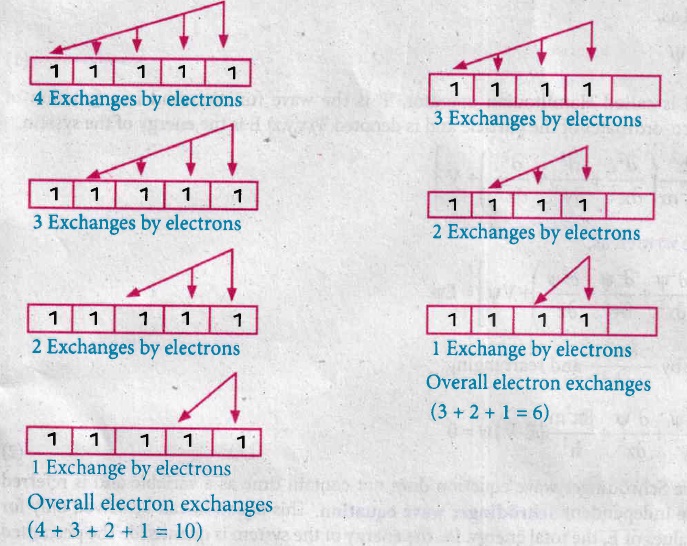
The exchange energy is the basis for Hund's rule, which allows maximum multiplicity, that is electron pairing is possible only when all the degenerate orbitals contain one electron each.
25.
Average atomic mass
= \(\frac { (78.99\times 23.99)+(10\times 24.99)+(11.01\times 25.98) }{ 100 } \)
= \(\frac { 2430.9 }{ 100 } \)
= 24.31 u
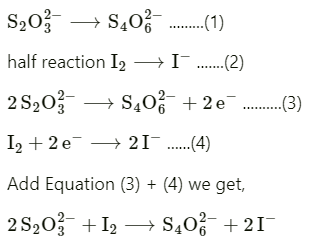
26.
half reaction \(\Rightarrow \) \({ S }_{ 2 }{ O }_{ 3 }^{ 2- }\longrightarrow { S }_{ 4 }{ O }_{ 6 }^{ 2- }\)
\({ I }_{ 2 }\longrightarrow { I }^{ - }\)
.png)
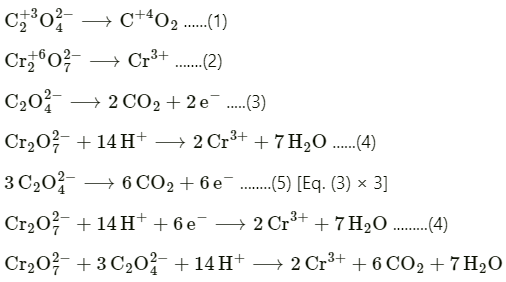
27.
\(\overset { +3 }{ C } _{ 2 }{ O }_{ 4 }^{ 2- }\longrightarrow \overset { +4 }{ C } { O }_{ 2 }\)
\(\overset { +6 }{ Cr } _{ 2 }{ O }_{ 7 }^{ 2- }\longrightarrow { Cr }^{ 3+ }\)
(1) \(\Rightarrow \) \({ C }_{ 2 }{ O }_{ 4 }^{ 2- }\longrightarrow { 2CO }_{ 2 }+{ 2e }^{ - }\)
\({ Cr }_{ 2 }{ O }_{ 7 }^{ 2- }\longrightarrow { 2Cr }^{ 3+ }+{ 7H }^{ 2 }O\)
.png)
28.
Half reactions are:
\(\overset { +7 }{ M } { nO }_{ 4 }^{ - }\longrightarrow { Mn }^{ 2+ }\)
and \({ Sn }^{ 2+ }\longrightarrow { Sn }^{ 4+ }\)
(1) \(\Rightarrow \) \({ MnO }_{ 4 }^{ - }+{ 8H }^{ - }+5e^{ - }\longrightarrow { Mn }^{ 2+ }+{ 4H }_{ 2 }O\)
(2) \(\Rightarrow \) \({ Sn }^{ 2+ }\longrightarrow { Sn }^{ 4+ }+{ 2e }^{ - }\)
.png)
ii)
iii)
iv)
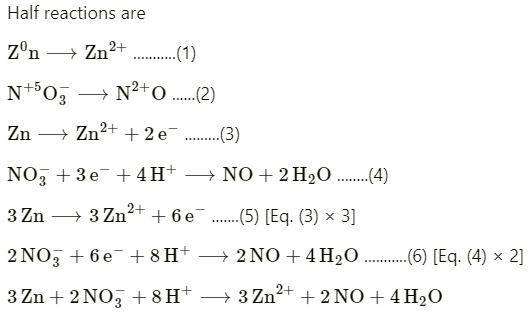
29.
| Element | % | Relative number of atoms | Simple Ratio |
| Na | 14.31 | \(\frac { 14.31 }{ 23 } =0.62\) | \(\frac { 0.62 }{ 0.31 } =2\) |
| S | 9.97 | \(\frac { 9.97 }{ 32 } =0.31\) | \(\frac { 0.31 }{ 0.31 } =1\) |
| H | 6.22 | \(\frac { 6.22 }{ 1 } =6.22\) | \(\frac { 6.22 }{ 0.31 } =20\) |
| O | 69.5 | \(\frac { 69.5 }{ 16 } =4.34\) | \(\frac { 4.34 }{ 0.31 } =14\) |
Empirical formula = Na2 SH20 O14
\(\left[ \begin{matrix} { Na }_{ 2 }{ SH }_{ 20 }{ O }_{ 14 } \\ =(2\times 23)+(1\times 32)+(20\times 1)+14(16) \\ =46+32+20+234 \\ =322 \end{matrix} \right] \)
n = \(\frac { molar\quad mass }{ caluclated\quad empirical\quad formula\quad mass } =\frac { 322 }{ 322 } =1\)
Molecular formula = Na2 SH20O14
Since all the hydrogen in the compound are present as water
\(\therefore \) The molecular formula is Na2 SO4 10H2O.
30.
The solution to Schrodinger equation gives the permitted total energy values called eigen values and the corresponding wave function represent atomic orbitals.
| Orbital | n | l |
| 3px | 3 | 1 |
| 4dx2-y2 | 4 | 2 |

11th Standard Syllabus & Materials
11th Standard
TN 11th Tamil பீடு பெற நில் - செய்யுள் - காவடிச்சிந்து Important Questions And Answers Study Material - QB365 Set A
NEW11th Standard
TN 11th Tamil பீடு பெற நில் - உரைநடை - மலை இடப்பெயர்கள் : ஓர் ஆய்வு Important Questions And Answers Study Material - QB365 Set A
NEW11th Standard
TN 11th Tamil மாமழை போற்றுதும் - துணைப்பாடம் - யானை டாக்டர் Important Questions And Answers Study Material - QB365 Set A
NEW11th Standard
TN 11th Tamil மாமழை போற்றுதும் - செய்யுள் - ஐங்குறுநூறு Important Questions And Answers Study Material - QB365 Set A



Tamilnadu Stateboard 11th Standard Subjects

Maths

Commerce

Economics

Biology

Business Maths and Statistics

Accountancy

Computer Science

Physics
Chemistry
Maths
Biology
Economics
Physics
Chemistry

History
Business Maths and Statistics

Computer Science
Accountancy

Computer Applications
History
Computer Technology
Commerce
Computer Applications
Computer Technology

Tamil

English

French
Tamilnadu Stateboard Standards
