
 100% FREE ACCESS
11th Standard Syllabus & Materials
11th Standard
TN 11th Tamil இயற்கை வேளாண்மை,சுற்றுச்சூழல் -செய்யுள் - மனோன்மணீயம் Important Questions And Answers Study Material - QB365 Set A
NEW11th Standard
TN 11th Tamil என்னுயிர் என்பேன் -துணைப்பாடம் - இசைத்தமிழர் இருவர் Important Questions And Answers Study Material - QB365 Set A
NEW11th Standard
TN 11th Tamil மொழி கலை -செய்யுள் - ஒவ்வொரு புல்லையும் Important Questions And Answers Study Material - QB365 Set A
NEW11th Standard
TN 11th Tamil பீடு பெற நில் - இலக்கணம் - பகுபத உறுப்புகள் Important Questions And Answers Study Material - QB365 Set A
NEW11th Standard
TN 11th Tamil பீடு பெற நில் - துணைப்பாடம் - வாடிவாசல் Important Questions And Answers Study Material - QB365 Set A
NEW11th Standard
TN 11th Tamil பீடு பெற நில் - செய்யுள் - குறுந்தொகை Important Questions And Answers Study Material - QB365 Set A

Published on: 28/07/2018
Some of the important questions from the chapter Quantum Mechanical Model of Atom covered in this question paper. The questions are prepared from the book back and PTA question.
For Teachers, can prepared question paper with answer key within five minutes. Please Click Here for subscribe.
Download Tamil Nadu 11th Standard Chemistry question papers, model tests, one-mark questions, important questions, and public exam papers in PDF format. Free study materials and answer keys for TN State Board students.
Questions + Answers key
Take MCQ Chemistry Test
1.
The uncertainty in the position of a moving bullet of mass 10 g is 10-5 m. Calculate the uncertainty in its velocity?
2.
An ion with mass number 56 contains 3 units of positive charge and 30.4% more neutrons than electrons. Assign symbol to the ion.
3.
How many unpaired electrons are present in the ground state of Fe3+ (z = 26), Mn2+(z = 25) and argon (z = 18)?
4.
Explain why the uncertainty principle is significant only for the motion of sub-atomic particles but is negligible for the macroscopic objects?
5.
An electron a proton which one will have a higher velocity to produce matter waves of the same wavelength? Explain it
6.
Define orbital ? what are the n and 1 values for 3px and 4dx2-y2 electron ?
7.
Write a note on limitations of Bohr's atom model.
8.
By applying Bohr's postulates, arrive at the radius of nth orbit for hydrogen like atom
9.
According to the Bohr Theory, which of the following transitions in the hydrogen atom will give rise to the least energetic photon?
n = 6 to n = 1
n = 5 to n = 4
n = 5 to n = 3
n = 6 to n = 5
10.
How many orbitals are possible in the 4th energy level? (n = 4)
11.
What did Rutherford's alpha ray scattering experiment prove
12.
Write a note on Thomson's plum pudding model of an atom.
13.
How many radial nodes for 2s, 4p, 5d and 4f orbitals exhibit? How many angular nodes
14.
How many orbitals are possible for n = 4?
15.
The stabilisation of a half filled d - orbital is more pronounced than that of the p-orbital why?
1.
According to uncertainty principle,
\(\triangle x.m\triangle v={h\over 4\pi}\) or \(\triangle v={h\over 4\pi m \triangle x};\) h = 6.626 x 10⁻³⁴ kg m2 s-1;m = 10g = 10-2 kg
\(\triangle x =10^{-5}m;\triangle v ={(6.626\times 10^{-.34}kgm^2s^{-1})\over4\times 3.143\times (10^{-2}kg)\times (10^{-5}m)}=5.27\times 10^{-28}\)mv
2.
Let the no. of electrons in the ion = x
\(\therefore\) the no. of the protons = x + 3 (as the ion has three units positive charge) and the no. of neutrons = \(x+{30.4x\over 100}=x+0.304x\)
Now, mass number of ion = Number of protons + Number of neutrons
= (x + 3) + (x + 0.304 x)
\(\therefore\) 56 = (x + 3) + (x + 0.304 x) or 2.304 x = 56 - 3 = 53
\(x={53\over 2.304}=23\)
Atomic number of the ion (or element) = 23 + 3 = 26
The element with atomic number 26 is iron (Fe) and the corresponding ion is Fe3+.
3.
Electronic configuration of Fe3+ 1s22s22p63s23p63d64s2
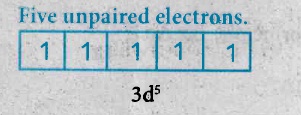
Electronic configuration of mn2+ is 1s2 2s2 2p6 3s2 3p6 4s2 3d5
Five unpaired electrons
Electronic configuration of Ar is 1s2 2s2 2p6 3s2 3p6
no unpaired electrons.
4.
(i) The energy of photon is sufficient to disturb a sub-atomic particle so that there is uncertainty in the measurement of position and momentum of the sub-atomic particle.
(ii) However, the energy is insufficient to disturb a macroscopic object.
5.
From de Broglie equation, wavelength \(\lambda =\frac { h }{ mv } \)
For same wavelength with two different particles, (ie) electron and proton m1v1 = m2v2 (h is constant) Lesser the mass of the particle, greater will be the velocity.
Hence electron will have higher velocity
6.
The solution to Schrodinger equation gives the permitted total energy values called eigen values and the corresponding wave function represent atomic orbitals.
| Orbital | n | l |
| 3px | 3 | 1 |
| 4dx2-y2 | 4 | 2 |
7.
Limitation of Bohr's atom model:
(a) The Bohr's atom model is applicable only to species having one electron such as hydrogen, Li2+ etc ... and not applicable to multi electron atoms.
(b) It was unable to explain the splitting of spectral lines in the presence of magnetic field (Zeeman effect) or an electric field (Stark effect).
(c) Bohr's theory was unable to explain why the electron is restricted to revolve around the nucleus in a fixed orbit in which the angular momentum of the electron is equal to nh/2π
8.
Applying Bohr's postulates to a hydrogen like atom (one electron species such as H, He+ and Li2+ etc...)the radius of the nth orbit and the energy of the electron revolving in the nth orbit were derived. The results are as follows:
rn = \(\frac { (0.529){ n }^{ 2 } }{ x } \mathring { A } \) ...(1)
En = \(\frac { -13.6({ z }^{ 2 }) }{ { n }^{ 2 } } ev\quad { atom }^{ -1 }\) or ... (2) or
En = \(\frac { (-1312.8){ z }^{ 2 } }{ { n }^{ 2 } } kJ\quad { mol }^{ -1 }\) .....(3)
9.
(d)
n = 6 to n = 5
10.
n = 4 l = 0,1,2,3
4 sub shells s, p, d & f.
I = 0 m1 = 0 + one 4s orbital.
I = 1 m1 = -1, 0, + 1 \(\Rightarrow\) three 4p orbitals.
I = 2 m1 = -2,:1, 0, +1, +2 \(\Rightarrow\) five 4d orbitals.
I = 3 m1 = -3, -2, -1,0, +1, +2, +3 \(\Rightarrow\) seven 4f orbitals.
Over all 16 orbitals are possible.
11.
(i) Atoms consist of huge positively charged centers called nuclei.
(ii) Most of the space inside the atom is empty.
12.
According to this theory, atom was assumed to consist of a sphere of uniform distribution of about 10-10 m positive charge with electrons embedded in it such that the number of electrons equal to the number of positive charges and the atom as a whole is electrically neutral.
13.
| Orbital | n | 1 | Radial node n-1-1 | Angular node 1 |
| 2s | 2 | 0 | 1 | 0 |
| 4p | 4 | 1 | 2 | 1 |
| 5d | 5 | 2 | 2 | 2 |
| 4f | 4 | 3 | 0 | 3 |
14.
| n | l | m | orbitals | Total no of orbitals |
| 0 | 0 | 1 | (1- 4s +3 - 4P orbital +5 - 4d orbital +7 - 4f orbital) =16 |
|
| 4 | 1 | -1 0 +1 |
3 | |
| 2 |
-2 |
5 | ||
| 3 |
-3 |
7 |
15.
Energy electrons symmetry
This is due to the symmetrical distribution and exchange energy of given d- electrons. Symmetry leads to stability.
Exchange energy:
If two or more electrons with the same spin are present in degenerate orbitals, there is a possibility for exchanging their positions. During exchange process, the energy is released and the released energy is called exchange energy. If more number of exchanges are possible, more exchange energy in released. More number of exchanges are possible only in case of half filled and fully filled configurations.
For example, in chromium the electronic configuration is [Ar]3d5 4s1. The 3d orbital is half filled and there are ten possible exchanges as shown in figure. On the other hand only six exchanges are possible for [Ar]3d4 4s2 configuration. Hence, exchange energy for the half filled configuration is more. This increases the stability of half filled 3d orbitals.
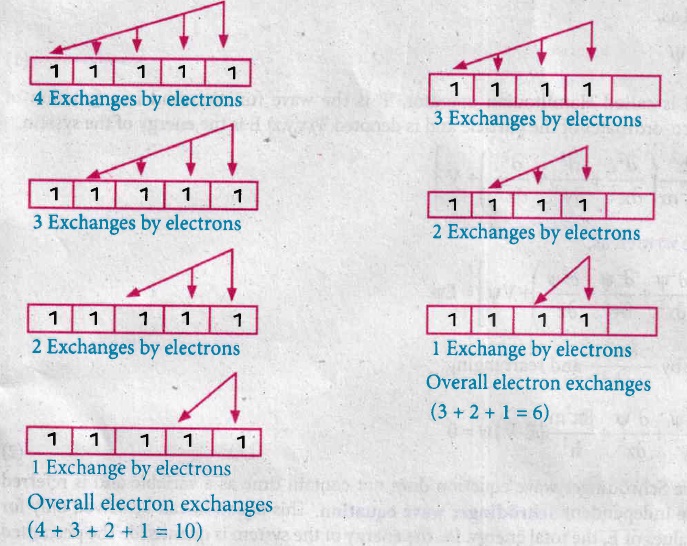
The exchange energy is the basis for Hund's rule, which allows maximum multiplicity, that is electron pairing is possible only when all the degenerate orbitals contain one electron each.

11th Standard Syllabus & Materials
11th Standard
TN 11th Tamil பீடு பெற நில் - செய்யுள் - காவடிச்சிந்து Important Questions And Answers Study Material - QB365 Set A
NEW11th Standard
TN 11th Tamil பீடு பெற நில் - உரைநடை - மலை இடப்பெயர்கள் : ஓர் ஆய்வு Important Questions And Answers Study Material - QB365 Set A
NEW11th Standard
TN 11th Tamil மாமழை போற்றுதும் - துணைப்பாடம் - யானை டாக்டர் Important Questions And Answers Study Material - QB365 Set A
NEW11th Standard
TN 11th Tamil மாமழை போற்றுதும் - செய்யுள் - ஐங்குறுநூறு Important Questions And Answers Study Material - QB365 Set A



Tamilnadu Stateboard 11th Standard Subjects

Maths

Commerce

Economics

Biology

Business Maths and Statistics

Accountancy

Computer Science

Physics
Chemistry
Maths
Biology
Economics
Physics
Chemistry

History
Business Maths and Statistics

Computer Science
Accountancy

Computer Applications
History
Computer Technology
Commerce
Computer Applications
Computer Technology

Tamil

English

French
Tamilnadu Stateboard Standards
