
 100% FREE ACCESS
11th Standard Syllabus & Materials
11th Standard
TN 11th Tamil இயற்கை வேளாண்மை,சுற்றுச்சூழல் -செய்யுள் - மனோன்மணீயம் Important Questions And Answers Study Material - QB365 Set A
NEW11th Standard
TN 11th Tamil என்னுயிர் என்பேன் -துணைப்பாடம் - இசைத்தமிழர் இருவர் Important Questions And Answers Study Material - QB365 Set A
NEW11th Standard
TN 11th Tamil மொழி கலை -செய்யுள் - ஒவ்வொரு புல்லையும் Important Questions And Answers Study Material - QB365 Set A
NEW11th Standard
TN 11th Tamil பீடு பெற நில் - இலக்கணம் - பகுபத உறுப்புகள் Important Questions And Answers Study Material - QB365 Set A
NEW11th Standard
TN 11th Tamil பீடு பெற நில் - துணைப்பாடம் - வாடிவாசல் Important Questions And Answers Study Material - QB365 Set A
NEW11th Standard
TN 11th Tamil பீடு பெற நில் - செய்யுள் - குறுந்தொகை Important Questions And Answers Study Material - QB365 Set A

Published on: 15/09/2018
Model paper
Download Tamil Nadu 11th Standard Chemistry question papers, model tests, one-mark questions, important questions, and public exam papers in PDF format. Free study materials and answer keys for TN State Board students.
Questions + Answers key
Take MCQ Chemistry Test
1.
Statement-I: The magnetic moment of parahydrogen is zero.
Statement-II: The spins of two hydrogen atoms in para H2 molecule neutralise each other.
Statements-I and II are correct and Statement-II is the correct explanation of statement-I.
Statements-I and II are correct but Statement-II is not the correct explanation of statement- I.
Statement-I is correct but Statement-II is wrong.
Statement-I is wrong but Statement-II is correct.
2.
Statement-I: Hydrogen is placed at the top of the group which is in-line with the latest periodic table.
Statement-II: Hydrogen has a tendency to lose its electron to form H+, thus showing electropositive character like alkali metals. On the other hand, hydrogen has a tendency to gain an electron to yield H-, thus showing an electronegative character like halogens.
Statements-I and II are correct and Statement-Il is the correct explanation of statement-I.
Statements-land II are correct but Statement-II is not the correct explanation of statement- I.
Statement-I is correct but Statement-II is wrong.
Statement-I is wrong but Statement-II is correct.
3.
Heavy water is used as _________
moderator in nuclear reactions
coolant in nuclear reactions
both (a) and (b)
none of these
4.
The type of H-bonding present in ortho nitro phenol and p-nitro phenol are respectively ____________
inter molecular H-bonding and intra molecular H-bonding
intra molecular H-bonding and inter molecular H-bonding
intra molecular H - bonding and no H - bonding
intra molecular H - bonding and intra molecular H - bonding
5.
In solid ice, oxygen atom is surrounded _____________
tetrahedrally by 4 hydrogen atoms
octahedrally by 2 oxygen and 4 hydrogen atoms
tetrahedrally by 2 hydrogen and 2 oxygen atoms
octahedrally by 6 hydrogen atoms
6.
Zeolite used to soften hardness of water is hydrated _____________
Sodium aluminium silicate
Calcium aluminium silicate
Zinc aluminium borate
Lithium aluminium hydride
7.
The cause of permanent hardness of water is due to _____________
Ca(HCO3)2
Mg(HCO3)2
CaCl2
MgCO3
8.
The hardness of water can be determined by volumetrically using the reagent _____________
sodium thio sulphate
potassium permanganate
hydrogen peroxide
EDTA
9.
Water gas is _____.
H2O(g)
CO + H2O
CO + H2
CO + N2
10.
Which of the following statements about hydrogen is incorrect?
Hydrogen ion, H3O+ exists freely in solution.
Dihydrogen acts as a reducing agent.
Hydrogen has three isotopes of which tritium is the most common.
Hydrogen never acts as cation in ionic salts.
11.
Predict which of the following hydrides is a gas on a solid
(a) HCI
(b) NaH
Give your reason.
12.
What happens when hydrogen reacts with
(i) O2
(ii) Cl2
(iii) Na?
13.
Explain the different methods of preparation of Tritium with equation.
14.
Draw the structure of the isotopes of hydrogen and distinguish them.
15.
Compare the properties of isotopes of hydrogen.
16.
Compare the properties of ortho and para hydrogen.
17.
Mention the uses of plaster of paris
18.
Substantiate lithium fluoride has the lowest solubility among group one metal fluorides.
19.
Write balanced chemical equation for each of the following chemical reactions.
Lithium metal with nitrogen gas.
20.
Arrange NH3, H2O and HF in the order of increasing magnitude of hydrogen bonding and explain the basis for your arrangement.
21.
How do you expect the metallic hydrides to be useful for hydrogen storage?
22.
Why interstitial hydrides have a lower density than the parent metal.
23.
Write chemical equation for the following reactions.
i) reaction of hydrogen with tungsten (VI) oxide on heating.
(ii) hydrogen gas and chlorine gas.
24.
Predict which of the following hydrides is a gas on a solid
(a) BCI
(b) NaH
Give your reason.
25.
Explain why hydrogen is not placed with the halogen in the periodic table.
26.
Do you think that heavy water can be used for drinking purposes?
27.
Explain what is meant by efflorescence.
28.
An ice cube at 0° C is placed in some liquid water at 00C, the ice cube sinks - Why? What will happen to ice at 00C placed in liquid water at 00C?
29.
How do you convert para hydrogen into ortho hydrogen?
30.
NH3 has exceptionally high melting point and boiling point as compared to those of the hydrides of the remaining element of group 15. Explain.
1.
(a)
Statements-I and II are correct and Statement-II is the correct explanation of statement-I.
2.
(a)
Statements-I and II are correct and Statement-Il is the correct explanation of statement-I.
3.
(c)
both (a) and (b)
4.
(b)
intra molecular H-bonding and inter molecular H-bonding
5.
(a)
tetrahedrally by 4 hydrogen atoms
6.
(a)
Sodium aluminium silicate
7.
(c)
CaCl2
8.
(d)
EDTA
9.
(c)
CO + H2
10.
(c)
Hydrogen has three isotopes of which tritium is the most common.
11.
(i) At room temperature, HCI is a colourless gas and the solution of HCI in water is called hydrochloric acid and it is in liquid state.
(ii) Sodium hydride NaH is an ionic compound and it is made of sodium cations (Na+) and hydride (H-) anions. It has the octahedral crystal structure. It is an alkali metal hydride.
12.
(i) 2 H2(g) + O(g) ⟶ 2 H2O(1) - Water
(ii) H2(g) + CI2(g) ⟶ 2 HCI(g) - Hydrogen Chloride
(iii) 2 Na(s) + H2(g) ⟶ 2NaH(s) - Sodium hydride
13.
It occurs naturally as a result of nuclear reactions induced by cosmic rays in the upper atmosphere.
\(_{ 7 }^{ 14 }{ N }+_{ 0 }^{ 1 }{ n }\rightarrow _{ 6 }^{ 12 }{ C }+_{ 1 }^{ 3 }{ H }\)
\(_{ 1 }^{ 2 }{ H }+_{ 1 }^{ 2 }{ H }\rightarrow _{ 1 }^{ 3 }{ H }+_{ 1 }^{ 1 }{ H }\)
\(_{ 3 }^{ 6 }{ Li }+_{ 0 }^{ 1 }{ n }\rightarrow _{ 2 }^{ 4 }{ He }+_{ 1 }^{ 3 }{ H }\)
14.
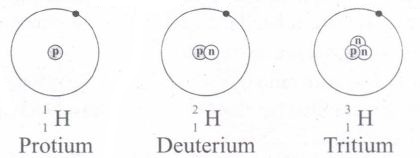
| Protium:\(_{ 1 }^{ 1 }{ H }\) | Deuterium\(_{ 1 }^{ 2 }{ H }\) | Tritium:\(_{ 1 }^{ 3 }{ H }\) | |
| Number of electrons | 1 | 1 | 1 |
| Number of protons | 1 | 1 | 1 |
| Number of neutrons | 0 | 1 | 2 |
| Abundance | 99.985 | 0.015 | ~10-16 |
| Melting point (K) | 13.96 | 18.73 | 20.62 |
| Boiling point (K) | 20.30 | 23.67 | 25.64 |
15.
| S.No. | Property | Protium | Deuterium | Tritium |
| 1 | Atomic nature | H | D | T |
| 2 | Atomic mass | 1.008 | 2.014 | 3.016 |
| 3 | Nuclear stability | Stable | Stable | Radioactive |
| 4 | Molecular hydrogen | H2 | D2 | T2 |
| 5 | Abundance (%) | 99.985 | 0.015 | ~10-16 |
| 6 | Molecular mass | 2.016 | 4.028 | 6.032 |
16.
| S.No. | Properties | Ortho hydrogen | Para hydrogen |
| 1. | Melting point | 13.95K | 13.83 K |
| 2. | Boiling point | 20.39 K | 20.26 K |
| 3. | Vapour pressure | Normal | higher |
| 4. | Magnetic moment | Twice | zero |
17.
The largest use of plaster of paris is in the building industry as well as plasters. It is used for immobilising the affected part of organ where there is a bone fracture or sprain. It is also employed in dentistry, in ornamental work and for making casts of statues and busts.
18.
The lattice energy of LiF is higher due to the smaller size of Li+ and F-. So LiF has lower solubility.
19.
6Li + N2 ⟶ 2Li3 N
20.
(i) The order : NH3 < H2O
(ii) Strength of H bond depends upon the atomic size and electronegativity of the other atom to which H atom is covalently bonded.
Since electronegativity of F > O > N, the strength of H-bond is in the order H-F......H > H - O......H > H-N......H.
H-bonds are much weaker than covalent bonds.
21.
Metal Hydride (Hydrogen Sponge):
The best studied binary hydrides are the palladium - hydrogen system. Hydrogen interacts with palladium in a unique way, and forms a limiting monohydride, PdH. Upon heating, H atoms diffuse through the metal to the surface and recombine to form molecular hydrogen. Since no other gas behaves this way with palladium, this process has been used to separate hydrogen gas from other gases.
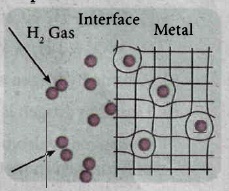
\(2 \mathrm{Pd}(\mathrm{s})+\mathrm{H}_{2}(\mathrm{~g}) \rightarrow 2 \mathrm{PdH}(\mathrm{s})\)
The hydrogen molecule readily adsorbs on the palladium surface, where it dissociates into atomic hydrogen. The dissociated atoms dissolve into the interstices or voids (octahedral/tetrahedral) of the crystal lattice.
Technically, the formation of metal hydride is by chemical reaction but it behaves like a physical storage method, i.e., it is absorbed and released like a water sponge. Such a reversible uptake of hydrogen in metals and alloys is also attractive for hydrogen storage and for rechargeable metal hydride battery applications.
22.
Interstitial hydrides have metallic bonding. These are non - stoichiometric; their composition varies with temperature and pressure. The crystal lattice expands due to the inclusion of dihydrogen and there is distortion of crystal lattice. So they have lower density than the parent metal. Recent studies have shown that except the hydrides of Ni, Pd, Ce & Ac, other hydride are different from the parent metals.
23.
(i) WO3 + 3H2 ➝ W + 3H2O
(ii) H2 + Cl2 ➝ 2HCl.
24.
a) HCl is a gas. It is an electron rich covalent hydride. It is a covalent molecule with strong covalent bond. However the forces between the molecules are not as strong.
b) NaH is a solid. It is an ionic hydride of group I sodium metal. It is an insoluble hydride
25.
Hydrogen has electronic configuration 1s1. So it resembles ns1 general valence shell configuration of alkali metals.
Its similarity with alkali metals are:
1. Form uni positive (H+) ions like Na+, K+, Cs+
2. Form halides, (HX), oxides (H2O) peroxides (H2O2) and sulphides (H2S) like (Nax, Na2O, Na2O2, Na2S)
3. Acts as reducing agent.
4. Has +1 oxidation state.
5. If it is placed in the halogen family it should be the most electro negative element which is not true.
26.
Heavy water is toxic when taken in large quantities. Heavy water is not radioactive. The deuterium in it is stable; it does not decay. Nobody will be in danger at all from radiation. It is heavier than plain water. D2O performs little different from H2O in chemical reactions. One has to drink a lot of D2O to kill him.
27.
Efflorescence is the spontaneous loss of water by a hydrated salt, which occurs when the aqueous vapor pressure of the hydrate is greater than the partial pressure of the water vapour in the air. This is the property of salts
Ex: Glauber's salt- Na2SO4·10H2O
Epsom salt - MgSO4·7H2O
28.
NOTE:
At any condition ice cube does not sink in water.
At 00C, ice and liquid water will be in equilibrium and will coexist. Hence no freezing or melting will occur.
29.
(i) By treatment with catalyst like Pt or Fe.
(ii) By passing an electric discharge
(iii) By heating to 800°C or more.
(iv) By mixing with paramagnetic molecules like O2,NO,NO2·
(v) By mixing with nascent hydrogen or atomic hydrogen.
30.
(i) Due to small size of Nitrogen atom.
(ii) Due to polar nature of N-H bond.
(iii) Due to inter molecular H- bonding which are stronger than London forces present in other hydrides. Other hydrides lack H - bonding

11th Standard Syllabus & Materials
11th Standard
TN 11th Tamil பீடு பெற நில் - செய்யுள் - காவடிச்சிந்து Important Questions And Answers Study Material - QB365 Set A
NEW11th Standard
TN 11th Tamil பீடு பெற நில் - உரைநடை - மலை இடப்பெயர்கள் : ஓர் ஆய்வு Important Questions And Answers Study Material - QB365 Set A
NEW11th Standard
TN 11th Tamil மாமழை போற்றுதும் - துணைப்பாடம் - யானை டாக்டர் Important Questions And Answers Study Material - QB365 Set A
NEW11th Standard
TN 11th Tamil மாமழை போற்றுதும் - செய்யுள் - ஐங்குறுநூறு Important Questions And Answers Study Material - QB365 Set A



Tamilnadu Stateboard 11th Standard Subjects

Maths

Commerce

Economics

Biology

Business Maths and Statistics

Accountancy

Computer Science

Physics
Chemistry
Maths
Biology
Economics
Physics
Chemistry

History
Business Maths and Statistics

Computer Science
Accountancy

Computer Applications
History
Computer Technology
Commerce
Computer Applications
Computer Technology

Tamil

English

French
Tamilnadu Stateboard Standards
