
 100% FREE ACCESS
11th Standard Syllabus & Materials
11th Standard
TN 11th Tamil இயற்கை வேளாண்மை,சுற்றுச்சூழல் -செய்யுள் - மனோன்மணீயம் Important Questions And Answers Study Material - QB365 Set A
NEW11th Standard
TN 11th Tamil என்னுயிர் என்பேன் -துணைப்பாடம் - இசைத்தமிழர் இருவர் Important Questions And Answers Study Material - QB365 Set A
NEW11th Standard
TN 11th Tamil மொழி கலை -செய்யுள் - ஒவ்வொரு புல்லையும் Important Questions And Answers Study Material - QB365 Set A
NEW11th Standard
TN 11th Tamil பீடு பெற நில் - இலக்கணம் - பகுபத உறுப்புகள் Important Questions And Answers Study Material - QB365 Set A
NEW11th Standard
TN 11th Tamil பீடு பெற நில் - துணைப்பாடம் - வாடிவாசல் Important Questions And Answers Study Material - QB365 Set A
NEW11th Standard
TN 11th Tamil பீடு பெற நில் - செய்யுள் - குறுந்தொகை Important Questions And Answers Study Material - QB365 Set A

Published on: 14/12/2019
Physical and Chemical Equilibrium
Download Tamil Nadu 11th Standard Chemistry question papers, model tests, one-mark questions, important questions, and public exam papers in PDF format. Free study materials and answer keys for TN State Board students.
Questions + Answers key
Take MCQ Chemistry Test
1.
A state of equilibrium is reached when _____________
The rate of forward reaction is greater than the rate of the reverse reaction
The concentration of the products and reactants are equal
More product is present than rea
The concentration of the products and reactants have reached constant value
2.
XY2 dissociates as,\(XY_{ 2\left( g \right) }\rightleftharpoons { XY }_{ \left( g \right) }+Y_{ \left( g \right) }\) Initial pressure of XY2 is 600mm Hg. The total pressure at equilibrium is 800mm Hg. Assuming volume of system to remain constant, the value of Kp is ______________
50
100
400
20
3.
Hydrogen (a moles) and iodine (b moles) react to give 2x moles of the HI at equilibrium. The total number of moles at equilibrium is _____________
a + b + 2x
(a - b) + (6 - 2x)
(a + b)
a + b - x
4.
Which one of the following is incorrect statement?
for a system at equilibrium, Q is always less than the equilibrium constant
equilibrium can be attained from either side of the reaction
presence of catalyst affects both the forward reaction and reverse reaction to the same extent
Equilibrium constant varied with temperature
5.
Solubility of carbon dioxide gas in cold water can be increased by ____________
increase in pressure
decrease in pressure
increase in volume
none of these
6.
Equilibrium constant K; for the reaction, N2(g) + 3H2(g)⇌ 2NH3(g) at 500 K is 0.06l. At particular time, the analysis shows that the composition of the reaction mixture is 3.0 mol L-1 of N2; 2.0 mol L-1 of H3; 0.50 mol L-1 of NH3. Is the reaction at equilibrium?
7.
For the equilibrium 2NOCl(g) ⇄ 2NO(g) + Cl2g) the value of the equilibrium constant Kc is 3.75 x 10⁻⁶ at 1069 K. Calculate the Kp for the reaction at this temperature?
8.
Explain how the equilibrium constant Kc predict the extent of a reaction.
9.
How will you arrive at the unit of equilibrium constant?
10.
Which of the following reactions involve homogeneous equilibrium and which involve heterogeneous equilibrium?
(i) \({ Ag }_{ 2 }{ O }_{ \left( s \right) }+2HN{ O }_{ 3\left( aq \right) }\rightleftharpoons 2Ag{ NO }_{ 3\left( aq \right) }+{ H }_{ 2 }O\)
(ii) \({ C }_{ \left( s \right) }+{ CO }_{ 2\left( g \right) }\rightleftharpoons { 2CO }_{ \left( g \right) }\)
(iii) \({ CH }_{ 3 }COO{ C }_{ 2 }{ H }_{ 5\left( aq \right) }+{ H }_{ 2 }{ O }_{ \left( l \right) }\rightleftharpoons { CH }_{ 3 }{ COOH }_{ \left( aq \right) }+{ C }_{ 2 }{ H }_{ 5 }OH_{ \left( aq \right) }\)
(iv) \({ 2SO }_{ 2\left( g \right) }+{ O }_{ 2 }\rightleftharpoons { 2SO }_{ 3 }\)
11.
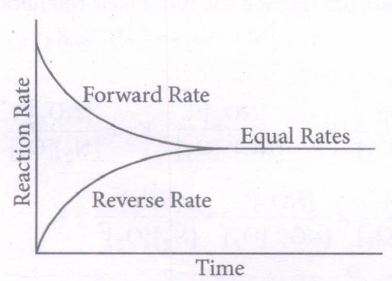
Explain the following diagrams
Diagram - I
12.
Give three examples for solid vapour equilibrium.
13.
Illustrate the formation of solid-vapour equilibrium with suitable example
14.
Discuss the equilibrium involving dissolution of solids or gases in liquids.
15.
Derive the values of Kp and Kc for dissociation of PCl5.
16.
Derive the expressions for KC and KP, for the synthesis of Hl.
17.
Write a relation between \(\triangle\)G and Q and define the meaning of each term and answer the following
(i) Why a reaction proceeds forward when Q < K and no net reaction occurs when Q=K?
(ii) Explain the effect of increase in pressure in terms of reaction quotient Q.
For the reaction,
\(CO_{(g)}+3H_{2(g)}\rightarrow CH_{4(g)}+H_2O_{(g)}\)
18.
Explain the effect of concentration, pressure, temperature, catalyst and inert gas on equilibrium.
1.
(d)
The concentration of the products and reactants have reached constant value
2.
(b)
100
3.
(c)
(a + b)
4.
(a)
for a system at equilibrium, Q is always less than the equilibrium constant
5.
(a)
increase in pressure
6.
The given reaction is: N2(g) + 3H2(g) ⇌ 2NH3(g)
According to available data
N2 = [3.0]; H2 = [2.0]; NH3 = [0.50]
\({ Q }_{ C }=\cfrac { \left[ { { NH }_{ 3 }\left( g \right) } \right] ^{ 2 } }{ \left[ { N }_{ 2 }\left( g \right) \right] \left[ { H }_{ 2 }\left( g \right) \right] ^{ 3 } } =\cfrac { \left[ 0.50 \right] ^{ 2 } }{ \left[ 3.0 \right] \left[ 2.0 \right] } =\cfrac { 0.25 }{ 24 } =0.0104\)
7.
We know that Kp = K, (RT) Δng
For the above reaction, Δng= (2 + 1) - 2 = 1
Kp = 3.75 x 10⁻⁶(0.0831 x 1069) = 3.3 x 10⁻⁴
8.
(i) The value of equilibrium constant KC tells us the extent of the reaction i.e., it indicates how far the reaction has proceeded towards product formation at a given temperature.
(ii) A large value of KC indicates that the reaction reaches equilibrium with high product yield on the other hand, lower value of KC indicates that the reaction reaches equilibrium with low product yield.
(iii) If KC > 103, the reaction proceeds nearly to completion.
(iv) If K; < 10 - 3 the reaction rarely proceeds.
(v) If the KC is in the range 10-3 to 103, significant amount of both reactants and products are present at equilibrium.
9.
(i) The units of Kp and Kc depend on the value of \(\triangle\)ng
(ii) If number of moles of reactants and products are equal (ie) \(\triangle\)ng = 0; Then Kp and Kc have no units.
(iii) If there is increase or decrease in the number of moles of the reaction, then
unit of Kp is (atmospherere)\(\triangle\)ng
Unit of Kc is (mol per litre )\(\triangle\) ng
10.
(i) Heterogeneous equilibrium
(ii) Heterogeneous equilibrium
(ii) Homogeneous equilibrium
(lv) Homogeneous equilibrium.
11.
(i) As the concentration of the products increases, more products collide and react in the backward direction.
(ii) As the rate of the reverse reaction increases, the rate of the forward reaction decreases.
(iii) Eventually the rate of both reactions becomes equal.
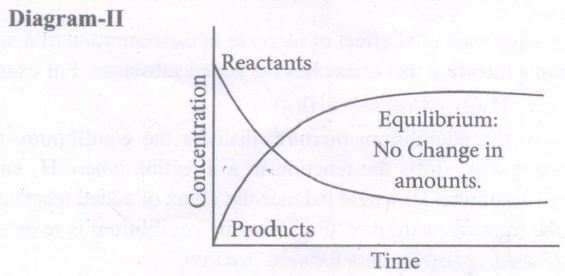
(i) Concentration of reactants decreases with time initially and concentration of products increases with time.
(ii) After sometime, equilibrium is reached i.e., concentration of reactants and products remains constant.
12.
\({ I }_{ 2 }(S)\leftrightharpoons { I }_{ 2 }\left( g \right) \)
Camphor (s) ⇌Camphor (g)
NH4Cl(s)⇌ NH4Cl(g)
13.
(i) Consider a system in which the solid sublimes to vapour. e.g., 12(or) camphor.
(ii) When solid iodine is placed in a closed transparent vessel, after sometime, the vessel gets filled up with violet vapour due to sublimation of iodine.
(iii) Initially the intensity of the violet colour increases, after some time it decreases and finally it becomes constant as the following equilibrium is attained.
\({ I }_{ 2 }\left( s \right) \leftrightharpoons { NH }_{ 4 }Cl(g)\)
14.
Solid in liquids:
1.When you add sugar to water at a particular temperature, it dissolves to form sugar solution. If you continue to which the added sugar remains as solid and the resulting solution is called a saturated solution. Here, as in the previous cases a dynamic equilibrium is established between the solute molecules in the solid phase and in the solution phase.
Sugar (Solid) In this process \(\rightleftharpoons \) Sugar (Solution)
Rate of dissolution of solute =Rate of crystallisation of solute
Gas in liquids:
1.When a gas dissolves in a liquid under a given pressure, there will be an equilibrium between gas molecules in the gaseous state and those dissolved in the liquid.
2. In carbonated beverages the following equilibrium exist
\({ CO }_{ 2 }\left( g \right) \rightleftharpoons { CO }_{ 2 }\left( s \right) \)
3. Henry's law is used to explain such gas-solution equilibrium processes
15.
Consider that 'a' moles of PCl , is taken in container of volume 'V'
Let x moles of PCl5 be dissociated into x moles of PCl3 and x moles of Cl2
| PCl5 | PCl3 | Cl2 | |
| Initial number of moles | a | 0 | 0 |
| Number of moles dissociated | x | 0 | 0 |
| Number of moles at equilibrium | a - x | x | x |
| Active mass | \(\cfrac { (a-x) }{ V } \) | \(\cfrac { x }{ V } \) | \(\cfrac { x }{ V } \) |
Applying law of mass action
\(\\ \\ { K }_{ C }=\cfrac { \left[ { PCl }_{ 3 } \right] \left[ { Cl }_{ 2 } \right] }{ \left[ { PCl }_{ 5 } \right] } =\cfrac { \left( \frac { x }{ V } \right) \left( \frac { x }{ V } \right) }{ \frac { a-x }{ V } } =\cfrac { { x }^{ 2 } }{ \left( a-x \right) V } \)
Kp, calculation: KP= KC . RTΔng
Δng = 2-1 = 1
We know that = PV = nRT
\(RT=\cfrac { PV }{ n } \)
Where 'n' is the total number of moles at equilibrium
n = a - x + x + x = a + x
\({ LK }_{ P }=\cfrac { { x }^{ 2 } }{ \left( a-x \right) V } .\cfrac { PV }{ n } \)
\({ K }_{ P }=\cfrac { { x }^{ 2 }\times PV }{ \left( a-x \right) V(a+x) } \)
\({ K }_{ P }=\cfrac { { x }^{ 2 }P }{ \left( a-x \right) \left( a+x \right) } \)
16.
Let us consider the formation of HI in which, 'a' moles of hydrogen and 'b' moles of iodine gas are allowed to react in a container of volume V. Let 'x' moles of each of H2 and I2 react together to form 2x moles of HI.
H2(g) + I2(g) ⇌ 2HI(g)
| H2 | I2 | HI | |
| Initial number of moles | a | b | 0 |
| Number of moles reacted | x | x | 0 |
| Number of moles at equilibrium | a - x | b - x | 2x |
| Active mass | \(\frac{a-x}{V}\) | \(\frac{b-x}{V}\) | \(\frac{2 x}{V}\) |
Applying law of mass action
\({ K }_{ C }=\cfrac { \left[ HI \right] ^{ 2 } }{ \left[ { H }_{ 2 } \right] \left[ I_{ 2 } \right] } \)
\({ K }_{ C }=\cfrac { \left( \cfrac { 2x }{ V } \right) ^{ 2 } }{ \cfrac { \left( a-x \right) }{ V } \cfrac { \left( b-x \right) }{ V } } =\cfrac { { 4x }^{ 2 } }{ \left( a-x \right) \left( b-x \right) } \)
The equilibrium constant Kp can also be calculated as follows:
We know the relationship between the Kc and Kp
KP, = KC . RTΔng
Here the
Δng = np - nr = 2 - 2 = 0
Hence, KP = KC
\(\\ \\ \\ { K }_{ P }=\cfrac { { 4x }^{ 2 } }{ \left( a-x \right) \left( b-x \right) } \)
17.
The relation between \(\triangle\)G and Q is
\(\triangle\)G =\(\triangle\)Go+ RT In Q
\(\triangle\)G = change in free energy as the reaction proceeds
\(\triangle\)Go= standard free energy
Q reaction quotient
R gas constant
T absolute temperature in K
(i) Since, \(\triangle\)Go = -RT in K
\(\therefore\) \(\triangle\)Go = -RT in K + RT in Q;
\(\triangle G=RT \ in {Q\over K}\)
If Q < K,\(\triangle\)G will be negative and the reaction proceeds in the forward direction. If Q = K, \(\triangle\)G = 0 reaction is in equilibrium and there is no net reaction.
(ii)\(CO_{(g)}+3H_{2(g)}\rightleftharpoons CH_{4(g)}+H_2O_{(g)}\)
\(K_c={[CH_4][H_2O]\over[CO][H_2]^3}\)
On increasing pressure, volume decreases. If we doubled the pressure, volume will be halved but the molar concentrations will be doubled.
Then,
\(Q_c={2[CH_4].2[H_2O]\over 2[CO]\{2[H_2]\}^3}\)\(={1\over4}{[CH_4][H_2O]\over[CO][H_2]^3}={1\over4}K_c\)
Therefore, Qc is less than Kc , so Qc will tend to increase to re-establish equilibrium and the
reaction will go in forward direction.
\(CO_{(g)}+3H_{2(g)}\rightleftharpoons CH_{4(g)}+H_2O_{(g)}\)
18.
| Condition | Stress | Direction in which equilibrium shifts |
| Concentration | Addition of reactants (increase in reactant concentration) | Forward reaction |
| Removal of products (decreas~ jn productconcentration) | Reverse reaction | |
| Addition of products (increase in product concentration) | ||
| Removal of reactants (decrease in reactant concentration) | ||
| Pressure | Increase of pressure (Decrease in volume) | Reaction that favours fewer moles of the gaseous molecules |
| Decrease of pressure (Increase in volume) | Reaction that favours more moles of the gaseous molecules |
|
| Temperature (Alters equilibrium constants | Increase (High T) | Towards endothermic reaction |
| Decrease (Low T) | Towards exothermic reaction | |
| Catalyst (Speeds up the attainment of equilibrium |
Addition of catalyst | No effect |
| Inert gas | Addition of inert gas at constant volume | No effect |

11th Standard Syllabus & Materials
11th Standard
TN 11th Tamil பீடு பெற நில் - செய்யுள் - காவடிச்சிந்து Important Questions And Answers Study Material - QB365 Set A
NEW11th Standard
TN 11th Tamil பீடு பெற நில் - உரைநடை - மலை இடப்பெயர்கள் : ஓர் ஆய்வு Important Questions And Answers Study Material - QB365 Set A
NEW11th Standard
TN 11th Tamil மாமழை போற்றுதும் - துணைப்பாடம் - யானை டாக்டர் Important Questions And Answers Study Material - QB365 Set A
NEW11th Standard
TN 11th Tamil மாமழை போற்றுதும் - செய்யுள் - ஐங்குறுநூறு Important Questions And Answers Study Material - QB365 Set A



Tamilnadu Stateboard 11th Standard Subjects

Maths

Commerce

Economics

Biology

Business Maths and Statistics

Accountancy

Computer Science

Physics
Chemistry
Maths
Biology
Economics
Physics
Chemistry

History
Business Maths and Statistics

Computer Science
Accountancy

Computer Applications
History
Computer Technology
Commerce
Computer Applications
Computer Technology

Tamil

English

French
Tamilnadu Stateboard Standards
