
 100% FREE ACCESS
11th Standard Syllabus & Materials
11th Standard
TN 11th Tamil இயற்கை வேளாண்மை,சுற்றுச்சூழல் -செய்யுள் - மனோன்மணீயம் Important Questions And Answers Study Material - QB365 Set A
NEW11th Standard
TN 11th Tamil என்னுயிர் என்பேன் -துணைப்பாடம் - இசைத்தமிழர் இருவர் Important Questions And Answers Study Material - QB365 Set A
NEW11th Standard
TN 11th Tamil மொழி கலை -செய்யுள் - ஒவ்வொரு புல்லையும் Important Questions And Answers Study Material - QB365 Set A
NEW11th Standard
TN 11th Tamil பீடு பெற நில் - இலக்கணம் - பகுபத உறுப்புகள் Important Questions And Answers Study Material - QB365 Set A
NEW11th Standard
TN 11th Tamil பீடு பெற நில் - துணைப்பாடம் - வாடிவாசல் Important Questions And Answers Study Material - QB365 Set A
NEW11th Standard
TN 11th Tamil பீடு பெற நில் - செய்யுள் - குறுந்தொகை Important Questions And Answers Study Material - QB365 Set A

Published on: 21/11/2019
Quantum Mechanical Model of Atom
Download Tamil Nadu 11th Standard Chemistry question papers, model tests, one-mark questions, important questions, and public exam papers in PDF format. Free study materials and answer keys for TN State Board students.
Questions + Answers key
Take MCQ Chemistry Test
1.
How many electrons in an atom with atomic number 105 can have (n + 1) = 8 ?
30
17
15
unpredictable
2.
Which of the following configuration is correct for iron?
1s22s22p63s23p64s23d7
1s22s22p63s23p64s23d6
1s22s22p63s23p63d7
1s22s22p63s23p64s23d7
3.
The subsidiary quantum number decides ______
the shape of the orbital
the orientation of the orbital
energy level of the orbital
the spin of the electron
4.
For d-electron, the orbital angular momentum is ___________
\(\frac { \sqrt { 2 } h }{ 2\pi } \)
\(\\ \frac { \sqrt { 2h } }{ 2\pi } \)
\(\frac { \sqrt { 2\times 4 } h }{ 2\pi } \)
\(\frac { \sqrt { 6 } h }{ 2\pi } \)
5.
The energies E1and E2 of two radiations are 25 eV and 50 eV respectively. The relation between their wavelengths ie \(\lambda \)1 and\(\lambda \)2 will be ___________
\(\frac { { \lambda }_{ 1 } }{ { \lambda }_{ 2 } } =1\)
\({ \lambda }_{ 1 }=2{ \lambda }_{ 2 }\)
\({ \lambda }_{ 1 }=\sqrt { 25\times 50{ \lambda }_{ 2 } } \)
\(2{ \lambda }_{ 1 }={ \lambda }_{ 2 }\)
6.
Suppose that the uncertainty in determining the position of an electron in an orbit is 0.6 \(\mathring{A}\) . What is the uncertainty in its momentum
7.
Determine the values of all the four quantum numbers of the 8th electron in O- atom and 15th electron in Cl atom.
8.
Give the electronic configuration of Mn2+ and Cr3+
9.
Explain briefly the time independent schrodinger wave equation?
10.
How many electrons can have s+ 1/2 in a d-subshell?
11.
Which quantum accounts for the orientation of the electron orbital?
12.
How many electrons in sulphur (z = 16) can have n + 1 = 3?
13.
Write the values of four quantum numbers present in the last electron in, an atom having the electronic configuration
(i) 1s2 2s2 2p1
(ii) 1s2 2s2 2p6 3s2 3p2.
14.
Which quantum number reveal information about the shape, energy, orientation and size of orbitals?
15.
The stabilisation of a half filled d - orbital is more pronounced than that of the p-orbital why?
16.
Explain the angular distribution function of 1s, 2s, 3s, 2p, 3d and 4f orbits.
17.
Explain about
(i) Magnetic quantum number
(ii) Spin quantum number
18.
What is the de Broglie wavelength (in cm) of a 160 g cricket ball travelling at 140 Km hr -1.
19.
Describe the Aufbau principle
1.
(b)
17
2.
(d)
1s22s22p63s23p64s23d7
3.
(a)
the shape of the orbital
4.
(d)
\(\frac { \sqrt { 6 } h }{ 2\pi } \)
5.
(b)
\({ \lambda }_{ 1 }=2{ \lambda }_{ 2 }\)
6.
\(\triangle\)x = 0.6\(\mathring{A}\) = 0.6 x 10⁻¹⁰m
\(\triangle p\) = ?
\(\triangle x.\triangle p\ge\frac{h}{4\pi}\)
\(\triangle x.\triangle p\ge5.28\times10^{-35}kgm^{2}s^{-1}\)
\((0.6 \times10^{-10}) \triangle p \ge5.28\times10^{-35}\)
\(\Rightarrow \triangle \ge \frac{5.28\times10^{-35}kgm^{2}s^{-1}}{0.6510^{-1}m}\)
\(\triangle p \ge8.8\times10^{-25}kgms^{-1}\)
7.
Electronic configuration of oxygen
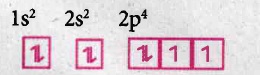
ஃ 8th electron present in 2px orbital and the quantum numbers are
n = 2,l = 1,m1 = either + 1 or -1 and s = -1/2
Electronic configuration of chlorine
.png)
15th electron present in 3Pz orbital and the quantum numbers are n = 3, l = 1, m1 = either +1 or -1 and ms = +1/2
8.
i) 25Mn - 1s2, 2S2, 2p6, 3s2, 3p6, 4s2, 3d5
23Mn2+ - 1s2, 2S2, 2p6, 3s2, 3p6, 3d5
ii) 24Cr - 1s2, 2S2,2p6, 3s2, 3p6, 4s1, 3d3
21Cr3+ - 1s2, 2S2,2p6, 3s2, 3p6, 3d3
9.
Erwin Schrodinger expressed the wave nature of electron in terms of a differential equation. This equation determines the change of wave function in space depending on the field of force in which the electron moves. The time independent Schrodinger equation can be expressed as,
\(\overset { \wedge }{ H } \psi =E\psi \) .........(1)
Where \(\overset { \wedge }{ H } \) is called Hamiltonian operator, \(\psi \) is the wave function and is a function of position coordinates of the particle and is denoted as \(\psi \) (x, y, z) E is the energy of the system
\(\overset { \wedge }{ H } =\left[ \frac { { -h }^{ 2 } }{ 8{ \pi }^{ 2 } } \left( \frac { { \partial }^{ 2 }\psi }{ { \partial x }^{ 2 } } +\frac { { \partial }^{ 2 }\psi }{ { \partial y }^{ 2 } } +\frac { { \partial }^{ 2 }\psi }{ { \partial z }^{ 2 } } \right) +V \right] \)
can be written as
\(\left[ \frac { { -h }^{ 2 } }{ 8{ \pi }^{ 2 }m } \left( \frac { { \partial }^{ 2 }\psi }{ { \partial x }^{ 2 } } +\frac { { \partial }^{ 2 }\psi }{ { \partial y }^{ 2 } } +\frac { { \partial }^{ 2 }\psi }{ { \partial z }^{ 2 } } \right) +V\Psi \right] =E\Psi \)
Multiply by \(\frac { 8{ \pi }^{ 2 }m}{ { -h }^{ 2 } } \)and rearranging
\(\frac { { \partial }^{ 2 }\psi }{ { \partial x }^{ 2 } } +\frac { { \partial }^{ 2 }\psi }{ { \partial y }^{ 2 } } +\frac { { \partial }^{ 2 }\psi }{ { \partial z }^{ 2 } } +\frac { 8{ \pi }^{ 2 }m }{ { -h }^{ 2 } } (E-V)\Psi =0\) ........(2)
The above Schrodinger wave equation does not contain time as a variable and is referred to as time independent Schrodinger wave equation. This equation can be solved only for certain values of E, the total energy. i.e. the energy of the system is quantised. The permitted total energy values are called eigen values and corresponding wave functions represent the atomic orbitals.
10.
d sub-shell has five orientations. Each orientation can accommodate one electron with spin quantum number +1/2 and another electron with -1/2 Hence number of electrons with s+1/2 in 'd' sub shell is 5.
11.
Magnetic quantum number accounts for the orientation of the electron in orbital.
12.
The electronic configuration of sulphur is 1s2 2s2 2p6 3s2 3p4
For 1s2, n,+ l = 1+ 0 = 1 ; For 2p6, n + 1 = 2 + 1 = 3
2s2, n + I = 2 + 0 = 2; For 3s2, n + I = 3 + 0 = 3
3p4, n + 1 = 3 + 1 = 4
Thus n + 1 = 3 for 2p6 electron and 3s2 electron = 8 electrons.
13.
(i) The last electron is the 'one' electron present in 'p' sub level.
i.e., n = 2; l = 1; m = -1,0 or + 1,s = + 1/2 or - 1/2
(ii) If the first electron present in 'p' subshell has the-following quantum numbers.
n = 3, l = 1, m = -1,0 (or) + 1, s = + 1/2,
the last electron has n = 3, l = 1, m = -1, 0 (or) + 1, s = - 1/2.
14.
a) Principal quantum number defines energy and size of an orbital.
b) Azimuthal quantum number defines shape of an orbital
c) Magnetic quantum number defines spatial orientation (direction) of an orbital.
15.
Energy electrons symmetry
This is due to the symmetrical distribution and exchange energy of given d- electrons. Symmetry leads to stability.
Exchange energy:
If two or more electrons with the same spin are present in degenerate orbitals, there is a possibility for exchanging their positions. During exchange process, the energy is released and the released energy is called exchange energy. If more number of exchanges are possible, more exchange energy in released. More number of exchanges are possible only in case of half filled and fully filled configurations.
For example, in chromium the electronic configuration is [Ar]3d5 4s1. The 3d orbital is half filled and there are ten possible exchanges as shown in figure. On the other hand only six exchanges are possible for [Ar]3d4 4s2 configuration. Hence, exchange energy for the half filled configuration is more. This increases the stability of half filled 3d orbitals.
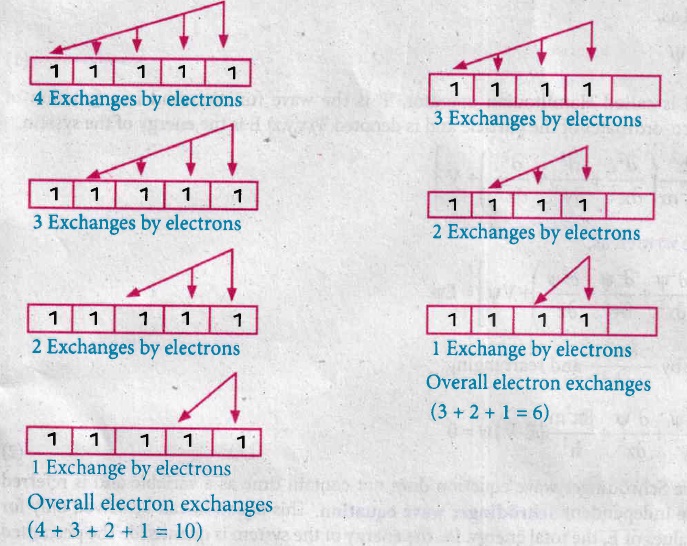
The exchange energy is the basis for Hund's rule, which allows maximum multiplicity, that is electron pairing is possible only when all the degenerate orbitals contain one electron each.
16.
The variation of the probability of locating the electron on a sphere with nucleus at its centre depends on the azimuthal quantum number of the orbital in which the electron is present.
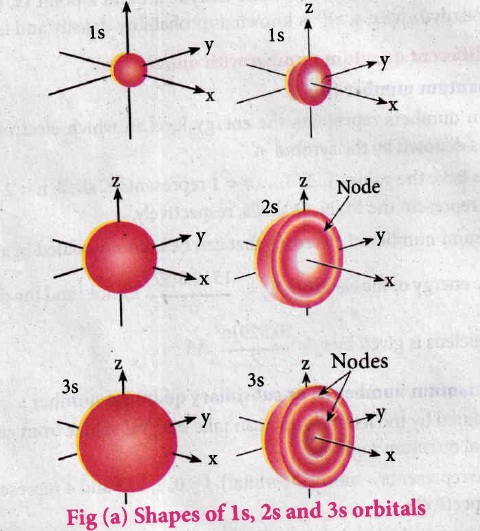
For 1s orbital, l = 0, m = 0,\(f(\theta)=\frac{1}{\sqrt 2}\)and \(g(\varphi)=\frac{1}{\sqrt 2\pi}\) Therefore, the angular distribution function is equal to \(\frac{1}{2\sqrt \pi }\)
i.e. it is independent of the angle \(\theta\) and \(\varphi\). Hence, the probability of finding the electron is independent of the direction from the nucleus. So, the shape of the s orbital is spherical.
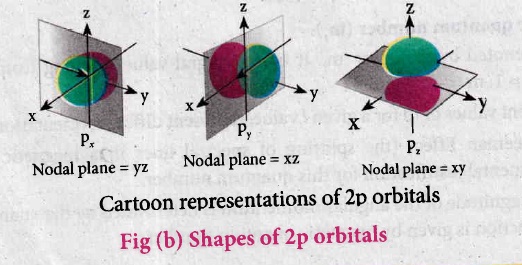
For p orbitals, l = 1 and the corresponding m values are -1, 0 and +1. The angular distribution functions are quite complex and are not discussed here, The shape of the p orbital is shown in Figure (b). The three different m values indicates that there are three different orientations possible for p orbitals. These orbitals are designated as Px, Py and Pz and the angular distribution for these orbitals shows that the lobes are along the x, y arid z axis respectively. As seen in the Figure the 2p orbitals have one nodal plane
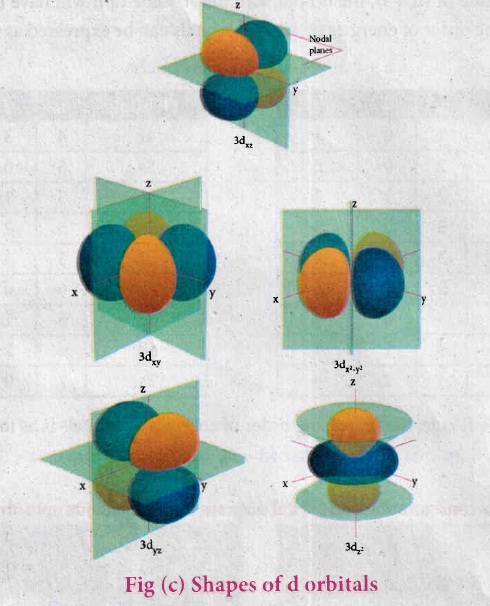
For 'd' orbital l = 2 and the corresponding m values are -2, -1, 0, +1, +2. The shape of the d orbital looks like a 'clover leaf'.
The five m values give rise to five d orbitals namely dxy, dyz, dzx, dx2-y2 and dz2. The 3d orbitals contain two nodal planes.
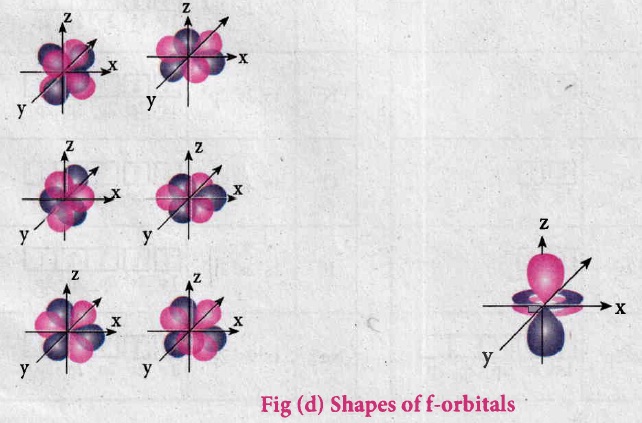
For 'f' orbital, l = 3 and the m values are -3, -2,-1,0, +1, +2, +3 corresponding to seven f orbitals. fz3, fxz2,fyz2,fxyz,fz(x2 - y2),fx(x2 - 3y2),fy(3x2 - y2) which are shown in Figure. There are 3 nodal planes in the f-orbitals.
17.
(i) Magnetic quantum number
1. It is denoted by the letter 'ml'. It takes integral values ranging from -I to +1 through 0. i.e. if l = 1; m = -1, 0 and +1.
2. The Zeeman Effect (the splitting of spectral lines in a magnetic field) provides the experimental justification for this quantum number.
3. The magnitude of the angular momentum is determined by the quantum number l while its direction is given by magnetic quantum number.
(ii) Spin quantum number
1. The spin quantum number represents the spin of the electron and is denoted by the letter 'ms'.
2. The electron in an atom revolves not only around the nucleus but also spins. It is usual to write this as electron spins about its own axis either in a clockwise direction or in anti-clockwise direction.
3. Corresponding to the clockwise and anti-clockwise spinning of the electron, maximum two values are possible for this quantum number.
4. The values of 'ms' is equal to \(-\frac{1}{2}\) and \(+\frac{1}{2}.\)
18.
m 160 g = 160 x 10-3 kg
\(v=140 km hr^{-1}=\frac{104\times10^{3}}{60\times60}ms^{-1}\)
\(v=38.88ms^{-1}\)
\(\lambda=\frac{h}{mv}\)
\(=\frac{6.626\times^{-34}Kgm^{2}s^{-1}}{160\times10^{-3}Kg\times38.88ms^{-1}}\)
\(\lambda=1.065\times10^{-34}m\)
19.
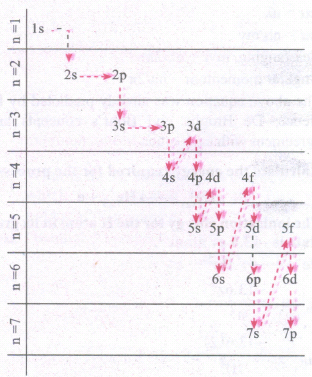
The word Aufbau in German means 'building up'. In the ground state of the atoms, the orbitals are filled in the order of their increasing energies. That is the electrons first occupy the lowest energy orbital available to them.
Once the lower energy orbitals are completely filled, then the electrons enter the next higher energy orbitals. The order of filling of various orbitals as per the Aufbau principle which is in accordance with (n + l) rule.

11th Standard Syllabus & Materials
11th Standard
TN 11th Tamil பீடு பெற நில் - செய்யுள் - காவடிச்சிந்து Important Questions And Answers Study Material - QB365 Set A
NEW11th Standard
TN 11th Tamil பீடு பெற நில் - உரைநடை - மலை இடப்பெயர்கள் : ஓர் ஆய்வு Important Questions And Answers Study Material - QB365 Set A
NEW11th Standard
TN 11th Tamil மாமழை போற்றுதும் - துணைப்பாடம் - யானை டாக்டர் Important Questions And Answers Study Material - QB365 Set A
NEW11th Standard
TN 11th Tamil மாமழை போற்றுதும் - செய்யுள் - ஐங்குறுநூறு Important Questions And Answers Study Material - QB365 Set A



Tamilnadu Stateboard 11th Standard Subjects

Maths

Commerce

Economics

Biology

Business Maths and Statistics

Accountancy

Computer Science

Physics
Chemistry
Maths
Biology
Economics
Physics
Chemistry

History
Business Maths and Statistics

Computer Science
Accountancy

Computer Applications
History
Computer Technology
Commerce
Computer Applications
Computer Technology

Tamil

English

French
Tamilnadu Stateboard Standards
