
 100% FREE ACCESS
11th Standard Syllabus & Materials
11th Standard
TN 11th Tamil இயற்கை வேளாண்மை,சுற்றுச்சூழல் -செய்யுள் - மனோன்மணீயம் Important Questions And Answers Study Material - QB365 Set A
NEW11th Standard
TN 11th Tamil என்னுயிர் என்பேன் -துணைப்பாடம் - இசைத்தமிழர் இருவர் Important Questions And Answers Study Material - QB365 Set A
NEW11th Standard
TN 11th Tamil மொழி கலை -செய்யுள் - ஒவ்வொரு புல்லையும் Important Questions And Answers Study Material - QB365 Set A
NEW11th Standard
TN 11th Tamil பீடு பெற நில் - இலக்கணம் - பகுபத உறுப்புகள் Important Questions And Answers Study Material - QB365 Set A
NEW11th Standard
TN 11th Tamil பீடு பெற நில் - துணைப்பாடம் - வாடிவாசல் Important Questions And Answers Study Material - QB365 Set A
NEW11th Standard
TN 11th Tamil பீடு பெற நில் - செய்யுள் - குறுந்தொகை Important Questions And Answers Study Material - QB365 Set A

Published on: 19/09/2019
Quantum Mechanical Model of Atom
Download Tamil Nadu 11th Standard Chemistry question papers, model tests, one-mark questions, important questions, and public exam papers in PDF format. Free study materials and answer keys for TN State Board students.
Questions + Answers key
Take MCQ Chemistry Test
1.
Mention the shape of s, p, d orbitals.
2.
How many orbitals are possible in the 3rd energy level?
3.
Explain how matter has dual character?
4.
Which is the actual configuration of Cr ( Z = 24). Why?
5.
The kinetic energy of a subatomic particle is 5.58 x 10⁻²⁵ J. Calculate the frequency of the particle wave. (Planck's constant h = 6.626 x 10⁻³⁴ kg m2 s-1)
6.
What is the angular momentum of an electron in
(i) 2s orbital
(ii) 4f orbital?
7.
The ground state electronic configurations listed below here are incorrect. Explain what mistakes have been made in each and correct the electronic configuration.
(i) Al = 1s2 2s2 2p4 3s2 3p6 .
(ii) B = 1s2 2s2 2p5
(iii) F = 1s2 2s2 2p5.
8.
Bring out the similarities and dissimilarities between a 1s and 2s orbital.
9.
What is the difference between atomic mass and mass number?
10.
What is the charge and mass of an electron?
11.
How many orbitals are possible for n = 4?
12.
The stabilisation of a half filled d - orbital is more pronounced than that of the p-orbital why?
13.
Give the electronic configuration of Mn2+ and Cr3+
14.
How fast must a 54g tennis ball travel in order to have a de Broglie wavelength that is equal to that of a photon of green light 5400\(\overset { 0 }{ A } \) ?
1.
Shape of s-orbital - sphere
Shape of p-orbital- dumb bell
Shape of d-orbital- clover leaf
2.
n = 3, main shell is m.
Total number of orbitals in 3rd energy level =?
| When n = 3 | l = 0 | 1 | 2 |
| Subshell | s | p | d |
| 3s |
3px, 3py, 3pz |
3dxz, 3dxy, 3dyz, 3dx2-y2,dz2 |
|
| 1 | 3 | 5 |
Total number of orbitals = 9.
3.
(i) Albert Einstein proposed that light has dual nature. i.e. like photons behave both like a particle and as a wave.
(ii) Louis de Broglie extended this concept and proposed that all forms of matter showed dual character.
(iii) He combined the following two equations of energy of which one represents wave character (hv) and the other represents the particle nature (mc2).
4.
Cr (Z = 24) 1s2 2s2 2p6 3s2 3p6 3d5 4s1.
The reason for this is, Cr with 3d5 configuration is half filled and it will be more stable.
Chromium has [Ar] 3d5 4s1 and not [Ar] 3d4 4s2 due to the symmetrical distribution and exchange energies of d electrons.
5.
KE = \(\frac{1}{2}\)mv2 = 5.85 x 10⁻²⁵ J
By de Broglie equation \(\lambda=\frac{h}{mv}\)
But \(\lambda=\frac{\nu}{V}=\frac{h}{mv}\)
v = \(\frac{mv^2}{h}=\frac{2\times 5.85\times 10^{-25}J}{6.026\times 10^{-34}J}\)
= 1.77 x 10⁹ s-1.
6.
Angular momentum of electron in any orbital = \(\sqrt{l(l+1)}\times\frac{h}{2\pi}\)
(i) for 2s orbital, l = 0
Therefore angular momentum = \(\sqrt{0(0+1)}\times\frac{h}{2\pi}=0\)
(ii) for 4f orbital, I = 3
Therefore angular momentum = \(\sqrt{3(3+1)}\times\frac{h}{2\pi}\)
= \(2\sqrt{3}\frac{h}{2\pi}\)
\(=\sqrt{3}\frac{h}{\pi}\)
7.
(i) In AI, 2p should be filled before filling 3s, orbital states.
\(\therefore\) correct electronic configuration is 1s2 2s2 2p6 3s2 2p1
(ii) In B, total electrons = 5. Electronic configuration is 1s2 2s2 2p1
(iii) In F, total electrons = 9. Electronic configuration is 1s2 2s2 2p5.
8.
Similarities:
(i) Both have similar shape.
(ii) Both have same angular momentum = \(\sqrt{l(l+1)} \frac{h}{2\pi}\)
Dissimilarities:
(i) Is orbital has no node while 2s orbital has one node.
(ii) Energy of 2s orbital is greater than Is orbital.
(iii) The size of the 2s orbital is larger than Is orbital.
9.
(i) Mass number is a whole number because it is the sum of number of protons and number of neutrons.
(ii) Atomic mass is fractional because it is the average relative mass of its atom as compared with mass of an atom of C-12 isotope taken as 12.
10.
The charge of an electron is 1.602 x 10⁻¹⁹ coulomb
The mass of an electron is 9.11 x 10⁻³¹ kg
11.
| n | l | m | orbitals | Total no of orbitals |
| 0 | 0 | 1 | (1- 4s +3 - 4P orbital +5 - 4d orbital +7 - 4f orbital) =16 |
|
| 4 | 1 | -1 0 +1 |
3 | |
| 2 |
-2 |
5 | ||
| 3 |
-3 |
7 |
12.
Energy electrons symmetry
This is due to the symmetrical distribution and exchange energy of given d- electrons. Symmetry leads to stability.
Exchange energy:
If two or more electrons with the same spin are present in degenerate orbitals, there is a possibility for exchanging their positions. During exchange process, the energy is released and the released energy is called exchange energy. If more number of exchanges are possible, more exchange energy in released. More number of exchanges are possible only in case of half filled and fully filled configurations.
For example, in chromium the electronic configuration is [Ar]3d5 4s1. The 3d orbital is half filled and there are ten possible exchanges as shown in figure. On the other hand only six exchanges are possible for [Ar]3d4 4s2 configuration. Hence, exchange energy for the half filled configuration is more. This increases the stability of half filled 3d orbitals.
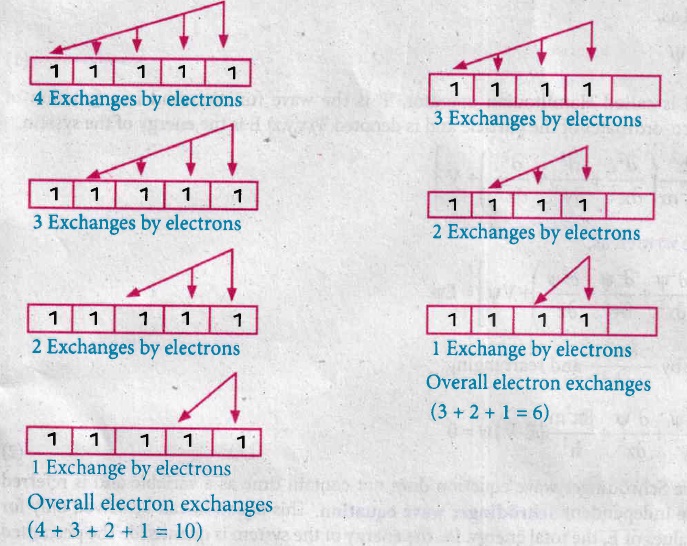
The exchange energy is the basis for Hund's rule, which allows maximum multiplicity, that is electron pairing is possible only when all the degenerate orbitals contain one electron each.
13.
i) 25Mn - 1s2, 2S2, 2p6, 3s2, 3p6, 4s2, 3d5
23Mn2+ - 1s2, 2S2, 2p6, 3s2, 3p6, 3d5
ii) 24Cr - 1s2, 2S2,2p6, 3s2, 3p6, 4s1, 3d3
21Cr3+ - 1s2, 2S2,2p6, 3s2, 3p6, 3d3
14.
De Broglie wavelength of the tennis ball equal to 5400 \(\overset { 0 }{ A } \).
m = 54 g
V = ?
\(\lambda=\frac{h}{mV}\)
\(V=\frac{h}{m\lambda}\)
\(\mathrm{v}=\frac{6.626 \times 10^{-34} \mathrm{JS}}{54 \times 10^{-3} \mathrm{~kg} \times 5400 \times 10^{-10} \mathrm{~m}}=2.27 \times 10^{-26} \mathrm{~ms}^{-1}\)

11th Standard Syllabus & Materials
11th Standard
TN 11th Tamil பீடு பெற நில் - செய்யுள் - காவடிச்சிந்து Important Questions And Answers Study Material - QB365 Set A
NEW11th Standard
TN 11th Tamil பீடு பெற நில் - உரைநடை - மலை இடப்பெயர்கள் : ஓர் ஆய்வு Important Questions And Answers Study Material - QB365 Set A
NEW11th Standard
TN 11th Tamil மாமழை போற்றுதும் - துணைப்பாடம் - யானை டாக்டர் Important Questions And Answers Study Material - QB365 Set A
NEW11th Standard
TN 11th Tamil மாமழை போற்றுதும் - செய்யுள் - ஐங்குறுநூறு Important Questions And Answers Study Material - QB365 Set A



Tamilnadu Stateboard 11th Standard Subjects

Maths

Commerce

Economics

Biology

Business Maths and Statistics

Accountancy

Computer Science

Physics
Chemistry
Maths
Biology
Economics
Physics
Chemistry

History
Business Maths and Statistics

Computer Science
Accountancy

Computer Applications
History
Computer Technology
Commerce
Computer Applications
Computer Technology

Tamil

English

French
Tamilnadu Stateboard Standards
