
 100% FREE ACCESS
11th Standard Syllabus & Materials
11th Standard
TN 11th Tamil இயற்கை வேளாண்மை,சுற்றுச்சூழல் -செய்யுள் - மனோன்மணீயம் Important Questions And Answers Study Material - QB365 Set A
NEW11th Standard
TN 11th Tamil என்னுயிர் என்பேன் -துணைப்பாடம் - இசைத்தமிழர் இருவர் Important Questions And Answers Study Material - QB365 Set A
NEW11th Standard
TN 11th Tamil மொழி கலை -செய்யுள் - ஒவ்வொரு புல்லையும் Important Questions And Answers Study Material - QB365 Set A
NEW11th Standard
TN 11th Tamil பீடு பெற நில் - இலக்கணம் - பகுபத உறுப்புகள் Important Questions And Answers Study Material - QB365 Set A
NEW11th Standard
TN 11th Tamil பீடு பெற நில் - துணைப்பாடம் - வாடிவாசல் Important Questions And Answers Study Material - QB365 Set A
NEW11th Standard
TN 11th Tamil பீடு பெற நில் - செய்யுள் - குறுந்தொகை Important Questions And Answers Study Material - QB365 Set A

Published on: 17/01/2020
Download Tamil Nadu 11th Standard Chemistry question papers, model tests, one-mark questions, important questions, and public exam papers in PDF format. Free study materials and answer keys for TN State Board students.
Questions + Answers key
Take MCQ Chemistry Test
1.
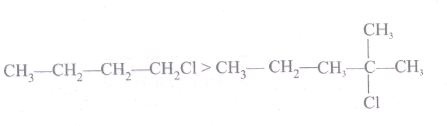
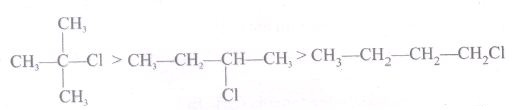
Identify the correct order of boiling point of halo alkanes?
CH3-CH2-CH2-CH2CI>(CH3)3C-CI > CH3-CH2-\(\underset { \overset { | }{ Cl } }{ CH } \)-CH3
CH3-CH2-CH2-CH2CI>CH3-CH2-\(\underset { \overset { | }{ Cl } }{ CH } \)-CH3< (CH3)3C-CI
2.
Molecular formula of benzene is ________.
C6H6
C6H5
C7H8
CH4
3.
Which one of the following has least acidic character ?
HCOOH
CH3COOH
CH2CICOOH
CCl3COOH
4.
Which of the following has see saw shape?
PCI5
IO2F-2
SOF4
ClO-3
5.
The isomer of ethanol is ____________
acetaldehyde
dimethylether
acetone
methyl carbinol
6.
The KH for the solution of oxygen dissolved in water is 4\(\times\)104 atm at a given temperature. If the partial pressure of oxygen in air is 0.4 atm, the mole fraction of oxygen in solution is ________
4.6\(\times\)103
1.6\(\times\)104
1\(\times\)10-5
1\(\times\)105
7.
[Co(H2O)6]2+ (aq) (pink) + 4Cl– (aq) ⇌ [CoCl4]2– (aq) (blue) + 6 H2O (l)
In the above reaction at equilibrium, the reaction mixture is blue in colour at room temperature. On cooling this mixture, it becomes pink in colour. On the basis of this information, which one of the following is true?
ΔH > 0 for the forward reaction
ΔH = 0 for the reverse reaction
ΔH < 0 for the forward reaction
Sign of the ΔH cannot be predicted based on this information
8.
The oxidation number of fluorine in all its compounds is equal to ______________.
-1
+1
-2
+2
9.
Pressure of a gas is equal to __________.
\(\frac{F}{a}\)
F x a
\(\frac{a}{F}\)
F - a
10.
Consider the following statements.
(i) Alkali metals exhibit high chemical reactivity due to their low ionization energy.
(ii) Lithium is a very soft metal and even it can be cut with a knife.
(iii) Francium is a radioactive element in group 1 elements
Which of the above statements is/are not correct?
(i) only
(ii) only
(i) and (iii)
(i), (ii) and (iii)
11.
Match the list-I and list-II using the correct code given below the list.
| List-I | List -II | ||
| A. | Jewels | 1. | 1.Sodium chloride |
| B. | Bolts and cot | 2. | Copper |
| C. | Table salt | 3. | Gold |
| D. | Utensils | 4. | Iron |
| A | B | C | D |
| 3 | 4 | 1 | 2 |
| A | B | C | D |
| 4 | 1 | 3 | 2 |
| A | B | C | D |
| 1 | 4 | 2 | 3 |
| A | B | C | D |
| 2 | 3 | 4 | 1 |
12.
The enthalpies of formation of Al2O3 and Cr2O3 are -1596 kJ and -1134 kJ, respectively. ΔH for the reaction 2Al + Cr2O3 ⟶ 2Cr + Al2O3 is _______________
- 1365 kJ
2730 kJ
- 2730 kJ
- 462 kJ
13.
Which of the following does not represent the mathematical expression for the Heisenberg uncertainty principle?
\(\triangle x.\triangle p\ge \frac { h }{ 4\pi } \)
\(\triangle x.\triangle v\ge \frac { h }{ 4\pi m } \)
\(\triangle E.\triangle t\ge \frac { h }{ 4\pi } \)
\(\triangle E.\triangle x\ge \frac { h }{ 4\pi } \)
14.
Non-stoichiometric hydrides are formed by _____________
palladium, vanadium
carbon, nickel
manganese, lithium
nitrogen, chlorine
15.
Carry over the following reaction mechanisms.
(i) Bromination of alkene
(ii) Addition of HCN to CH3CHO
(iii) Formation of alkyl bromide with benzoyl peroxide as radical initiator.
16.
Mention the standards prescribed by BIS for quality of drinking water.
17.
0.24 g of a gas dissolves in 1 L of water at 1.5 atm pressure. Calculate the amount of dissolved gas when the pressure is raised to 6.0 atm at constant temperature.
18.
Explain graphical representation of Gay Lussac's law.
19.
Give a brief account of covalent hydrides.
20.
Balance the following reaction:
S2O32- + I2\(\rightarrow\)S2O62- + I-
21.
The equilibrium constant of a reaction is 10, what will be the sign of ΔG? Will this reaction be spontaneous?
22.
Justify that the fifth period of the periodic table should have 18 elements on the basis of quantum numbers.
23.
Starting from methyl magnesium iodide, how would you prepare
(i) Ethyl methyl ether
(ii) methyl cyanide
(iii) methane
24.
Explain about sp hybridisation with suitable example.
25.
0.24g of an organic compound gave 0.287 g of silver chloride in the carius method. Calculate the percentage of chlorine in the compound.
26.
An alkali metal (A) belongs to period number II and group number I react with oxygen to form (B). (A) reacts with water to form (C) with liberation of hydrogen compound (D).Identify A, B, C and D.
27.
Balance the following equations by oxidation number method.
K2Cr2O7 + HI ⟶ KI + Crl3 + H2O + I2
28.
If an electron is moving with a velocity 600 ms-1 which is accurate upto 0.005%, then calculate the uncertainty in its position. (h = 6.63 x 10⁻³⁴ Js. mass of electron = 9.1 x 10⁻³¹ kg)
29.
Calculate the heat of glucose and its calorific value from following data:
(i) C(graphite)+O2(g) ➝ CO2(g); ΔH= -395 KJ
(ii) H2(g)+\(\frac{1}{2}\)O2 ➝ H2O(l); ΔH= -269.4 KJ
(iii) C+6H2(g)+3O2(g) ➝ C6H12O6(s); ΔH= -1169.8 KJ
30.
Calculate the effective nuclear charge experienced by the 4s electron in potassium atom.
31.
An isotope of hydrogen (A) reacts with diatomic molecule of element which occupies group number 16 and period number 2 to give compound (B) is used as a moderator in nuclear reaction. (A) adds on to a compound ( C), which has the molecular formula C3H6 to give (D). Identify A, B, C and D.
32.
State and explain pauli exclusion principle.
33.
Indicate the \(\sigma\) and \(\pi\) bonds in the following molecules.
C6H6, CH2CI2, CH3NO2, CH2 = C = CH2
34.
Discuss the aromatic nucleophilic substitutions reaction of chlorobenzene.
35.
Give IUPAC names for the following compounds
CH3 – CH = CH – CH = CH – C ≡ C – CH3
36.
For a given reaction at a particular temperature, the equilibrium constant has constant value. Is the value of Q also constant? Explain.
37.
The bond dissociation energies of gaseous chlorine, hydrogen, and hydrogen chloride are 104, 58, and 103 k.cal mol-1 respectively. Calculate the enthalpy of formation of HCI(g). Predict in which of the following, entropy increases/decreases. - 2NaHCO3(s) \(\rightarrow\)Na2CO3(s) + CO2(g) + H2O(s)
38.
Calculate the equivalent mass of the following - Sodium Hydroxide
39.
Why are the airplane cabins artificially pressurized?
40.
Why sodium hydroxide is much more water soluble than chloride ?
41.
Explain what is meant by efflorescence.
42.
The stabilisation of a half filled d - orbital is more pronounced than that of the p-orbital why?
43.
Assertion (A) : Excessive use of chlorinated pesticide causes soil and water pollution.
Reason (R) : Such pesticides are non-biodegradable.
i) Both (A) and R are correct and (R) is the correct explanation of (A)
ii) Both (A) and R are correct and (R) is not the correct explanation of (A)
iii) Both (A) and R are not correct
iv) (A) is correct but( R) is not correct
Both (A) and R are correct and (R) is the correct explanation of (A)
Both (A) and R are correct and (R) is not the correct explanation of (A)
Both (A) and R are not correct
(A) is correct but( R) is not correct
1.
(c)
2.
(a)
C6H6
3.
(b)
CH3COOH
4.
(b)
IO2F-2
5.
(b)
dimethylether
6.
(c)
1\(\times\)10-5
7.
(a)
ΔH > 0 for the forward reaction
8.
(a)
-1
9.
(a)
\(\frac{F}{a}\)
10.
(b)
(ii) only
11.
(a)
| A | B | C | D |
| 3 | 4 | 1 | 2 |
12.
(d)
- 462 kJ
13.
(d)
\(\triangle E.\triangle x\ge \frac { h }{ 4\pi } \)
14.
(a)
palladium, vanadium
15.
(i) Brominatin of alkene to give bromo alkane.
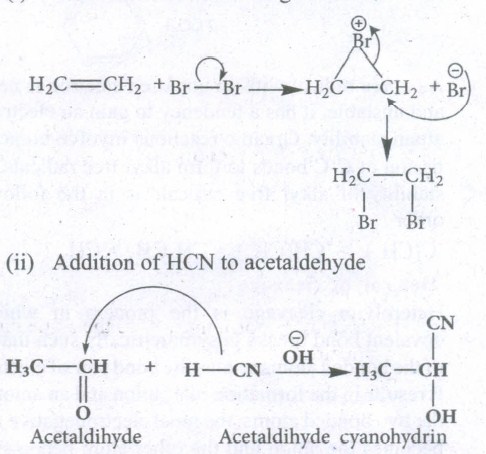
(iii) In this reaction, benzoyl peroxide acts as a radical initiator. The mechanism involves free radicals.
\({ H }_{ 2 }C=CH+H-Br\overset { \overset { Benzoyl }{ Peroxide } }{ \longrightarrow } C{ H }_{ 3 }-C{ H }_{ 2 }-Br\)
16.
Standard characteristics of drinking water.
| S.No | Characteristics | Desirable limit |
|---|---|---|
| I | Physico-chemical Characteristics | |
| i) | pH | 6.5 to 8.5 |
| ii) | Total Dissolved Solids (TDS) | 500ppm |
| iii) | Total Hardness (as CaCO3) | 300 ppm |
| iv) | Nitrate | 45ppm |
| v) | Chloride | 250ppm |
| vi) | Sulphate | 200ppm |
| vii) | Fluoride | 1 ppm |
| II | Biological Characteristics | |
| i) | Escherichia Coli (E.Coil) | Not at all |
| ii) | Coliforms | Not to exceed 10 (In 100 ml water sample) |
17.
Psolute = KH Xsolute in solution
At pressure 1.5 atm,
p1 = KH x1 ------(1)
At pressure 6.0 atm,
p2 = KH x2 -----(2)
Dividing equation (1) by (2)
From equation p1/p2 = x1/x2
1.5/6.0 = 0.24/x2
Therefore x2 = 0.24 x 6.0/1.5 = 0.96 g/L.
18.
Gay Lussac's law:
At constant volume, the pressure of a fixed mass of a gas is directly proportional .to temperature.
\(P\propto T\) (or) \(P\over T\) = Constant
It can be graphically represented as shown here:
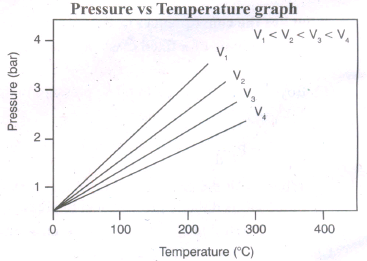
Lines in the pressure vs temperature graph are known as isochores ( constant volume) of a gas.
19.
Covalent hydrides are compounds in which hydrogen is attached to another element by sharing of electrons. Covalent hydrides are further divided into three categories, viz., electron precise (CH4, C2H6, SiH4, GeH4), electron-deficient (B2H6) and electron-rich hydrides (NH3, H2O).
Since most of the covalent hydrides consist of discrete, "Small molecules that have relatively weak intermolecular forces, they are generally gases or volatile liquids.
20.
S2O32-+I2\(\rightarrow\)S2O62-+I-
.png)
Equalise the increase/decrease in O.N by multiplying the S species by 1 and I species by 3.
S2O32-+I2\(\rightarrow\)S2O62-+3I-
Balance all other atoms except 0 and H
S2O32-+3I2\(\rightarrow\)S2O62-+6I-
Balance 0 atom by adding H20 on the side falling short of Oxygen.
S2O32-+3I2+3H2O\(\rightarrow\)S2O62-+6I-
Balance H atom by adding H+ ion on the side falling short of hydrogen.
S2O32-+3I2+3H2O\(\rightarrow\)S2O62-+6I- + 6H+
Add the equal number of OH- ion on both side since the medium is alkaline
S2O32-+3I2+3H2O + 6OH-\(\rightarrow\)S2O62-+6I- + 6H+ + 60H-
S2O32-+3I2+3H2O + 6OH-\(\rightarrow\)S2O62-+6I- + 6H2
21.
Given Keq= 10
Gas constant R = 8.314 JK-1 mol-1
T=300K
The relationship between Free energy change ΔG and equilibrium constant K is ΔGo=-RTlnK
Since K, T and R are positive values, ΔGo will be negative.
When ΔG is -ve, the process is spontaneous and feasible
22.
(i) According to aufbau's principle 5th period has nine orbital (one 5s, five 4d and three 6p) to be filled.
(ii) Nine orbitals can accommodate a maximum of 18 electrons. Hence fifth period of the periodic table should has 18 elements from rubidium (2 = 37) to Xenon (Z = 54).
23.
(i) Ethyl methyl ether: Lower halogenated ether reacts with grignard reagent to form higher ether.
\(\underset { Chloro\quad dim\quad ether }{ { CH }_{ 3 }O-{ CH }_{ 2 }Cl } +\underset { Methyl\quad magnesium\\ iodide }{ { CH }_{ 3 }Mgl } \longrightarrow \underset { Ethyl\quad methyl\quad ether }{ { CH }_{ 3 }-O-{ CH }_{ 2 }-{ CH }_{ 3 } } \)
(ii) Methyl cyanide: Grignard reagent reacts with cyanogen chloride to form alkyl cyanide.

(iii) Methane: Grignard reagent reacts with water to give methane as product.

24.
(i) Bond formation in Beryllium chloride takes place by sp hybridisation.
(ii) The valence shell of Beryllium has the electronic configuration as follows:
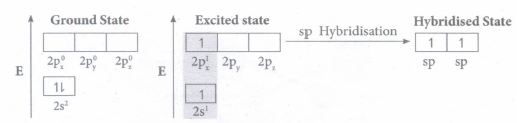
(iii) In BeCl2 both the Be-Cl bonds are equivalent and it was observed that the molecule is linear. VB theory explains this observed behaviour by sp hybridisation. One of the paired electrons in the 2s orbital gets excited to 2p orbital.
(iv) Now the 2s and 2p orbitals hybridise and produce two equivalent sp hybridised orbitals which have 50% s-character and 50% p-character. These sp hybridised orbitals are oriented in opposite direction.
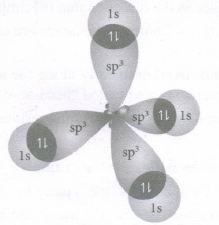
(v) Each of the sp hybridised orbitals linearly overlap with Pz orbital of the chlorine to form a covalent bond between Be and CI atoms as follow.
25.
w = 0.24g and a = 0.287 g
\(
\% \mathrm{Cl} =\frac{35.5}{143.5} \times \frac{\mathrm{a}}{\mathrm{w}} \times 100
\)
\(=\frac{35.5}{143.5} \times \frac{0.287}{0.24} \times 100=.29 .42 \%\)
26.
(i) An alkali metal (A) belongs to period number II and group number I is lithium.
(ii) Lithium reacts with oxygen to form simple oxide lithium oxide (B).
\(4Li + O_2 ⟶ \underset{Lithium\ oxide (B)}{2Li_2O}\)
(iii) Lithium reacts with water to form lithium hydroxide with liberation of hydrogen.
\(2Li + 2H_2O ⟶ \underset{Lithium\ hydroxide (C)}{2LiOH + H_2}\)
(iv) Lithium directly react with carbon to form an ionic compound lithium carbide.
\(2Li + 2C ⟶ \underset{Lithium\ carbide}{Li_2C_2}\)
| A | Lithium | Li |
| B | Lithium oxide | Li2O |
| C | Lithium hydroxide | LiOH |
| D | Lithium carbide | Li2C2 (kindly insert a table) |
27.
Step - 1 : To find atoms undergoing change in O.N.
K2Cr2O7 + HI ⟶ KI + Crl3 + H2O + I2
Step - 2 : To find the total increase and decrease in O.N.
K2Cr2O7 + CrI3 (decrease of 3 unit / atom = Total decrease = 6 units / 2 atom)
HI ⟶ I2 (increase of 1 unit / atom = total increase 1 x 6 = 6)
Step - 3 : To balance the total increase and decrease in O.N, multiply HI by 6.,
K2Cr2O7 + 6 HI ⟶ KI + Crl3 + H2O + I2
Step - 4 : To balance all atoms other than '0' and 'H'
K2Cr2O7 + 6 HI ⟶ 2KI + 2Crl3 + H2O + 3I2
This makes 14 iodine atoms on RHS. (These iodide ions do not undergo any change in O.N). Hence to balance the iodine atoms add 8HI to LHS.
i.e., K2Cr2O7 + 14 HI ⟶ 2KI + 2CrI3 + H2O + 3I2
These, the oxygen atoms are balanced by making 7H2O as RHS.
K2Cr2O7 + 14 HI ⟶ 2KI + 2CrI3 + 7H2O + 3I2
The hydrogen atoms are balanced by themselves.
Hence the balanced equation is
K2Cr2O7 + 14HI ⟶ 2KI + 2Crl3 + 7H2O + 3I2
28.
Velocity of the electron = 600 ms-1
Uncertainty in velocity = \(\frac{0.005}{100}\times 600 ms^{-1}\)
= 0.03 ms-1
= 3 x 10⁻² ms-1
Now, ( \(\Delta\)x) (m \(\Delta\) v) = \(\frac{h}{4\pi}\)
\(\therefore \Delta x=\frac{h}{4\pi.m.\Delta v}\)
= \(\frac{6.626\times 10^{-34}kgm^2 s^{-1}}{4\times 3.14\times 9.1\times10^{-31}kg\times 3\times 10^{-2}ms^{-1}}\)
= 1.93 x 10⁻³ m.
29.
The required equation is
C6H12O6(s)+6O2(g) ➝ 6CO2(g)+6H2O(l)
(i) C(graphite)+O2(g) ➝ CO2(g); ΔH= -395.0 KJ
(ii) H2(g)+\(\frac{1}{2}\)O2(g) ➝ H2O(l); ΔH= -269.4 KJ
(iii) 6C(graphite)+6H2(g)+3O2(g) ➝ C6H12O6(s); ΔH= -1169.8 KJ
Multiply equation (i) and (ii) by 6 and add them up
(iv) 6C(graphite)+6H2(g)+9O2(g) ➝ 6CO2(g)+6H2O(l) ; ΔH= -3984.6 KJ
Subtracting equation (iii) from (iv)
C6H12O6(s)+6O2(g) ➝ 6CO2(g)+6H2O(l) ΔH= -2816.6 KJ
∴ Enthalpy of combustion of glucose = -2816.6 KJ.
30.
The electronic configuration of K atom is
K19 = (1s2)(2s2p6)(3s23p6)4s1
Effective nuclear charge (Z*) = Z - S
Z* = 19 - [(0.85 \(\times\) No. of electrons in (n -1)th shell) + (1.00 total number of electrons in the inner shells)]
= 19-[0.85 \(\times\) (8) + (1.00 \(\times\) 10)]
Z* = 2.20
31.
The element which occupies group number (16) and period number (2) is oxygen. (B) is D2O which is used as a moderator in nuclear reactions.
So (A) must be deuterium, which is an isotope of hydrogen
\(2\underset { (A) }{ { D }_{ 2 } } +{ O }_{ 2 }\rightarrow 2\underset { (B) }{ { D }_{ 2 }O } \)
So (B) is D2O
(A) adds to (C) as follows :
\(3 \mathrm{D}_{2}+\mathrm{C}_{3} \mathrm{H}_{6} \rightarrow \mathrm{CH}_{3}-\mathrm{CH}-\mathrm{CH}_{2}\)
So (D) is 1,2 - dideutero propane.
| A | D2 | Deuterium |
| B | D2O | Heavy water or deuterium oxide |
| C | CH3-CH = CH2 | Propene |
| D | CH3 - CHD - CH2D | Propane deuteride |
32.
Statement : "No two electrons in an atom can have the same set of values of all four quantum numbers"
Explanation : It means that, each electron must have unique values for the four quantum numbers (n, l, m and s).
For the lone electron present in hydrogen atom, the four quantum numbers are: n = 1; l = 0; m = 0 and s = +1/2. For the two electrons present in helium, one electron has the quantum numbers same as the electron of hydrogen atom, n = 1.
l = 0, m = 0 and s = +1/2. For other electron, the fourth quantum number is different i.e., n = 1, l = 0, m = 0 and s = -1/2.
As we know that the spin quantum number can have only two values +1/2 and - 1/2, only two electrons can be accommodated in a given orbital in accordance with pauli exclusion principle.
| Atom | e- | n | l | m | s |
| Helium | First | 1 | 0 | 0 | +1/2 |
| Second | 1 | 0 | 0 | +1/2 |
33.
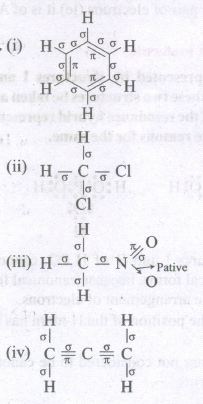
34.
Halo arenes do not undergo nucleophilic substitution reaction readily is due to C-X bond in aryl halide is short and strong and also the aromatic ring isa centre of high electron density.
The halogen of haloarenes can be substituted by OH-, NH2-, or CN- with appropriate nucleophilic reagents at high temperature and pressure.
35.

36.
The equilibrium constant is a constant and it is for equilibrium condition. But 'Q', the reaction quotient is not a constant as it is for non - equilibrium condition. 'Q' is the ratio of the product of active masses of a reaction products raised to the respective stoichiometric coefficients in the balanced chemical equation to that of the reactants, under non - equilibrium conditions.
i) If Q = Kc; it is equilibrium
ii) If Q > Kc.; the reaction will proceed in reverse direction
iii) If Q < Kc ; the reaction will proceed in forward direction
37.
In the reaction 2NaHCO3(s) \(\rightarrow\) Na2CO3(s) +CO2(g) + H2O(g) the number of gaseous components increase and hence entropy of the system will increase.
38.
Molar Mass of NaOH = 23 + 16 + 1 = 40
Acidity = 1
Equivalent Mass = \(\frac { Molar\ mass }{ acidity } =\frac { 40 }{ 1 } =40geq^{ -1 }\)
39.
The pressure decreases with the increase in altitude because there are fewer molecules per unit volume of air. Above 9200 m (30000 ft.) the pressure is so low that one could pass out for lack of oxygen. For this reason most airplanes cabins are artificially pressurized.
40.
The solubility product of NaCl is lower than that of NaOH. The more soluble a substance is, the higher the Ksp value it has In aqueous solution NaOH gives OH- ions. It can be solvated by establishing H-bonds with water molecules. So it is more water soluble.
41.
Efflorescence is the spontaneous loss of water by a hydrated salt, which occurs when the aqueous vapor pressure of the hydrate is greater than the partial pressure of the water vapour in the air. This is the property of salts
Ex: Glauber's salt- Na2SO4·10H2O
Epsom salt - MgSO4·7H2O
42.
Energy electrons symmetry
This is due to the symmetrical distribution and exchange energy of given d- electrons. Symmetry leads to stability.
Exchange energy:
If two or more electrons with the same spin are present in degenerate orbitals, there is a possibility for exchanging their positions. During exchange process, the energy is released and the released energy is called exchange energy. If more number of exchanges are possible, more exchange energy in released. More number of exchanges are possible only in case of half filled and fully filled configurations.
For example, in chromium the electronic configuration is [Ar]3d5 4s1. The 3d orbital is half filled and there are ten possible exchanges as shown in figure. On the other hand only six exchanges are possible for [Ar]3d4 4s2 configuration. Hence, exchange energy for the half filled configuration is more. This increases the stability of half filled 3d orbitals.
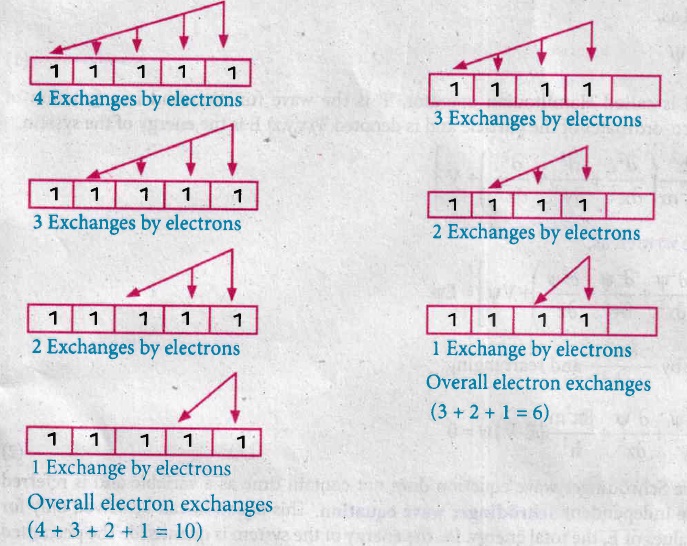
The exchange energy is the basis for Hund's rule, which allows maximum multiplicity, that is electron pairing is possible only when all the degenerate orbitals contain one electron each.
43.
i) Both (A) and R are correct and (R) is the correct explanation of (A)

11th Standard Syllabus & Materials
11th Standard
TN 11th Tamil பீடு பெற நில் - செய்யுள் - காவடிச்சிந்து Important Questions And Answers Study Material - QB365 Set A
NEW11th Standard
TN 11th Tamil பீடு பெற நில் - உரைநடை - மலை இடப்பெயர்கள் : ஓர் ஆய்வு Important Questions And Answers Study Material - QB365 Set A
NEW11th Standard
TN 11th Tamil மாமழை போற்றுதும் - துணைப்பாடம் - யானை டாக்டர் Important Questions And Answers Study Material - QB365 Set A
NEW11th Standard
TN 11th Tamil மாமழை போற்றுதும் - செய்யுள் - ஐங்குறுநூறு Important Questions And Answers Study Material - QB365 Set A



Tamilnadu Stateboard 11th Standard Subjects

Maths

Commerce

Economics

Biology

Business Maths and Statistics

Accountancy

Computer Science

Physics
Chemistry
Maths
Biology
Economics
Physics
Chemistry

History
Business Maths and Statistics

Computer Science
Accountancy

Computer Applications
History
Computer Technology
Commerce
Computer Applications
Computer Technology

Tamil

English

French
Tamilnadu Stateboard Standards
