
 100% FREE ACCESS
11th Standard Syllabus & Materials
11th Standard
TN 11th Tamil இயற்கை வேளாண்மை,சுற்றுச்சூழல் -செய்யுள் - மனோன்மணீயம் Important Questions And Answers Study Material - QB365 Set A
NEW11th Standard
TN 11th Tamil என்னுயிர் என்பேன் -துணைப்பாடம் - இசைத்தமிழர் இருவர் Important Questions And Answers Study Material - QB365 Set A
NEW11th Standard
TN 11th Tamil மொழி கலை -செய்யுள் - ஒவ்வொரு புல்லையும் Important Questions And Answers Study Material - QB365 Set A
NEW11th Standard
TN 11th Tamil பீடு பெற நில் - இலக்கணம் - பகுபத உறுப்புகள் Important Questions And Answers Study Material - QB365 Set A
NEW11th Standard
TN 11th Tamil பீடு பெற நில் - துணைப்பாடம் - வாடிவாசல் Important Questions And Answers Study Material - QB365 Set A
NEW11th Standard
TN 11th Tamil பீடு பெற நில் - செய்யுள் - குறுந்தொகை Important Questions And Answers Study Material - QB365 Set A

Published on: 14/12/2019
Solutions
Download Tamil Nadu 11th Standard Chemistry question papers, model tests, one-mark questions, important questions, and public exam papers in PDF format. Free study materials and answer keys for TN State Board students.
Questions + Answers key
Take MCQ Chemistry Test
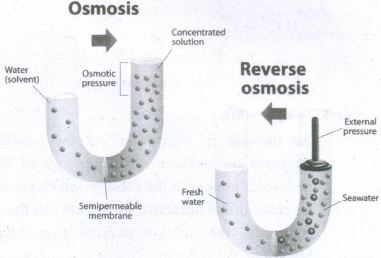
1.
The normality of 10% weight/volume) acetic and is ____________
1 N
10 N
1.7 N
0.83 N
2.
For a non-electrolytic solution ____________
i =+ve
i = -ve
i = 0
i = 1
3.
For associative solutes ____________
i < 1 and a < 1
i > 1 and a >. 1
i < 1 and a < 1
i > 1 and a < 1
4.
A sample of toothpaste weighting 500g, on analysis was found to contain 0.2g of fluorine. The concentration of fluorine in ppm is ____________
4\(\times\)103
4\(\times\)102
4\(\times\)10
2\(\times\)102
5.
Vapour pressure is the pressure exerted by vapours ____________
in equilibrium with liquid
in any condition
in an open system
in atmospheric conditions
6.
What are non-ideal solution? Give example.
7.
Define mole fraction of a component in a solution ?
8.
Define formality.
9.
Write a short note on Van't Hoff equation
10.
State Raoult's law
11.
Mention the significances of osmotic pressure over other colligative properties ?
12.
Caiculate the molefraction of each component in a mixture containing 40 mass percent of toluene in CHCI3
13.
Discuss the significances of osmotic-pressure over other colligative properties.
14.
How does the change in temperature, pressure, and concentration causes deviation from' ideal behaviour ?
15.
Distinguish between ideal and non-ideal solution
16.
(I) Define Solubility
(ii) Explain about the factors that influences the solubility
17.
(I) Define solution.
(il) E plain the types of solutions with suitable example.
18.
Calculate the percent by mass of NaC lif 1.75 g of NaCI is dissolved in 7.85 g of water.
19.
Write note on reverse osmosis and explain its application in desalination of sea water.
1.
(c)
1.7 N
2.
(d)
i = 1
3.
(a)
i < 1 and a < 1
4.
(b)
4\(\times\)102
5.
(a)
in equilibrium with liquid
6.
(i) The solutions which do not obey Raoult's law over the entire range of concentration are called non-ideal solutions. The deviation of the non-ideal solution from the Raoult's law may be positive (or) negative.
(ii) Example, Ethyl alcohol and cyclohexane.
7.
It is the ratio of the number of moles of a component to the total number of moles of all the components present in a solution.
\(\text { Mole fraction of a components }=\frac{\text { No. of moles of the components }}{\text { Total no. of moles of all the components present in a solution } }\)
\(\mathrm{X}_{\mathrm{A}}=\frac{\mathrm{n}_{\mathrm{A}}}{\mathrm{n}_{\mathrm{A}}+\mathrm{n}_{\mathrm{B}}}\).
8.
It is the ratio nurnber of formula weight of a solute to the volume of the solution in litres.
\(\text { Formality }=\frac{\text {No.of formula weight of the solute }}{\text { Volume of the solution in } \mathrm{L}}\)
9.
Van't Hoff found out that for dilute solutions, the osmotic pressure is directly proportional to the molar concentration ofthe solute and the temperature of the solution. He proposed the following equation to calculate osmotic pressure which is now called as van't Hoff equation.
\(\pi\) = cRT
Here,
c = Concentration of the solution in molarity
T = Temperature
R = Gas constant
10.
This law states that "in the case of a solution of volatile liquids, the partial vapour pressure of each component (A & B) of the solution is directly proportional to its mole fraction".
According to Raoult's law,
PA \(\alpha\) XA
PA = K XA
when XA = 1, K p p0
where p0 A is the vapour pressure of pure component 'A' at the same temperature.
Therefore, pA = \({ p }_{ A }^{ 0 }x_{ A }\)
11.
(i) Unlike elevation of boiling point and the depression in freezing point, the magnitude of osmotic pressure is large.
(ii) The osmotic pressure can be measured at room temperature enables to determine the molecular mass ofbiomolecules which are unstable at higher temperature.
(iii) Even for a very dilute solution, the osmotic pressure is large.
12.
Mass of toluene = 40g; Mol mass of toluene = 92
Mass of CHCl3 = 60g; Mol. mass ofCHCl3 = 119.3
No.of moles of toluene = \(\frac { 40 }{ 92 } \) = 0.4347
No.of. moles of CHCl3 = \(\frac { 60 }{ 119.3 } \)
= 0.5029
Total moles 0.4347 + 0.5029 = 0.9376
Mole fraction of toluene = \(\frac { 0.4347 }{ 0.9376 } \)
0.4636
Mole fraction of CHCl3 - \(\frac { 0.5029 }{ 0.9376 } \)
= 0.5363
13.
Unlike elevation of boiling point (for 1 molal solution the elevation in boiling point is 0.512°C for water) and the depression in freezing point (for 1 molal solution the depression in freezing point is . 1.86°C for water), the magnitude of osmotic pressure is large.
The osmotic pressure can be measured at room temperature enables to determine the molecular mass of biomolecules which are unstable at higher temperatures.
Even for a very dilute solution, the osmotic pressure is large
14.
(i) An increase in temperature of the solution increases the average kinetic energy of the molecules present in the solution which causes decrease in the attractive force between them.
(ii) At high pressure the molecules tend to stay close to each other and therefore there will be an increase in their intermolecular attraction.
(iii) When the concentration is increased by adding solute, the solvent-solute interaction becomes significant.
15.
| S.No | Ideal Solution | Non - Ideal Solution |
|---|---|---|
| i | A solution in which the solute and solvent obeys Raoult's law over the entire range of concentration. | These solutions do not obey do not obeyRaoult's law over the entire range of concentrations |
| ii |
For an ideal solution |
For non-ideal solution, \(\triangle\)Vmixing \(\neq \) 0 \(\triangle\)Hmixing \(\neq \) 0 |
| iii | Does not shows any deviation from Raoult's law. | Shows positive and negative deviation from Raoult's law |
| iv | Eg : Benzene & toulene | Eg : Benzene & acetone. |
16.
(i) The solubility of a substance at a given temperature is defined as the amount of the solute that can be dissolved in 100 g of the solvent at a given temperature to form a saturated solution.
(ii) Factors influencing solubility
(a) Nature of solute and solvent: Sodium chloride, an ionic compound readily dissolves in polar solvent such as water but it does not dissolve in non polar solvent such as benzene. Most of the organic compounds dissolve in organic solvent and do not dissolve in water.
(b) Effect of temperature: Generally, the solubility of a solid solute in a liquid solvent increases with increase in temperature. The dissolution of NaCI does not vary as the maximum solubility is achieved at normal temperature. The dissolution of ammonium nitrate is endothermic, the solubility increases with increase in temperature. The dissolution of eerie sulphate is exothermic and the solubility decreases with increase of temperature.
In the case of gaseous solute in liquid solvent the solubility decreases with increase in temperature.
Effect of pressure: Generally the change in pressure does not have any significant effect in the solubility of solids and liquids as they are not compressible. However, the solubility of gases generally increases with increase of pressure.
17.
(i) solution is a homogeneous mixture of two or more substances, consisting of atoms, ions or molecules.
(ii) Types and examples of solution.
| S.No. | State of solutio | Solute | Solvent | Example |
| 1. | Gaseous solution | Solid | Gas | Camphor in nitrogen |
| Liquid | Gas | Humid oxygen (Oxygen containing w | ||
| Gas | Gas | Air (A mixture of nitrogen, oxygen and other gases) | ||
| 2. | Liquid solution | Solid | Liquid | Salt water |
| Liquid | Liquid | Ethanol dissolved in water | ||
| Gas | Liquid | CO2 dissolved in water (carbonated water) | ||
| 3. | Solid solution | Solid | Solid | Gold alloy (of copper used in making Jewellery |
| Liquid | Solid | Amalgam of potassium (used for dental filling) | ||
| Gas | Solid | Solution of H2 in palladium |
18.
Mass Percentage of NaCl
= \(\frac { Mass\ of\ NaCl }{ Total\ Mass\ of\ the\ solution } \times 100\)
= \(\frac { 1.75 }{ 1.75+7.88 } =\frac { 1.75 }{ 9.6 } \) = 18.2 %
19.
Let us consider the experimental setup discussed in the osmosis. The pure water moves through the semipermeable membrane to the NaCl solution due to osmosis. is process can be reversed by applying pressure greater than the osmotic pressure to the solution side. Now the pure water moves from the solution side to the solvent side and this process is called reverse osmosis. It can be defined as a process in which a solvent passes through a semipermeable membrane in the .opposite direction of osmosis, when subjected to a hydrostatic pressure greater than the osmotic pressure.
Applications of Reverse osmosis in water purication:
Reverse osmosis is used in the desalination of sea .water and also in the purication of drinking water. A simple set up used in both the process is shown in the figure. When a pressure higher than the osmotic pressure is applied on the solution sided (sea water) the water molecules moves from solution side to the solvent side through semi-permeable membrane (Opposite to the Osmotic flow). The pure water can be collected are different types of semi-permeable membranes used in this process. The membrane used for reverse osmosis has to withstand high pressures. Generally, cellulose acetate or polyamide membranes are commonly used in commercial systems. The selection of membrane used for reverse osmosis will be decided based on the nature of the input water.

11th Standard Syllabus & Materials
11th Standard
TN 11th Tamil பீடு பெற நில் - செய்யுள் - காவடிச்சிந்து Important Questions And Answers Study Material - QB365 Set A
NEW11th Standard
TN 11th Tamil பீடு பெற நில் - உரைநடை - மலை இடப்பெயர்கள் : ஓர் ஆய்வு Important Questions And Answers Study Material - QB365 Set A
NEW11th Standard
TN 11th Tamil மாமழை போற்றுதும் - துணைப்பாடம் - யானை டாக்டர் Important Questions And Answers Study Material - QB365 Set A
NEW11th Standard
TN 11th Tamil மாமழை போற்றுதும் - செய்யுள் - ஐங்குறுநூறு Important Questions And Answers Study Material - QB365 Set A



Tamilnadu Stateboard 11th Standard Subjects

Maths

Commerce

Economics

Biology

Business Maths and Statistics

Accountancy

Computer Science

Physics
Chemistry
Maths
Biology
Economics
Physics
Chemistry

History
Business Maths and Statistics

Computer Science
Accountancy

Computer Applications
History
Computer Technology
Commerce
Computer Applications
Computer Technology

Tamil

English

French
Tamilnadu Stateboard Standards
