
 100% FREE ACCESS
11th Standard Syllabus & Materials
11th Standard
TN 11th Tamil இயற்கை வேளாண்மை,சுற்றுச்சூழல் -செய்யுள் - மனோன்மணீயம் Important Questions And Answers Study Material - QB365 Set A
NEW11th Standard
TN 11th Tamil என்னுயிர் என்பேன் -துணைப்பாடம் - இசைத்தமிழர் இருவர் Important Questions And Answers Study Material - QB365 Set A
NEW11th Standard
TN 11th Tamil மொழி கலை -செய்யுள் - ஒவ்வொரு புல்லையும் Important Questions And Answers Study Material - QB365 Set A
NEW11th Standard
TN 11th Tamil பீடு பெற நில் - இலக்கணம் - பகுபத உறுப்புகள் Important Questions And Answers Study Material - QB365 Set A
NEW11th Standard
TN 11th Tamil பீடு பெற நில் - துணைப்பாடம் - வாடிவாசல் Important Questions And Answers Study Material - QB365 Set A
NEW11th Standard
TN 11th Tamil பீடு பெற நில் - செய்யுள் - குறுந்தொகை Important Questions And Answers Study Material - QB365 Set A

Published on: 21/09/2019
Download Tamil Nadu 11th Standard Chemistry question papers, model tests, one-mark questions, important questions, and public exam papers in PDF format. Free study materials and answer keys for TN State Board students.
Questions + Answers key
Take MCQ Chemistry Test
1.
The correct order of decreasing electronegativity values among the elements X, Y, Z and A with atomic numbers 4, 8, 7 and 12 respectively __________
Y > Z > X > A
Z > A > Y > X
X > Y > Z > A
X > Y > A > Z
2.
The correct order of electron gain enthalpy with negative sign of F, Cl, Br and I having atomic number 9, 17, 35 and 53 respectively is _____________
I > Br > Cl > F
F > Cl > Br > I
Cl > F > Br > I
Br > I > Cl > F
3.
The characteristic feature of orderly arrangement of molecules belongs to ______________.
Solids
Liquid
Gases
None of these
4.
RbO2 is _____________
superoxide and paramagnetic
peroxide and diamagnetic
superoxide and diamagnetic
peroxide and paramagnetic
5.
The value of the gas constant R is ____________
0.082 dm3 atm.
0.987 cal mol-1K-1
8.3 J mol-1 K-1
8 erg mol-1 K-1
6.
The maximum number of electrons in a sub shell is given by the expression _____________
2n2
2l + 1
4l + 2
none of these
7.
Tritium nucleus contains _____________
1 p+0 n
2 p+1 n
1 p + 2 n
none of these
8.
An element X has the following isotopic Composition 200X = 90%, 199X = 8% and 202X = 2%. The Weighted average atomic mass of the element X is closest to _________.
201 u
202 u
199 u
200 u
9.
Define modern periodic law.
10.
State the first law of thermodynamics.
11.
Why sodium hydroxide is much more water soluble than chloride ?
12.
Discuss the three types of Covalent hydrides.
13.
What are state and path functions? Give two examples
14.
How many moles of ethane is required to produce 44 g of CO2(g) after combustion.
15.
For each of the following, give the sub level designation, the allowable m values and the number of orbitals
(i) n = 4, l = 2
(ii) n = 5, l = 3
(iii) n = 7, l = 0
16.
How is plaster of paris prepared ?
17.
Give the uses of heavy water?
18.
Distinguish between oxidation and reduction.
19.
Mention any two anomalous properties of second period elements.
20.
A gas mixture of 3.67 lit of ethylene and methane on complete combustion at 25°C and at 1 atm pressure produce 6.11 lit of carbon dioxide . Find out the amount of heat evolved in kJ, during this combustion. (ΔHc(CH4)= - 890 kJ mol-1 and (ΔHc(C2H4) = -1423 kJ mol-1
21.
List the characteristics of internal energy.
22.
The reaction between aluminium and ferric oxide can generate temperatures up to 3273 K and is used in welding metals. (Atomic mass of Al = 27 u atomic mass of O = 16 u )
2Al + Fe2O3 \(\longrightarrow \) Al2O3 + 2Fe; If in this process, 324 g of aluminum is allowed to react with 1.12 kg of ferric oxide
i) Calculate the mass of Al2O3 formed
ii) How much of the excess reagent is left at the end of the reaction ?
23.
Describe the Aufbau principle
24.
Distinguish between diffusion and effusion.
25.
Explain the diagonal relationship.
1.
(a)
Y > Z > X > A
2.
(c)
Cl > F > Br > I
3.
(a)
Solids
4.
(a)
superoxide and paramagnetic
5.
(c)
8.3 J mol-1 K-1
6.
(c)
4l + 2
7.
(c)
1 p + 2 n
8.
(d)
200 u
9.
The modem periodic law states that, "the physical and chemical properties of the elements are periodic functions of their atomic numbers."
10.
The first law of thermodynamics, also known as the law of conservation of energy, states that "The total energy of an isolated system remains constant though it may change from one form to another."
The mathematical statement of the First Law is: ΔU=q+w
Where q - the amount of heat supplied to the system; w - work done on the system
11.
The solubility product of NaCl is lower than that of NaOH. The more soluble a substance is, the higher the Ksp value it has In aqueous solution NaOH gives OH- ions. It can be solvated by establishing H-bonds with water molecules. So it is more water soluble.
12.
a) Electron-precise hydrides:
These have required number of electron to represent their conventional d lewis structure. All the elements of carbon group (14) form such hydrides.
Eg CH4, C2H6, SiH4, GeH4
b) Electron - deficient hydrides:
There act as Lewis acids (ie) electron acceptors. The elements from group (13) form such hydrides.
Eg: B2H6
c) Electron - rich hydrides:
There have excess electron, which are present as lone pairs. Elements of group 15-17 form such hydrides. They behave as Lewis bases (ie) electron donors.
Eg: NH3 ,H2O, HF
13.
(i) State function: A state function is a thermodynamic property of a system, which has a specific value for a given state and does not depend on the path (or manner) by which the particular state is reached.
Example: Pressure (P), Volume (V), Temperature(T)
(ii) Path functions: A path function is a thermodynamic property of the system whose value depends on the path by which the system changes from its initial to final states.
Example: Work (w), Heat (q).
14.
The balanced equation for the combustion of ethane
C2H6 + \(\frac { 7 }{ 2 } \)O2 \(\longrightarrow \) 2CO2 +3H2O
2C2H6 + 7O2 \(\longrightarrow \) 4CO2 + 6H2O
To produce 4 moles of CO2, 2 moles of ethane is required
To produce 1 moles (44 g) of CO2 required
Number of moles of ethane
\(=\frac{2 \mathrm{~mol} \text { ethane }}{4 \not \mathrm{molCO}_{2}} \times 1 \not \mathrm{molCO}_{2}\)
= \(\frac { 1 }{ 2 } mole\quad of\quad ethane\)
= 0.5 mole of ethane
15.
| n | 1 | Sub Energy | m1values | Number of orbitals |
| 4 | 2 | 4d | -2,-1,0+1,+2 | Five 4d orbitals |
| 5 | 3 | 5f | -3,-2,-1,0,+1,+2,+3, | seven 5f orbitals |
| 7 | 0 | 7s | 0 | one 7s orbitals |
16.
Calcium Sulphate (plaster of paris), CaSO4. 1/2H2O :
It is a hemihydrate of calcium sulphate. It is obtained when gypsum, CaSO4 .2H2O,is heated to 393 K
2(CaSO4.2H2O) ⟶ 2CaSO4,H2O + 3H2O
Above 393 K, no water of crystallisation is left and anhydrous calcium sulphate, CaSO4 is formed. This is a known 'dead burnt plaster'.
It has a remarkable property of setting with water. on mixing with an adequate quantity of water it forms a plastic mass that gets into hard solid in 5 to 15 minutes.
17.
1. Heavy water is widely used as moderator in nuclear reactors as it can lower the energies of fast neutrons
2. It is commonly used as a tracer to study organic reaction mechanisms and mechanism of metabolic reactions
3. It is also used as a coolant in nuclear reactors as it absorbs the heat generated.
18.
| Oxidation | Reduction | |
| 1. | Addition of oxygen | Addition of Hydrogen |
| 2. | Removal of Hydrogen | Removal of oxygen |
| 3. | Addition of an electronegative element. | Addition of an electro positive element |
| 4. | Removal of an electro positive element | Removal of an electro negative element |
| 5. | Loss of electron | Gain of electron |
| 6. | Increase in oxidation state / number | Decrease in oxidation state/ number. |
19.
(i) Lithium and beryllium form more covalent compounds, unlike the alkali and alkali earth metals which predominantly form ionic compounds.
(ii) The elements of the second period have only four orbitals (2s & 2p) in the valence shell and have a maximum co-valence of 4, whereas the other members of the subsequent periods have more orbitals in their valence shell and shows higher valences. For example, boron forms BF4- and aluminium forms AIF63-.
20.
ΔHc(CH4)= - 890 kJ mol-1
ΔHc(C2H4) = -1423 kJ mol-1
ΔHc=-203.87 kJ mol-1
Let the mixture contain x lit of CH4 and (3.67 - x)
lit of ethylene
CH4+2O2\(\rightarrow \)2CO2+2H2O
XLit
C2H4+3O2\(\rightarrow \)2CO2+2H2O
(3.67-X)Lit 2(3.67-X)Lit
Volume of Carbondioxide formed
=x + 2 (3.67 - x) = 6.11 lit
X+7.34-2X=6.11
7.34-X=6.11
X=1.23Lit
Given mixture contains 1.23 lit of methane and 2.44 lit of ethylene, hence
\(\triangle { H }_{ C }=\left[ \frac { \triangle { H }_{ C }\left( { CH }_{ 4 } \right) }{ 22.4Lit } \times \left( X \right) lit \right] +\left[ \frac { \triangle { H }_{ C }\left( { C }_{ 2 }{ H }_{ 4 } \right) }{ 22.4lit } \times \left( 3.67-X \right) lit \right] \)
\(\triangle { H }_{ C }=\left[ \frac { -890KJ{ mol }^{ -1 } }{ 22.4Lit } \times 1.23lit \right] +\left[ \frac { -1423 }{ 22.4lit } \times \left( 3.67-1.23 \right) lit \right] \)
ΔHc =[-48.87kJ mol-1]+[-155kJ mol-1]
ΔHc =-203.87kJ mol-1 .
21.
Characteristics of internal energy (U) :
22.
2Al + Fe2O3 \(\longrightarrow \) Al2O3 + 2Fe
| Reactants | Products | |||
| Al | Fe2O3 | Al2O3 | Fe | |
| Amount of reactant allowed to react | 324 g | 1.12 kg | - | - |
| Number of moles allowed to react | \(\frac { 324 }{ 27 } =12mol\) | \(\frac { 1.12\times { 10 }^{ 3 } }{ 160 } =7mol\) | - | - |
| Stoichiometric Co-efficient | 2 | 1 | 1 | 2 |
| Number of moles consumed during reaction | 12 mol | 6 mol | - | - |
| Number of moles of reactant unreacted and number of moles of product formed | - | 1 mol | 6 mol | 12 mol |
Molar mass of Al2O3 format = 6 mol x 102 g mol-1 = 612 g
[ Al2O3 : (2 x 27) + 3(16) = 54 + 48 = 102] = 612 g
Excess reagent = Fe2O3
Amount of excess reagent left at the end of the reaction = 1 mol x 160 g mol-1
= 160g [ Fe2O3 : (2 x 56) + (3 x 16) = 112 + 48 = 160] = 160 g
23.
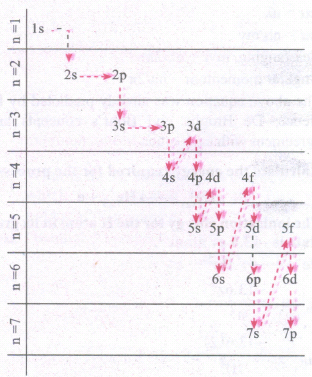
The word Aufbau in German means 'building up'. In the ground state of the atoms, the orbitals are filled in the order of their increasing energies. That is the electrons first occupy the lowest energy orbital available to them.
Once the lower energy orbitals are completely filled, then the electrons enter the next higher energy orbitals. The order of filling of various orbitals as per the Aufbau principle which is in accordance with (n + l) rule.
24.
| S.NO | diffusion | effusion |
| 1 | It is the spreading of molecules of a substance throughout a space or second substance | It is the escape of the gas molecules through a very small hole (orifice) in a membrane into an evacuated area. |
| 2 | It is typically used to describe statistical properties of a gas at length scales that are much larger than mean free path. | The diameter of the hole should be smaller than mean free path of the molecules. |
| 3 | It is the spreading of gases. | It is the pouring out of gases. |
25.
On moving diagonally across the periodic table, the second and third period elements show certain similarities. It is quite pronounced in the following pair of elements.

The similarity in properties existing between the diagonally placed elements is called diagonal relationship.

11th Standard Syllabus & Materials
11th Standard
TN 11th Tamil பீடு பெற நில் - செய்யுள் - காவடிச்சிந்து Important Questions And Answers Study Material - QB365 Set A
NEW11th Standard
TN 11th Tamil பீடு பெற நில் - உரைநடை - மலை இடப்பெயர்கள் : ஓர் ஆய்வு Important Questions And Answers Study Material - QB365 Set A
NEW11th Standard
TN 11th Tamil மாமழை போற்றுதும் - துணைப்பாடம் - யானை டாக்டர் Important Questions And Answers Study Material - QB365 Set A
NEW11th Standard
TN 11th Tamil மாமழை போற்றுதும் - செய்யுள் - ஐங்குறுநூறு Important Questions And Answers Study Material - QB365 Set A



Tamilnadu Stateboard 11th Standard Subjects

Maths

Commerce

Economics

Biology

Business Maths and Statistics

Accountancy

Computer Science

Physics
Chemistry
Maths
Biology
Economics
Physics
Chemistry

History
Business Maths and Statistics

Computer Science
Accountancy

Computer Applications
History
Computer Technology
Commerce
Computer Applications
Computer Technology

Tamil

English

French
Tamilnadu Stateboard Standards
