
 100% FREE ACCESS
11th Standard Syllabus & Materials
11th Standard
TN 11th Tamil இயற்கை வேளாண்மை,சுற்றுச்சூழல் -செய்யுள் - மனோன்மணீயம் Important Questions And Answers Study Material - QB365 Set A
NEW11th Standard
TN 11th Tamil என்னுயிர் என்பேன் -துணைப்பாடம் - இசைத்தமிழர் இருவர் Important Questions And Answers Study Material - QB365 Set A
NEW11th Standard
TN 11th Tamil மொழி கலை -செய்யுள் - ஒவ்வொரு புல்லையும் Important Questions And Answers Study Material - QB365 Set A
NEW11th Standard
TN 11th Tamil பீடு பெற நில் - இலக்கணம் - பகுபத உறுப்புகள் Important Questions And Answers Study Material - QB365 Set A
NEW11th Standard
TN 11th Tamil பீடு பெற நில் - துணைப்பாடம் - வாடிவாசல் Important Questions And Answers Study Material - QB365 Set A
NEW11th Standard
TN 11th Tamil பீடு பெற நில் - செய்யுள் - குறுந்தொகை Important Questions And Answers Study Material - QB365 Set A

Published on: 03/08/2018
Based on the Term I syllabus, the model question paper is prepared. In this question paper, it covers the important one mark, two, three marks and five marks question.
The chapters covered in this question paper
1. Basic Concepts of Chemistry and Chemical Calculations
2. Quantum Mechanical Model of Atom
3.Periodic Classification of Elements
Download Tamil Nadu 11th Standard Chemistry question papers, model tests, one-mark questions, important questions, and public exam papers in PDF format. Free study materials and answer keys for TN State Board students.
Questions + Answers key
Take MCQ Chemistry Test
1.
In which of the following reactions, hydrogen peroxide acts as an oxidising agent?
I2+ H2O2 + 20H- \(\longrightarrow\) 21- + 2H2O + O2
PbS + 4H2O2 \(\longrightarrow\) PbSO4 + 4H2O
2MnO4-+ 3H2O2 \(\longrightarrow\) 2MnO2 + 3O2 + 2H2O + 2OH-
HOCl + H2O2 \(\longrightarrow\) H2O+ + Cl- + O2
2.
The change in the oxidation number of S in H2S and SO2,in the following industrial reaction:
2H2S(g) + SO2(g) \(\longrightarrow\) 3S(s) + H2O(g)
-2 to 0, +4 to 0
-2 to 0, +4 to -1
-2 to -1, +4 to 0
-2 to -1, +4 to -2
3.
4.
Which of the following contain same number of carbon atoms as in 6 g of carbon-12?
7.5 g ethane
8 g methane
both (a) and (b)
none of these
5.
The oxidation number of Cr in Cr2O72- _______ is
+6
-6
+7
-7
6.
Which one of the following represents 180 g of water ?
5 Moles of water
90 moles of water
\(\frac { 6.022\times { 10 }^{ 23 } }{ 180 } \) molecules of water
6.022\(\times\)1024molecules of water
7.
The number of water molecules in a drop of water weighing 0.018 g is ________.
6.022\(\times\)1026
6.022\(\times\)1023
6.022\(\times\)1020
9.9 \(\times\)1022
8.
An element X has the following isotopic composition 200X = 90%, 199X = 8% and 202X = 2%. The weighted average atomic mass of the element X is closest to _________.
201 u
202 u
199 u
200 u
9.
40 ml of methane is completely burnt using 80 ml of oxygen at room temperature The volume of gas left after cooling to room temperature is _______.
40 ml CO2 gas
40 ml CO2 gas and 80 ml H2O gas
60 ml CO2 gas and 60 ml H2O gas
120 ml CO2 gas
10.
Explain how matter has dual character?
11.
A microscope using suitable photons is employed to locate an electron in an atom within a distance of 0.1\(\overset { o }{ A } \) What is the uncertainty involved in the measurement of its velocity.
12.
The kinetic energy of a subatomic particle is 5.58 x 10⁻²⁵ J. Calculate the frequency of the particle wave. (Planck's constant h = 6.626 x 10⁻³⁴ kg m2 s-1)
13.
Calculate the wave length of an electron (mass = 9.1 x 10⁻³¹ kg) moving with 'a velocity of 103 ms-1 (h = 6.6 x 10⁻³⁴ kg m2 sec-1).
14.
Bring out the similarities and dissimilarities between a 1s and 2s orbital.
15.
Why Pauli exclusion principle is called exclusion principle?
16.
How many neutrons and protons are there in the Following nuclei?
\(_{ 6 }^{ 13 }{ C }\),\(_{ 2 }^{ 18 }{ O }\).\(_{ 12}^{ 24}{ Mg }\),\(_{26 }^{ 56}{ Fe }\),\(_{ 88}^{ 38}{ Sr }\)
17.
What are the defects of Rutherford's model?
18.
Write a note on Thomson's plum pudding model of an atom.
19.
Calculate the molar mass of the following compounds.
Sulphuric Acid [H2 SO4]
20.
Calculate the empirical and molecular formula of a compound containing 32% carbon, 4% hydrogen and rest oxygen. Its vapour density is 75.
21.
Explain about the factors that influence the ionization enthalpy.
22.
Balance the following equations by oxidation number method.
KBr + MnO2 + H2SO4 ⟶ KHSO4 + MnSO4 + H2O + Br2
23.
Light of wavelength 12818 \(\overset { o }{ A } \) is emitted when the electron of a hydrogen atom drops from 5th to 3rd orbit. Find the wavelength of a photon emitted when the electron falls from 3rd to 2nd orbit.
24.
Arrange the elements silver, Zinc and copper in the order of their decreasing electron releasing tendency and justify your arrangement with an appropriate experiment.
25.
Write note on combination reaction.
26.
Calculate the molar mass of 20 L of gas weighing 23.2 g at STP.
27.
Calculate the molar volume of 146 g of HCI gas and the number of molecules present in it
28.
Balance the following reaction:
H2C2O4+KMnO4 + H2SO4 \(\rightarrow\) H2SO4 + MnSO4 + CO2 + H2O
29.
A piece of cut apple becomes brown. Why? Can you prevent it by a simple method
30.
1.05 g of a metal gives on oxidation 1.5 g of its oxide. Calculate its equivalent mass.
31.
Write down the formulae for calculating the equivalent mass of an acid, base and oxidizing agent.
32.
Write a note on the differences between elements and compounds
33.
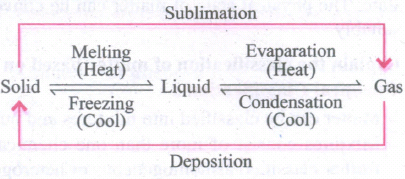
Matter is defined as anything that has mass and occupies space. All matter is composed of atoms
34.
Explain classification of elements based on Newlands law of Octaves.
35.
Describe in brief Lothar Meyer's classification of elements.
1.
(b)
PbS + 4H2O2 \(\longrightarrow\) PbSO4 + 4H2O
2.
(a)
-2 to 0, +4 to 0
3.
(a)
4.
(c)
both (a) and (b)
5.
(a)
+6
6.
(d)
6.022\(\times\)1024molecules of water
7.
(c)
6.022\(\times\)1020
8.
(d)
200 u
9.
(a)
40 ml CO2 gas
10.
(i) Albert Einstein proposed that light has dual nature. i.e. like photons behave both like a particle and as a wave.
(ii) Louis de Broglie extended this concept and proposed that all forms of matter showed dual character.
(iii) He combined the following two equations of energy of which one represents wave character (hv) and the other represents the particle nature (mc2).
11.
Given \(\Delta\)x = 0.1 or 0.1 x 10⁻¹⁰ m or 10-11 m.
h = 6.626 x 10⁻³⁴ kg m2 s-1, m = 9.11 x 10⁻³¹ kg
According to uncertainty principle,
\(\Delta x,m(\Delta v)=\frac{h}{4\pi}\)
i.e., \(\Delta v=\frac{h}{4\pi\times m\times \Delta x}\)
= \(\frac{6.626\times 10^{-34}kg m^2 s^{-1}}{4\times 3.14\times 9.11\times 10^{-31}kg \times 10^{-11}m}\)
= 5.79 x 10⁶ ms-1.
12.
KE = \(\frac{1}{2}\)mv2 = 5.85 x 10⁻²⁵ J
By de Broglie equation \(\lambda=\frac{h}{mv}\)
But \(\lambda=\frac{\nu}{V}=\frac{h}{mv}\)
v = \(\frac{mv^2}{h}=\frac{2\times 5.85\times 10^{-25}J}{6.026\times 10^{-34}J}\)
= 1.77 x 10⁹ s-1.
13.
Given m = 9.1 x 10⁻³¹ kg; v = 103 ms-1
h = 6.6 x 10⁻³⁴ kg m2 sec-1
\(\lambda=\frac{h}{mv}=\frac{6.6\times 10^{-34}kgm^2 sec^{-1}}{9.1\times 10^{-31}kg\times 10^3 ms^{-1}}\)
= 7.25 x 10⁻⁷ m.
14.
Similarities:
(i) Both have similar shape.
(ii) Both have same angular momentum = \(\sqrt{l(l+1)} \frac{h}{2\pi}\)
Dissimilarities:
(i) Is orbital has no node while 2s orbital has one node.
(ii) Energy of 2s orbital is greater than Is orbital.
(iii) The size of the 2s orbital is larger than Is orbital.
15.
This is because, according to this principle, if one electron of an atom has same particular values, for the four quantum numbers, then all the other electrons in that atom are excluded from having the same set of values.
16.
| Nucleus | Atomic Number (Z) | Mass Number (A) | Number of protons =Z | Number of Neutrons =A-Z |
| \(_{ 6 }^{ 13 }{ C }\) | 6 | 13 | 6 | 13 - 6 = 7 |
| \(_{ 2 }^{ 18 }{ O }\) | 8 | 16 | 8 | 16 - 8 = 8 |
| \(_{ 12}^{ 24}{ Mg }\) | 12 | 24 | 12 | 24 - 12 = 12 |
| \(_{26 }^{ 56}{ Fe }\) | 26 | 56 | 26 | 56 - 26 = 30 |
| \(_{ 88}^{ 38}{ Sr }\) | 38 | 88 | 38 | 88 - 38 = 50 |
17.
According to J. C. Maxwell, whenever an electron is subjected to acceleration, it emits radiation and loses energy. As a result of this, its orbit should become smaller and smaller and finally it should drop into the nucleus by following a spiral path. This means that atom would collapse and thus Rutherford's model failed to explain stability of atoms. Another drawback of the Rutherford's model is that it gives no information about the electronic structure of an atom.
18.
According to this theory, atom was assumed to consist of a sphere of uniform distribution of about 10-10 m positive charge with electrons embedded in it such that the number of electrons equal to the number of positive charges and the atom as a whole is electrically neutral.
19.
Mol. mass = 2(H) + 1(S) + 4(O)
= 2(1) + 1(32) + 4(16)
= 2 + 32 + 64 = 98
20.
| Elements | Percentage | Atomic mass | Relative No. of atoms |
Simple ratio of atoms | Simplest whole number ratio |
| C | 32% | 12 | \({32\over 12}=2.666\) | \({2.666\over 2.666}=1\) | 1x2=2 |
| H | 4% | 1 | \({4\over 1}=4\) | \({4\over 2.666}=1.5 or \ {3\over 2}\) | \({3\over 2} \times 2=3\) |
| O | 64% | 16 | \({64\over 16}=4\) | \({4\over 2.666}=1.5 or \ {3\over 2}\) | \({3\over 2} \times 2=3\) |
Empirical formula = C2H3O3
Empirical formula mass = 24 + 3 + 48 = 75
Molecular mass = 2 x Vapour density
= 2 x 75 = 150
n = \({Molecular \ mass \over Empirical \ formula \ mass }={150\over 75}=2\)
Molecular formula = (Empirical formula)n
\(\therefore\) Molecular formula = C2H3O3 x 2
Molecular formula = C4H6O6
21.
Factors influencing ionization enthalpy:
(i) Size of the atom:
If the size of an atom is larger, the outermost electron shell from the nucleus is also larger and hence the outermost electrons experience lesser force of attraction. Hence it would be more easy to remove an electron from the outermost shell. Thus, ionization energy decreases with increasing atomic sizes.
Ionization enthalpy \(\infty{1\over Atomic \ size}\)
(ii) Magnitude of nuclear charge:
As the nuclear charge increases, the force of attraction between the nucleus and valence electrons also increases. So, more energy is required to remove a valence electron. Hence I.E increases with increase in nuclear charge.
Ionization enthalpy \(\alpha \ nuclear \ charge\)
(iii) Screening or shielding effect of the inner electrons:
The electrons of inner shells form a cloud of negative charge and this shields the outer electron from the nucleus. This screen reduces the coulombic attraction between the positive nucleus and the negative outer electrons. If screening effect increases, ionization energy decreases.
Ionization enthalpy \(\infty{1\over Screening\ effects}\)
(iv) Penetrating power of subshells s, p, d, and f:
The s-orbital penetrate more closely to the nucleus as compared to p-orbitals. Thus, electrons in s-orbitals are more tightly held by the nucleus than electrons in p-orbitals. Due to this, more energy is required to remove a electron from an s-orbital as compared to a p-orbital. For the same value of 'n', the penetration power decreases in a given shell in the order.
s>p>d>f.
(v) Electronic configuration:
If the atoms of elements have either completely filled or exactly half filled electronic configuration, then the ionization energy increases.
22.
Step - 1 : To find atoms undergoing change in O.N.
\(\overset { +1-1 }{ KBr } +\overset { +4-2 }{ MnO_{ 2 } } +\overset { +1+6-2 }{ { H }_{ 2 }SO_{ 4 } } \rightarrow +\overset { +1+1+6-2 }{ KHSO_{ 4 } } +\overset { +2+6-2 }{ MnSO_{ 4 } } +\overset { -1-2 }{ { H }_{ 2 }O } +\overset { 0 }{ { Br }_{ 3 } } \)
Step - 2 : To find the total increase and decrease
\(\overset { +4 }{ MnO_{ 4 } } \rightarrow \overset { +2 }{ MnSO_{ 4 } } \) (Decrease in O.N. of 2 units per atom)
KBr-1Br2 (increase in O.N. of I unit per atom)
Total decrease = 2 x 1 = 2
Total increase = 1 x 2 = 2
Step - 3 : To balance the total increase and decrease in O.N, multiply KBr by 2.
2KBr + MnO2 + H2SO4 ⟶ KHSO4 + MnSO4 + H2O + Br2
Step - 4 : To balance all atoms other than hydrogen and oxygen atoms
2KBr + MnO2 + H2SO4 ⟶ 2KHSO4 + MnSO4+ H2O + Br2
Since SO4-2 (sulphate) radical does not undergo any change in O.N.
balance them RHS = 3 (SO42) radical; RHS = I (SO4-2)
Hence multiply H2SO4 in LHS by 3. The equation now becomes
2KBr + MnO2 + 3H2SO4 ⟶ 2KHSO4 + MnSO4 + H2O + Br2
To balance 'O' atoms, multiply H2O in RHS by 2.
2KBr + MnO2 + 3H2SO4 ⟶ 2KHSO4 + MnSO4 + 2H20 + Br2
This is the balanced equation.
23.
\(\frac{1}{\lambda}=R[\frac{1}{n_1^2}-\frac{1}{n_2^2}]\)
n1 = 3, n2 = 5
\(\frac{1}{12818}=R[\frac{1}{9}-\frac{1}{25}]=\frac{16R}{9\times 25}\)
or 12418 = \(\frac{9\times 25}{16\times R}\)...(1)
When n1 = 2,
\(\frac{1}{\lambda}=R[\frac{1}{4}-\frac{1}{9}]=\frac{5}{36}R\)
\(\lambda=\frac{36}{5R}\)......(2)
Dividing equation (2) by equation (1)
\(\frac{\lambda}{12818}=\frac{36}{5R}\times \frac{16R}{9\times 25}=\frac{64}{125}\)
\(\lambda=\frac{64}{125}\) x 12818 = 6562.8 \(\overset { o }{ A } \)
24.
(i) In metal displacement reactions, we learnt that zinc replaces copper from copper sulphate solution. Let us examine whether the reverse reaction takes place or not. As discussed earlier, place a metallic copper strip in zinc sulphate solution. If copper replaces zinc from zinc sulphate solution, Cu2+ ions would be released into the solution and the colour of the solution would change to blue. But no such change is observed. Therefore, we conclude that among zinc and copper, zinc has more tendency to release electrons and copper to accept the electrons.
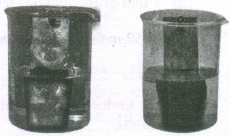
(ii) Let us extend the reaction to copper metal and silver nitrate solution. Place a strip of metallic copper in silver nitrate solution taken in a beaker. After some time, the solution slowly turns blue. This is due to the formation of Cu2+ ions, i.e. copper replaces silver from silver nitrate. The reaction is
(iii) It indicates that between copper and silver, copper has the tendency to release electrons and silver to accept electrons.
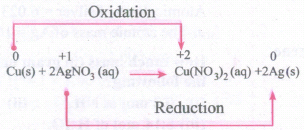
(iv) From the above experimental observations, we can conclude that among the three metals, namely, zinc, copper and silver, the electron releasing tendency is in the following order
Zinc> Copper> Silver.
25.
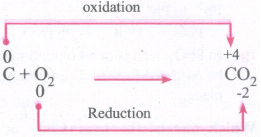
Combination reaction: Redox reactions in which two substances combine to form a single compound are called combination reaction.
26.
Molar mass = \(\frac { weight\ of\ the\ substance\ \times \ Molar\ volume }{ Volume\ of\ the\ substance\ at\ STP } \)
Molar volume at STP = 2.24 x 10⁻² m3
= 22.4 L (or) 22400 cc
Molar mass of the gas at STP = \(\frac { 23.2\times 22.4 }{ 20 } \)
= 25.984 g
27.
Molar mass of HCl = 36.5 g
The molar volume of 36.5 g (1 mole) of He 1 = 2.24 x 10⁻²m3.
\(\therefore\) The volume of 146 g (4 moles) of HCI = \(\frac { 2.24\times { 10 }^{ -2 } }{ 36.5 } \times 146\)
= 8.96 x 10⁻²m3
No. of molecules in 146 g of HCI = 4 N
= 4 x Avogadro Number
= 4 x 6.023 x 1023
= 24.092 x 1023
= 2.4092 x 1024 molecules.
28.
H2C2O4+KMnO4 + H2SO4 \(\rightarrow\) H2SO4 + MnSO4 + CO2 + H2O
.png)
Equalise the increase / decrease in O N by multiplying C species by 5 and Mn species by 1
5H2C2O4+KMnO4 + H2SO4 \(\rightarrow\) K2SO4 + MnSO4 + 5CO2 + H2O
Balance all other atoms except H and O atoms
5H2C2O4+2KMnO4 + 3H2SO4 \(\rightarrow\) K2SO4 + 2MnSO4 + 10CO2 + H2O
Balance O atom by adding H2O on the side falling short of oxygen atoms.
5H2C2O4+2KMnO4 + 3H2SO4 \(\rightarrow\) K2SO4 + 2MnSO4 + 10CO2 + H2O+ 7H2O
The balanced equation is
5H2C2O4+2KMnO4 + 3H2SO4 \(\rightarrow\) K2SO4 + 2MnSO4 + 10CO2 + 8H2O
29.
Apple turns brown when cut since the surface is exposed to air and undergoes oxidation. It can be prevented by dipping sliced apples in lemon juice. Lemon juice is an antioxidant which takes in all the available oxygen and prevents it from reaching the apple tissues
30.
Mass of oxygen = 1.5 - 1.05
= 0.45 g
0.45 g of oxygen combines with 1.05 g of metal.
∴ 8g of oxygen combines with \(\frac{8\times1.05}{0.45}\) g of metal
= 18.66 g of metal
∴ equivalent mass of metal = 18.66 g equ-1
31.
(i) Equivalent Mass of Acids:
E = \(\frac { Molar\ mass\ of\ the\ acid }{ basicity\ of\ the\ acid } \)
(ii) Equivalent Mass of Bases
E = \(\frac { Molar\ mass\ of\ the\ base }{ Acidity\ of\ the\ base } \)
(iii) Equivalent Mass of Oxidising agent:
E = \(\frac { Molar\ mass\ of\ the\ oxidising\ agent }{ no.\ of\ moles\ of\ electrons\ gained\ by\ one\ mole\ of\ the\ oxidsing\ agent } \)
32.
| ELEMENTS | COMPOUNDS | |
|---|---|---|
| (i) | An element consists of only one type of atom | Compounds are made up of molecules which contain two or more atoms of different elements. |
| (ii) | Element can exist as monatomic or polyatomic units. The polyatomic elements are called molecules | Properties of compounds are different from those of their constituent elements. |
| (iii) | Eg : Monatomic unit - Gold (Au), Copper (Cu); Polyatomic unit - Hydrogen (H2) |
Eg: Carbon dioxide (CO2), Glucose (C6H12O6) |
33.
34.
Newlands law of Octaves:
When elements are arranged in increasing order of their atomic weights every eighth element resembles its properties with the first one just like the eighth note of a musical table.
| Element: | Li | Be | B | C | N | O | F |
| Atomic Weight: | 7 | 9 | 11 | 12 | 14 | 16 | 19 |
Limitations: Failed for heavier elements beyond calcium.
35.
(i) Lothar Meyer plotted the physical properties such as atomic volume, melting point and boiling point against atomic weight and obtained a periodically repeated pattern.
(ii) Lothar Meyer observed a change in length of that repeating pattern.
(iii) In 1868, Lothar Meyer had developed a table of the elements that closely resembles the modern periodic table.

11th Standard Syllabus & Materials
11th Standard
TN 11th Tamil பீடு பெற நில் - செய்யுள் - காவடிச்சிந்து Important Questions And Answers Study Material - QB365 Set A
NEW11th Standard
TN 11th Tamil பீடு பெற நில் - உரைநடை - மலை இடப்பெயர்கள் : ஓர் ஆய்வு Important Questions And Answers Study Material - QB365 Set A
NEW11th Standard
TN 11th Tamil மாமழை போற்றுதும் - துணைப்பாடம் - யானை டாக்டர் Important Questions And Answers Study Material - QB365 Set A
NEW11th Standard
TN 11th Tamil மாமழை போற்றுதும் - செய்யுள் - ஐங்குறுநூறு Important Questions And Answers Study Material - QB365 Set A



Tamilnadu Stateboard 11th Standard Subjects

Maths

Commerce

Economics

Biology

Business Maths and Statistics

Accountancy

Computer Science

Physics
Chemistry
Maths
Biology
Economics
Physics
Chemistry

History
Business Maths and Statistics

Computer Science
Accountancy

Computer Applications
History
Computer Technology
Commerce
Computer Applications
Computer Technology

Tamil

English

French
Tamilnadu Stateboard Standards
