
 100% FREE ACCESS
11th Standard Syllabus & Materials
11th Standard
TN 11th Tamil இயற்கை வேளாண்மை,சுற்றுச்சூழல் -செய்யுள் - மனோன்மணீயம் Important Questions And Answers Study Material - QB365 Set A
NEW11th Standard
TN 11th Tamil என்னுயிர் என்பேன் -துணைப்பாடம் - இசைத்தமிழர் இருவர் Important Questions And Answers Study Material - QB365 Set A
NEW11th Standard
TN 11th Tamil மொழி கலை -செய்யுள் - ஒவ்வொரு புல்லையும் Important Questions And Answers Study Material - QB365 Set A
NEW11th Standard
TN 11th Tamil பீடு பெற நில் - இலக்கணம் - பகுபத உறுப்புகள் Important Questions And Answers Study Material - QB365 Set A
NEW11th Standard
TN 11th Tamil பீடு பெற நில் - துணைப்பாடம் - வாடிவாசல் Important Questions And Answers Study Material - QB365 Set A
NEW11th Standard
TN 11th Tamil பீடு பெற நில் - செய்யுள் - குறுந்தொகை Important Questions And Answers Study Material - QB365 Set A

Published on: 18/07/2019
Download Tamil Nadu 11th Standard Chemistry question papers, model tests, one-mark questions, important questions, and public exam papers in PDF format. Free study materials and answer keys for TN State Board students.
Questions + Answers key
Take MCQ Chemistry Test
1.
The oxidation number of Cr in Cr2O72- _______ is
+6
-6
+7
-7
2.
The oxidation number of hydrogen in LiH is _________
+1
-1
+2
-2
3.
An element X has the following isotopic Composition 200X = 90%, 199X = 8% and 202X = 2%. The Weighted average atomic mass of the element X is closest to _________.
201 u
202 u
199 u
200 u
4.
40 ml of methane is completely burnt using 80 ml of oxygen at room temperature The volume of gas left after cooling to room temperature is _______.
40 ml CO2 gas
40 ml CO2 gas and 80 ml H2O gas
60 ml CO2 gas and 60 ml H2O gas
120 ml CO2 gas
5.
Assertion: Two mole of glucose contains 12.044 x 10²³ molecules of glucose
Reason: Total number of entities present in one mole of any substance is equal to 6.02 x 10²²
(a) both assertion and reason are true and the reason is the correct explanation of assertion
(b) both assertion and reason are true but reason is not the correct explanation of assertion
(c) assertion is true but reason is false
(d) both assertion and reason are false
both assertion and reason are true and the reason is the correct explanation of assertion
both assertion and reason are true but the reason is not the correct explanation of assertion
an assertion is true but reason is false
both assertion and reason are false
6.
Calculate the amount of water produced by the combustion of 32 g of methane.
7.
Why is anode called oxidation electrode, whereas the cathode is called reduction electrode?
8.
What is the most essential conditions that must be satisfied in a redox reaction?
9.
2Cu2S + 3O2 \(\longrightarrow\) 2Cu2O + 2SO2
(i) In this reaction which substance is getting oxidised and which substance is getting reduced?
(ii) Name the oxidising and reducing agents.
10.
What is the difference between molecular mass and molar mass ? Calculate the molecular mass and molar mass for carbon monoxide.
11.
Which contains the greatest number of moles of oxygen atoms
i) 1 mol of ethanol
ii) 1 mol of formic acid
iii) 1 mol of H2O
12.
The density of carbon dioxide is equal to 1.965 kgm-3 at 273 K and 1 atm pressure. calculate the molar mass of CO2.
13.
Distinguish between oxidation and reduction.
14.
Balance the following equations by oxidation number method.
KIO3 + SO2 + H2O ⟶ KHSO4 + H2SO4 + I2
15.
Balance the following equations by oxidation number method.
P + HNO3 ⟶ HPO3 + NO + H2O
16.
The reaction between aluminium and ferric oxide can generate temperatures up to 3273 K and is used in welding metals. (Atomic mass of Al = 27 u atomic mass of O = 16 u )
2Al + Fe2O3 \(\longrightarrow \) Al2O3 + 2Fe; If in this process, 324 g of aluminum is allowed to react with 1.12 kg of ferric oxide
i) Calculate the mass of Al2O3 formed
ii) How much of the excess reagent is left at the end of the reaction ?
17.
Mass of one atom of an element is 6.645 x 10⁻²³g. How many moles of element are there in 0.320 kg.
18.
Give examples for the following redox reaction "Metal displacement reaction".
19.
Give examples for the following redox reaction "Decomposition".
20.
Give examples for the following redox reaction "Combination".
1.
(a)
+6
2.
(b)
-1
3.
(d)
200 u
4.
(a)
40 ml CO2 gas
5.
(c) assertion is true but reason is false
6.
CH4(g) + 2O2 \(\rightarrow\) CO2 + 2H2O
16g (2x18)g
As per stoichiometric equation,
16 g of methane produces 36 g of H2O
\(\therefore\) 32 g of methane will produce = \(\frac { 36 }{ 16 } \times 32=72\) g of water.
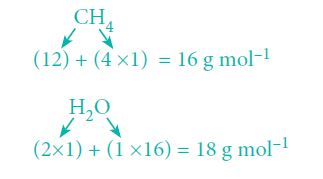
7.
At the anode, loss of electron takes place (ie.,) oxidation occurs. Hence called as oxidation electrode.
At the cathode, the gain of electrons takes place (ie.,) reduction occurs. Hence called as reduction electrode.
8.
In a redox reaction, the total number of electrons lost by the reducing agent must be equal to the number of electrons gained by the oxidising agent.
9.
(i) Oxygen is being added to Cu, (ie.,) Cu2S is oxidised to Cu2O and the other reactant O2 is getting reduced
(ii) Cu2S is the reducing agent.
O2 is an oxidising agent.
10.
1) The unit of molecular mass is atomic mass unit [amu]. The unit of molar mass is gram per mole.
2) Molecular mass is the mass of one molecule while molar mass is the mass of one mole of molecules (6.022 x 10²³)
(i) Molecular mass of CO2 = 1(C) + 2(0) = 12 + 32 = 44 amu
or 7.304 x 10⁻²³ g
(ii) Molar mass of CO2 = 44 g mol-1.
11.
| Compound | Given No.of moles | No.of oxygen atoms |
|---|---|---|
| Ethanol - C2H5OH | 1 | 1\(\times\)6.022\(\times\)1023 |
| Formic acid - HCOOH | 1 | 2\(\times\)6.022\(\times\)1023 |
| Water - H2O | 1 | 1\(\times\)6.022\(\times\)1023 |
| Formic acid | ||
12.
Molar mass = density x Molar volume
= 1.965 x 2.24 x 10-2
= 4.4016 x 10⁻² kg/mol
= 4.4016 x 10-2 x 103 g/mol
= 44.016 g/mol
13.
| Oxidation | Reduction | |
| 1. | Addition of oxygen | Addition of Hydrogen |
| 2. | Removal of Hydrogen | Removal of oxygen |
| 3. | Addition of an electronegative element. | Addition of an electro positive element |
| 4. | Removal of an electro positive element | Removal of an electro negative element |
| 5. | Loss of electron | Gain of electron |
| 6. | Increase in oxidation state / number | Decrease in oxidation state/ number. |
14.
Step - 1 : To find atoms undergoing change in O.N.
\(\overset { +1+5-2 }{ KIO_{ 3 } } +\overset { +4-2 }{ SO_{ 2 } } +\overset { +1-2 }{ H_{ 2 }O } \rightarrow \overset { +1+1+6-2 }{ KHSO_{ 4 } } +\overset { +1+6-2 }{ H_{ 2 }SO_{ 4 } } +\overset { 0 }{ { I }_{ 2 } } \)
Step - 2 : To find the total decrease and increase in O.N.
KIO3 ⟶ I2 (decrease of 5 units per atom)
SO2 ⟶ H2SO4 (increase of 2 units per atom)
Total decrease = 5 x 2 = 10
Total increase = 2 x 5 = 10
Step - 3 : To balance the total decrease and in O.N. increase, multiply KIO3 by 2 and SO2 by 5.
2 KIO3 + 5SO2 + H2O ⟶ KHSO4 + H2SO4 + I2
Step - 4 : To balance all atoms other than 'O' and 'H'
2KIO3 + 5SO2 + H2O ⟶ 2KHSO4 + 3H2SO4 + I2
Step - 5 : To balance 'O' atoms
2 KIO3 + 5SO2 + 4H2O ⟶ 2KHSO4 + 3H2SO4 + I2
Hydrogen atoms balance by themselves.
Hence, the balanced equations is
2KIO3 + 5SO2 + 4H2O ⟶ 2KHSO4 + 3H2SO4 + I2
15.
Step-1: To find atoms undergoing change in O.N
\(\overset { 0 }{ P } +\overset { +1\quad +5 }{ HNO_{ 3 } } \rightarrow \overset { +1+5-2 }{ HPO_{ 3 } } +\overset { +1-2 }{ NO } +\overset { +1-2 }{ { H }_{ 2 }O } \)
Step-2: To find total decrease and increase in O.N.
P ⟶ HPO3 (increase in O.N. of 5 units per atom)
HNO3 ⟶ NO (decrease in O.N. of3 units per atom)
Total decrease 5 x 3 = 15
Total increase 3 x 5 = 15
Step-3: To balance the total increase and decrease in the equation, by multiplying P by 3 and HNO3 by 5.
3P + 5HNO3 ⟶ HPO3 + NO + H2O
Step-4: To balance all atoms other than 'O' and 'H'
3P + 5HNO3 ⟶ 3HPO3 + 5NO + H2O
Step-5: To balance by oxygen atoms
Oxygen and hydrogen atoms balance by themselves.
Hence the balanced equation is 3P + 5HNO3 ⟶ 3HPO3 + 5 NO + H2O
16.
2Al + Fe2O3 \(\longrightarrow \) Al2O3 + 2Fe
| Reactants | Products | |||
| Al | Fe2O3 | Al2O3 | Fe | |
| Amount of reactant allowed to react | 324 g | 1.12 kg | - | - |
| Number of moles allowed to react | \(\frac { 324 }{ 27 } =12mol\) | \(\frac { 1.12\times { 10 }^{ 3 } }{ 160 } =7mol\) | - | - |
| Stoichiometric Co-efficient | 2 | 1 | 1 | 2 |
| Number of moles consumed during reaction | 12 mol | 6 mol | - | - |
| Number of moles of reactant unreacted and number of moles of product formed | - | 1 mol | 6 mol | 12 mol |
Molar mass of Al2O3 format = 6 mol x 102 g mol-1 = 612 g
[ Al2O3 : (2 x 27) + 3(16) = 54 + 48 = 102] = 612 g
Excess reagent = Fe2O3
Amount of excess reagent left at the end of the reaction = 1 mol x 160 g mol-1
= 160g [ Fe2O3 : (2 x 56) + (3 x 16) = 112 + 48 = 160] = 160 g
17.
mass of one atom = 6.645 x 10⁻²³ g
\(\therefore\) mass of 1 mole of an atom = 6.645 x 10-23 g x 6.022 x 1023 = 40 g
\(\therefore\) number of moles of element in 0.320 kg = \(\frac { 1\quad mole }{ 40g } \times 0.320kg\)
= \(\frac { 1mol\times 320g }{ 40g } \)
= 8 mol
18.
.png)
19.
.png)
20.
.png)

11th Standard Syllabus & Materials
11th Standard
TN 11th Tamil பீடு பெற நில் - செய்யுள் - காவடிச்சிந்து Important Questions And Answers Study Material - QB365 Set A
NEW11th Standard
TN 11th Tamil பீடு பெற நில் - உரைநடை - மலை இடப்பெயர்கள் : ஓர் ஆய்வு Important Questions And Answers Study Material - QB365 Set A
NEW11th Standard
TN 11th Tamil மாமழை போற்றுதும் - துணைப்பாடம் - யானை டாக்டர் Important Questions And Answers Study Material - QB365 Set A
NEW11th Standard
TN 11th Tamil மாமழை போற்றுதும் - செய்யுள் - ஐங்குறுநூறு Important Questions And Answers Study Material - QB365 Set A



Tamilnadu Stateboard 11th Standard Subjects

Maths

Commerce

Economics

Biology

Business Maths and Statistics

Accountancy

Computer Science

Physics
Chemistry
Maths
Biology
Economics
Physics
Chemistry

History
Business Maths and Statistics

Computer Science
Accountancy

Computer Applications
History
Computer Technology
Commerce
Computer Applications
Computer Technology

Tamil

English

French
Tamilnadu Stateboard Standards
