
 100% FREE ACCESS
11th Standard Syllabus & Materials
11th Standard
TN 11th Tamil இயற்கை வேளாண்மை,சுற்றுச்சூழல் -செய்யுள் - மனோன்மணீயம் Important Questions And Answers Study Material - QB365 Set A
NEW11th Standard
TN 11th Tamil என்னுயிர் என்பேன் -துணைப்பாடம் - இசைத்தமிழர் இருவர் Important Questions And Answers Study Material - QB365 Set A
NEW11th Standard
TN 11th Tamil மொழி கலை -செய்யுள் - ஒவ்வொரு புல்லையும் Important Questions And Answers Study Material - QB365 Set A
NEW11th Standard
TN 11th Tamil பீடு பெற நில் - இலக்கணம் - பகுபத உறுப்புகள் Important Questions And Answers Study Material - QB365 Set A
NEW11th Standard
TN 11th Tamil பீடு பெற நில் - துணைப்பாடம் - வாடிவாசல் Important Questions And Answers Study Material - QB365 Set A
NEW11th Standard
TN 11th Tamil பீடு பெற நில் - செய்யுள் - குறுந்தொகை Important Questions And Answers Study Material - QB365 Set A

Published on: 06/09/2019
Chemical Bonding
Download Tamil Nadu 11th Standard Chemistry question papers, model tests, one-mark questions, important questions, and public exam papers in PDF format. Free study materials and answer keys for TN State Board students.
Questions + Answers key
Take MCQ Chemistry Test
1.
In which of the following molecules /ions BF3, NO2-, H2O the central atom is sp2 hybridised?
NH2- and H2O
NO2- and H2O
BF3 and NO2-
BF3 and NH2-
2.
Shape and hybridisation of IF5 are ________
Trigonal bipyramidal, Sp3d2
Trigonal bipyramidal, Sp3d
Square pyramidal, Sp3d2
Octahedral, Sp3d2
3.
Hybridisation of central atom in PCl5 involves the mixing of orbitals __________
s, px, py, dx2 , dx2-y2
s, px . py, pxy . dx2-y2
s, px, py, pz, dx2-y2
s, px, py, dxy, dx2-y2
4.
Which of these represents the correct order of their increasing bond order _________
C2 < C2 2- < O2 2- < O2
C 2 2- < C2 + < O2 < O2 2-
O2 2- < O2 < C2 2- < C 2+
O2 2- < C2 + < O2 < C2 2-
5.
In ClF3, NF3 and BF3 molecules the chlorine, nitrogen and boron atoms are ______
sp3 hybridised
sp3 ,sp3 and sp2 respectively
sp2 hybridised
sp3d, sp3 and sp hybridised respectively
6.
The ratio of number of sigma (σ) and pi (л) bonds in 2- butynal is __________
8/3
5/3
8/2
9/2
7.
In the molecule OA = C = OB, the formal charge on OA, C and OB are respectively.
-1, 0, +1
+1, 0, -1
-2, 0, +2
0, 0, 0
8.
In which of the following Compounds does the central atom obey the octet rule ?
XeF4
AlCl3
SF6
SCl2
9.
Assertion: Oxygen molecule is paramagnetic.
Reason: It has two unpaired electron in its bonding molecular orbital.
a) both assertion and reason are true and reason is the correct explanation of assertion
b) both assertion and reason are true but reason is not the correct explanation of assertion
c) assertion is true but reason is false
d) Both assertion and reason are false
both assertion and reason are true and reason is the correct explanation of assertion
both assertion and reason are true but reason is not the correct explanation of assertion
assertion is true but reason is false
Both assertion and reason are false
10.
What is Polar Covalent bond ? explain with example.
11.
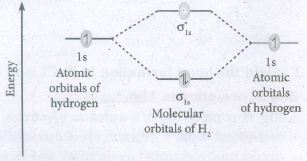
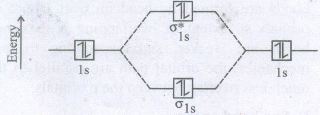
Hydrogen gas is diatomic where as inert gases are monoatomic – explain on the basis of MO theory.
12.
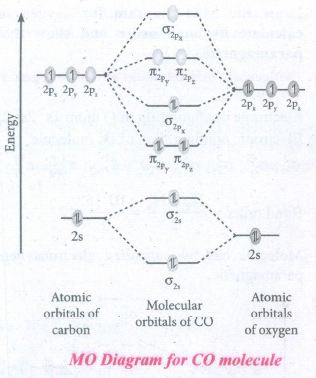
Draw MO diagram of CO and calculate its bond order.
13.
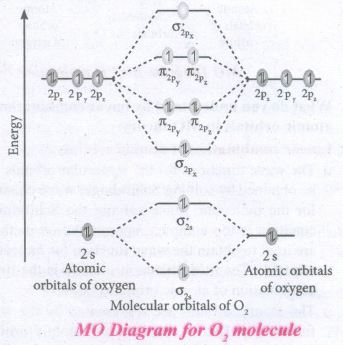
Draw the M.O diagram for oxygen molecule calculate its bond order and show that O2 is paramagnetic.
14.
Describe fajan's rule.
15.
CO2 and H2O both are triatomic molecule but their dipole moment values are different. Why ?
16.
Explain VSEPR theory. Applying this theory to predict the shapes of IF7, and SF6.
17.
Discuss the formation of N2 molecule using MO Theory
1.
(c)
BF3 and NO2-
2.
(c)
Square pyramidal, Sp3d2
3.
(c)
s, px, py, pz, dx2-y2
4.
(d)
O2 2- < C2 + < O2 < C2 2-
5.
(d)
sp3d, sp3 and sp hybridised respectively
6.
(a)
8/3
7.
(d)
0, 0, 0
8.
(d)
SCl2
9.
c) assertion is true but reason is false
10.
In the case of covalent bond formed between atoms having different electronegativities, the atom with higher electro negativity will have greater tendency to attract the shared pair of electrons more towards itself than the other atom. As a result the cloud of shared electron
pair gets distorted. Let us consider the covalent bond between hydrogen and fluorine in hydrogen fluoride. The electro negativities ofhydrogen and fluorine on Pauling's scale are 2.1 and 4 respectively. It means that fluorine attracts the shared pair of electrons approximately twice as much as the hydrogen which leads to partial negative charge on fluorine and partial positive charge on hydragen. Hence, the H-F bond is said to be polar covalent bond.
11.
H2 molecule :
Electronic configuration of H atom 1s1
Electronic configuration of H2 molecule \(\sigma^{2}_{1s}\)
Bond order = \({N_b-N_a\over2}={2-0\over2}=1\)
Molecule has no unpaired electrons hence it is diamagnetic
Helium molecule (i.e) He2 :
The electronic econfiguration of He atom is 1 s2
.'. Electronic configuration of He2 molecule is \((\sigma_{1s})^2(\sigma^*_{1s})^2\)
Bond order = \({N_b-N_a\over2}={2-2\over2}\)
= 0
He, cannot exist. Similarly all the inert gases, X2 cannot orist as their bond order = 0.
12.
Bonding in some heteronuclear di-atomic molecules:
Molecular orbital diagram of Carbon monoxide molecule (CO)
Electronic configuration of C atom 1s22s22p2
Electronic configuration of O atom 1s22s22p4
Electronic conguration of CO molecule
\(\sigma^{2}_{1s},\sigma^{*2}_{1s},\sigma^{2}_{2s},\sigma^{*2}_{2s}\)\(\pi^{2}_{2py},\pi^{2}_{2pz},\sigma^2_{2px}\)
Bond order = \({N_b-N_a\over2}={10-4\over2}=3\)
Molecule has no unpaired electrons hence it is diamagnetic
13.
Molecular orbital diagram of oxyge molecule (O2) :
Electronic configuration of O atom 1s22s22p4
Electronic configuration of O2 molecule
\(\sigma^{2}_{1s},\sigma^{*2}_{1s},\sigma^{2}_{2s},\sigma^{*2}_{2s},\sigma^{2}_{2px},\)\(\pi^{2}_{2py},\pi^{2}_{2pz},\pi^{*1}_{2py},\pi^{*1}_{2pz}\)
Bond order=\({N_b-N_a\over2}={10-6\over2}=2\)
Molecule has two unpaired electrons hence it is paramagnetic.
14.
The ability of a cation to polarise an anion is called its polarising ability and the tendency of an anion to get polarised is called its polarisability. The extent of polarisation in an ionic compound is given by the Fajans rules
Fajans Rules:
(i) To show greater covalent character, both the cation and anion should have high charge on them. Higher the positive charge on the cation, greater will be the attraction on the electron cloud of the anion. Similarly higher the magnitude of negative charge on the anion, greater is its polarisability. Hence, the increase in charge on cation or in anion increases the covalent character Let us consider three ionic compounds aluminum chloride, magnesium chloride and sodium chloride. Since the charge of the cation increase in the order Na+ < Mg2+ < AI3+, the covalent character also follows the same order NaCI < MgCl2 < AICI3.
2. The smaller cation and larger anion show greater covalent character due to the greater extent of polarisation.
Lithium chloride is more covalent than sodium chloride. e size of Li+ is smaller than Na+ and hence the polarising power of Li+ is more. Lithium iodide is more covalent than lithium chloride as the size of I- is larger than the CI-. Hence I- will be more polarised than CI- by the cation, Li+.
3. Cations having ns2 np6 nd10 configuration show greater polarising power than the cations with ns2 np6 configuration. Hence, they show greater covalent character.
CuCI is more covalent than NaCl. Compared to Na+ (1.13 \(\mathring { A } \)). Cu+ (0.6 \(\mathring { A } \)) is small and have 3s2 3p6 3d10 conguration.
Electronic conguration of Cu+
[Ar] 3s2, 3p6, 3d10
Electronic Conguration of Na+
[He] 2s2, p6
15.
Molecules having polar bonds will not necessarily have a dipole moment. For example, the linear form of carbon dioxide haszero dipole moment, even though it has two polar bonds. In CO2, the dipole moments of two polar bonds (CO) are equal in magnitude but have opposite direction. Hence, the net dipole moment of the CO2 is,
\(\mu=\mu_{1}+\mu_{2}=\mu_{1}+(-\mu_{1})=0.\)
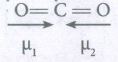
In this case \(\mu=\overrightarrow { { \mu }_{ 1 } } +\overrightarrow { { \mu }_{ 2 } } \quad \)
\(=\overrightarrow { { \mu }_{ 1 } } +\overrightarrow { ({ \mu }_{ 1 }) } =0\)
Incase of water net dipole moment is the vector sum of \(\mu_{1}+\mu_{2}\) as shown.
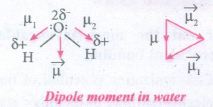
Dipole moment in water is found to be 1.85 D
16.
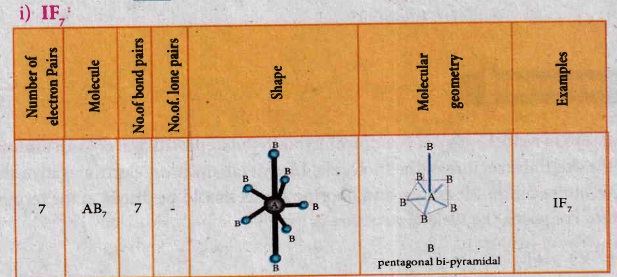
Important principles of VSEPR Theory are as follows:
1. The shape of the molecules depends on the number of valence shell electron pair around the central atom.
2. There are two types of electron pairs namely bond pairs and lone pairs. The bond pair of electrons are those shared between two atoms, while the lone pairs are the valence electron pairs that are not involved in bonding.
3. Each pair of valence electrons around the central atom repels each other and hence, they are located as far away as possible in three dimensional space to minimize the repulsion between them.
4. The repulsive interaction between the different types of electron pairs is in the following order.
lp - lp > lp - bp > bp - bp
lp - lone pair; bp - bond pair
The lone pair of electrons are localised only on the central atom and interacts with only one nucleus whereas the bond pairs are shared between two'atoms and they interact with two nuclei. Because of this the ione pairs occupy more space and have greater repulsive Power than the bond Pairs in a molecule.
.jpg)
17.
Molecular orbital diagram of nitrogen molecule (N2) :
Electronic configuration of N atom 1s2 2s2 2p3
Electronic configuration of N, molecule
\(\sigma^{2}_{1s},\sigma^{*2}_{1s},\sigma^{2}_{2s},\sigma^{*2}_{2s}\)\(\pi^{2}_{2py},\pi^{2}_{2pz},\sigma^2_{2px}\)
Bond order = \({N_b-N_a\over2}={10-4\over2}=3\)
Molecule has no unpaired electrons hence it is diamagnetic.


11th Standard Syllabus & Materials
11th Standard
TN 11th Tamil பீடு பெற நில் - செய்யுள் - காவடிச்சிந்து Important Questions And Answers Study Material - QB365 Set A
NEW11th Standard
TN 11th Tamil பீடு பெற நில் - உரைநடை - மலை இடப்பெயர்கள் : ஓர் ஆய்வு Important Questions And Answers Study Material - QB365 Set A
NEW11th Standard
TN 11th Tamil மாமழை போற்றுதும் - துணைப்பாடம் - யானை டாக்டர் Important Questions And Answers Study Material - QB365 Set A
NEW11th Standard
TN 11th Tamil மாமழை போற்றுதும் - செய்யுள் - ஐங்குறுநூறு Important Questions And Answers Study Material - QB365 Set A



Tamilnadu Stateboard 11th Standard Subjects

Maths

Commerce

Economics

Biology

Business Maths and Statistics

Accountancy

Computer Science

Physics
Chemistry
Maths
Biology
Economics
Physics
Chemistry

History
Business Maths and Statistics

Computer Science
Accountancy

Computer Applications
History
Computer Technology
Commerce
Computer Applications
Computer Technology

Tamil

English

French
Tamilnadu Stateboard Standards
