
 100% FREE ACCESS
11th Standard Syllabus & Materials
11th Standard
TN 11th Tamil இயற்கை வேளாண்மை,சுற்றுச்சூழல் -செய்யுள் - மனோன்மணீயம் Important Questions And Answers Study Material - QB365 Set A
NEW11th Standard
TN 11th Tamil என்னுயிர் என்பேன் -துணைப்பாடம் - இசைத்தமிழர் இருவர் Important Questions And Answers Study Material - QB365 Set A
NEW11th Standard
TN 11th Tamil மொழி கலை -செய்யுள் - ஒவ்வொரு புல்லையும் Important Questions And Answers Study Material - QB365 Set A
NEW11th Standard
TN 11th Tamil பீடு பெற நில் - இலக்கணம் - பகுபத உறுப்புகள் Important Questions And Answers Study Material - QB365 Set A
NEW11th Standard
TN 11th Tamil பீடு பெற நில் - துணைப்பாடம் - வாடிவாசல் Important Questions And Answers Study Material - QB365 Set A
NEW11th Standard
TN 11th Tamil பீடு பெற நில் - செய்யுள் - குறுந்தொகை Important Questions And Answers Study Material - QB365 Set A

Published on: 07/09/2019
Fundamentals of Organic Chemistry
Download Tamil Nadu 11th Standard Chemistry question papers, model tests, one-mark questions, important questions, and public exam papers in PDF format. Free study materials and answer keys for TN State Board students.
Questions + Answers key
Take MCQ Chemistry Test
1.
Write the molecular formula of the first six members of homologous series of nitro alkanes.
2.
Give the general characteristics of organic compounds?
3.
0.40 g of an iodo-substituted organic compound gave 0.235 g of AgI by carius method. Calculate the percentage of iodine in the compound. (Ag = 108, I = 127)
4.
0.185 g of an organic compound when treated with Conc. HNO3 and silver nitrate gave 0.320 g of silver bromide. Calculate the % of bromine in the compound. (Ag =108, Br = 80)
5.
Write all the possible isomers of molecular formula C4H10O and identify the isomerisms found in them.
6.
Describe the reactions involved in the detection of nitrogen in an organic compound by Lassaigne method.
7.
0.33 g of an organic compound containing phosphorous gave 0.397 g of Mg2P2O7 by the analysis. Calculate the percentage of P in the compound.
8.
0.26g of an organic compound gave 0.039 g of water and 0.245 g of carbon dioxide on combustion. Calculate the percentage of C & H.
9.
The IUPAC name of the compound 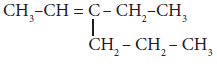 is ____________
3 – Ethyl -2– hexene
3 – Propyl -3– hexene
4 – Ethyl – 4 – hexene
3 – Propyl -2-hexene
10.
IUPAC name of \({ CH }_{ 3 }-\overset { \underset { | }{ H } }{ \underset { \overset { | }{ { C }_{ 2 }{ H }_{ 5 } } }{ C } } -\overset { \underset { | }{ { C }_{ 4 }{ H }_{ 9 } } }{ \underset { \overset { | }{ { CH }_{ 3 } } }{ C } } -{ CH }_{ 3 }\) is ________
3, 4, 4 – Trimethylheptane
2 – Ethyl –3, 3– dimethyl heptane
3, 4, 4 – Trimethyloctane
2 – Butyl -2 –methyl – 3 – ethyl-butane
11.
Which one of the following names does not fit a real name?
3 – Methyl –3–hexanone
4–Methyl –3– hexanone
3– Methyl –3– hexanol
2– Methyl cyclo hexanone
12.
In the hydrocarbo \(\overset { 7 }{ { CH }_{ 3 } } -\overset { 6 }{ { CH }_{ 2 } } -\overset { 5 }{ CH } =\overset { 4 }{ CH } -\overset { 3 }{ { CH }_{ 2 } } -\overset { 2 }{ C } =\overset { 1 }{ CH } \) the state of hybridisation of carbon 1,2,3,4 and 7 are in the following sequence.
sp, sp, sp3, sp2, sp3
sp2, sp, sp3, sp2, sp3
sp, sp, sp2, sp, sp3
none of these
13.
Select the molecule which has only one \(\pi\) bond.
CH3– CH = CH – CH3
CH3– CH = CH – CHO
CH3– CH = CH – COOH
All of these
1.
The first six members of nitro alkanes are
(i) CH2-NO2 - Nitromethane
(ii) CH2-CH2-NO2 - Nitroethane
(iii) CH3-CH2-CH2-NO2 - 1- nitropropane'
(iv) CH3-CH2-CH2-CH2-NO2 - 1- nitrobutane
(v) CH3-CH2-CH2-CH2-CH2-NO2 - 1- nitropentane
(vi) CH2-CH2-CH2-CH2-CH2-CH2 - NO2 - 1- nitrohexane
2.
They are covalent compounds of carbon and generally insoluble in water and readily soluble in organic solvent such as benzene, toluene, ether, chloroform etc...
Many of the organic compounds are inflammable (except CCI4). They possess low boiling and melting points due to their covalent nature
Organic compounds are characterised by functional groups. A functional group is an atom or a specific combination of bonded atoms that react in a characteristic way, irrespective of the organic molecule in which it is present. In almost all the cases, the reaction of an organic compound takes place at the functional group. They exhibit isomerism which is a unique phenomenon.
Homologous series: Aseries of organic compounds each containing a characteric functional group and the successive members differ from each other in molecular formula by a CH2 group is called homologous series. Eg.
Alkanes: Methane (CH4), Ethane (C2H6), Propane(C3H8) etc.Alcohols: Methanol (CH3OH), Ethanol (C2H5OH) Propanol (C3H7OH) etc..) Compounds of the homologous series are represented by a general formula Alkanes CnH2n+2, Alkenes CnH2n, Alkynes CnHr2n-2 and can be prepared by general methods. They show regular gradation in physicial properties but have almost similar chemical property.
3.
(w) = 0.33 g
(c) = 0.397 g
\(\% I=\frac{127}{235} \times \frac{c}{w} \times 100=\frac{127}{235} \times \frac{0.235}{0.40} \times 100=31.75 \%\)
4.
(w) = 0.185 g
(x) = 0.320 g
\(\% \mathrm{Br}=\frac{80}{188} \times \frac{b}{w} \times 100=\frac{80}{188} \times \frac{0.320}{0.185} \times 100=73.6 \%\)
5.
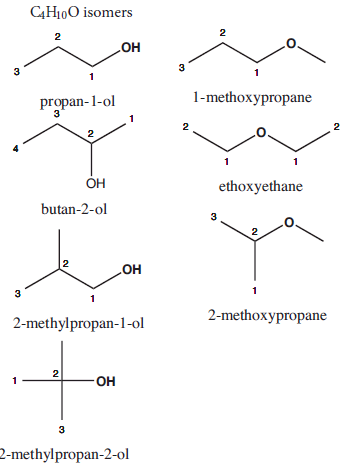
i) Butan.- I - ol & Butan - 2 -ol are position isomers. - Position isomerism
ii) Butan -I -ol & 2-methyl propan - I - ol are chain isomers - Chainisomerism
iii) Butan -I - ol and I - methoxy propane are functional isomers - Functional isomerism
iv) 1 - methoxy Propane and ethoxy ethane and 2 - methoxy Propane are metamers - Metamerism
6.
A small piece of Na dried by pressing between the folds of a filter Paper is taken in a fusion tube and it is gently heated.
When it melts to a shining globule, put a pinch of the organic compound on it. Heat the tube till reaction ceases and becomes red hot. Plunge it in about 50 mL of distilled water taken in a china dish and break the bottom of the tube by striking against the dish. Boil the contents of the dish for about 10 mts and filter. This filtrate is known as lassaignes extract or sodium fusion extract and it used for detection of nitrogen, sulfur and halogens present in organic compounds.
If nitrogen is present it gets converted to sodium cyanide which reacts with freshly prepared furro,sulphate and feiric ion followed by conc. HCI and gives a Prussian blue color or green color precipitate. It confirms the presence of nitrogen. HCI is added to dissolve the lreenish precipitate of ferrous hydrbxide iroduced by the excess of NaOH on Feson which would otherwise markthe Prussian blue piecipitate. The following reaction takes part in the formation of Prussian blue.

from organic compounds
\(FeSo_{ 4 }+2NaOH\longrightarrow Fe(OH)_{ 2 }+Na_{ 2 }{ SO }_{ 4 }\)
from organic compounds
\(6FeCN+Fe(OH)_{ 2 }\longrightarrow Na_{ 4 }[Fe(CN)]_{ 6 }+2NaOH\)
Sod.ferrocyanide
\(3Na_{ 4 }[Fe(CN)_{ 6 }]+FeC1_{ 3 }\longrightarrow Fe_{ 4 }[Fe(CN)]_{ 3 }+12NaCI\)
ferric ferrocyanidePrussian blue or greenppt
Incase if both N & S are present, a blood red color is obtained due to the following reactions.
\(\mathrm{Na}+\mathrm{C}+\mathrm{N}+\mathrm{S} \stackrel{\text { Heat }}{\longrightarrow} \mathrm{NaCNS}\)
sodium sulphocyanide
\(3 \mathrm{NaCNS}+\mathrm{FeCl}_3 \longrightarrow \mathrm{Fe}(\mathrm{CNS})_3+3 \mathrm{NaCl}\)
ferric sulphocyanide
(Blood red colour).
7.
(w) = 0.33 g
y = 0.397 g
\(\% \mathrm{P}=\frac{62}{222} \times \frac{\mathrm{y}}{\mathrm{w}} \times 100=\frac{62}{222} \times \frac{0.397}{0.33} \times 100=33.60 \%\)
8.
Weight of organic compound = 0.26g
Weight of water = 0.039g
Weight of CO2 = 0.245g
Percentage of hydrogen
\(
\% =\frac{2}{18} \times \frac{x}{\mathrm{w}} \times 100
\)
\(=\frac{2}{18} \times \frac{0.039}{0.26} \times 100
\)
\(=1.66 \%\)
Percentage of carbon
\(\% \mathrm{C} =\frac{12}{44} \times \frac{\mathrm{y}}{\mathrm{w}} \times 100
\)
\(=\frac{12}{44} \times \frac{0.245}{0.26} \times 100=25.69 \%
\)
9.
(a)
3 – Ethyl -2– hexene
10.
(c)
3, 4, 4 – Trimethyloctane
11.
(a)
3 – Methyl –3–hexanone
12.
(a)
sp, sp, sp3, sp2, sp3
13.
(a)
CH3– CH = CH – CH3

11th Standard Syllabus & Materials
11th Standard
TN 11th Tamil பீடு பெற நில் - செய்யுள் - காவடிச்சிந்து Important Questions And Answers Study Material - QB365 Set A
NEW11th Standard
TN 11th Tamil பீடு பெற நில் - உரைநடை - மலை இடப்பெயர்கள் : ஓர் ஆய்வு Important Questions And Answers Study Material - QB365 Set A
NEW11th Standard
TN 11th Tamil மாமழை போற்றுதும் - துணைப்பாடம் - யானை டாக்டர் Important Questions And Answers Study Material - QB365 Set A
NEW11th Standard
TN 11th Tamil மாமழை போற்றுதும் - செய்யுள் - ஐங்குறுநூறு Important Questions And Answers Study Material - QB365 Set A



Tamilnadu Stateboard 11th Standard Subjects

Maths

Commerce

Economics

Biology

Business Maths and Statistics

Accountancy

Computer Science

Physics
Chemistry
Maths
Biology
Economics
Physics
Chemistry

History
Business Maths and Statistics

Computer Science
Accountancy

Computer Applications
History
Computer Technology
Commerce
Computer Applications
Computer Technology

Tamil

English

French
Tamilnadu Stateboard Standards
