
 100% FREE ACCESS
11th Standard Syllabus & Materials
11th Standard
TN 11th Tamil இயற்கை வேளாண்மை,சுற்றுச்சூழல் -செய்யுள் - மனோன்மணீயம் Important Questions And Answers Study Material - QB365 Set A
NEW11th Standard
TN 11th Tamil என்னுயிர் என்பேன் -துணைப்பாடம் - இசைத்தமிழர் இருவர் Important Questions And Answers Study Material - QB365 Set A
NEW11th Standard
TN 11th Tamil மொழி கலை -செய்யுள் - ஒவ்வொரு புல்லையும் Important Questions And Answers Study Material - QB365 Set A
NEW11th Standard
TN 11th Tamil பீடு பெற நில் - இலக்கணம் - பகுபத உறுப்புகள் Important Questions And Answers Study Material - QB365 Set A
NEW11th Standard
TN 11th Tamil பீடு பெற நில் - துணைப்பாடம் - வாடிவாசல் Important Questions And Answers Study Material - QB365 Set A
NEW11th Standard
TN 11th Tamil பீடு பெற நில் - செய்யுள் - குறுந்தொகை Important Questions And Answers Study Material - QB365 Set A

Published on: 12/08/2019
Gaseous State
Download Tamil Nadu 11th Standard Chemistry question papers, model tests, one-mark questions, important questions, and public exam papers in PDF format. Free study materials and answer keys for TN State Board students.
Questions + Answers key
Take MCQ Chemistry Test
1.
Gas equation PV = nRT is obeyed by __________
only isothermal process
only adiabatic process
both (a) and (b)
none of the above
2.
Maximum deviations from ideal gas is expected from ___________
H2(g)
N2(g)
CH4(g)
NH3(g)
3.
Pick out the correct relation for 1 mole of real gas.
\(\left( P+\frac { V }{ { a }^{ 2 } } \right) (V-b)=RT\)
\(P=\frac { RT }{ (V-b) } +\frac { a }{ { V }^{ 2 } } \)
\(\left( P+\frac { a }{ { V }^{ 2 } } \right) (V-b)=RT\)
\(\left( P-\frac { a }{ { V }^{ 2 } } \right) (V+b)=\frac { 1 }{ RT } \)
4.
Compression factor Z is given by _____________
PV/nRT
P/nRT
PV/R
PV/T
5.
The rate of diffusion of gas is _________ to square root of their molecular mass.
inversely proportional
directly proportional
equal
twice
6.
The hydrogen balloon was invented by ______________
Robert Boyle
J.A.C. Charles
Maxwell
Gay Lussac
7.
Pressure is _____________
Force/ area
force x Area
Area/ force
Force / area \(\times\) volume
8.
The value of universal gas constant depends upon __________
Temperature of the gas
Volume of the gas
Number of moles of the gas
units of Pressure and volume.
9.
Rate of diffusion of a gas is ________
directly proportional to its density
directly proportional to its molecular weight
directly proportional to its square root of its molecular weight
inversely proportional to the square root of its molecular weight
10.
What is meant by Boyle temperature (or) Boyle point? How is it related with compression point?
11.
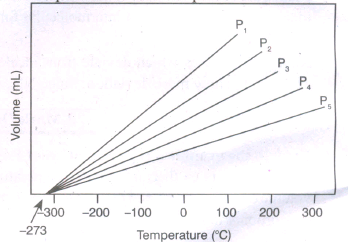
Explain the graphical representation of Charles law.
12.
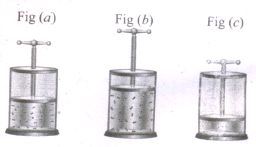
In the below figure, let us find the missing parameters [volume in (b) and temperature in (c)]
PI = 1 atm, P2 = 1 atm, P3 = 1 atm
V1 = 0.3 dm3, V2 = ? dm3, V3 = 0.15 dm3
T1 = 200 K, T2 = 300 K, T3 = ? K.
13.
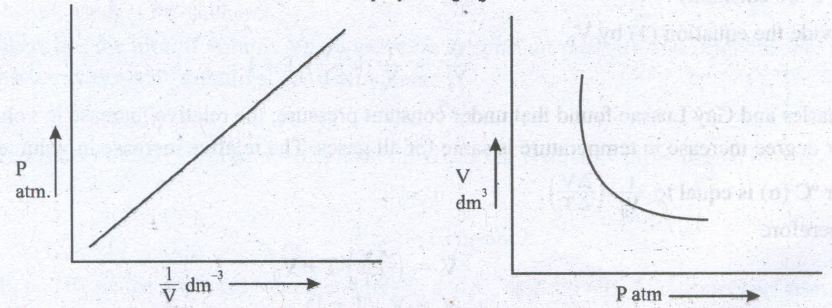
Give the graphical representation of Boyle's law.
14.
Inside a certain automobile engine, the volume of air in a cylinder is 0.375 dm3, when the pressure is 1.05 atm. When the gas is compressed to a volume of 0.125 dm3 at the same temperature, what is the pressure of the compressed air?
15.
Which of the following gases would you expect to deviate from ideal behaviour under conditions of low temperature F2, Cl2 or Br2? Explain.
16.
Suppose there is a tiny sticky area on the wall of a container of gas. Molecules hitting this area stick there permanently. Is the pressure greater or less than on the ordinary area of walls?
17.
Define rate of diffusion
18.
According to kinetic theory. What are the two assumptions made with regard to ideal gas?
19.
Why are the airplane cabins artificially pressurized?
20.
Explain whether a gas approaches ideal behavior or deviates from ideal behaviour if
it is compressed to a smaller volume at constant temperature.
21.
Derive the expression between Ptotal and Partial pressure of a gas.
22.
Why do astronauts have to wear protective suits when they are on the surface of moon?
1.
(c)
both (a) and (b)
2.
(d)
NH3(g)
3.
(c)
\(\left( P+\frac { a }{ { V }^{ 2 } } \right) (V-b)=RT\)
4.
(a)
PV/nRT
5.
(a)
inversely proportional
6.
(b)
J.A.C. Charles
7.
(a)
Force/ area
8.
(d)
units of Pressure and volume.
9.
(d)
inversely proportional to the square root of its molecular weight
10.
(i) Over a range of low pressures, the real gases can behave ideally at a particular temperature called as Boyle temperature or Boyle point.
(ii) The Boyle point varies with the nature of the gas.
(iii) Above the Boyle point, the compression point Z > 1 for real gases i.e. real gases show positive deviation.
(iv) Below the Boyle point, the real gases first show a decrease for Z, reaches a minimum and then increase with increase in pressure. So, it is clear that at low pressure and at high temperature, the real gases behave as ideal gases.
(v) Hence, \(Z=\frac{PV_{real}}{nRT}\)
\(PV_{ideal}=\frac{nRT}{P}\)
So, \(Z=\frac{V_{real}}{V_{ideal}}\)
11.
(i) Variation of volume of the gas sample with temperature at constant
(ii) Each line (iso bar) represents the variation of volume with temperature at certain pressure. The pressure increases from P1 to P5.
(iii) i.e. P1 < P2 < P3 < P4 < P5 When these lines are extrapolated to zero volume, they intersect at a temperature of -273.15°C.
(iv) All gases are becoming liquids if they are cooled to sufficiently low temperatures.
(v) In other words, all gases occupy zero volume at absolute zero. So the volume of a gas can be measured over only a limited temperature range.
12.
According to Charles' law,
\(\frac{V_1}{T_1}=\frac{V_2}{T_2}=\frac{V_3}{T_3}\)
\(\frac{0.3dm^3}{200K}=\frac{V_2}{300K}=\frac{0.15dm^3}{T_3}\)
\(\frac{V_2}{300K}=\frac{0.3dm^3}{200K}\)
.png)
V2 = 0.45 dm3 and
\(\frac{0.15dm^3}{T_3}=\frac{0.3dm_3}{200K}\)
.png)
T3 = 100 K.
13.
According to Boyle 's law for a given mass of a gas under two different sets of conditions at constant temperature we can write
P1V1 = P2V2 = k . ...(1)
14.
V1 = 0.375 dm3 V2 = 0.125
P1 = 1.05 atm P2 = ?
' T '- Constant
P1V1 = P2V2
\(\therefore \) P2 = \(\frac { { P }_{ 1 }{ V }_{ 1 } }{ { V }_{ 2 } } =\frac { 1.05\times 0.375 }{ 0.125 } \) = 3.15 atm
15.
The larger the size of the molecule, the greater will be Van der Waals' attraction. Therefore greater the deviation from ideal behaviour. So bromine will deviate more from ideal behaviour because it has bigger atoms.
16.
If there is a tiny sticky area on the walls of the container of a gas, then the collision of the molecules will not be elastic. So the gas will behave as a real gas. So the pressure will be less than the calculated value.
17.
It is defined as the number of molecules of a gas that get diffused in unit time.
rate of diffusion = \(\frac{Volume\ of \ the\ gas\ diffused}{time\ taken}\)
18.
(i) The individual gas molecules occupy negligible volume when compared to the total volume of the gas.
(ii) There is no attractive force between the gas molecules.
19.
The pressure decreases with the increase in altitude because there are fewer molecules per unit volume of air. Above 9200 m (30000 ft.) the pressure is so low that one could pass out for lack of oxygen. For this reason most airplanes cabins are artificially pressurized.
20.
The gas deviates from ideal gas behaviour and will be a real gas only. In the compressed state, the inter molecular forces will be very high as the molecules are very close.
21.
Ptotal = Xi - Ptotal
Assuming that the gases behave ideally,
\(p_1=n_1{{RT}\over{V}};p_2=n_2{{RT}\over{V}};p_3=n_3{{RT}\over{V}}\)
\(\mathrm{p}_{\text {Total }}=\mathrm{n}_{1} \frac{\mathrm{RT}}{\mathrm{V}}+\mathrm{n}_{2} \frac{\mathrm{RT}}{\mathrm{V}}+\mathrm{n}_{3} \frac{\mathrm{RT}}{\mathrm{V}}=\left(\mathrm{n}_{1}+\mathrm{n}_{2}+\mathrm{n}_{3}\right) \frac{\mathrm{RT}}{\mathrm{V}}\)
\(\mathrm{P}_{\text {Total }}=\mathrm{n}_{\text {Total }}\left(\frac{\mathrm{RT}}{\mathrm{V}}\right)\)
The partial pressure can also be expressed as
\(\left( {{RT}\over{V}} \right)\) can be expressed as \({{p_1}\over{n_1}}\) or \({{p_2}\over{n_2}}\) or \({{p_3}\over{n_3}}\) or in general in \({{p_i}\over{n_i}}\)
Therefore
\(
\mathrm{p}_{\text {Total }} =\mathrm{n}_{\text {Total }} \frac{\mathrm{p}_{\mathrm{i}}}{\mathrm{n}_{\mathrm{i}}}=\frac{\mathrm{n}_{\text {Total }}}{\mathrm{n}_{\mathrm{i}}} \mathrm{p}_{\mathrm{i}}
\)
\(\Rightarrow \mathrm{p}_{\mathrm{i}} =\frac{\mathrm{n}_{\mathrm{i}}}{\mathrm{n}_{\text {Total }}} \mathrm{p}_{\text {Total }}=x_{\mathrm{i}} \mathrm{p}_{\text {Total }}\)
where xi is the mole fraction of the ith component.
22.
Astronauts must wear space suits filled with air, whenever they leave a space craft and are exposed to the environment of space.
Dangers experienced on moon's space :
1. In space there is no air to breathe and no air pressure.
2. Space is extremely cold and filled with dangerous radiations.
3. If they do not wear space suits, there may be bleeding due to high body pressure.
4. The space suits prevent astronauts from impacts of small bits of space dust.
5. There is no atmosphere on the moon and there are dangers from micro-meteorite impacts.
6. The astronauts are protected from these dangers on wearing space suits.

11th Standard Syllabus & Materials
11th Standard
TN 11th Tamil பீடு பெற நில் - செய்யுள் - காவடிச்சிந்து Important Questions And Answers Study Material - QB365 Set A
NEW11th Standard
TN 11th Tamil பீடு பெற நில் - உரைநடை - மலை இடப்பெயர்கள் : ஓர் ஆய்வு Important Questions And Answers Study Material - QB365 Set A
NEW11th Standard
TN 11th Tamil மாமழை போற்றுதும் - துணைப்பாடம் - யானை டாக்டர் Important Questions And Answers Study Material - QB365 Set A
NEW11th Standard
TN 11th Tamil மாமழை போற்றுதும் - செய்யுள் - ஐங்குறுநூறு Important Questions And Answers Study Material - QB365 Set A



Tamilnadu Stateboard 11th Standard Subjects

Maths

Commerce

Economics

Biology

Business Maths and Statistics

Accountancy

Computer Science

Physics
Chemistry
Maths
Biology
Economics
Physics
Chemistry

History
Business Maths and Statistics

Computer Science
Accountancy

Computer Applications
History
Computer Technology
Commerce
Computer Applications
Computer Technology

Tamil

English

French
Tamilnadu Stateboard Standards
