
 100% FREE ACCESS
11th Standard Syllabus & Materials
11th Standard
TN 11th Tamil இயற்கை வேளாண்மை,சுற்றுச்சூழல் -செய்யுள் - மனோன்மணீயம் Important Questions And Answers Study Material - QB365 Set A
NEW11th Standard
TN 11th Tamil என்னுயிர் என்பேன் -துணைப்பாடம் - இசைத்தமிழர் இருவர் Important Questions And Answers Study Material - QB365 Set A
NEW11th Standard
TN 11th Tamil மொழி கலை -செய்யுள் - ஒவ்வொரு புல்லையும் Important Questions And Answers Study Material - QB365 Set A
NEW11th Standard
TN 11th Tamil பீடு பெற நில் - இலக்கணம் - பகுபத உறுப்புகள் Important Questions And Answers Study Material - QB365 Set A
NEW11th Standard
TN 11th Tamil பீடு பெற நில் - துணைப்பாடம் - வாடிவாசல் Important Questions And Answers Study Material - QB365 Set A
NEW11th Standard
TN 11th Tamil பீடு பெற நில் - செய்யுள் - குறுந்தொகை Important Questions And Answers Study Material - QB365 Set A

Published on: 12/08/2019
Hindu Undivided Family and Partnership
Download Tamil Nadu 11th Standard Commerce question papers, model tests, one-mark questions, important questions, and public exam papers in PDF format. Free study materials and answer keys for TN State Board students.
Questions + Answers key
Take MCQ Commerce Test1.
_______ is that form of business organisation which is owned and controlled by a single individual.
Sole trading concern
Partnership firm
Joint Hindu family business
Joint stock companies
2.
The written agreement among partners is called _______
Partnership
Partnership deed
Articles of association
Partnership act
3.
Partner who contribute capital but do not take part in the management affairs of the firm is called partner ____________
Active
Sleeping
Nominal
Secret
4.
A Partnership cannot engage in __________
large scale production
small scale production
foreign trade
smuggling goods
5.
Every Partner has the right to receive interest on loans and advances at the rate of per _________ annum.
6%
10%
12%
No Interest
6.
___________ is governed by the Indian Partnership Act.
Partnership Firm
Sole tradership
Joint Hindu Family
None of these
7.
___________ is created by the operation of law.
Sole Proprietorship
Joint Hindu Family Firm
Co-operative Society
Partnership firm
8.
A partnership is registered with _______.
Registrar of Companies
Registrar of Co-operatives
Registrar of Firms
District Collector
9.
The Members in the joint Hindu family are called ________
Karta
Coparceners
Generations
Partners
10.
The firm of Hindu Undivided Family is managed by whom?
Owner
Karta
Manager
Partner
11.
Write any two examples of Joint Hindu Family business run in India.
12.
In Hindu Undivided Family how is the liability of Karta?
13.
How many types of Dissolution?
14.
Who is called a Partner?
15.
Who is called KARTA?
16.
What are the Liabilities of Partner.
17.
Who is a minor? Can a minor become a Partner?
18.
What is meant by Joint and Several Liability?
19.
Who is called a Secret Partner?
20.
What is the meaning of Partnership Deed?
21.
Explain the Characteristics of Joint Hindu Family Business.
22.
23.
What are the contents of Partnership Deed? (any 5)
1.
(a)
Sole trading concern
2.
(b)
Partnership deed
3.
(b)
Sleeping
4.
(d)
smuggling goods
5.
(a)
6%
6.
(a)
Partnership Firm
7.
(b)
Joint Hindu Family Firm
8.
(c)
Registrar of Firms
9.
(b)
Coparceners
10.
(b)
Karta
11.
Tata Consultancy Services and Haldirams are the top most Joint Hindu family businesses run in India.
12.
In Hindu Undivided Family the liability of Karta are unlimited.
13.
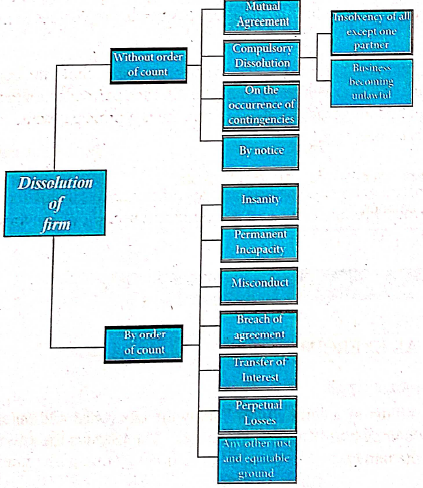
14.
The Person who enters into the partnership are individually called Partners and collectively known as 'Firm'.
15.
All the affairs of a Joint Hindu Family are controlled and managed by one person who is known as 'Karta' or 'Manager'. The Karta is the senior most male member of the family.
16.
(i) Joint and Several liabilities:
(1) Every partner is jointly and severally liable for all acts of the firm.
(2) It means that in case the assets are inadequate for meeting the claims of creditors, even their personal properties should be made available.
(3) The creditors can recover their claims from all the partners.
(ii) Liable for any loss to the third party:
The firm is liable for any loss caused to a third party because of a wrongful act done in the ordinary course of business.
(iii) Liability to the third party to make good the loss:
Where a partner receives money or property from a third party on behalf of the firm and misappropriates it, then the firm is liable to make good the loss.
17.
(i) A minor is a person who has not completed 18 years of age, where a guardian is appointed by a court, his age majority extends to 21 years.
(ii) Legally, a minor cannot become a Partner because he is incapable of entering into a contract.
(iii) He may however be admitted to the benefits of Partnership with the consent of all partners.
18.
Joint and Several liabilities:
Every partner is jointly and severally liable for all acts of the firm. It means that in case the assets are inadequate for meeting the claims of creditors, even their personal properties should be made available. The creditors can recover their claims from all the partners.
19.
1. A secret partner is one whose association is not known to the general public.
2. Other than this distinct feature, he is like rest of the partners in all respects.
20.
Though a partnership agreement need not necessarily be in writing, it is important to have a written agreement in order to avoid misunderstandings; it is desirable to have a written agreement. A carefully drafted partnership deed helps in ironing out differences which may develop among partners and in ensuring smooth running of the partnership business. It should be properly stamped and registered.
21.
Characteristics: The main characteristics of Joint Hindu Family Business are given below:
(i) Governed by Hindu Law: The business of the Joint Hindu Family is controlled and managed under the Hindu law.
(ii) Management: All the affairs of a Joint Hindu Family are controlled and managed by one person who is known as 'Karta' or 'Manager'. The Karta is the senior most male member of the family.
(iii) Membership Birth: The membership of the family can be acquired only by birth. Membership requires no consent or agreement.
(iv) Liability: Except the Karta, the liability of all other members is limited to their shares in the business.
(v) Permanent Existence: The death, lunacy or insolvency of any member of the family does not affect the existence of the business of Joint Hindu Family.
(vi) Implied Authority of Karta: In a joint family firm, only Karta has the implied authority to enter into a contract for debts and pledge the property of the firm for the ordinary purpose of the businesses of the firm.
22.
23.
Contents of Partnership Deed:
a) Name:
Name of the Firm.
b) Nature of Business:
Nature of the proposed business to be carried on by the partners.
c) Duration of Partnership:
Duration of the partnership business whether it is to be run for a fixed period of time or whether it is to be dissolved after completing a particular venture.
d) Capital Contribution:
The capital is to be contributed by the partners. It must be remembered that capital contribution is not necessary to become a partner for one who contribute his organising power, business acumen, managerial skill, etc., instead of capital.
e) Withdrawal from the Firm:
The amount that can be withdrawn from the firm by each partner
f) Profit/Loss Sharing:
The ratio in which the profits or losses are to be shared. If the profit sharing ratio is not specified in the deed, all the partners must share the profits and bear the losses equally.
g) Interest on Capital:
Whether any interest is to be allowed on capital and if so, the rate of interest. If the deed is silent on interest on capital, the rules for interest on capital in partnership act will take effect.
h) Rate of Interest on Drawing:
Whether any interest is to be allowed on drawing, the rate of interest is to be specified.
i) Loan from Partners:
Whether loans can be accepted from the partners and if so the rate of interest payable thereon.
j) Account Keeping:
Maintenance of accounts and audit.
k) Salary and Commission to Partners:
Amount of salary or commission payable to partners for their services. (Unless this is specifically provided, no partner is entitled to any salary).
l) Retirement:
Matters relating to retirement of a partner. The arrangement to be made for paying out the amount due to a retired or deceased partner must also be stated.
m) Goodwill Valuation:
Method of valuing goodwill on the admission, death or retirement of a partner.
n) Distribution of Responsibility:
The work that is entrusted to each partner is better stated in the deed itself.
o) Dissolution Procedure:
Procedure for dissolution of the firm and the mode of settlement of accounts thereafter.
p) Arbitration of Dispute:
Arbitration in case of disputes among partners. The deed should provide the method for settling disputes or difference of opinion. This clause will avoid costly litigations.

11th Standard Syllabus & Materials
11th Standard
TN 11th Tamil பீடு பெற நில் - செய்யுள் - காவடிச்சிந்து Important Questions And Answers Study Material - QB365 Set A
NEW11th Standard
TN 11th Tamil பீடு பெற நில் - உரைநடை - மலை இடப்பெயர்கள் : ஓர் ஆய்வு Important Questions And Answers Study Material - QB365 Set A
NEW11th Standard
TN 11th Tamil மாமழை போற்றுதும் - துணைப்பாடம் - யானை டாக்டர் Important Questions And Answers Study Material - QB365 Set A
NEW11th Standard
TN 11th Tamil மாமழை போற்றுதும் - செய்யுள் - ஐங்குறுநூறு Important Questions And Answers Study Material - QB365 Set A



Tamilnadu Stateboard 11th Standard Subjects

Maths
Commerce

Economics

Biology

Business Maths and Statistics

Accountancy

Computer Science

Physics

Chemistry
Maths
Biology
Economics
Physics
Chemistry

History
Business Maths and Statistics

Computer Science
Accountancy

Computer Applications
History
Computer Technology
Commerce
Computer Applications
Computer Technology

Tamil

English

French
Tamilnadu Stateboard Standards

