
 100% FREE ACCESS
11th Standard Syllabus & Materials
11th Standard
TN 11th Tamil இயற்கை வேளாண்மை,சுற்றுச்சூழல் -செய்யுள் - மனோன்மணீயம் Important Questions And Answers Study Material - QB365 Set A
NEW11th Standard
TN 11th Tamil என்னுயிர் என்பேன் -துணைப்பாடம் - இசைத்தமிழர் இருவர் Important Questions And Answers Study Material - QB365 Set A
NEW11th Standard
TN 11th Tamil மொழி கலை -செய்யுள் - ஒவ்வொரு புல்லையும் Important Questions And Answers Study Material - QB365 Set A
NEW11th Standard
TN 11th Tamil பீடு பெற நில் - இலக்கணம் - பகுபத உறுப்புகள் Important Questions And Answers Study Material - QB365 Set A
NEW11th Standard
TN 11th Tamil பீடு பெற நில் - துணைப்பாடம் - வாடிவாசல் Important Questions And Answers Study Material - QB365 Set A
NEW11th Standard
TN 11th Tamil பீடு பெற நில் - செய்யுள் - குறுந்தொகை Important Questions And Answers Study Material - QB365 Set A

Published on: 28/12/2018
11th Half Yearly Model Question
Download Tamil Nadu 11th Standard Commerce question papers, model tests, one-mark questions, important questions, and public exam papers in PDF format. Free study materials and answer keys for TN State Board students.
Questions + Answers key
Take MCQ Commerce Test1.
What is Cash Reserve Ratio?
2.
What is meant by Industry?
3.
What is FDI?
4.
Explain the meaning of Entrepot trade.
5.
What is meant by Entrepot Trade?
6.
What do you mean by Balance of Payment?
7.
What is free enterprise?
8.
Give two examples of MNC's
9.
What is Sole trading business?
10.
..............are generally organised and managed in the form of a joint stock company.
Multiple shop
Mail order business
Consumer's co-operative society
Hire-purchase system
11.
Mercantile person denotes ....................
Individual
Partnership
A Company
All the above
12.
Debenture holders of a company are its_____________.
creditors
members
credit customers
borrowers
13.
Indent House is also called_______.
indent firms
clearing agent
middle men
service agent
14.
CII stands for ..................
Company Internal Infra-structure
Confederation of Indian Industry
Chamber of Indian Industry
Continuous Internal Intervention
15.
Investment limit of medium enterprises under service sector does not exceeds ........crores.
2
4
5
7
16.
What is the minimum period of Life Assurance?
More than one year
5 years
10 years
15 years or more
17.
Income Tax Act came into force on ________________
1.4.1932
1.4.1962
1.4.1947
1.4.1954
18.
Which of the following is correct.
(i) NEFT - National Electronic Fund Transfer
(ii) RTGS - Real Time Gross Settlement System
(iii) ECS - Electronic Clearing Services
(iv) CORE - Centralised Online Real time Exchange
(i) & (iii)
(i), & (ii) & (iii) only
(ii) , (iii) and (iv) only
All of them
19.
Production which involves several stages for manufacturing finished product is known as __________
Analytical Industry
Synthetic Industry
Processing Industry
None of the above
20.
A Government company purchases shares in the name of
Prime Minister
President
Chief Justice of India
State Chief Minister
21.
A, B, C jointly promised to pay Rs. 50,000 to D. Before performance of the contract, C dies. Here, the contract ______________
Becomes void on C's death
Should be performed by A and B along with C's legal representatives.
Should be performed by A and B alone
Should be renewed between A, B and D
22.
A partnership is registered with _______.
Registrar of Companies
Registrar of Co-operatives
Registrar of Firms
District Collector
23.
Debenture holders are entitled to a fixed rate of ________.
Dividend
Profits
Interest
Ratios
24.
The document which authorizes to deliver the goods either in part or full is called ___________.
Warehouse warrant
Dock receipt
Dock warrant
None of these
25.
Trade middleman who acts as a link between wholesaler and customers refers to a ____________
Producer
Broker
retailer
customer
26.
Cooperative fails because of _______.
Unlimited membership
Cash trading
Mismanagement
Loss-making
27.
An organization carrying out activities to move goods from Producer to Consumer is __________
Transport
Logistics
Channels
Marketing
28.
Which bank has the power to issue Bank notes?
Central Bank
Commercial Bank
Co-operative Bank
Foreign Bank
29.
Trade and Commerce was common to ____________ Dynasty.
Pallava
Chola
Pandya
Chera
30.
Show the classification of contract by a flow chart.
31.
What is fire insurance and bring its importance?
32.
What are the major types of Commercial ships?
33.
Under what circumstances can a partnership be dissolved by the court? Dissolution through court (Sec. 44):
34.
At what circumstances the court may order injunction at the time of claim?
35.
Illustrate with example the working of a MNC.
36.
State the investment limit for Medium Enterprise engaged in manufacturing and service sector.
37.
What do you mean by Core Banking Solutions?
38.
Write a note on Agricultural Income.
39.
Explain the objectives of Export Trade?
40.
Explain the types of Mercantile Agents
41.
Describe the contract to be discharged by the operation law.
42.
Describe the demerits of Foreign Trade.
43.
Take up a recent newspaper clipping about RBI such as the measures taken to reduce NPA etc.
44.
Explain Corporate Social Responsibility in India with an example:
45.
What are the disadvantages of franchising?
46.
Explain the various kinds of industries on the basis of size.
47.
State any three limitations of departmental stores
48.
Explain the various documents involved in Transport?
49.
Highlights the functions of IBRD
50.
51.
Explain the essentials of a valid contract?
52.
Write a note on consumer Co-operative Society ?
53.
List out the various Sources of Financing.
54.
Explain the development of Commerce and Trade in North India.
1.
Cash Reserve Ratio (CRR): It is the ratio of Cash reserves with the RBI kept by Scheduled banks in proportion to the Total Time and Demand Liabilities with them.
2.
Industry includes all those business activities which are connected with raising, producing or processing of consumer goods. Example-bread, butter, cheese, shoes, or capital goods like machinery.
3.
Foreign direct investment (FDI) is an investment made by a company or an individual in one country with business interests in another country, in the form of either establishing business operations or acquiring business assets in the other country, such as ownership or controlling interest in a foreign company.
4.
Entrepot trade means importing of goods from one country and exporting the same to foreign countries. It is also known as 'Re-export trade'.
5.
When the firm of a country imports goods for the purpose of exporting the same goods to the firms of some other country with or without making any change in the goods meant for export it is known as entrepot trade.
6.
Balance of payment refers to a systematic record of all economic transactions between the residents of one country and the residents of foreign countries during a particular period of time. For example: one year.
7.
1. A Business Enterprise which accepts and discharges social obligations enjoys greater freedom.
2. For Example, the government has passed the consumer protection Act to prevent businessmen from indulging in adulteration, black marketing and other anti-social practices.
8.
(i) Bata corporation
(ii) Coca-cola corporation
9.
A sole trader is a simple business structure whereby one individual runs and owns the entire business.
10.
(a)
Multiple shop
11.
(d)
All the above
12.
(a)
creditors
13.
(a)
indent firms
14.
(b)
Confederation of Indian Industry
15.
(c)
5
16.
(d)
15 years or more
17.
(b)
1.4.1962
18.
(d)
All of them
19.
(c)
Processing Industry
20.
(b)
President
21.
(b)
Should be performed by A and B along with C's legal representatives.
22.
(c)
Registrar of Firms
23.
(c)
Interest
24.
(c)
Dock warrant
25.
(c)
retailer
26.
(c)
Mismanagement
27.
(a)
Transport
28.
(a)
Central Bank
29.
(c)
Pandya
30.
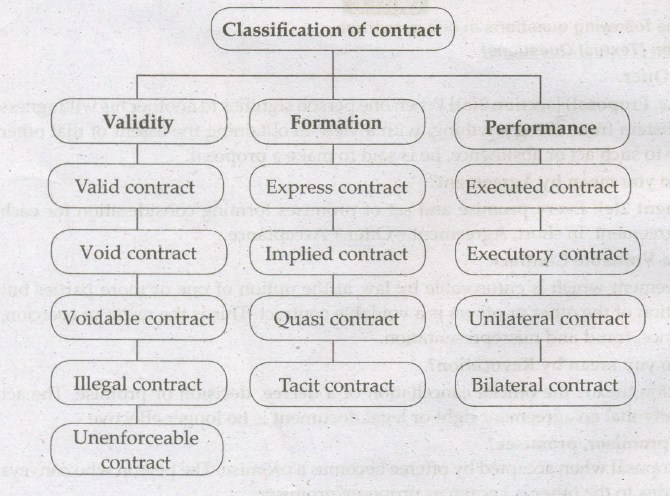
31.
A fire insurance contract does not ensure the safety of the insured property. Its purpose is to compensate the pecuniary loss from the insured property due to fire. It is a personal contract between the insurer and the insured. If the insured property is transferred to another person, the contract of insurance comes to an end. Thus, the object of fire insurance is to indemnity, the insured against loss from fire.
32.
The major types of commercial ships are:
(i) General cargo ship
(ii) Bulk carriers
(iii) Container ships
(iv) Auto carrier
(v) Tankers
(vi) Fishing vessels
(vii) Oil vessels
(viii) Passengers ships
(ix) Ferryboats
(x) Tow and tug boats
(xi) Specialised ships
33.
Any partner may bring a suit in a court of law to get the partnership dissolved on any of the following grounds:
(i) Partner's insanity,
(ii) Permanent incapacity,
(iii) Persistent breach of agreement,
(iv) Misconduct of a partner,
(v) Transfer of share without consent of other partners,
(vi) Continuous loss,
(vii) Just and equitable grounds.
34.
The court may order injunction in the following cases:
1. If the contract is voidable
2. If the contract becomes void or
3. On discovering the contract as void.
35.
1. Any company is referred to as a multinational company or corporation (MNC) when that company manages its operation or production or service delivery from more than a single country.
2. It has its headquarters based in one country with several other operating branches in different other countries.
3. The country where the headquarters is located is called the home country whereas; the other countries with operational branches are called the host countries.
4. Example: IBM
36.
| Enterprise | Manufacturing Sector | Service Sector |
| A medium enterprise | More than 5 Crores but not exceeding Rs.10 crores | More than Rs.2 crores but not exceeding Rs.5 crores |
37.
1. 'CORE' stands for 'Centralized Online Real time Exchange'.
2. In the centralized server of the bank, all the details of all the accounts of all the branches of the bank are available.
3. A customer can withdraw money through cheque at any branch of that bank throughout the world.
4. Similarly anyone can deposit money into the account.
38.
(i) Any rent or revenue derived from land which is situated in India and is used for agricultural purpose.
(ii) Agricultural income is fully exempted from tax u/s 10(1) and as such does not form part of total income.
39.
The important objectives of export trade are:
(i) Facilitating selling of goods to countries which desperately need such goods.
(ii) Expanding the market for goods by producing them on a large scale.
(iii) Earning foreign exchange through exports.
(iv) Helping a country increase the national income.
(v) Creating employment opportunity by promoting export-oriented and export-related enterprises.
(vi) Creating revenue for the government in the form of customs and excise duties.
(vii) Promoting mutual understanding and cooperation among the nations.
(viii) Achieving optimum utilisation of resources by largescale production of goods.
40.
Kinds of Mercantile Agents or Agent Middlemen:
1. Brokers
2. Factors
3. Commission Agents
4. Del-credere Agents
5. Auctioneers
6. Warehousekeepers.
41.
A contract can be discharged by the operation of law. The operation of law by which contract can be discharged are:
(i) By Death:
If the contracts depend on the personal skill'or ability, then such contract may be discharged on the death of the promisor
(ii) By Merger:
Merger will take place when an inferior right accruing to the same party either under the same or another contract.
(iii) By Insolvency:
An insolvent is discharged from all liabilities incurred prior to his adjudication.
(iv) Unauthorised Alteration of the Terms of a Contract:
If one party makes any material alteration in the contract without the consent ofthe other party, then the other party can avoid the contract.
(v) Rights and liabilities vesting in the same person:
Where the right and liability become vested in the same person, the other parties are discharged.
42.
The demerits of Foreign Trade are:
(i) Complicated procedure:
Export and import procedures are very complicated. A layman cannot understand them easily.
(ii) Economic dependence:
The underdeveloped country has to depend on the exporting country which leads to the exploitation of the developing country.
(iii) Adverse effect on the home industry:
International trade provides a threat to the smalland cottage industries at home. These industries cannot stand in competition to the developed countries products.
(iv) Import of harmful goods:
Import of luxury goods and harmful drugs hamper the well being of the people,
(v) World war:
Due to unhealthy competition, enmity among the countries may increase. This may lead to war between countries.
(vi) Political dependence:
It may make one country a slave of other country. Because economic dependence endangers the political stability of the dependent country.
(vii) Exhaust of natural resources:
With the intention of earning more money excessive use of natural resources may take place. This will cause the economic downfall of the country in the long run.
43.
The non-performing asset (NPA) situation has been one of the contentious issue in the country over the last few years. Even though demonstration has been issueed. Recently, the issue of NPAs has been at the foremost of the banking fraternity's concerns in the last year. In the context of an ordinance issued by the government to provide more independence to the Rese~e Bank of India (RBI), it is important to understand what can really be done, considering that RBI has more powers to address this issue. The question for the RBI now is "How will it solve the problem?". While experts have commented on various measures, it would also be prudent to look across the border to China to see how to deal with this.
1. The first was to reduce risks by strengthening banks and spearheading reforms to the state-owned enterprises (SOEs) by reducing their level of debt.
2. The second important measure was enacting laws that allowed the creation of assets management companies, equity participation and most importantly asset-based securitization.
3. The third key measure that the China took was to ensure the government had the financial loss of the debt "discounted" and debts equity swaps were allowed in case of growth opportunity.
4. The fourth measure they took was producing incentives like tax breaks, exemption from administrative fees and transparent evaluation norms.
To conclude, it is important to look after some of the key measures taken by other countries to address the NPA issue. India should learn from it, especially is the context of valuations, securitization and more targeted NPA redresal mechanism.
44.
Tata Group is the best example for the corporate social responsibility in India. The Tata Group conglomerate in India carries out various CSR projects, most of which are community improvement and poverty alleviation programs. Through self-help groups, it is engaged in women empowerment activities, income generation, rural community development, and other social welfare programs. In the field of education, the Tata Group provides scholarships and endowments for numerous institutions.
45.
Franchising fees:
The initial franchising fee and the subsequent renewal fees can be very high in case of successful businesses. From the franchisee's point of view, this may be a deterrent.
Fixed royalty payment:
The franchisee has to make payment of royalty to the franchiser on a regular basis. This considerably reduces the income of the franchisee.
Danger of image tarnishing:
If the franchisee does not maintain standards of quality and service; there is a danger that the goodwill and image of the reputed franchiser will be adversely affected.
Lack of freedom:
The franchisee does not have the freedom to run his business in an independent manner. He has to abide by management and operational policies of the franchiser, This may serve as a deterrent whether suitable to him or not.
Limitation on range of products:
The franchisee cannot introduce new product lines into the business, except those permitted by franchiser. This may mean loss of business to franchisee amidst demands based on local conditions.
46.
On the basis of size or scale of operations industries may be classified as follows:
1. Micro Industries
2. Small Industries
3. Medium Industries and
4. Large Industries
Under the Micro, Small and Medium Enterprises (MSME) Development Act, 2006, the above types of industries are defined as follows.
1. Micro Units:
A unit wherein investment in plant and machinery is up to Rs. 25 lakhs in case of manufacturing and up to Rs. 10 lakhs in case of service enterprises.
2. Small Units:
A manufacturing unit wherein investment in plant and machinery is more than Rs. 25 lakhs but does not exceed Rs. 5 crore. In case of service enterprises these limits are Rs. 10 lakhs and Rs. 2 crore respectively.
3. Medium Units:
A manufacturing unit wherein investment in plant and machinery is more than Rs. 5 crore but does not exceed Rs. 10 crore. In case of service enterprises, these limits are Rs. 2 crore and Rs. 5 crore respectively.
4. Large Industries:
A manufacturing unit wherein investment in plant and machinery exceeds Rs. 10 crore. In case of a service unit investment in equipment exceeds Rs. 5 crore.
47.
(i) High cost of operation :
(1) A departmental store requires a large building with ample parking at a central place. It has to incur heavy expenditure on salaries, maintenance of building, customer services, advertising, etc
(2) As a result, establishment and overhead cost of operation are very high
(ii) Higher Prices:
(i) Due to high operating costs, prices of goods in a departmental store are comparatively high.
(ii) Only rich persons can afford to buy goods at a departmental store.
(iii) Distance:
It is located at a central place of a city, away from people living in suburban areas have to travel a long distance to reach the store.
(iv) Lack of Personal Touch:
(i) The management of a store finds it very difficult to maintain personal contact with the consumers.
(ii) The salaried staff may not take interest in securing the satisfaction and goodwill of the consumers.
(v) Difficult to Establish:
A large amount of Capital investment and a large number of specialised persons are required to establish a departmental store.
(vi) High Risk:
Due to Central Location and large-scale operations, risk of loss is very high. Moreover, change in tastes and fashion and market fluctuations may lead to heavy loss
48.
(i) Way Bill:
(1) The way bill is an acknowledgement of receipt of goods for transport by the carrier.
(2) The carrier, accepting goods for transport, issues way bills in the name of the consignors or consignees.
(3) It serves as an evidence of the contract of transport. It is also a document of title of goods.
(ii) Railway Receipt:
(1) Railway Receipt is an acknowledgement of receipt of goods by the railway for transporting.
(2) It serves as a document of title of goods. It may be issued in the name of the consignor or consignee.
(3) Only on presentation of the railway receipt the railways will deliver the goods.
(iii) Bill of Lading :
(1) Bill of Lading is a document containing the terms and conditions of the contract of carriage.
(2) It is issued by the shipping company and signed by the captain of the ship.
(3) It acknowledges the receipt of the goods described in it on board the ship. It is also serves as an official receipt of goods. It is a document of title of goods.
(iv) Charter Party:
(1) When goods are to be consigned in large quantity, it is advantages to hire the whole or substantial part of the ship.
(2) The document through which this contract is made is known as 'Charter Party' which may be 'Voyage Charter' or 'Time Charter'.
(3) The person who hires the ship is known as 'Charter'. The charter party brings the vessel and crew under the control of the charters.
(v) Air Consignment Note:
(1) It is a document prepared by the consignor, which is handed over to the carrier of goods, while transporting goods through Airways. Air Consignment Note is made out in three original parts.
(2) One is signed by the consignor and marked for the carrier.
(3) The second is signed by both the consignor and the carrier and marked for the consignee and third is signed by the carrier and handed over to the consignor after the goods have been accepted.
49.
Functions Of IBRD:
The main functions of World Bank are as follows:
(i) Assisting reconstruction of war-affected countries.
(ii) Promoting economic growth and balanced growth of international Business.
(iii) Promoting infrastructural facilities like energy and transportation, road development, etc. in member countries.
(iv) Encouraging agricultural and industrial development in developing countries by providing adequate resources.
(v) Providing resources for promoting sanitation, education, healthcare and small-scale enterprises in member countries.
(vi) Improving standard of living of people of member countries by providing assistance' by removing poverty, raising productivity, providing technical support and conducting research and development.
50.
51.
Essentials of a Valid Contract:
"All agreements are contracts, if they are made by free consent of the parties, competent to contract, for a lawful consideration and with a lawful object, and not hereby expressly declared to be void" Sec.10.
a) Offer and Acceptance:
There must be two parties to an agreement namely one party making the offer and the other party accepting it.
b) Legal Relationship:
1. The parties must have the intention to create legal relationship between them.
2. An agreement of Social or domestic nature is not at all a contract.
c) Lawful Consideration (quid pro quo):
1. As per Contract Act under Sec.2(d) Consideration means something in return.
2. A contract without consideration becomes invalid.
3. It may be in cash or kind or in any form as specified in the act.
4. Consideration must not be unlawful, immoral or opposed to the public policy.
d) Lawful Object (Section 23):
1. The object of agreement should be lawful and legal.
2. It must not be immoral, illegal or opposed to public policy.
3. Two persons cannot enter into an agreement to do a criminal act.
e) Free Consent (Section 13 & 14):
1. Consent of the parties must be free and genuine.
2. Consent means agreeing upon same thing in the same sense at the same time i.e. there should be consensus-ad-idem.
3. Consent is said to be free when it is not caused by coercion, undue influence, fraud, misrepresentation or mistake.
f) Capacity of Parties (Section 11):
1. The parties to a contract must have capacity (legal ability) to make valid contract.
2. The Indian contract Act specifies that every person is competent to contract provided
a) is of the age of majority according to the Law which he is subject to, and
b) who is of sound mind and
c) is not disqualified from contracting by any law to which he is subject to an alien enemy, foreign sovereigns and accredited representative of a foreign state, insolvents and convicts are not competent to contract.
g) Certainty of Terms (Section 29):
1. The agreement should be clear to the parties of the agreement.
2. The agreement must be precise. For example X informs Y "I agree to sell my car".
3. X has four cars. Here nothing is stated about which car he is going to sell. There is no clarity of terms.
h) Possibility of Performance (Section 56):
1. The terms of the agreement should be capable of performance.
2. An agreement to do an act, impossible in itself cannot be enforced.
3. For example A agrees to B to discover a new planet. The agreement is void because the act in itself is impossible to be performed from the very beginning.
i) Not declared Void:
The agreement should be such that it should be capable of being enforced by law. Certain agreements have been expressly declared illegal or void by the law.
j) Necessary Legal Formalities:
1. A contract may be oral or in writing. Where a particular type of contract is required by law to be in writing and registered, it must comply with necessary formalities as to writing, registration and attestation.
2. If legal formalities are not carried out then the contract is not enforceable by law.
52.
1. Consumer cooperatives are organized by consumers that want to achieve better prices or quality in the goods or services they purchase.
2. In contrast to traditional retail stores, or service providers, a consumer cooperative exists to deliver goods or services rather than to maximize profit from selling those goods or services.
3. Nationally, the most widely used cooperative form is the credit union, with some 90 million members.
4. Credit union assets have grown a hundred-fold in three decades.
5. Credit unions are essentially cooperatives of people that use banking services.
6. Students' cooperative stores, Cooperative provision stores, and supermarkets set up on cooperative societies of India are examples of this type.
53.
The various sources of Finance can be classified into three categories on the basis of :
(i) Period
(ii) Ownership and
(iii) Source of generation
(i) On the basis of period :
The different source of finance can be further grouped into three categories on the basis of period:
(1) Short-term Finance - Bank overdraft, Commercial paper
(2) Medium-term Finance - Loan from bank, Lease financing.
(3) Long-term Finance - Shares, Debentures, etc.
(ii) On the basis of Ownership:
Business Finance can be divided into two categories based on ownership funds :
(1) Owners Funds - Equity shares, Retained earnings.
(2) Borrowed Funds - Debentures, loan from bank and institutions.
(iii) On the basis of Generation:
The sources of funds can be grouped into two categories based on generation:
(1) Internal sources - Trade debtors and bills receivable.
(2) External sources - Factoring, Leasing, Hire purchasing, etc.
54.
Commerce and Trade in North India:
1. India was prosperous even during medieval period from 12th to 16th centuries despite political upheavals.
2. Balban was first sultan who paved the way in the dense forest and helped traders and their commercial caravans to move from one market place to others.
3. Alauddin Khilji brought the price to a very low ebb.
4. He encouraged import of foreign goods from Persia and subsidised the goods.
5. Arabs were dominant players in India's foreign trade.
6. They never discouraged Indian traders like Tamils, Gujaratis, etc.
7. The trade between the coastal ports were in the hands of Marwaris and Gujaratis.
8. The overland trade with central and west Asia was in the hands of Multanis who were Hindus and Khurasanis who were Afghans, Iranians and so on.
9. During Sultanate period, trade flourished due to the establishment of currency system based on silver and copper.
10. Moorish traveller described the teeming market of big cities in the Gangetic plains, Malwa, Gujarat and South India.
11. The important trade centres were Delhi, Mumbai, Ahmedabad, Sonar, Sonargoon, Jaunpur, Lahore and so on. The burgeoning foreign trade led to the development of market place in the towns and villages.
12. India's handicraft commanded a good foreign market. India imported horses, dry fruits, precious stones, glassware, high grade textiles, raw silk, corals, scented oil, velvets, etc.. from Kabul, Arabia, Europe, West Asia and China.
13. Indian products were exported to East Africa, Malaya, China and Far East.
14. Trade was conducted through overland routes with Afghanistan, Central Asia and Persia. India conducted foreign trade via land route with Quetta, Khyber pass, Iraq and Bukhara.
15. The traders of Malabar, Gujarat and foreign settlers in the ports of Calicut, Khambhat and Mangalore controlled a major business sector in port cities.

11th Standard Syllabus & Materials
11th Standard
TN 11th Tamil பீடு பெற நில் - செய்யுள் - காவடிச்சிந்து Important Questions And Answers Study Material - QB365 Set A
NEW11th Standard
TN 11th Tamil பீடு பெற நில் - உரைநடை - மலை இடப்பெயர்கள் : ஓர் ஆய்வு Important Questions And Answers Study Material - QB365 Set A
NEW11th Standard
TN 11th Tamil மாமழை போற்றுதும் - துணைப்பாடம் - யானை டாக்டர் Important Questions And Answers Study Material - QB365 Set A
NEW11th Standard
TN 11th Tamil மாமழை போற்றுதும் - செய்யுள் - ஐங்குறுநூறு Important Questions And Answers Study Material - QB365 Set A



Tamilnadu Stateboard 11th Standard Subjects

Maths
Commerce

Economics

Biology

Business Maths and Statistics

Accountancy

Computer Science

Physics

Chemistry
Maths
Biology
Economics
Physics
Chemistry

History
Business Maths and Statistics

Computer Science
Accountancy

Computer Applications
History
Computer Technology
Commerce
Computer Applications
Computer Technology

Tamil

English

French
Tamilnadu Stateboard Standards

