
 100% FREE ACCESS
11th Standard Syllabus & Materials
11th Standard
TN 11th Tamil இயற்கை வேளாண்மை,சுற்றுச்சூழல் -செய்யுள் - மனோன்மணீயம் Important Questions And Answers Study Material - QB365 Set A
NEW11th Standard
TN 11th Tamil என்னுயிர் என்பேன் -துணைப்பாடம் - இசைத்தமிழர் இருவர் Important Questions And Answers Study Material - QB365 Set A
NEW11th Standard
TN 11th Tamil மொழி கலை -செய்யுள் - ஒவ்வொரு புல்லையும் Important Questions And Answers Study Material - QB365 Set A
NEW11th Standard
TN 11th Tamil பீடு பெற நில் - இலக்கணம் - பகுபத உறுப்புகள் Important Questions And Answers Study Material - QB365 Set A
NEW11th Standard
TN 11th Tamil பீடு பெற நில் - துணைப்பாடம் - வாடிவாசல் Important Questions And Answers Study Material - QB365 Set A
NEW11th Standard
TN 11th Tamil பீடு பெற நில் - செய்யுள் - குறுந்தொகை Important Questions And Answers Study Material - QB365 Set A

Published on: 21/09/2019
Download Tamil Nadu 11th Standard Commerce question papers, model tests, one-mark questions, important questions, and public exam papers in PDF format. Free study materials and answer keys for TN State Board students.
Questions + Answers key
Take MCQ Commerce Test1.
What are the different types of companies?
2.
What are Foreign banks?
3.
Give two examples of MNC's
4.
Write a note on Profession.
5.
Who is a Minor?
6.
Define Cooperatives.
7.
What is meant by Nalangadi?
8.
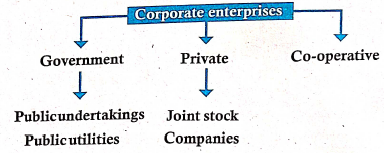
What are the Corporate enterprises?
9.
Commerce is mainly concerned with ______.
Connecting producer and consumer
Pricing of Goods
Buying and Selling of Goods
Manufacturing of goods
10.
The Board of directors of a company is elected by _________
Creditors
Debtors
Debenture holders
Shareholders (members)
11.
The share capital of the government company must not be less than
75%
60%
95%
51%
12.
Foreign banks are begun their operation since
1978
1979
1980
1976
13.
Activities undertaken out of love and affection or with social service motive are termed as:
Economic activities
Monetary activities
Non Economic activities
Financial Activities
14.
The firm of Hindu Undivided Family is managed by whom?
Owner
Karta
Manager
Partner
15.
The Central Bank of India is
PNB
SBI
ICICI
RBI
16.
In Pandyas Dynasty the place where the goods are sold is ______
Angadi
Market
Nalangadi
Allangadi
17.
Narrate commerce with an example.
18.
19.
Explain the classification of ‘Business’.
20.
What is meant by Joint and Several Liability?
21.
What is meant by Producers Cooperative Society?
22.
Explain the origin of RBI.
23.
What are the ports developed by Pandiya Kingdom?
24.
What are the advantages and disadvantages of Public corporation?
25.
Distinguish between economic and non-economic activity.
26.
State the demerits in barter system.
1.
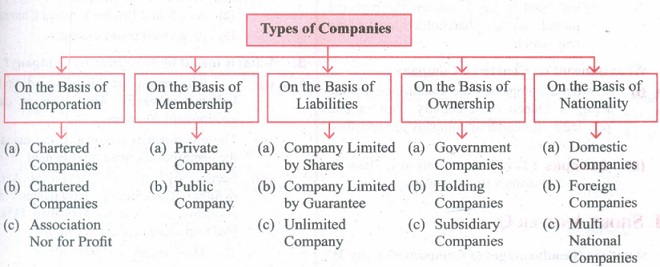
Chartered company, statutory company, public limited company, private limited company and government company are some of the different types of Companies.
2.
Banks which have registered office in a foreign country and branches in India are called foreign banks.
3.
(i) Bata corporation
(ii) Coca-cola corporation
4.
(i) Professions are those occupations which involve rendering of personal services of a special and expert nature.
(ii) It includes professional activities.
(iii) People engaged in a profession are known as Professionals.
For Example: Lawyers, Doctors, Engineers and Chartered Accountants.
5.
Under the Indian Majority Act, person who has not completed 18 years of age is a minor. However, he will continue to be a minor till he completes 21 years if a guardian has been appointed to the minor. He can be admitted to the benefits of partnership.
Partnership arises as a result of contract. But a minor has no contractual capacity. Though a partnership cannot be created with a minor as a partner, a minor can be admitted to the benefits of a partnership which is already in existence. The consent of all partners is a 'must' for such admission.
6.
According to Sir Horace Plunkett, Co-operation is "better farming, better business and better living".
7.
Day market was called as Nalangadi.
8.
9.
(a)
Connecting producer and consumer
10.
(d)
Shareholders (members)
11.
(d)
51%
12.
(c)
1980
13.
(c)
Non Economic activities
14.
(b)
Karta
15.
(d)
RBI
16.
(a)
Angadi
17.
(i) Commerce refers to all those activities which are necessary for bringing goods from the place of production to the place of their consumption.
(ii) According to Evelyn Thomas "Commercial Operations deal with the Buying and Selling of goods, the exchange of commodities and the contribution of finished products".
(iii) Commerce includes not only trade but also services such as transport warehousing, packaging, insurance, banking and sales Promotion which are incidental or auxiliaries to trade.
(iv) Nearly every business transaction is a form of commerce. purchasing food at a restaurant, buying stocks on the stock market, selling goods in a store, drilling for oil etc.
(v) For example, international commerce takes place between countries, interstate commerce is done across state lines and electronic commerce takes place via the Internet.
18.
19.
On the basis of size, business activities may be broadly grouped into two categories.
A. Small Scale:
Small scale units require less capital, employ a small number of workers and produce the goods on small scale
B. Large Scale:
Large scale units require huge capital, employ large number of workers and produce the goods on large scale.
20.
Joint and Several liabilities:
Every partner is jointly and severally liable for all acts of the firm. It means that in case the assets are inadequate for meeting the claims of creditors, even their personal properties should be made available. The creditors can recover their claims from all the partners.
21.
(i) Producer co-operatives are established and operated by producers.
(ii) Producers can decide to work together or as separate entities to help increase marketing possibilities and production efficiency.
22.
Origin of RBI:
1. The imperial bank of India carried out the note issue and other functions of the Central Bank.
2. In 1926 the Hilton-Young Commission or the Royal Commission on Indian Currency and Finance (J.M. Keynes and Sir Ernest Cable were its members) made recommendations to create a Central Bank.
3. As a result, the RBI Act 1934 was passed and RBI launched in its operations from April 1, 1935.
4. RBI was established with a share capital of Rs.5 crores divided into shares of Rs.100 each fully paid up.
5. The entire share capital was owned by the private shareholders. Its head office was in Calcutta and moved to Mumbai in 1937.
6. After independence, the Government of India passed Reserve Bank (Transfer to Public Ownership) Act, 1948 and took over RBI after paying appropriate compensation to the private shareholders.
7. From January 1, 1949, RBI started functioning as a government owned central bank of India.
8. It had three departments. The RBI was the central bank of Burma until 1947, and the central bank of Pakistan until June 1948.
23.
Port towns like Tondi, Korkai, Puhar and Muziri were developed by Pandiya kingdom.
24.
Advantages of Public Corporation:
a) Bold Management due to Operational Autonomy:
i. A public corporation enjoys internal operational autonomy; as it is free from Governmental control. It can, therefore, run in a business like manner.
ii. Management can take bold decisions involving experimentation in its lines of activities, taking advantage of business situations.
b) Legislative Control:
i. Affairs of a public corporation are subject to scrutiny by Committees of Parliament or State Legislature.
ii. The Press also keeps a watchful eye on the working of a public corporation.
iii. This keeps a check on the unhealthy practices on the part of the management of the public corporation.
c) Qualified and Contented Staff:
i. Public corporation offers attractive service conditions to its staff. As such it is able to attract qualified staff.
ii. Because of qualified and contented staff, industrial relations problems are not much severe.
iii. Staff has a motivation to work hard for the corporation.
d) Tailor-Made Statute:
The special Act, by which a public corporation is created, can be tailor-made to meet the specific needs of the public corporation; so that the corporation can function in the best manner to achieve its objectives.
e) Not Affected by Political Changes:
i. Being a distinct legal entity, a public corporation is not much affected by political changes.
ii. It can maintain continuity of policy and operations.
Disadvantages of Public Corporation:
a) Autonomy and Flexibility, Only in Theory:
i. Autonomy and flexibility advantages of a public corporation exist only in theory
ii. In practice, there is a lot of interference in the working of a public corporation by ministers, government officers and other politicians.
b) Misuse of Monopolistic Power:
i. Public corporations often enjoy monopoly in their field of operation.
ii. As such, on the one hand they are indifferent to consumer needs and problems; and on the other hand, often do not hesitate to exploit consumers.
c) Rigid Constitution:
i. The constitution of a public corporation is very rigid.
ii. It cannot be changed, without amending the Statute of its formation. Hence, a public corporation could not be flexible in its operations.
d) Low Managerial Efficiency:
i. Quite often civil servants, who do not possess management knowledge and skills, are appointed by the government on the Board of Directors, of a public corporation.
ii. As such, managerial efficiency of public corporation is not as much as found in private business enterprises.
e) Problem of Passing a Special Act:
A public corporation cannot be formed without passing a special Act; which is a time consuming and difficult process. Hence, the scope for setting up public corporations is very restricted.
25.
| Basis | Economic activities | Non-economic activities |
| (1) Definition | Economic activities are those activities which are undertaken to earn money or financial gain for livelihood. e.g.: Fruit seller selling fruits. |
Non-economic activities are those activities which are undertaken for the sake of pleasure, performed out of love, sympathy, sentiments etc. e.g.: Mother cooks for her family, |
| (2) Motive | The Sole motive is to earn money or financial gain. e.g.: Working as lawyer |
Undertaken for satisfaction of social, psychological or emotional needs. e.g.: Visit to a temple |
| (3) Money Measurement | All economic activities can be valued in monetary terms. e.g.: Doctor charges a fee for consultation. |
Non-economic activities cannot be valued in monetary terms. These are an expression of a thought, feeling or a gesture. e.g.: An NGO distributes free clothes to poor children. |
| (4) Relationship | Economic activities are related to creation of wealth. e.g.: Ram saved part of his salary to purchase a house of his Own. |
Non-economic activities do not create wealth. e.g.: Money received as donation is spent on charity work. |
| (5) Outcome | All economic activities result In production, procurement, distribution and consumption of goods and services. e.g: Nokia produces cell phones and sells across India through its distributors. |
The end result of a non-economic activity is the mental, emotional or psychological satisfaction of the person doing the activity. e.g.: Sona enjoys teaching orphans in an orphanage. |
| (6) Duration | Economic activities are repetitive. They are done on a regular basis to earn a living. e.g.: Kulfi ice cream seller sells ice creams every evening. |
Non-economic activities may not be undertaken regularly. Usually they are done during free time. e.g.: Sankar visits orphanage in his free time |
| (7) Source of Initiation | Economic activities are initiated to satisfy human needs and wants. | Non-economic activities are initiated to satisfy emotional or sentimental pleasures. |
26.
The barter system envisages mutual exchange of one's goods to other without the intervention of money as a medium of exchange. It imposes certain constraints in the smooth flow of trade as explained below.
Lack of Double Coincidence of Wants:
Unless two persons who have surplus have the demand for the goods possessed by each other, barter could not materialize. For instance 'A' is having a surplus of groundnut and 'B' is possessing rice in surplus. In this case A should be in need of rice possessed by B as the latter should desperately need groundnut possessed by A. If this "coincidence of wants" does not exist, Barter cannot take place.
Non-Existence of Common Measure of Value:
Barter system could not determine the value of commodities to be exchanged as they lacked commonly acceptable measures to evaluate each and every commodity. It was difficult to compare the values of all articles in the absence of an acceptable medium of exchange.
Lack of Direct Contact between Producer and Consumers:
It was not possible for buyers and sellers to meet face to face in many contexts for exchanging the commodities for commodities. This hindered the process of barter in all practical sense.
Lack of Surplus Stock:
Absence of surplus stock was one of the impediments in barter system. If the buyers and sellers do not have surplus then no barter was possible.

11th Standard Syllabus & Materials
11th Standard
TN 11th Tamil பீடு பெற நில் - செய்யுள் - காவடிச்சிந்து Important Questions And Answers Study Material - QB365 Set A
NEW11th Standard
TN 11th Tamil பீடு பெற நில் - உரைநடை - மலை இடப்பெயர்கள் : ஓர் ஆய்வு Important Questions And Answers Study Material - QB365 Set A
NEW11th Standard
TN 11th Tamil மாமழை போற்றுதும் - துணைப்பாடம் - யானை டாக்டர் Important Questions And Answers Study Material - QB365 Set A
NEW11th Standard
TN 11th Tamil மாமழை போற்றுதும் - செய்யுள் - ஐங்குறுநூறு Important Questions And Answers Study Material - QB365 Set A



Tamilnadu Stateboard 11th Standard Subjects

Maths
Commerce

Economics

Biology

Business Maths and Statistics

Accountancy

Computer Science

Physics

Chemistry
Maths
Biology
Economics
Physics
Chemistry

History
Business Maths and Statistics

Computer Science
Accountancy

Computer Applications
History
Computer Technology
Commerce
Computer Applications
Computer Technology

Tamil

English

French
Tamilnadu Stateboard Standards

