
 100% FREE ACCESS
11th Standard Syllabus & Materials
11th Standard
TN 11th Tamil இயற்கை வேளாண்மை,சுற்றுச்சூழல் -செய்யுள் - மனோன்மணீயம் Important Questions And Answers Study Material - QB365 Set A
NEW11th Standard
TN 11th Tamil என்னுயிர் என்பேன் -துணைப்பாடம் - இசைத்தமிழர் இருவர் Important Questions And Answers Study Material - QB365 Set A
NEW11th Standard
TN 11th Tamil மொழி கலை -செய்யுள் - ஒவ்வொரு புல்லையும் Important Questions And Answers Study Material - QB365 Set A
NEW11th Standard
TN 11th Tamil பீடு பெற நில் - இலக்கணம் - பகுபத உறுப்புகள் Important Questions And Answers Study Material - QB365 Set A
NEW11th Standard
TN 11th Tamil பீடு பெற நில் - துணைப்பாடம் - வாடிவாசல் Important Questions And Answers Study Material - QB365 Set A
NEW11th Standard
TN 11th Tamil பீடு பெற நில் - செய்யுள் - குறுந்தொகை Important Questions And Answers Study Material - QB365 Set A

Published on: 28/07/2018
In this question paper, it covers the important question from this chapter Computer Organization. The questions are prepared based on the book back and previous year question.
Please click here, to get the answer of this question paper.
Download Tamil Nadu 11th Standard Computer Applications question papers, model tests, one-mark questions, important questions, and public exam papers in PDF format. Free study materials and answer keys for TN State Board students.
Questions + Answers key
Take MCQ Computer Applications Test
1.
Which of the following is an integrated circuit?
Personal computers
Microprocessors
INTEL
Transistors
2.
The first general purpose Microprocessor was......
5005
4004
8085
8086
3.
Microprocessor is driven by ..........
Clock pulses
ALU
Control unit
Register
4.
The first general purpose Microprocessor developed by ............
IBM
Intel
Apple
Microsoft
5.
Microprocessors were first introduced in the early_________.
1956
1958
1960
1970
6.
How many memory locations are identified by a processor with 8 bits address bus at a time?
28
1024
256
8000
7.
Which is the fastest memory?
Hard disk
Main memory
Cache memory
Blue-Ray disc
8.
Which of the following is a CISC processor?
Intel P6
AMD K6
Pentium III
Pentium IV
9.
Which of the following device identifies the location when address is placed in the memory address register?
locator
encoder
decoder
multiplexed
10.
How many bits constitute a word?
8
16
32
determined by the processor used.
11.
What are the methods used to access the memo
12.
Write a note on else processor.
13.
Write a note on RISC processor.
14.
Write down the interfaces and ports available in a computer.
15.
Differentiate PROM and EPROM
16.
Write down the classifications of microprocessors based on the instruction set.
17.
Differentiate Arithmetic and logical operations.
18.
Define Silicon Chip.
19.
What is meant by data transfer?
20.
Name the measurement of clock speed of the computer.
21.
Draw the block diagram of a microprocessor based system.
22.
What are the collections of System Bus?
23.
Define the following. (a) Bus (b) Data bus (c) Address bus (d) Control Bus
24.
Explain the classification of Microprocessor based on Instruction set?
1.
(b)
Microprocessors
2.
(b)
4004
3.
(a)
Clock pulses
4.
(b)
Intel
5.
(d)
1970
6.
(c)
256
7.
(c)
Cache memory
8.
(c)
Pentium III
9.
(c)
decoder
10.
(d)
determined by the processor used.
11.
(i) There are two types of accessing methods to access (read and write) the memory.
(ii) They are sequential access and random access. In sequential access, the memory is accessed an orderly manner from starting to end.
(iii) But, in random access, any byte of memory can be accessed directly without navigating through previous bytes.
12.
(i) CISC stands for Complex Instruction Set Computers.
(ii) They support hundreds of instructions. Computers supporting CISC can accomplish a wide variety of tasks, making them ideal for personal computers.
(iii) Examples of CISC processors are Intel 386 & 480 Pentium, Pentium II and Ill, and Motorola 68000
13.
(i) RISC stands for Reduced Instruction Set Computers. They have a small set of highly optimized instructions.
(ii) Complex instructions are also implemented using simpler instructions, thus reducing the size of the instruction set.
(iii) Examples of RISC processors are Intel P6, Pentium IV, AMD K6 and K7.
14.
(i) Serial Port
(ii) Parallen Port
(iii) USB 3.0
(iv) VGA connector
(v) Audio plugs
(vi) PS/2 Port
(vii) SCSI Port
(viii) High Definition Multimedia Interface(HDMI).
15.
| PROM | EPROM |
| (i) Programmable Read Only Memory | Erasable Programmable Read Only Memory |
| (ii) It is also a non volatile memory on which data can be written only one. | It is also a non-volatile memory and a special type of memory. |
| (iii) PROM burner is used to write data to a PROM chip | Which serves as a PROM, but the content can be erased using ultraviolet rays |
16.
There are two types of microprocessors based on their instruction sets.
(i) Reduced Instruction Set Computers (RISC)
(ii) Complex Instruction Set Computers (CISC)
17.
1. Arithmetic operations are the mathematical operations on data like add, subtract etc.
2. Logical operations are the operations on binary Boolean data like AND, OR, NOT
18.
Silicon chip is an integrated , a set of electronic circuits on one small flat piece of semiconductor material, silicon
19.
Data Transfer means moving data from one component to another
20.
(i) MHz (Mega Hertz)
(ii) GHz (Giga Hertz)
21.
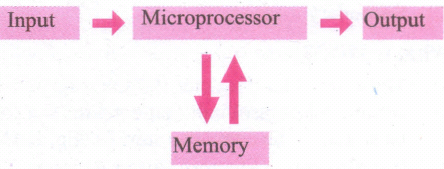
22.
(i) Address Bus
(ii) Data Bus
(iii) Control Bus
23.
(a) Bus:
A bus is a collection of wires used for communication between the internal components of a computer.
(b) Data bus:
(i) Data busis a collection of wires to carry data in bits.
(ii) A data bus is used to transfer data between the memory and the CPU.
(iii) The data bus is bidirectional.
(c) Address bus:
(i) Address bus is a collection of wires to carry data in bits.
(ii) The address bus is used to point a memory location.
(iii) The address bus is unidirectional.
(d) Control bus:
(i) Control bus is a control line/collection of wires to control the operation/functions.
(ii) The control bus controls both read and write operations.
24.
(i) The size of the instruction set is another important consideration while categorizing microprocessors.
(ii) Initially, microprocessors had very small instruction sets because complex hardware was expensive as well as difficult to build.
(iii) As technology had developed to overcome these issues, more and more complex instructions were added to increase the functionality of the microprocessor,
(iv) Let us learn more about the two types of microprocessors which are based on their instruction sets.
(v) RISC stands for Reduced Instruction Set Computers. They have a small set of highly optimized instructions.
(vi) Complex instructions are also implemented using simpler instructions, thus reducing the size of the instruction set.
(vii) Examples of RISC processors are Intel P6, Pentium IV, AMD K6 and K7.
(viii) CISC stands for Complex Instruction Set Computers. They support hundreds of instructions. Computers supporting CISC can accomplish a wide variety of tasks, making them ideal for personal computers.
(ix) Examples of CISC processors are Intel 386 & 486, Pentium, Pentium II and III, and Motorola 68000.

11th Standard Syllabus & Materials
11th Standard
TN 11th Tamil பீடு பெற நில் - செய்யுள் - காவடிச்சிந்து Important Questions And Answers Study Material - QB365 Set A
NEW11th Standard
TN 11th Tamil பீடு பெற நில் - உரைநடை - மலை இடப்பெயர்கள் : ஓர் ஆய்வு Important Questions And Answers Study Material - QB365 Set A
NEW11th Standard
TN 11th Tamil மாமழை போற்றுதும் - துணைப்பாடம் - யானை டாக்டர் Important Questions And Answers Study Material - QB365 Set A
NEW11th Standard
TN 11th Tamil மாமழை போற்றுதும் - செய்யுள் - ஐங்குறுநூறு Important Questions And Answers Study Material - QB365 Set A



Tamilnadu Stateboard 11th Standard Subjects

Maths

Commerce

Economics

Biology

Business Maths and Statistics

Accountancy

Computer Science

Physics

Chemistry
Maths
Biology
Economics
Physics
Chemistry

History
Business Maths and Statistics

Computer Science
Accountancy
Computer Applications
History
Computer Technology
Commerce
Computer Applications
Computer Technology

Tamil

English

French
Tamilnadu Stateboard Standards
