
 100% FREE ACCESS
11th Standard Syllabus & Materials
11th Standard
TN 11th Tamil இயற்கை வேளாண்மை,சுற்றுச்சூழல் -செய்யுள் - மனோன்மணீயம் Important Questions And Answers Study Material - QB365 Set A
NEW11th Standard
TN 11th Tamil என்னுயிர் என்பேன் -துணைப்பாடம் - இசைத்தமிழர் இருவர் Important Questions And Answers Study Material - QB365 Set A
NEW11th Standard
TN 11th Tamil மொழி கலை -செய்யுள் - ஒவ்வொரு புல்லையும் Important Questions And Answers Study Material - QB365 Set A
NEW11th Standard
TN 11th Tamil பீடு பெற நில் - இலக்கணம் - பகுபத உறுப்புகள் Important Questions And Answers Study Material - QB365 Set A
NEW11th Standard
TN 11th Tamil பீடு பெற நில் - துணைப்பாடம் - வாடிவாசல் Important Questions And Answers Study Material - QB365 Set A
NEW11th Standard
TN 11th Tamil பீடு பெற நில் - செய்யுள் - குறுந்தொகை Important Questions And Answers Study Material - QB365 Set A

Published on: 14/12/2019
Computer Ethics and Cyber Security
Download Tamil Nadu 11th Standard Computer Applications question papers, model tests, one-mark questions, important questions, and public exam papers in PDF format. Free study materials and answer keys for TN State Board students.
Questions + Answers key
Take MCQ Computer Applications Test
1.
The crime stealing tiny amounts of money from transaction is _________.
Salami Slicing
Spyware
Malware
Spam
2.
Which of the following is an intellectual whitecollar crime?
Cyber crime
Crime over area
Crime over time
Organized crime
3.
Which of the following is not the common ethical issues?
Cyber crime
Authorized access
Hacking
Piracy
4.
Which of the following is a set of moral principles that regulate the use of computers?
piracy
programs
virus
computer ethics
5.
Which of the following is not a cyber - crime?
Phishing
Piracy
Virus
Crime by area
6.
Which determines the functional output of cryptographic algorithm?
7.
What is meant by cyber attacks?
8.
What is software cracking and password cracking?
9.
What is meant by unauthorized access?
10.
What does software piracy includes?
11.
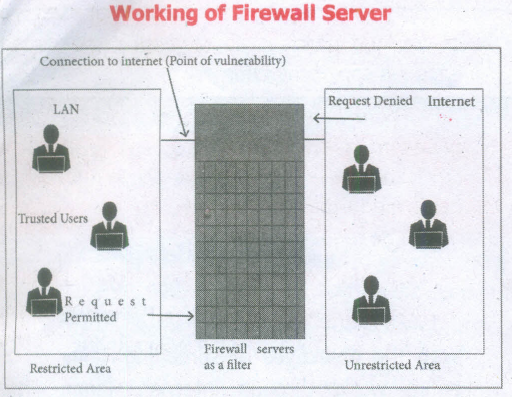
Explain the working of Firewall server.
12.
Explain Cracking in detail.
13.
Explain the function of digital signature.
14.
Explain the different types of encryption.
15.
How to prevent cyber crime?
16.
Explain the working of Proxy Server.
17.
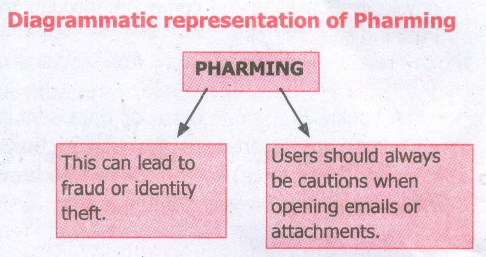
What is Pharming? Explain with suitable diagram.
18.
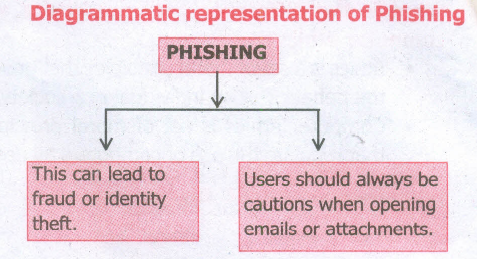
What is phishing? Explain with suitable diagram.
19.
Write note on unauthorized access.
1.
(a)
Salami Slicing
2.
3.
(b)
Authorized access
4.
(d)
computer ethics
5.
(d)
Crime by area
6.
In cryptography a key is a piece of information (parameter) that determines the functional output of a cryptographic algorithm.
7.
Cyber attacks are launched primarily or causing significant damage to a computer system or for stealing important information from an individual or from an organization.
8.
Password cracking is the process of using an application program to identify an unknown or forgotten password to a computer or network resource. It can also be used to help a threat actor obtain unauthorized access to resources. A password cracker recovers passwords using various techniques.
9.
Unauthorized access is when someone gains access to a website, program, server, service, or other system by breaking into a legitimate user account.
10.
It includes stealing of codes/ programs and other information illegally and creating duplicate copies by unauthorized means and utilizing this data either for one's own benefit or for commercial profit.
11.
Firewall Server:
A firewall is a computer network security-based system that monitors and controls the incoming and outgoing network traffic based on predefined security rules. A firewall commonly establishes a block between a trusted internal computer network and entrusted computer outside the network.
They are generally categorized as network-based or host-based.
1. Network-based firewalls are positioned on the gateway computers of LANs [local area Network], WANs [Wide Area Network], and intranets,
2. Host-based firewalls are positioned on the network node itself. The host-based firewall may be a service as a part of the operating system or an agent application such as endpoint security or protection.
12.
CRACKING:
1. Cracking is where someone edits a program source so that the code can be exploited or modified. A cracker (also called a black hat or dark side hacker) is a malicious or criminal hacker
2. "Cracking" means trying to get into computer systems in order to steal, corrupt, or illegitimately view data.
3. A cracker is someone who breaks into someone else's computer system, often on a network, bypassing passwords or licenses in computer programs
4. Software cracking is the most often used of cracking which is nothing but removing tl, encoded copy protection.
5. There is another type of cracking called password cracking. This is mainly used to crack the passwords. Password cracking can be performed either by using an automated program or can be manually realized.
6. One more interesting fact apout cracking is social engineering. It is a method of getting passwords and information using human weakness
7. The other method that uses social engineering crackers is password guessing.
8. They find your personal information from some personal datal facts and try to guess a password
9. Usually a cracker maintains knowledge of the vulnerabilities he or she finds and exploits them for personal advantage, not revealing them to either to the general public or to the manufacturer.
13.
Digital signature :
(i) Digital signatures are based on asymmetric cryptography and can provide -assurances of evidence to origin, identity and status of an electronic document, transaction or message, as well as acknowledging informed by the signer.
(ii) To create a digital signature, signing software (email) creates a one-way hash of the electronic data to be signed.
(iii) The user's private key to encrypt the hash, returning a value that is unique to the hashed data. The encrypted hash, along with other information such as the hashing algorithm, forms the digital signature. Any change in the data, even to a single bit, results in a different hasp value.
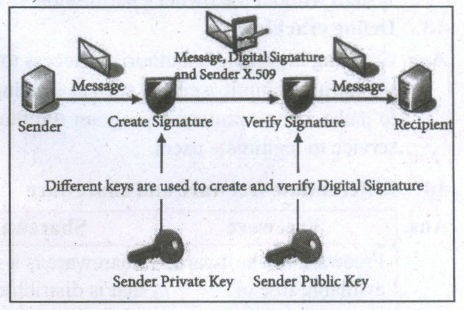
(iv) This attribute enables others to validate the integrity of the data by using the signer's public key to decrypt the hash. If the decrypted hash matches a second computed hash of the same data, it proves that the data hasn't changed since it was signed.
(v) If the two hashes don't match, the data has either been tampered with in some way (indicating a failure of integrity) or the signature was created with a private key that doesn't correspond to the public key presented by the signer (indicating a failure of authentication).
14.
Types of Encryption :
There are two types of encryption schemes as listed below:
i. Synunetric Key encryption,
ii. Public Key encryption.
Symmetric Key Encryption :
Symmetric encryption is a technique to use the same key for both encryption and decryption. The main disadvantage of the symmetric key encryption is that all authorized persons involved, have to exchange the key used to encrypt the data before they can decrypt it. If anybody intercepts the key information, they may read all message. Depicts the working of symmetric key encryption.
Public Key Encryption:
Public key encryption is also called Asymmetric encryption. It uses the concept of a key value pair, a different key is used for the encryption and decryption process. One of the keys is typically known as the private key and the other is known as the public key. The private key is kept secret by the owner and the public key is either shared amongst authorized recipients or made available to the public at large. The data encrypted with the recipient's public key can only be decrypted with the corresponding private key. public key encryption.
15.
To protect the information the following points to be noted:
1. Complex password settings can make your surfing secure.
2. When the internet is not in use, disconnect it.
3. Do NOT open spam mail or emails that have an unfamiliar sender.
4. When using anti-virus software, keep it up to- date
16.
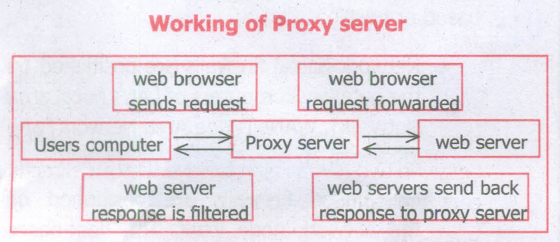
1. A proxy server acts as an intermediary between the end users and a web server. A client connects to the proxy server, requesting some service, such as a file, connection, web page, or other resources available from a different server.
2. The proxy server examines the request, checks authenticity and grants the request based on that. Proxy servers typically keep the frequently visited site addresses in its cache which leads to improved response time.
17.
Pharming:
Pharming is a scamming practice in which malicious code is installed on a personal computer or server, misdirecting users to fraudulent web sites without their knowledge or permission. Pharming has been called "phishing without a trap". It is another way hackers attempt to manipulate users on the Internet. It is a cyberattac intended to redirect a website's traffic to a fake site.
18.
Phishing:
1. Phishing is a type of computer crime used to attack, steal user data, including login name, password and credit card numbers. It occurs when an attacker targets a victim into opening an e-rnailer an instant text message.
2. The attacker uses phishing to distribute malicious links or attachments that can perform a variety of functions including the extraction of sensitive login credentials from victims.
19.
UNAUTHORIZED ACCESS:
1. Unauthorized access is when someone gains access to a website, program, server, service, or other system by breaking into a legitimate user account.
2. For example, if someone tries guessing a password or user name for an account that was not theirs until they gained access, it is considered an unauthorized access.

11th Standard Syllabus & Materials
11th Standard
TN 11th Tamil பீடு பெற நில் - செய்யுள் - காவடிச்சிந்து Important Questions And Answers Study Material - QB365 Set A
NEW11th Standard
TN 11th Tamil பீடு பெற நில் - உரைநடை - மலை இடப்பெயர்கள் : ஓர் ஆய்வு Important Questions And Answers Study Material - QB365 Set A
NEW11th Standard
TN 11th Tamil மாமழை போற்றுதும் - துணைப்பாடம் - யானை டாக்டர் Important Questions And Answers Study Material - QB365 Set A
NEW11th Standard
TN 11th Tamil மாமழை போற்றுதும் - செய்யுள் - ஐங்குறுநூறு Important Questions And Answers Study Material - QB365 Set A



Tamilnadu Stateboard 11th Standard Subjects

Maths

Commerce

Economics

Biology

Business Maths and Statistics

Accountancy

Computer Science

Physics

Chemistry
Maths
Biology
Economics
Physics
Chemistry

History
Business Maths and Statistics

Computer Science
Accountancy
Computer Applications
History
Computer Technology
Commerce
Computer Applications
Computer Technology

Tamil

English

French
Tamilnadu Stateboard Standards
