
 100% FREE ACCESS
11th Standard Syllabus & Materials
11th Standard
TN 11th Tamil இயற்கை வேளாண்மை,சுற்றுச்சூழல் -செய்யுள் - மனோன்மணீயம் Important Questions And Answers Study Material - QB365 Set A
NEW11th Standard
TN 11th Tamil என்னுயிர் என்பேன் -துணைப்பாடம் - இசைத்தமிழர் இருவர் Important Questions And Answers Study Material - QB365 Set A
NEW11th Standard
TN 11th Tamil மொழி கலை -செய்யுள் - ஒவ்வொரு புல்லையும் Important Questions And Answers Study Material - QB365 Set A
NEW11th Standard
TN 11th Tamil பீடு பெற நில் - இலக்கணம் - பகுபத உறுப்புகள் Important Questions And Answers Study Material - QB365 Set A
NEW11th Standard
TN 11th Tamil பீடு பெற நில் - துணைப்பாடம் - வாடிவாசல் Important Questions And Answers Study Material - QB365 Set A
NEW11th Standard
TN 11th Tamil பீடு பெற நில் - செய்யுள் - குறுந்தொகை Important Questions And Answers Study Material - QB365 Set A

Published on: 14/12/2019
HTML - Structural Tags
Download Tamil Nadu 11th Standard Computer Applications question papers, model tests, one-mark questions, important questions, and public exam papers in PDF format. Free study materials and answer keys for TN State Board students.
Questions + Answers key
Take MCQ Computer Applications Test
1.
Which of the following not needed to start writing HTML?
Web server
Web hosting
Internet
All of these
2.
Which section is used to display the main content on the browser window?
Head
Title
Body
Window
3.
Which tag is used to specify the title of the webpage?
< HTML >
< Body >
< Head >
< Title >
4.
Which of the following defines the structure and appearance of the document?
HTML document
HTML tags
HTML attributes
HTML symbols
5.
Which of the following is used to improve the appearance of an HTML document?
Tags
Information
Attributes
Symbols
6.
Write note on < body > tag
7.
Write note on
8.
Name the types of HTML elements.
9.
Write a note on < p > tag
10.
What is the use of head section?
11.
Explain Container a empty Elements.
12.
Write briefly about HTML attributes.
13.
Explain two attributes used in HTML
14.
Write the steps for viewing webpage in a Browser.
15.
What is HTML?
16.
Explain Line Breaks and Paragraphs in HTML document.
17.
Create a webpage in HTML documents
18.
Explain the four structural tags used in webpage.
19.
Explain the steps to create a webpage.
1.
(a)
Web server
2.
(c)
Body
3.
(d)
< Title >
4.
(a)
HTML document
5.
(c)
Attributes
6.
i) The < body > tag encloses all the tags, attributes and information to be displayed in the web page.
ii) < body > tag should be entered below the < /head > tag
7.
i) The < title > tag contains the title of the document.
ii) The title specified between opening and closing tags appears in the title bar / page tab of the browser.
iii) < title > tag should be placed within < head > tag.
8.
The HTML elements (Tags) can be classified as two types :
(1) Container elements
(2) Empty elements.
9.
In HTML, paragraphs are created using the < p > tag. The content between < p > and < /p > is identified as a paragraph and display as a paragraph by the browser. Because, the browser does not recognize returns (Pressing "Enter" Key). Remember that in word processors, pressing "Enter" key is identifying a paragraph.
10.
The heading section is used to show the title of a webpage in title bar or tab heading in browser. The head section should begins with < head > tag and end with < /head > tag. The tag' < title > is used to specify the title of the webpage.
11.
The HTMLelements (Tags)can bedassified as two types -
(1) Container elements
(2) Empty elements.
(1) Container Elements·
The tags which are required opening and closing is known as container elements or tags. For example: < html >, < body >, < title >, < p > etc.,
(2) Empty Elements:
The tags which are required, only opening tag is known as empty elements or tags.
For example: < br >
12.
i) Attributes are special words used inside a tag to specify additional information to a tag. Attributes should be placed within the opening tag. Most of the tags support specialized attributes and there are also a few global elements that can be used with any tag.
ii) Global elements are common to all HTML elements; they can be used on all elements.
13.
| Attribute | Value to be set to attribute | Description |
|---|---|---|
| dir | ltr (align left- to-right) rtl (align right-to-left) | dir attribute specifies the direction of the text to be aligned within the entire document. It is global attribute. 1. ltr is the default value 2. rtl is used for Arabian languages |
| lang | Predefined language code English - en Tamil- ta Telugu - te |
lang attribute specify the language used with in the document. Predefined language code will be used for this purpose. Malayalam - ml Kannada - Kn; Hindi - hi; French - fr; German - de; |
14.
Step 1: Open a Browser (Internet Explorer / Mozilla Firefox or any)
Step 2: Click File ⟶ Open File (or) Press Ctrl + 0
If menu bar is not visible in your browser refer in this picture.
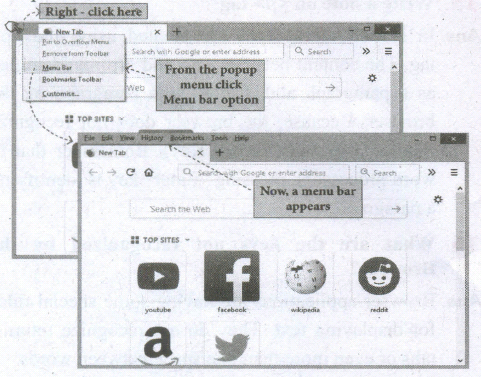
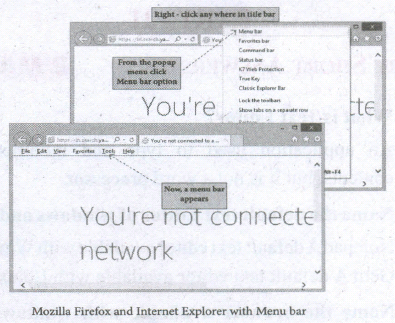
Step 3: From the "Open" dialog box, browse the folder in which the HTML document is saved. Choose the File name and click "Open" button.
15.
HTML stands for Hyper Text Markup Language. HTML is a special markup language used to create web pages. This, language tells the browsers, how to display the text, images, animations and other contents of a hypertext document on the screen. The language also tells, how to make a document interactive through special hyper links.
16.
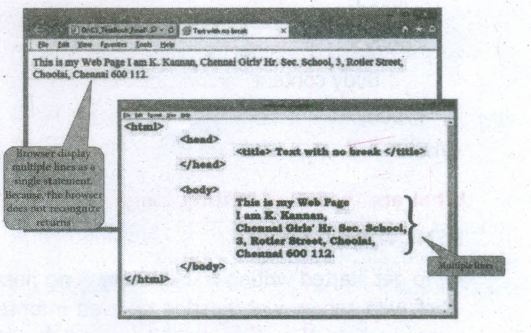
Browser applications are having some special rules for displaying text. They do not recognize returns, tabs or even more than one space between words. If we create an HTML document with multiple lines of text, browser will display it as a single line.
The
tag is used for line break. The < br > is an empty tag, does not have close tag and attribute. It should be placed at the end of a line.
.JPG)
In HTML, paragraphs are created using the < p > tag. The content what we type between < p > and < /p > is identified as a paragraph and display as a paragraph by the browser. Because, the browser does not recognize returns.
HlTML code to create a p ragraph:
< html >
< head >
< title > Paragraph < /title >
< /head >
< body >
< hi align=center > Business < /hi >
< p > Business may be defined as any activity in which a man is very much interested and these activities bring him profit, money, prestige and power. < /p > < p > In economic sense, the term business means works, efforts and acts of people, which are connected with the production of wealth and activities, which are directed with the object of making profit.< /p > < p > Production and distribution of goods to consumers for a profit constitute business. < /p >
< /body >
< /html >
.JPG)
Changing Paragraph alignment
In HTML documents there are four paragraph alignments viz. Left, Right, Center and Justify. The text that we type between < p > and < /p > is by default aligned to left. To change the alignment of a paragraph align attribute can be used with < p > tag.
The tag to specify the alignment to paragraphs:
Where alignment can either be Right, Center or Justify. Note that, left is the default alignment.
.JPG)
17.
Create a web page (HTML document) to the following specification.
(i) Title: My First Web Page:
(ii) Text to be display: Welcome to Computer Applications.
(iii) Background color: Lime
(iv) Body text color: Blue
(v) Margin: from left and top 1 inch
< html >
< head >
< title > My First Web Page < /title >
< /head >
< body bgcolor = Lime text = blue leftmargin = 72 topmargin = 72 >
Welcome to Computer Applications
< /body >
< /html >
18.
| Opening Tag | Closing Tag | Description |
|---|---|---|
| < html > | < /htrnl > | The < html > tag identified the document as an HTML document. All HTML documents should begins with < htrnl > and end with < /htrnl >. |
| < head > | < /head > | The < head > tag contains information about the document, including its title, scripts used, style definition and document descriptions |
| < title > | < /title > | The < title > tag contains the title of the document. The title specified between opening and closing tags appears in the title bar / page tab of the browser. < title > tag should be placed within < head > tag. |
| < body > | < /body > | The < body > tag encloses all the tags, attributes and information to be displayed in the web page. < body > tag should be entered below the < /head > tag. |
19.
Creating a Webpage :
Step 1: Open a text editor Windows7:
Start ⟶ All Programs Accessories ⟶ Notepad⟶Linux: Applications ⟶ Accessories ⟶ Text Editor.
Step 2: In the appearing Note pad / Text Editor, type the HTML document.
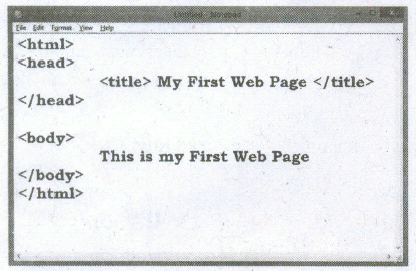
Step 3: Save the file as HTML
(i) Click File ⟶ Save (or) Press Ctrl + S
(ii) Save as dialog box appears.
(iii) In "File Name" text box, type a file name with .htm or .htmlextension.
(iv) Select "All Files" from "Save as type" list box. Click "Save" button.

11th Standard Syllabus & Materials
11th Standard
TN 11th Tamil பீடு பெற நில் - செய்யுள் - காவடிச்சிந்து Important Questions And Answers Study Material - QB365 Set A
NEW11th Standard
TN 11th Tamil பீடு பெற நில் - உரைநடை - மலை இடப்பெயர்கள் : ஓர் ஆய்வு Important Questions And Answers Study Material - QB365 Set A
NEW11th Standard
TN 11th Tamil மாமழை போற்றுதும் - துணைப்பாடம் - யானை டாக்டர் Important Questions And Answers Study Material - QB365 Set A
NEW11th Standard
TN 11th Tamil மாமழை போற்றுதும் - செய்யுள் - ஐங்குறுநூறு Important Questions And Answers Study Material - QB365 Set A



Tamilnadu Stateboard 11th Standard Subjects

Maths

Commerce

Economics

Biology

Business Maths and Statistics

Accountancy

Computer Science

Physics

Chemistry
Maths
Biology
Economics
Physics
Chemistry

History
Business Maths and Statistics

Computer Science
Accountancy
Computer Applications
History
Computer Technology
Commerce
Computer Applications
Computer Technology

Tamil

English

French
Tamilnadu Stateboard Standards
