
 100% FREE ACCESS
11th Standard Syllabus & Materials
11th Standard
TN 11th Tamil இயற்கை வேளாண்மை,சுற்றுச்சூழல் -செய்யுள் - மனோன்மணீயம் Important Questions And Answers Study Material - QB365 Set A
NEW11th Standard
TN 11th Tamil என்னுயிர் என்பேன் -துணைப்பாடம் - இசைத்தமிழர் இருவர் Important Questions And Answers Study Material - QB365 Set A
NEW11th Standard
TN 11th Tamil மொழி கலை -செய்யுள் - ஒவ்வொரு புல்லையும் Important Questions And Answers Study Material - QB365 Set A
NEW11th Standard
TN 11th Tamil பீடு பெற நில் - இலக்கணம் - பகுபத உறுப்புகள் Important Questions And Answers Study Material - QB365 Set A
NEW11th Standard
TN 11th Tamil பீடு பெற நில் - துணைப்பாடம் - வாடிவாசல் Important Questions And Answers Study Material - QB365 Set A
NEW11th Standard
TN 11th Tamil பீடு பெற நில் - செய்யுள் - குறுந்தொகை Important Questions And Answers Study Material - QB365 Set A

Published on: 27/12/2018
11th Half Yearly Model Question
Download Tamil Nadu 11th Standard Computer Science question papers, model tests, one-mark questions, important questions, and public exam papers in PDF format. Free study materials and answer keys for TN State Board students.
Questions + Answers key
Take MCQ Computer Science Test
1.
Which of the following function executes when class comes into scope?
destructor
inline
Normal
constructor
2.
How many times the following loop with execute? for (int i=0; i<10; i++).
0
10
9
11
3.
What will happen when the structure is declared?
it will not allocate any memory
it will allocate the memory
it will be declared and initialized
it will be only declared
4.
Which of the following are used to search any information from the cyberspace?
Operating System
Compiler
Search engines
Web clients
5.
Which of the following statement is true or false?
(i) Strcat ( ) function appends copy of the character string pointed by the source to the memory location pointed by target.
(ii) strcpy () function appends copy of the character string pointed by the source to the end of the string pointed by the target.
(iii) strcmp ( ) and strlen ( ) function takes two arguments.
(iv) strcmp ( ) function compares the contents of strings lexicographically
(i) true, (ii) false, (iii) false, (iv) true
(i) false, (ii) true, (iii) false, (iv) false
(i) false, (ii) false, (iii) false, (iv) true
(i) false, (ii) false, (iii) false, (iv) false
6.
Which of the following create a temporary instance?
Implicit call to the constructor
Explicit call to constructor
Implicit call to the destructor
Explicit call to the destructor
7.
Which of the following provides flexibility of creating multiple type of objects for a class?
function overloading
operator overloading
constructor overloading
object overloading
8.
Which of the following concept encapsulate all the essential properties of the object that are to be created?
class
Encapsulation
Polymorphism
Abstraction
9.
The logical grouping of an operators are called ________.
Precedence
order
association
execution
10.
If m x a + n x b is an invariant for the assignment a, b: = a + 8, b + 7, the values of m and n are
m = 8, n = 7
m = 7, n = -8
m = 7, n = 8
m = 8, n = -7
11.
Which coding schemes have 65000 representations?
Byte code
Binary code
Unicode
EBCDIC
12.
Which of the following is not a version of windows 2000?
server
professional
DOS
Data center server
13.
Omitting details inessential to the task and representing only the essential features of the task is known as
specification
abstraction
composition
decomposition
14.
15.
Interactive Operating System provides
Graphics User Interface (GUI)
Data Distribution
Security Management
Real Time Processing
16.
What is meant by social engineering?
17.
Write the output of the following program.
#include < string.h >
#include < iostream >
using namespace std;
int main()
{
char target[50] = "Learning C++ is fun";
char source[50] =" , easy and Very useful";
strcat(target, source);
cout << target;
return 0;
}
18.
Write the syntax of an array can be initialized at the time of declaration.
19.
What is the difference between the class and object in terms of oop?
20.
Which of the following two statements are valid? Why? Also write their result.
int a;
(i) int a; a = 3,014;
(ii) int a; a=(3,014);
21.
What Blu-Ray Disc?
22.
How do we refine a statement?
23.
What is an invariant?
24.
What are the different Operating Systems used in computer?
25.
Differentiate Input and output unit.
26.
Differentiate implicit call and explicit call of involving parameterized constructor.
27.
Why do you need for inheritance?
28.
What are the rules for function overloading?
29.
What is paradigm? Mention the different types of paradigm.
30.
31.
Write a short program to print following series:
(a) 1 4 7 10...... 40
32.
Write a note on Pseudo code.
33.
Write the memory management techniques.
34.
When do you say that a problem is algorithmic in nature?
35.
Convert (150)10 into Binary, then convert that Binary number to Octal.
36.
Write the output of the following program
#include < iostream >
using namespcae std;
class simple
{
private:
int a,b;
public:
simple( )
{
a=0;
b=0;
cout << "\n Constructor of class-simple";
}
void getdata( )
{
cout << "\nEnter value for a and b (sample data 6 and 7)...";
cin >> a >> b;
}
void putdata( )
{
cout << "\nThe two integers are ... " << a << 't\' << b << endl;
cout << "\nThe sum of the variables" << a << " + " << b << "=" << a+b;
}
};
int main ( )
{
simple s;
s.getdata( );
s.putdata( );
return 0;
}
37.
Write the output of the following program.
#include < iostream >
using namespace std;
class Container {
public:
// Constructor definition
Container(double 1 = 2.C, double b = 2.0, double
h= 2.0) { -
cout<<"Constructor called." << endl;
length = 1;
breadth = b;
height = h;
}
double Volume ( ) {
return length * breadth * height;
}
int compare(Container container)
{
return this->Volume( )>Container.volume ( ):
}
private:
double length; // Length of a Container
double breadth; // Breadth of a Container
double height; // Height of a Container
} ;
int main(void) {
Container Container1(3.3, 1.2, 1.5); II Declare
Container!
Container Container2(8.5, 6.0, 2.0); II Declare
Container2
if(Container l.compare(Container2)) {
cout << "Container2 is smaller than Container1"
<
cout << "Container2 is equal to or larger than
Container1' n <
return 0
}
38.
What are the rules for operator overloading?
39.
Write a C++ program to add two distances using the following structure definition
struct Distance{
int feet;
float inch;
}d1 , d2, sum;
40.
Write a program to accept any integer number and reverse it.
41.
42.
Explain how will you copy files and folders in windows.
43.
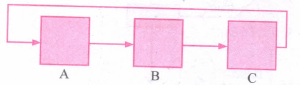
44.
Explain any two input and output devices.
45.
How the read and write operations are performed by a processor? Explain.
1.
(d)
constructor
2.
(b)
10
3.
(a)
it will not allocate any memory
4.
(c)
Search engines
5.
(c)
(i) false, (ii) false, (iii) false, (iv) true
6.
(b)
Explicit call to constructor
7.
(c)
constructor overloading
8.
(d)
Abstraction
9.
(c)
association
10.
(b)
m = 7, n = -8
11.
(c)
Unicode
12.
(c)
DOS
13.
(b)
abstraction
14.
(d)
15.
(a)
Graphics User Interface (GUI)
16.
Social Engineering is a method of getting passwords and information using human weakness. These crackers trick people, not software. They can use just the phone for getting information, they can pretend being your friend and talk to you on Internet Relay Chat(IRC) or by Instant messenger.
17.
Output:
Learning C++ is fun, easy and Very useful
18.
Syntax: < datatype > < array_name > [size] = {value-1,value-2, .............value-n} ;
19.
| Class | Object |
|---|---|
| Class is a blueprint or template from which objects are created. | Object is an instance of class |
| Class is a group of similar objects. | Object is a real world entity such as pen, laptop, mobile, chair etc. |
| Class doesn't allocate memory when it is created. | Object allocates memory when it is created. |
20.
(i) It is invalid as comma is not allowed in an integer constant.
(ii) It is valid, Comma in bracket is allowed.
21.
It is a high density optical disc format similar to DVD.
22.
In refinement, each statement is repeatedly expanded into more detailed statements in the subsequent levels.
23.
An expression involving variables, which remains unchanged by an assignment to one of these variables is called as an invariant of the assignment.
24.
Different operating system used:
1. Single user, single Task Operating system
2. Multi user operating system
3. Multiprocessing operating system
4. Distributed Operating system
25.
| Input Unit | Output Unit |
| An input device feeds information to a computer system for processing. | output device reproduces or displays the results of that processing. |
| Input devices only allow for input of data to a computer. | output devices only receive the output of data from another device. |
| It is a peripheral device used to provide data and control signals to an information processing system such as computer. | It is a unit which sends data from the computer to another device. |
| Eg. keyboard, mouse | Eg. printer, monitor |
26.
Implicit call: In this method, the parameterized constructor is invoked automatically whenever an object is created. For example simple s1(10,20); in this for creating the object s 1 parameterized constructor is automatically invoked.
Explicit call: In this method, the name of the constructor is explicitly given to invoke the parameterized constructor so that the object can be created and initialized.For example: simple s1=simple(10,20); //explicit call.
27.
(i) Inheritance is an important feature of object oriented programming used for code reusability. It is a process of creating new classes called derived classes, from the existing or base classes.
(ii) Inheritance allows us to inherit all the code (except declared as private) of one class to another class. The class to be inherited is called base class or parent class and the class which inherits the other class is called derived class or child class.
(iii) The derived class is a power packed class, as it can add additional attributes and methods and thus enhan e its functionality.
28.
Rules for function overloading:
(i) The overloaded function must differ in the number of its arguments or data types.
(ii) The return type of overloaded functions are not considered for overloading same data type.
(iii) The default arguments of overloaded functions are not considered as part of the parameter list in function overloading
29.
Paradigm means organizing principle of a program. It is an approach to programming. There are different approaches available for problem solving using computer. They are Procedural programming, Modular Programming and Object Oriented Programming.
30.
31.
#include <iostream>
using namespace std;
int main()
{
cout<<"\n PRINT SERIES";
for (int i=1;i< 40; i=i+3)
cout << i << "1+";
cin.get():
return ();
}
32.
(i) Pseudo code is a mix of programming-language like constructs and plain English. This notation is not formal nor exact. It uses the same building blocks as programs, such as variables and control flow.
(ii) But it allows the use of natural English for statements and conditions. An algorithm expressed as pseudo code is not for computers to execute directly, but for 'human readers to understand.
(iii) Therefore, there is no need to follow the rules of the grammar of a programming language. However, even pseudo-code must be rigorous and correct. Pseudo code is the most widely used notation to represent algorithms
33.
The memory management techniques are
(i) Single contiguous allocation.
(ii) Partitioned allocation
(iii) Paged Memory Management
(iv) Segmented Memory Management.
34.
A Problem is algorithmic in nature when its solution involves the construction of an algorithm.
Also when the
(a) Input data and output data of the problem is specified
(b) Relation between the input data and the output data is specified
35.
Change it to Binary
.png)
15010 = 100101102
Step 2 : Change it to Octal
10,010,110
421 421 421
010 010 110
Binary 100101102
Octal =2268
36.
Output:
Constructor of class-simple
Enter values for a and b (sample data 6 and 7)...6 7
The two integers are ...6 7
The sum of the variables 6 + 7 = 13
37.
Output:
Constructor called.
Constructor called
Container 2 is equal to or larger than Container 1
38.
Following are some rules to be followed while implementing operator overloading.
(i) Precedence and Associativity of an operator cannot be changed.
(ii) No new operators can be created, only existing operators can be overloaded.
(iii) Cannot redefine the meaning of an operator's procedure. You cannot change how integers are added. Only additional functions can be to an operator.
(iv) Overloaded operators cannot have default arguments.
(v) When binary operators are overloaded, the left hand object must be an object of the relevant class.
39.
#include< iostream >
using namespace std;
struct Distance
{
int feet;
float inch;
}d1, d2, sum;
int main()
{
cout<<"Enter 1st distance:"<<endl;
cout<<"Enter feet:";
cin>>d1.feet;
cout<<"Enter inch:";
cin>>dl.inch;
cout<<"\n information for 2nd distance:"<<endl;
cout<<"Enter feet:"";
cin>>d2.feet;
cout<<"Enter inch:"
cin>>d2.inch;
sum.feet = d1.feet +d2.feet;
sum.inch-d1.inch + d2.inch;
if (sum.inch > 12)
{
++sum.feet;
sum.inch 12;
}
cout<<endl; "Sum of distance="<<sum.feet << "feet" << sum.inch<< "inches";
return 0;
}
Output:
Enter 1st distance
Enter feet: 6
Enter inch: 3.4
Enter 2nd distance
Enter feet: 5
Enter inch: 10.2
Sum of distances = 12 feet 1.6 inches
40.
#include<iostream>
using namespace std;
int reverse (int n);
int main()
{
int n=0, result = 0;
cout<<"Enter number:"";
cin >>n;
result reverse (n);
cout<<"Reverse number is:" << result << endl;
}
int reverse (int n)
{
int temp=0, rev = 0;
while (n! =0).
{
temp=n;
rev= (rev*10) + temp;
n = n/10;
}
return rev;
}
Output:
Enter number: 1 2 3
Reverse number: 3 2 1
41.
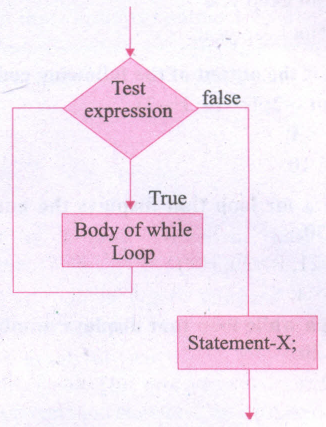
42.
To copy file(s) or folder(s), first select the file(s) or folder(s) and then choose one of the following:
(i) Click on the EDIT menu, select the COPY function.
(ii) Keyboard shortcut, CTRL + C.
(iii) Or else click on the selected item with the RIGHT mouse button and select "COPY" from the shortcut menu.
To place a copy of the file( s) or folder( s) in the new location, navigate to the new location then paste using one of the following:
(i) Click on the EDIT menu, select the PASTE function.
(ii) Keyboard shortcut, CTRL + V.
(iii) In the position where you want the item to be pasted, click with the Right mouse button and select "Paste" from the shortcut menu.
Method Dragging and Dropping:
(i) In the RIGHT pane, select the file( s) or folder( s) you want to copy.
(ii) Manipulate the FOLDER LIST on the left side of the Windows Explorer so that it shows the new location.
(iii) Make sure you use the scroll bars and the + and ( collapse and expand buttons) to navigate.
(iv) Hold down the CTRL key on the keyboard and at the same time, click and drag the selected file(s) and/or folder(s) over to the FOLDER LIST on the left, and drop it where you want to copy the file(s) and/or folder(s) to.
(v) Before dropping, make sure the target folder is highlighted (active). Also make sure you release the mouse before you release the CTRL key when dropping.
(vi) The file(s) and folder(s) will now appear in the new area.
43.
44.
(i) Scanner:
Scanners are used to enter the information directly into the computer's memory. This device works like a Xerox machine. The scanner converts any type of printed or written information including photographs into a digital format, which can be manipulated by the computer.
(ii) Fingerprint Scanners:
Fingerprint Scanner is a fingerprint recognition device used for computer security, equipped with the fingerprint recognition feature that uses biometric technology. Fingerprint Reader / Scanner is a very safe and convenient device for security instead of using passwords, which is vulnerable to fraud and is hard to remember.
(iii) Monitor:
Monitor is the most commonly used output device to display the information. It looks like a TV. Pictures on a monitor are formed with picture elements called PIXELS. Monitors may either be Monochrome which display text or images in Black and White or can be color, which display results in multiple colors. There are many types of monitors available such as CRT (Cathode Ray Tube), LCD (Liquid Crystal Display) and LED (Light Emitting Diodes). The monitor works with the VGA (Video Graphics Array) card. The video graphics card helps the keyboard to communicate with the screen. It acts as an interface between the computer and display monitor. Usually the recent motherboards incorporate built-in video card.
(iv) Plotter:
Plotter is an output device that is used to produce graphical output on papers. It uses single colour or multi colour pens to draw pictures.
45.
1. The Central Processing Unit(CPU) has a Memory Data Register (MDR) and a Memory Address Register (MAR).
2. The Memory Data Register (MDR) keeps the data which is transferred between the Memory and the CPU. The Program Counter (PC) is a special register in the CPU which always keeps the address of the next instruction to be executed.
3. The Arithmetic and Logic unit of CPU places the address of the memory to be fetched, into the Memory Address Register.
4. A bus is a collection of wires used for communication between the internal components of a computer.
5. The address bus is used to point a memory location. A decoder, a digital circuit is used to point to the specific memory location where the word can be located.
6. The address register is connected with the address bus, which provides the address of the instruction. A data bus is used to transfer data between the memory and the CPU.
7. The data bus is bidirectional and the address bus is unidirectional. The control bus controls both read and write operations.
8. The read operation fetches data from memory and transfers to MDR. A single control line performs two operations like Read/Write using 1 or 0.
9. Also, the write operation transfers data from the MDR to memory. This organisation is shown below.
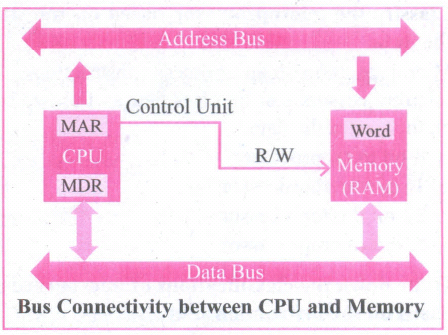
10. The word in the RAM has the same size (no.of bits) as the Memory Data Register (MDR). If the processor is an 8-bit RAM processor like Intel 8085, its MDR and the word in the both have 8 bits.
11. If the size of the MDR is eight bits, which can be connected with a word in the memory which is also eight bits size. The data bus has eight parallel wires to transfer data either from MDR to word or word to MDR based on the control(Read or write).
.png)
13. This control line is labeled as which becomes 1 means READ operation and 0 means WRITE operation.
.png)
14. These pictures show the contents of MDR and the word before and after the READ operation.
i. The read operation transfers the data(bits) from word to Memory Data Register.
ii. The write operation transfers the data(bits) from Memory Data Register to word.

11th Standard Syllabus & Materials
11th Standard
TN 11th Tamil பீடு பெற நில் - செய்யுள் - காவடிச்சிந்து Important Questions And Answers Study Material - QB365 Set A
NEW11th Standard
TN 11th Tamil பீடு பெற நில் - உரைநடை - மலை இடப்பெயர்கள் : ஓர் ஆய்வு Important Questions And Answers Study Material - QB365 Set A
NEW11th Standard
TN 11th Tamil மாமழை போற்றுதும் - துணைப்பாடம் - யானை டாக்டர் Important Questions And Answers Study Material - QB365 Set A
NEW11th Standard
TN 11th Tamil மாமழை போற்றுதும் - செய்யுள் - ஐங்குறுநூறு Important Questions And Answers Study Material - QB365 Set A



Tamilnadu Stateboard 11th Standard Subjects

Maths

Commerce

Economics

Biology

Business Maths and Statistics

Accountancy
Computer Science

Physics

Chemistry
Maths
Biology
Economics
Physics
Chemistry

History
Business Maths and Statistics

Computer Science
Accountancy

Computer Applications
History
Computer Technology
Commerce
Computer Applications
Computer Technology

Tamil

English

French
Tamilnadu Stateboard Standards
