
 100% FREE ACCESS
11th Standard Syllabus & Materials
11th Standard
TN 11th Tamil இயற்கை வேளாண்மை,சுற்றுச்சூழல் -செய்யுள் - மனோன்மணீயம் Important Questions And Answers Study Material - QB365 Set A
NEW11th Standard
TN 11th Tamil என்னுயிர் என்பேன் -துணைப்பாடம் - இசைத்தமிழர் இருவர் Important Questions And Answers Study Material - QB365 Set A
NEW11th Standard
TN 11th Tamil மொழி கலை -செய்யுள் - ஒவ்வொரு புல்லையும் Important Questions And Answers Study Material - QB365 Set A
NEW11th Standard
TN 11th Tamil பீடு பெற நில் - இலக்கணம் - பகுபத உறுப்புகள் Important Questions And Answers Study Material - QB365 Set A
NEW11th Standard
TN 11th Tamil பீடு பெற நில் - துணைப்பாடம் - வாடிவாசல் Important Questions And Answers Study Material - QB365 Set A
NEW11th Standard
TN 11th Tamil பீடு பெற நில் - செய்யுள் - குறுந்தொகை Important Questions And Answers Study Material - QB365 Set A

Published on: 14/12/2019
Specification and Abstraction
Download Tamil Nadu 11th Standard Computer Science question papers, model tests, one-mark questions, important questions, and public exam papers in PDF format. Free study materials and answer keys for TN State Board students.
Questions + Answers key
Take MCQ Computer Science Test
1.
How the state of the process represented in an algorithm?
Data
Variables
Statements
Program
2.
The data stored in a variable is also called ________.
value
process
input
control flow
3.
When operations are done on data, the results are stored in ________.
control flow
functions
variables
instructions
4.
How many basic building blocks are there to construct algorithms?
1
2
4
3
5.
Which is intended to solve a problem?
Program
Statements
Process
Algorithm
6.
Write the following
(i) initial state
(ii) final state.
7.
How the assignment statement changes the state of an algorithm?
8.
Differentiate state and functions of an algorithm.
9.
Write the specification of an algorithm to compute the quotient and remainder after dividing two integers.
10.
Differentiate initial and final state of an algorithm.
11.
Define State.
12.
Define control flow.
13.
Write the basic building blocks of algorithms.
14.
What is a state?
15.
What is an Abstraction?
16.
Explain the Basic Building Blocks of Algorithms.
17.
Explain specification.
18.
Explain Algorithm Design Techniques.
19.
Explain the three control flow statement.
1.
(b)
Variables
2.
(a)
value
3.
(c)
variables
4.
(c)
4
5.
(d)
Algorithm
6.
The values of the variables when the algorithm starts is known as the initial state, and the values of the variables when the algorithm finishes is known as the final state.
7.
Assignment statement changes the values of variables, and hence the state.
8.
| State | Functions |
|---|---|
|
In algorithms, the state of a computation |
When an algorithm is very complex, we can decompose it into functions and abstract each function by its specification |
9.
1. divide (A, B)
2. -- inputs: A is an integer and B \(\neq \) 0
3. -- outputs: A = q X B + r and 0 < r < B
10.
The inputs and outputs are passed between an algorithm and the user through variables. The values of the variables when the algorithm starts is known as the initial state, and the values of the variables when the algorithm finishes is known as the final state.
11.
The state of a process can be represented by a set of variables in an algorithm. The State at any point of execution is simply the values of the variables at that point
12.
The order in which the statements are executed may differ from the order in which they are written in the algorithm. This order of execution of statements is known as the control flow.
13.
i) Data
ii) Variables
iii) Control flow
iv) Functions
14.
The state is an assignment that changes the values of the variables.
15.
Abstraction is the process of hiping or ignoring the details irrelevant to the task so as to model a problem only by its essential features.
16.
Data:
Algorithms take input data, process the data, and produce output data. Computers provide instructions to perform operations on data. For example, there are instructions for doing arithmetic operations on numbers, such as add, subtract, multiply and divide. There are different kinds of data such as numbers and text.
Variables:
Variables are named boxes for storing data. When we do operations oft data, We need to store the results in variables. The data stored in a variable is also known as the value of the variable. We can store a value in a variable or change the value of variable, using an assignment statement.
Control flow:
An algorithm is a sequence of statements. However, after executing a statement, the next statement executed need not be the next statement in the algorithm. The statement to be executed next may depend on the state of the process. Thus, the order in which the statements are executed may differ front the order in which they are written in the algorithm. This order of execution of statements is known as the control flow.
There are three important control flow statements to alter the. control flow depending on the state.
1. In sequential control flow, a sequence of statements are executed one after another in the same order as they are written.
2. In alternative control flow, a condition of the state is tested, and if the condition is true, one statement is executed; if the condition is false, an alternative statement is executed.
In iterative control flow, a condition of the state is tested, and if the condition is true, a statement is executed. The two steps of testing the condition and executing the statement are repeated until the condition becomes false.
Functions:
The parts of an algorithm are known as functions. A function is like a sub algorithm. It takes an input, and produces an output, satisfying a desired input output relation.
17.
a. Specification:
1. To solve a problem, first we must state the problem clearly and precisely. A problem is specified by the given input and the desired output. To design an algorithm for solving a problem, we should know the properties of the given input and the properties of the desired output. The goal of the algorithm is to establish the relation between the input and the desired output.
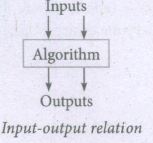
2. An algorithm is specified by the properties of the given input and the relation between the input and the desired output. In simple words, specification of an algorithm is the desired input-output relation.
3. The inputs and .outputs are passed between an algorithm and the user through variables. The values of the variables when the algorithm starts is known as the initial state, and the values of the variables when the algorithm finishes is known as the final state.
4. Let P be the required property of the inputs and Q the property of the desired outputs. Then the algorithm S is specified as
(i) . algorithm_name (inputs)
(ii) . -- inputs: P
(iii). -- outputs: Q
5. This specification means that if the algorithm starts with inputs satisfying P, then it will finish with the outputs satisfying Q.
6. A double dash -- indicates that the rest of the line is a comment. Comments are statements which are used to annotate a program for the human readers and not executed by the computer. Comments at crucial points of flow are useful, and even necessary, to understand the algorithm. In our algorithmic notation, we use double dashes (-) to start a comment line. (In C++, a double. slash II indicates that the rest of the line is a comment).
b. Specification format:
We can write the specification in a standard three-part format:
1. The name of the algorithm and the inputs.
2. Input: the property of the inputs.
3. Output: the desired input-output relation.
4. The first part is the name of the algorithm and the inputs.
5. The second part is the property of the inputs. It is written as a comment which starts with -- inputs.
6. The third part is the desired input-output relation. It is written as a comment which starts with - outputs.
7. The input and output can be written using English and mathematical notation.
Specification as a contract:
1. Specification of an algorithm serves as a contract between the designer of the algorithm and the users of the algorithm, because it defines the rights and responsibilities of the designer and the user.
2. Ensuring that the inputs satisfy the required properties is the responsibility of the user, but the right of the designer. The desired input-output relation is the responsibility of the designer and the right of the user.
3. Importantly, if the user fails to satisfy the properties of the inputs, the designer is free from his obligation to satisfy the desired input-output relation.
18.
There are a few basic principles and techniques for designing algorithms.
1. Specification:
The first step in problem-solving is to state the problem precisely. A problem is specified in terms of the input given and the output desired. The specification must also state the . properties of the given input; and the relation between the input and the output.
2. Abstraction:
A problem can involve a lot of details. Several of these details are unnecessary for solving the problem. Only a few details are essential. Ignoring or hiding unnecessary details and modeling an entity only by its essential properties is known as abstraction. For example, when we represent the state of a process, we select only the variables essential to the problem and ignore inessential details.
3. Composition:
An algorithm is composed of assignment and control flow statements. A control flow statement tests a condition of the state and depending on the value of the condition, decides the next statement to be executed.
4. Decomposition:
We divide the main algorithm into functions. We construct each function independently of the main algorithm and other functions. Finally, we construct the main algorithm using. the functions. When we use the functions, it is enough to know the specification of the function. It is not necessary to know how the function is implemented.
19.
There are three important control flow statements to alter the control flow depending on the state.
(i) In sequential control flow, a sequence of statements are executed one after another in the same order as they are written
(ii) In alternative control flow, a condition of the state is tested, and if the condition is true, one statement is executed; if the condition is false, an alternative statement is executed.
(iii) In iterative control flow, a condition of the state is tested, and if the condition is true, a statement is executed. The two steps of testing the condition and executing the statement are repeated until the condition becomes false.

11th Standard Syllabus & Materials
11th Standard
TN 11th Tamil பீடு பெற நில் - செய்யுள் - காவடிச்சிந்து Important Questions And Answers Study Material - QB365 Set A
NEW11th Standard
TN 11th Tamil பீடு பெற நில் - உரைநடை - மலை இடப்பெயர்கள் : ஓர் ஆய்வு Important Questions And Answers Study Material - QB365 Set A
NEW11th Standard
TN 11th Tamil மாமழை போற்றுதும் - துணைப்பாடம் - யானை டாக்டர் Important Questions And Answers Study Material - QB365 Set A
NEW11th Standard
TN 11th Tamil மாமழை போற்றுதும் - செய்யுள் - ஐங்குறுநூறு Important Questions And Answers Study Material - QB365 Set A



Tamilnadu Stateboard 11th Standard Subjects

Maths

Commerce

Economics

Biology

Business Maths and Statistics

Accountancy
Computer Science

Physics

Chemistry
Maths
Biology
Economics
Physics
Chemistry

History
Business Maths and Statistics

Computer Science
Accountancy

Computer Applications
History
Computer Technology
Commerce
Computer Applications
Computer Technology

Tamil

English

French
Tamilnadu Stateboard Standards
