
 100% FREE ACCESS
11th Standard Syllabus & Materials
11th Standard
TN 11th Tamil இயற்கை வேளாண்மை,சுற்றுச்சூழல் -செய்யுள் - மனோன்மணீயம் Important Questions And Answers Study Material - QB365 Set A
NEW11th Standard
TN 11th Tamil என்னுயிர் என்பேன் -துணைப்பாடம் - இசைத்தமிழர் இருவர் Important Questions And Answers Study Material - QB365 Set A
NEW11th Standard
TN 11th Tamil மொழி கலை -செய்யுள் - ஒவ்வொரு புல்லையும் Important Questions And Answers Study Material - QB365 Set A
NEW11th Standard
TN 11th Tamil பீடு பெற நில் - இலக்கணம் - பகுபத உறுப்புகள் Important Questions And Answers Study Material - QB365 Set A
NEW11th Standard
TN 11th Tamil பீடு பெற நில் - துணைப்பாடம் - வாடிவாசல் Important Questions And Answers Study Material - QB365 Set A
NEW11th Standard
TN 11th Tamil பீடு பெற நில் - செய்யுள் - குறுந்தொகை Important Questions And Answers Study Material - QB365 Set A

Published on: 14/12/2019
Computer Network
Download Tamil Nadu 11th Standard Computer Technology question papers, model tests, one-mark questions, important questions, and public exam papers in PDF format. Free study materials and answer keys for TN State Board students.
Questions + Answers key
Take MCQ Computer Technology Test
1.
Differentiate 3G and 4G communication.
2.
What do you understand by the term node in computer networks?
3.
What is spamming?
4.
What is electronic commerce?
5.
Define Computer network.
6.
Write the specific functions of
a) Subscriber Channel (SC)
b) Straight-Tip (ST)
c) MT-RJ connector.
7.
Draw an outline for the following:
a) Coaxial Cable
8.
Write short notes on the following: a) Hub b) Switch c) Gateway
9.
Switches are usually preferred over a hub. Why?
10.
Differentiate Web page, Web browser and a Web Server.
11.
Explain the applications of internet.
12.
Mention the types of wireless technologies we are using. Write in brief on each of them.
13.
Define wired technology. Explain the common types of bounded media in the data transmission.
14.
Define Topology. Explain different topologies using schematic diagram.
15.
Identify the network security system that uses rules to control incoming and outgoing network traffic.
Firewall
Cookies
Hacking
Crackers
16.
ASCII stands for___________.
American Standard Code for Information Interchange
American Scientific Code for International Interchange
American Standard Code for Intelligence Interchange
American Scientific Code for Information Interchange
17.
Identify the twisted pair cable in which metal casing improves penetration of noise or crosstalk.
insulated twisted pair cable
Shielded twisted pair cable
Unshielded twisted pair cable
Both A & B
18.
Identify the device that forwards packets between networks by processing the routing information included in the packet.
bridge
firewall
router
all of the mentioned
19.
Which is the first network used to exchange information?
CNNET
NSFNET
ASAPNET
ARPANET
1.
3G communication
1. It stands for 3rd generation technology.
2. Maximum upload rate of 3 G technology is 5 Mbps.
3. Maximum download rate of 3 G technology is 21 Mbps.
4. It uses packet switching technique.
5. The frequency range of 3 G technology is from 1.8 GHz to 2.5 GHz
4G communication
1. It stands for 4rd generation technology.
2. Maximum upload rate of 4 G technology is 500 Mbps.
3. Maximum download rate of 4 G technology is 1 Gbps.
4. It uses packet switching technique as well as message switching technique.
5. Its frequency range is from 4 G technology is from 2 GHz to 8 GHz.
2.
(i) Network is a broad term similar to system. Network is a communication system which supports many users. In relation with the computers, we can say that a "computer network" is a system which allows communication among computers connected in the network.
(ii) A computer network is the interconnection of two or more computers. It is done to enable the computers to communicate and share the available resources.
3.
(i) Spam can be defined as irrelevant or unsolicited messages sent over the internet. These are usually sent to a large number of users for advertising, phishing, spreading malware, etc.
(ii) Spamming is the process of sending digital junk mail: unsolicited communication sent in bulk over the internet or through any electronic messaging system.
4.
(i) Ecommerce or electronic commerce refers to transactions conducted via the internet. Ever time individual and companies are buying or selling products and services online they are engaging in ecommerce.
(ii) Ecommerce is a popular term for electronic commerce or even internet commerce.
(iii) Examples of ecommerce: Amazon, flipkart, eBay, Olx, Quikr,
5.
(i) Network is a broad term similar to "system". Network is a communication system which supports many users. In relation with the computer, we can say that a "computer network" is a system which allows communication among the computers connected in the network.
(ii) In a computer network, we need to make use of hardware and software. The hardware consists of connecting cables, connectors, network connecting devices and the software consists of protocols, programs, etc. This enables the systematic exchange of information between the computers connected in the network.
6.
Subscriber Channel:
1. At the point when you purchase in to a channel, any new accounts it disseminates will show up in your Subscriptions feed.When it purchase in to a channel we'll normally send you admonitions about the highlights from that channel.
2. You can pick to get a notification each time the channel circulates content by changing your notification settings. Note that accepting you pull out and, re-purchase in to a channel, your admonition settings will be reset.
Straight-Tip:
1. A fiber-optic link connector that utilizes a blade attachment and attachment. It was the primary accepted standard connector for most business wiring.
2. For bi-directional transmission, two fiber links and two ST connectors are utilized.
MT-RJ connector:
1. MT-RJ is a fiber-optic Cable Connector that is well known for little structure factor gadgets because of its little size.
2. Lodging two strands and mating along with finding pins on the attachment, the MT-RJ comes from the MT connector, which can contain up to 12 filaments.
3. The MT-RJ is one of the recently arising little structure factor connectors that are getting more normal in the systems administration industry.
7.
1. The coaxial cable consists of two concentric conductors namely an inner conductor and a braided outer conductor.
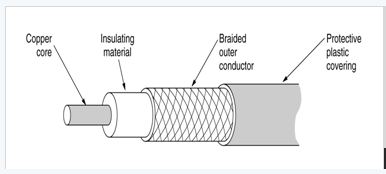
2. It has a solid conductor at its center, located coaxially within a cylindrical outer conductor.
3. A plastic layer provides insulation between the center conductor and the outer braided metal shield.
4. Outer conductor acts a shield against noise and crosstalk.
5. Whole cable protected by a plastic cover and outer conductor is enclosed in an insulated sheath.
6. Distance between the outer conductor and inner conductor plus the type of material used for insulating the inner conductor determine the cable properties or impedance.
7. For cable TV typical impedance is 75 \(\Omega \) and for ethernet, thin-net and thick net is 50 \(\Omega \).
8. Thin coaxial cable is referred as thin net and thick coaxial cable is referred as thick net.
(i) Television signals in cable TV networks
(ii) Analog telephone networks to carry voice signal
(iii) Traditional ethernet LAN because of its high bandwidth.
8.
1. A hub is the most basic networking device that connects multiple computers or other network device together.
2. It joins together the workstations, printers, and servers on a network to communicate with each other.
3. Each hub has a number of ports that connect it to the other devices via a network cable.
4. A hub connects all the devices on its port together.
5. When data arrives at one port, it is sent to the other ports so that all the devices can see all the information, commonly known as packets.
6. There is no intelligence in hub about what devices are connected to hub. When one device sends packet to the hub, it just broadcasts the packet on all ports.
9.
1. A switch is hardware device that filters and forwards network packets.
2. A network switch also connects computer to each other like hub
3. When a switch receives a packet of data, it determines what computer or device the packet is intended for and sends it to that computer only
4. It does not broadcast the packet to all computers as hub.
5. For this reason, switches are preferred over a hub.
6. Switches are successor of Hubs. Hubs didn't provide security nor do they store MAC address. So, were introduced to overcome these issues.
10.
Web Browser:
Internet Browser is an Application program that shows a World wide web report. It ordinarily utilizes the web access to get to the archive.
Web Server:
Web worker is a program or the PC that offer types of assistance to different projects called customer.
Web Page:
A page (or site page) is a hypertext report given by a site and showed to a client in an internet browser. A site ordinarily comprises of many pages connected together in a rational style. The name "page" is an allegory of paper pages bound together into a book.
At the point when the web worker gets the solicitation, it look through its stores to track down the fitting page. On the off chance that the web worker can find the page, it distributes to the HTML contained inside, delivers these bundles to the program (utilizing HTTP), and communicate them back across the organization.
11.
There are many applications of internet such as:
1. Communication: Computer users around the world extensively use the email service on internet to communicate with each other. Pictures, documents and other files are sent as email attachments. VolP stands for Voice over Internet Protocol, referring to the protocol that underlies all internet communication.
2. Job search: Nowadays many people search for their jobs online as it is quicker and there is a larger variety of jobs vacancies present. People can publish resume online for prospective job.
3. Video conferencing: It enables direct face to face communication across networks via web cameras, microphones and other communication tools. Video conferencing can enable individuals in distant locations to participate in meetings on short notice, with time and money saving. Video conferencing is very interactive in education to communicate between teacher to teacher, teacher to classroom and classroom to classroom with students at different places.
4. E-commerce: E-commerce or electronic commerce is the buying and selling of goods and services, or transmitting of funds or data, over an electronic network. These transactions occur either business-to-business, business to consumer, consumer to consumer or consumer to business.
5. Travel: One can use internet to gather information about various touristplace. It can be used for booking Holiday tours. Some of the websites providing this service are goibibo.com, makemytrip.com,olacabs.com.
6. Nowadays internet is almost use in every fields. Due to increase in technology, use of internet has benefitted the users in many ways. Internet enables millions of computers from different organization and people to communicate and share resource globally.
12.
Different types of wireless technologies are:
1. Bluetooth:
(i) It is named after a Danish king named Harald Bluetooth.
(ii) Bluetooth is used to connect different electronic devices wirelessly to a system for transferring and sharing data.
(iii) Cell phones are connected to hands-free earpieces, wireless keyboard, mice and mike to laptops with the help of Bluetooth as it transmits information from one device to other device.
2. Infrared:
(i) Infrared technology is a type of wireless communication technology to transfer data between two infrared enabled devices through infrared radiation.
(ii) This technology plays a very important role in wireless data communication
(iii) Infrared is used in devices such as the mouse, wireless keyboard and printers.
3. Wi-Fi:
(i) Wi-Fi is a low-cost wireless communication technology.
(ii) A Wi-Fi setup consists of a wireless router which serves a communication hub, linking portable device with an internet connection.
(iii) This network facilitates connection of many devices depending on the router configuration.
4. Radio link:
(i) A radio link is a wireless connection(also called wireless Point-to-Point connection) between two nodes, or radio units, in a data network.
(ii) Each radio unit consists of a transceiver(a device that can both send and receive communication) and a highly directive antenna.
(iii) The antenna only emits or receives power in the direction it is pointing.
5. Microwave Link:
(i) Microwave is a line-of-sight wireless communication technology that uses high frequency beams of radio waves to provide high speed wireless connections that can send and receive voice, video and data information.
(ii) One of the reasons microwave links are so adaptable is that they are broadband.
(iii) They require no equipment or facilities between the two terminal points, so installing a microwave link is often faster and less costly than a cable connection.
5. Microwave Link:
(i) Microwave is a line-of-sight wireless communication technology that uses high frequency beams of radio waves to provide high speed wireless connections that can send and receive voice, video and data information.
(ii) One of the reasons microwave links are so adaptable is that they are broadband.
(iii) They require no equipment or facilities between the two terminal points, so installing a microwave link is often faster and less costly than a cable connection.
6. Satellite Link:
(i) Satellite communication is one of the wireless technologies, used to transfer the signals from the transmitter to a receiver with the help of satellites.
(ii) It is widely spread all over the world allowing users to stay connected virtually anywhere on the Earth.
(iii) The Satellites used in this mode of communication, communicate directly with the orbiting satellites via radio signals.
13.
Wired Technology: Wired technology is more associated with wired communication. Wired technology refers to the transmission of data over a wired based communication technology.
Types of bounded media in the data transmission:
1. Twisted pair Cable:
(i) A twisted pair consists of two conductors (normally copper), each with its own plastic insulation, twisted together.
(ii) One of these wires is used to carry signals to the receiver, and the other is used only as ground reference. In addition to the signal sent by the sender on one of the wires, interference (noise) and crosstalk may affect both wires and create unwanted signals.
(iii) Twisted Pair is of two types:
(a) Unshielded Twisted Pair (UTP)
(b) Shielded Twisted Pair (STP)
2. Fibre Optical Cable:
(i) A fibre-optical cable is made of glass or plastic and transmits signals in the form of light.
(ii) In fibre optical cable, light moves only in one direction.
(iii) For two-way communication to take place a second communication must be made between the two devices.
(iv) Optical fibres use reflection to guide light through a channel. A glass or plastic core is surrounded by a cladding of less dense glass or plastic.
(v) The difference in density of the two materials must be such that a beam of light moving through the core is reflected off the cladding instead of being refracted into it.
3. Coaxial Cable:
(i) Coaxial is called by this name because it contains two conductors that are parallel to each other.
(ii) Copper is used in this as a central conductor. It is surrounded by PVCinstallation.
(iii) Outer metallic wrapping is used as a shield against noise and as a second conductor which completes the circuit.
(iv) The outer conductor is also encased inan insulating sheath.
(v) The outermost partis the plastic cover which protects the whole cable.
(vi) Anything and everything you see around yourself having wires and uses electricity to operate belongs to wired technology.
14.
Topology describes the physical cabling layout and the logical way of moving data between components. Network topology is the schematic description of a network arrangement, connecting various nodes (sender and receiver) through lines of connection. The following are different types of network topology:
1. BUS topology: Bus topology is a network type in which every computer and network device is connected to a single cable.
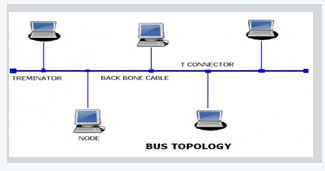
A single cable is used without additional electronics to amplify the signal or pass it along from computer to computer. Therefore, the bus is a passive topology.
Bus topology transmits data only in one direction.
2. STAR topology: In a star topology all the components are connected via a cable to a central location where they are all connected by a device called a hub. There is no direct connection among the computers. All the connections are made via the central hub.
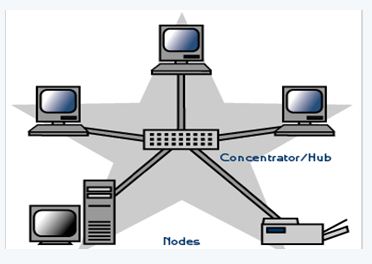
TREE topology: This type of topology is arranged in the form of a tree like structure in which top level contains parent node (root node), which is connected with the child nodes in the second level of hierarchy. The second level nodes are connected to the third level nodes, which in turn are connected to the fourth level nodes and so on. Except thetop-level nodes, each level node has a parent node.
Devices or nodes in a network get connected to each other via communication links and all these links are related to each other in one way or other. The geometric representation of such relationship of links and nodes is known as the topology of that network.
15.
(a)
Firewall
16.
(a)
American Standard Code for Information Interchange
17.
(d)
Both A & B
18.
(c)
router
19.
(d)
ARPANET

11th Standard Syllabus & Materials
11th Standard
TN 11th Tamil பீடு பெற நில் - செய்யுள் - காவடிச்சிந்து Important Questions And Answers Study Material - QB365 Set A
NEW11th Standard
TN 11th Tamil பீடு பெற நில் - உரைநடை - மலை இடப்பெயர்கள் : ஓர் ஆய்வு Important Questions And Answers Study Material - QB365 Set A
NEW11th Standard
TN 11th Tamil மாமழை போற்றுதும் - துணைப்பாடம் - யானை டாக்டர் Important Questions And Answers Study Material - QB365 Set A
NEW11th Standard
TN 11th Tamil மாமழை போற்றுதும் - செய்யுள் - ஐங்குறுநூறு Important Questions And Answers Study Material - QB365 Set A



Tamilnadu Stateboard 11th Standard Subjects

Maths

Commerce

Economics

Biology

Business Maths and Statistics

Accountancy

Computer Science

Physics

Chemistry
Maths
Biology
Economics
Physics
Chemistry

History
Business Maths and Statistics

Computer Science
Accountancy
Computer Applications
History
Computer Technology
Commerce
Computer Applications
Computer Technology

Tamil

English

French
Tamilnadu Stateboard Standards
