
 100% FREE ACCESS
11th Standard Syllabus & Materials
11th Standard
TN 11th Tamil இயற்கை வேளாண்மை,சுற்றுச்சூழல் -செய்யுள் - மனோன்மணீயம் Important Questions And Answers Study Material - QB365 Set A
NEW11th Standard
TN 11th Tamil என்னுயிர் என்பேன் -துணைப்பாடம் - இசைத்தமிழர் இருவர் Important Questions And Answers Study Material - QB365 Set A
NEW11th Standard
TN 11th Tamil மொழி கலை -செய்யுள் - ஒவ்வொரு புல்லையும் Important Questions And Answers Study Material - QB365 Set A
NEW11th Standard
TN 11th Tamil பீடு பெற நில் - இலக்கணம் - பகுபத உறுப்புகள் Important Questions And Answers Study Material - QB365 Set A
NEW11th Standard
TN 11th Tamil பீடு பெற நில் - துணைப்பாடம் - வாடிவாசல் Important Questions And Answers Study Material - QB365 Set A
NEW11th Standard
TN 11th Tamil பீடு பெற நில் - செய்யுள் - குறுந்தொகை Important Questions And Answers Study Material - QB365 Set A

Published on: 21/11/2019
Consumption Analysis
Download Tamil Nadu 11th Standard Economics question papers, model tests, one-mark questions, important questions, and public exam papers in PDF format. Free study materials and answer keys for TN State Board students.
Questions + Answers key
Take MCQ Economics Test
1.
The __ principle is quite useful in explaining the "water diamond paradox"
Equi - marginal
Marginal utility
Utility
Total utility
2.
The concept of consumer's surplus was introduced by ____
Alfred Marshall
J.R. Hicks
A.C. Pigou
J.K. Easthan
3.
The concept of elasticity of demand was introduced by
Ferguson
Keynes
Adam Smith
Marshall
4.
5.
Choice is always constrained or limited by the _______ of our resources.
Scarcity
Supply
Demand
Abundance
6.
Mention few determinants of Elasticity of demand?
7.
Define budget set.
8.
9.
Write the formula of consumer's surplus?
10.
Define utility.
11.
What are the assumptions of Law of Diminishing Marginal utility?
12.
Describe the feature of human wants
13.
Explain the theory of Consumer's surplus with the help of a table and a diagram.
14.
Explain briefly Levels or degrees of Price Elasticity of Demand?
15.
Explain the law of Equi-marginal utility
16.
Elucidate the law of diminishing marginal utility with diagram.
1.
(a)
Equi - marginal
2.
(a)
Alfred Marshall
3.
(d)
Marshall
4.
(a)
5.
(a)
Scarcity
6.
Determinants of Elasticity of demand
i) Availability of substitutes.
ii) Proportion of Consumer's Income.
iii) Number of uses of Commodity.
iv) Complementarity between goods and
v) Time.
7.
It refers to attainable combinations of a set of two goods at given prices of goods and income of the consumer.
8.
9.
(i) Consumer's surplus = potential price - actual price (or)
(ii) Consumer's surplus = what a person is willing to pay - what he actually pays (or)
(iii) Consumer's surplus = TU - (P x Q)
10.
(i) Want satisfying power of a commodity is called utility.
(ii) It is measured in utils.
11.
Assumptions of the Law of Diminishing Marginal Utility:
i. The units of consumption must be in standard units e.g., a cup of tea, a bottle of cool drink etc.
ii. All the units or the commodity must be identical in all aspects like taste, quality, colour and size.
iii. The law holds good only when the process of consumption continues without any time gap.
iv. The consumer's taste, habit or preference must remain the same during the process of consumption.
v. The income of the consumer remains constant.
vi. The prices of the commodity consumed and its substitutes are constant.
vii. The consumer is assumed to be a rational economic man. As a rational consumer, he wants to maximise the total utility.
viii. Utility is measurable.
12.
Characteristics
Wants are unlimited
(i) Wants are countless and various in kinds.
(ii) When one want is satisfied another want arises.
Wants become habits
(i) When a man starts reading newspaper in the morning it becomes a habit.
Wants are satiable
(i) We can satisfy particular wants at a given time.
(ii) When one feels hungry, he takes food and that want is satisfied.
Wants are alternative
(i) There are alternative ways to satisfy a particular want (eg) idly, dosa.
Wants are competitive
(i) There is competition among wants.
(ii) So we have to choose more urgent wants and satisfy them first.
Wants are complementary
(i) Satisfaction of a particular want requires the use of more than one commodity. (eg) car and petrol.
Wants are recurring
(i) Some wants occur again and again. For ex. if we feel hungry, we take food and satisfy our want.
(ii) But after some time we again feel hungry and want food.
13.
Definition: Alfred Marshall defines consumer's surplus as, "the excess of price which a person would be willing to pay a thing rather than go without the thing, over that which he actually does pay is the economic measure of this surplus satisfaction. This may be called consumer's surplus".
Assumption:
(1) Marshall assunied that utility can be measured.
(2) The marginal utilities of money of the consumer remain constant.
(3) There are no substitutes for the commodity in question.
(4) The taste, income and character of the consumer do not change.
(5) Utility of one commodity does not depend upon the other commodities.
Explanation: The concept of consumer's surplus can be explained with the help of an example. Suppose a consumer wants to buy an apple.
He is willing to pay rs.4, rather than go without it and the actual price of the apple is rs.2. Hence the consumer's surplus is rs.2 (rs.4 - rs.2).
Thus, consumer's surplus is the difference between the price that a consumer is willing to pay (potential price) and what he actually pays. Therefore,
Consumer's surplus = What a person is willing to pay - What he actually pays.
OR
Consumer's surplus = Potential price - Actual price.
Mathematically, Consumer's surplus = TU - (P x Q)
where, TU = Total Utility, P = Price and Q = Quantity of the commodity
Assumption:
(1) Marshall assunied that utility can be measured.
(2) The marginal utilities of money of the consumer remain constant.
(3) There are no substitutes for the commodity in question.
(4) The taste, income and character of the consumer do not change.
(5) Utility of one commodity does not depend upon the other commodities.
Explanation:
The concept of consumer's surplus can be explained with the help of an example. Suppose a consumer wants to buy an apple. He is willing to pay Rs 4, rather than go without it and the actual price of the apple is Rs2. Hence the consumer's surplus is Rs2 Rs4 - Rs 2). Thus, consumer's surplus is the difference between the price that a consumer is willing to pay (potential price) and what he actually pays. Therefore,
Consumer's surplus = What a person is willing to pay - What he actually pays.
OR
Consumer's surplus = Potential price - Actual price.
Mathematically,
Consumer's surplus = TU - (P x Q)
where, TU = Total Utility, P = Price and Q = Quantity of the commodity
Consumer's Surplus
| Units of commodity(Apple) | Willingness to pay or potential price(Marginal Utility) | Actual Price | Consumer's Surplus Potential Price Actual Price |
| 1 2 3 4 5 |
6 5 4 3 2 |
2 |
6-2=4 5-2=3 4-2=2 3-2=1 2-2=0 |
| Total | 20 | 10 | 10 |
Where,
TU= Total Utility, P = Price and Q = Quantity of the commodity
The measurement of consumer's surplus is illustrated in the Table.
In the Table the consumer is willing to pay rupees 6, 5, 4, 3 and 2 for purchasing the successive units of apples.
Hence, he is willing to pay (potential Price Total Utility) ~20 for apples. But, he actually pays ~lQ ~2 x 5» for getting 5 apples. Hence,
Consumer's Surplus = Total Utility (Actual Price x units of Commodity)
= TU - (P x Q)
= 20 - (2 x 5)
= 20 - 10 = 10.
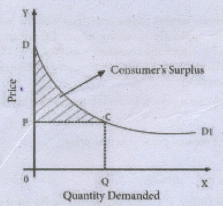
In the diagram, X axis shows the amount demanded and Y axis represents the price.\({ DD }_{ 1 }\) shows the utility which the consumer derives from the purchase of different amounts of commodity.
When price is OP, the amount demanded is OQ. Hence, actual price is OPCQ (OP x OQ). Potential Price (Total Utility) is ODCQ.
Therefore,
Consumer'Surplus = ODCQ - OPCQ
= PDC (the shaded area)
Criticism
(1) Utility cannot be measured, because utility is subjective.
(2) Marginal utility of money does not remain constant.
(3) Potential price is internal, it might be known to the consumer himself.
14.
Definition: The Price Elasticity of Demand is commonly known as the elasticity of demand which refers to the degree of responsiveness of demand to the change in the price of the commodity.
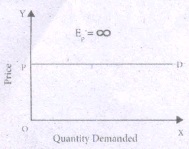
i. Perfectly Elastic Demand (Ep = \(\infty \)):
The demand is said to be perfectly elastic when a slight change in the price of a commodity causes an infinite. change in its quantity demanded. Such as, even a small rise in the price of a commodity can result in greater fall in demand even to zero. In some cases a little fall in the price can result in the increase in demand to infinity. In perfectly elastic demand the demand curve is a horizontal straight line parallel to x axis.
ii. Perfectly Inelastic Demand (Ep = 0)
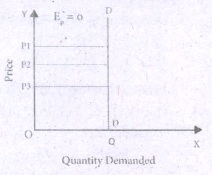
When there is no change in the product due to the change in the price, then the demand is said to be perfectly inelastic. Here, the demand curve is a vertical straight line which shows that the demand remains unchanged irrespective of change in the price., i.e. quantity OQ remains unchanged at different prices, P1P 2, and P3.
iii. Relatively Elastic Demand: (Ep > 1)
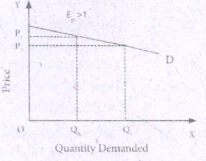
The demand is relatively elastic when the proportionate change in the demand for a commodity is greater than the proportionate change in Its price. Here, the demand curve is gradually sloping which shows that a proportionate change in quantity from 5 to 10 is greater than the proportionate change in the price from 11 to 10. Change in demand is: 10-5/5 x 100 = 100%
Change in price =10%. Hence, it is more elastic demand.
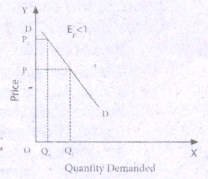
Relatively Inelastic Demand: (Ep < 1)
When the proportionate change in the demand for a product is less than the proportionate change in the price, the demand is said to be relatively inelastic. It is also called as the elasticity less than unity. Here the demand curve is steeply sloping, which shows that the change in the quantity from OQ0 to OQ1 is relatively smaller than the change in the price from OP1 to OP2.
v. Unitary Elastic Demand (Ep = 1):
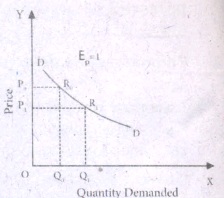
The demand is unitary elastic when the proportionate change in the price of a product results in the same propionate change in the quantity demand here the shape of the demand curve is a rectangular hyperbola, which shows that area under the curve is equal to one. Here OP0R 0Q 0= OP 1R 1Q 1.
15.
Introduction:
(i) The law of diminishing marginal utility was extended and is called Law of Equi-marginal utility
(ii) Law of substitution or Law of consumer's Equilibrium or Gossen's II law or law of maximum satisfaction.
Definition:
Marshall, "If a person has a thing which he can put to several uses, he will distribute it among these uses in such a way that it has the same marginal utility in all. For, if it had a greater marginal utility in one use than another, he would gain by taking away some of it from the second use and applying it to first.
Assumption
(i) Consumer is rational and wants maximum satisfaction.
(ii) Utility is measurable in cardinal numbers.
(iii) Marginal utility of money is constant.
(iv) Income of the consumer is given.
(v) There is perfect competition.
(vi) Price is given.
(vii) Law of diminishing marginal utility operates
Explanation:
(i) The consumer has Rs. 11.
(ii) He wants to spend it on apple ( Rs 1 each) and orange (Rs. 1 each)
(iii) He will be in equilibrium only when he gets maximum satisfaction ie.
\(\mathrm{K}=\frac{\text { Marginal utility of apple }}{\text { Price of apple }}=\frac{\text { Marginal utility of orange }}{\text { Price of orange }}\)
If is \(\frac{\mathrm{MU_A}}{\mathrm{P_A}}\) less than \(\frac{\mathrm{MU_O}}{\mathrm{P_O}}\) he would transfer money from apple to orange till it is equal.
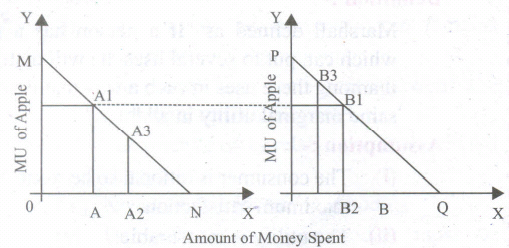
He should buy 6 units of apple & 5 units of oranges. He gets (92 + 58) = 150 units satisfaction.
\(\frac{\mathrm{MU_A}}{\mathrm{P_A}}=\frac{\mathrm{MU_O}}{\mathrm{P_O}}=\frac{4}{1}=\frac{4}{1}\)
| Apple | orange | |||
| Units of Commodities | Total Utility | marginal Utility | Total Utility | marginal Utility |
| 1 | 25 | 25 | 30 | 30 |
| 2 | 45 | 20 | 41 | 11 |
| 3 | 63 | 18 | 49 | 8 |
| 4 | 78 | 15 | 54 | 5 |
| 5 | 88 | 10 | 58 | 4 |
| 6 | 92 | 4 | 61 | 3 |
Explanation:
(i) X axis shows amount of money spent
(ii) Y axis shows marginal utility of apple and orange.
(iii) If consumer spends Rs.6 on apple and Rs.5 on orange MU will be equal.
(iv) ie. AA1 = BB1 = 4 = 4. So he gets maximum utility.
Criticisms:
(i) Utility cannot be measured.
(ii) No consumer compares the utility and disutility from each unit of the commodity while buying it.
(iii) This law cannot be applied to durable goods.
Conclusion:
(i) The law of Equi-marginal utility is an improvement over the law of diminishing marginal utility because it can be used for many commodities consumed at the same time.
16.
Introduction:
(i) H. H. Gossen first formulated this law.
(ii) So Jevons called it "Gossen's First law of consumption"
(iii) Marshall perfected it on the basis of cardinal analysis.
(iv) It is based on the satiable character of human wants.
Definition
Marshall states the law as "the additional benefit which a person derives from a given increase of his stock of a thing, diminishes with every increase in the stock that he already has".
Assumptions
(i) Utility can be measured - 1,2,3.
(ii) Marginal utility of money is constant.
(iii) The consumer is rational. He wants maximum satisfaction.
(iv) The units consumed must be reasonable in size.
(v) The commodity must be homogeneous.
(vi) The consumption must be continuous.
(vii) There is no change in taste, habit, preferences, fashion, income & character of the consumer.
Illustration:
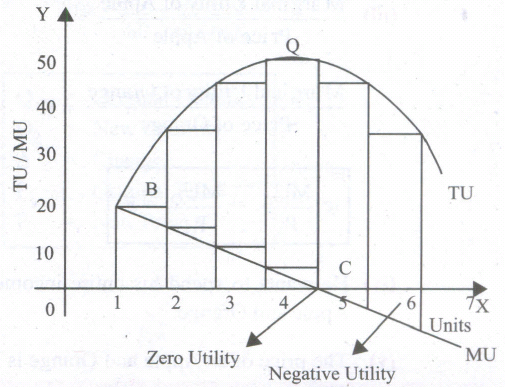
(i) Suppose a consumer wants to consume 7 apples one after another.
(ii) The utility from the first apple is 20.
(iii) The utility from the 2nd apple is less than the first (15), the utility from the 3rd apple is less than the 2nd (10) and so on.
(iv) Finally the utility from the 5th apple becomes zero and the utility from the 6th apple is -5.
| Number of Apples | Total utility | Marginal Utility |
| 1 | 20 | 20 |
| 2 | 35 | 15(35 - 20) |
| 3 | 45 | 10(45 - 35) |
| 4 | 50 | 5 (50 - 45) |
| 5 | 50 | 0 (50 - 50) |
| 6 | 45 | -5 (45- 50) |
| 7 | 35 | -10 (35-45) |
Explanation:
(i) TU goes on increasing but at a diminishing rate.
(ii) MU goes on diminishing
(iii) When MU is zero TU is maximum.
(iv) When MU becomes negative, TU diminishes.
Criticism:
(i) Utility is subjective so cannot be measured numerically.
(ii) The assumptions are unrealistic.
(iii) The law is not used for indivisible commodities.
Exceptions:
(i) Hobbies
(ii) Drunkards
(iii) Readings
(iv) Misers
(v) Music
(vi) Poetry
Importance:
(i) It is a fundamental law of consumption.
(ii) It is the basis for the law of demand, elasticity of demand, consumer's surplus.
(iii) Finance Minister uses it for progressive taxation.
(iv) Redistribution of income is justified.
(v) Adam Smith uses it for his "diamond water paradox".
Conclusion:
The law of diminishing marginal utility is of great use in our daily life.

11th Standard Syllabus & Materials
11th Standard
TN 11th Tamil பீடு பெற நில் - செய்யுள் - காவடிச்சிந்து Important Questions And Answers Study Material - QB365 Set A
NEW11th Standard
TN 11th Tamil பீடு பெற நில் - உரைநடை - மலை இடப்பெயர்கள் : ஓர் ஆய்வு Important Questions And Answers Study Material - QB365 Set A
NEW11th Standard
TN 11th Tamil மாமழை போற்றுதும் - துணைப்பாடம் - யானை டாக்டர் Important Questions And Answers Study Material - QB365 Set A
NEW11th Standard
TN 11th Tamil மாமழை போற்றுதும் - செய்யுள் - ஐங்குறுநூறு Important Questions And Answers Study Material - QB365 Set A



Tamilnadu Stateboard 11th Standard Subjects

Maths

Commerce
Economics

Biology

Business Maths and Statistics

Accountancy

Computer Science

Physics

Chemistry
Maths
Biology
Economics
Physics
Chemistry

History
Business Maths and Statistics

Computer Science
Accountancy

Computer Applications
History
Computer Technology
Commerce
Computer Applications
Computer Technology

Tamil

English

French
Tamilnadu Stateboard Standards
