
 100% FREE ACCESS
11th Standard Syllabus & Materials
11th Standard
TN 11th Tamil இயற்கை வேளாண்மை,சுற்றுச்சூழல் -செய்யுள் - மனோன்மணீயம் Important Questions And Answers Study Material - QB365 Set A
NEW11th Standard
TN 11th Tamil என்னுயிர் என்பேன் -துணைப்பாடம் - இசைத்தமிழர் இருவர் Important Questions And Answers Study Material - QB365 Set A
NEW11th Standard
TN 11th Tamil மொழி கலை -செய்யுள் - ஒவ்வொரு புல்லையும் Important Questions And Answers Study Material - QB365 Set A
NEW11th Standard
TN 11th Tamil பீடு பெற நில் - இலக்கணம் - பகுபத உறுப்புகள் Important Questions And Answers Study Material - QB365 Set A
NEW11th Standard
TN 11th Tamil பீடு பெற நில் - துணைப்பாடம் - வாடிவாசல் Important Questions And Answers Study Material - QB365 Set A
NEW11th Standard
TN 11th Tamil பீடு பெற நில் - செய்யுள் - குறுந்தொகை Important Questions And Answers Study Material - QB365 Set A

Published on: 04/10/2019
Consumption Analysis
Download Tamil Nadu 11th Standard Economics question papers, model tests, one-mark questions, important questions, and public exam papers in PDF format. Free study materials and answer keys for TN State Board students.
Questions + Answers key
Take MCQ Economics Test
1.
Explain the different types of Elasticity of Demand.
2.
Explain the importance or the application of the Law of Diminishing Marginal Utility.
3.
Explain the importance of Elasticity of Demand.
4.
5.
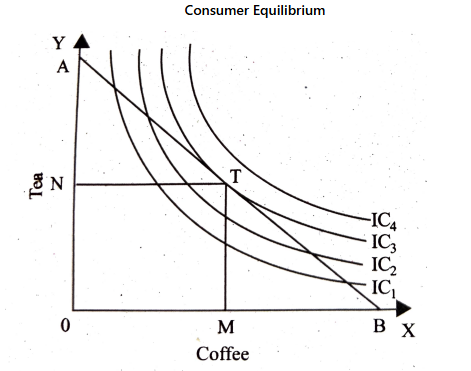
Explain the concept of consumer's equilibrium with a diagram.
6.
Mention the relationship between marginal utility and total utility.
7.
Describe the feature of human wants
1.
Different types of Elasticity of Demand :
Price Elasticity of Demand
Price elasticity of demand is commonly known as elasticity of demand. This is because price is the most influential factor affecting demand. "Elasticity of demand measures the responsiveness of the quantity demanded to changes in the price".
(1) Price Elasticity of Demand: The price elasticity of demand; commonly known as the elasticity of demand refers to the responsiveness and sensitiveness of demand for a product to the changes in its price. In other words, the price elasticity of demand is equal to
\({ E }_{ p }=\frac { Proportionate \ change \ in \ quantity \ demanded }{ Proportionate \ change \ in \ price } \)
Numerically,
\({ E }_{ p }=\frac { \triangle Q }{ \triangle P } \times \frac { P }{ Q } \)
Where, \(\triangle Q={ Q }_{ 1 }-{ Q }_{ 0 },\triangle P={ P }_{ 1 }-{ P }_{ 0 },Q1\)=New quantity,
\({ Q }_{ 0 }\)=Original quantity, \({ P }_{ 1 }\)=New price, \({ P }_{ 0 }\)=Original price.
(2) Income 'Elasticity of Demand: The income is also a factor that influences the demand for a product. Hence, the degree of responsiveness of a change in demand for a product due to the change in the income is known as income elasticity of demand. , The formula to compute the income elasticity of demand is:
\({ E }_{ Y }=\frac { Proportionate\ change\ in\ quantity\ Demanded\ for\ a\ product }{ Proportionate\ change\ in\ Income } \)
For most of the goods, the income elasticity of demand is greater than one indicating that with the change in income the demand will also change and that too in the same direction, i.e. more income means more demand and vice-versa.
(3) Cross Elasticity of Demand The cross elasticity of demand refers to the percentage change in quantity demanded for one commodity as a result of a small change in the price of another commodity. This type of elasticity usually arises in the case of the interrelated goods such as substitutes and complementary goods. The cross elasticity of demand for goods X and Y can be expressed as:
\({ E }_{ C }=\frac { Proportionate\ change\ in\ Demanded\ of\ commodity\ X }{ Proportionate\ change\ in\ price\ of\ commodity\ Y } \)
(4) Advertising Elasticity of Demand: The responsiveness of the change in demand due to the change in advertising or other promotional expenses, is known as advertising 'elasticity-of demand. It can be expressed as:
\({ E }_{ a }=\frac { Proportionate\ change\ in\ Demand }{ Proportionate\ change\ in\ Advertising\ Expenditure } \)
2.
Importance or Application of the Law of DMU:
(1) The Law of DMU is one of the fundamental laws of consumption. It has applications in several fields of study.
(2) This law is the basis for other consumption laws such as Law of Demand, Elasticity of Demand, Consumer's Surplus and the Law of Substitution etc.
(3) The Finance Minister taxes a more-moneyed person more and a less-moneyed person less. When a person's income rises, the tax-rate rises because the MU of money to him falls with every rise in his income. Thus, the Law of DMU is the basis for progressive taxation.
(4) This law emphasises an equitable distribution of wealth. The MU of money to the more-moneyed is low. Hence, redistribution of income from rich to poor is justified.
(5) Adam Smith explains the famous "diamond-water paradox". Diamond is scarce, hence, its MU is high and its price is high, even though it is not very much needed. Water is abundant, hence, its MU is low and its price is low, even though it is very much essential.
3.
Importance of Elasticity of Demand
The concept of elasticity of demand is of much practical importance.
(1) Price fixation: Each seller Under monopoly and imperfect competition has to take into account elasticity of demand while fixing the price for his product. If the demand for the product is inelastic, he can fix a higher price.
(2) Production: Producers generally decide their production level on the basis of demand for the product.
(3) Distribution: Elasticity of demand also helps in the determination of rewards for factors of production.
(4) International trade: Elasticity of demand helps in finding out the terms of trade between two countries. Terms of trade depends upon the elasticity of demand for the goods of the two countries.
(5) Public finance: Elasticity of demand helps the government in formulating tax policies. For example, for imposing tax on a commodity.
(6) Nationalization: The concept of elasticity of demand enables the government to decide over nationalization of industries.
4.
5.
(i) The consumer reaches equilibrium at the point where the budget line is tangent on the indifference curve.
(ii) T is the point of equilibrium as budget line AB is tangent on indifference curve IC3 the upper IC which implies maximum possible level of satisfaction.
(iii) At equilibrium point, the slope of IC refers to MRSXY and the slope of BL (Budget Line) refers to ratio of price of X to price of Y ie PX/Py. Therefore MRSx,y = PX/Py.
6.
| Total utility | Marginal utility |
| Increases at a diminishing rate | Goes on diminishing |
| Reaches maximum | Becomes zero |
| Diminishes | Becomes negative |
7.
Characteristics
Wants are unlimited
(i) Wants are countless and various in kinds.
(ii) When one want is satisfied another want arises.
Wants become habits
(i) When a man starts reading newspaper in the morning it becomes a habit.
Wants are satiable
(i) We can satisfy particular wants at a given time.
(ii) When one feels hungry, he takes food and that want is satisfied.
Wants are alternative
(i) There are alternative ways to satisfy a particular want (eg) idly, dosa.
Wants are competitive
(i) There is competition among wants.
(ii) So we have to choose more urgent wants and satisfy them first.
Wants are complementary
(i) Satisfaction of a particular want requires the use of more than one commodity. (eg) car and petrol.
Wants are recurring
(i) Some wants occur again and again. For ex. if we feel hungry, we take food and satisfy our want.
(ii) But after some time we again feel hungry and want food.

11th Standard Syllabus & Materials
11th Standard
TN 11th Tamil பீடு பெற நில் - செய்யுள் - காவடிச்சிந்து Important Questions And Answers Study Material - QB365 Set A
NEW11th Standard
TN 11th Tamil பீடு பெற நில் - உரைநடை - மலை இடப்பெயர்கள் : ஓர் ஆய்வு Important Questions And Answers Study Material - QB365 Set A
NEW11th Standard
TN 11th Tamil மாமழை போற்றுதும் - துணைப்பாடம் - யானை டாக்டர் Important Questions And Answers Study Material - QB365 Set A
NEW11th Standard
TN 11th Tamil மாமழை போற்றுதும் - செய்யுள் - ஐங்குறுநூறு Important Questions And Answers Study Material - QB365 Set A



Tamilnadu Stateboard 11th Standard Subjects

Maths

Commerce
Economics

Biology

Business Maths and Statistics

Accountancy

Computer Science

Physics

Chemistry
Maths
Biology
Economics
Physics
Chemistry

History
Business Maths and Statistics

Computer Science
Accountancy

Computer Applications
History
Computer Technology
Commerce
Computer Applications
Computer Technology

Tamil

English

French
Tamilnadu Stateboard Standards
