
 100% FREE ACCESS
11th Standard Syllabus & Materials
11th Standard
TN 11th Tamil இயற்கை வேளாண்மை,சுற்றுச்சூழல் -செய்யுள் - மனோன்மணீயம் Important Questions And Answers Study Material - QB365 Set A
NEW11th Standard
TN 11th Tamil என்னுயிர் என்பேன் -துணைப்பாடம் - இசைத்தமிழர் இருவர் Important Questions And Answers Study Material - QB365 Set A
NEW11th Standard
TN 11th Tamil மொழி கலை -செய்யுள் - ஒவ்வொரு புல்லையும் Important Questions And Answers Study Material - QB365 Set A
NEW11th Standard
TN 11th Tamil பீடு பெற நில் - இலக்கணம் - பகுபத உறுப்புகள் Important Questions And Answers Study Material - QB365 Set A
NEW11th Standard
TN 11th Tamil பீடு பெற நில் - துணைப்பாடம் - வாடிவாசல் Important Questions And Answers Study Material - QB365 Set A
NEW11th Standard
TN 11th Tamil பீடு பெற நில் - செய்யுள் - குறுந்தொகை Important Questions And Answers Study Material - QB365 Set A

Published on: 14/12/2019
Distribution Analysis
Download Tamil Nadu 11th Standard Economics question papers, model tests, one-mark questions, important questions, and public exam papers in PDF format. Free study materials and answer keys for TN State Board students.
Questions + Answers key
Take MCQ Economics Test
1.
The concept of meeting unexpected expenditure according to Keynes is
Transaction motive
Precautionary motive
Speculative motive
Personal motive
2.
The reward given for the use of capital
rent
wage
interest
profit
3.
Residual Claimant Theory is propounded by
Keynes
Walker
Hawley
Knight
4.
Money wages are also known as
real wages
nominal wages
original wages
transfer wages
5.
6.
7.
Describe briefly the Innovation Theory of Profit.
8.
State the Dynamic Theory of profit.
9.
Distinguish between rent and quasi-rent.
10.
11.
What is personal distribution?
12.
Name the few Theories of Interest.
13.
What is Standard of Living Theory of Wages?
14.
What are the factors determining demand for loanable funds?
15.
What is net interest?
16.
Describe Uncertainty Bearing Theory of Profit.
17.
How to determine the rate of interest with diagram? Determination of Rate of Interest.
18.
How is the Marginal product of a factor expressed as? Explain.
19.
What are the assumptions of the Marginal Productivity Theory of Distribution?
1.
(b)
Precautionary motive
2.
(c)
interest
3.
(b)
Walker
4.
(b)
nominal wages
5.
(b)
6.
7.
(i) According to Schumpeter profit is the reward for innovation.
(ii) Innovation means invention put into commercial practice.
(iii) Innovation may consist of introduction of a new product or a new method of production or opening a new market or discovery of new raw materials or reorganisation of an industry.
(iv) The cost of production decreases and so profit increases.
(v) Innovation should be done continuously.
8.
(i) According to Clark profit is the difference between price and cost of production.
(ii) Profit is the reward for dynamic changes in society-like increase in population, increase in volume of capital, improvement in methods of production, change in forms of industrial organisation and increase in wants of consumers.
9.
| SI.No | Rent | Quasi Rent |
|---|---|---|
| 1 | Rent accrues to land | Quasi - Rent accrues to man made appliances |
| 2 | The supply of land is fixed forever. | The supply of man made appliances is fixed for a short period only. |
| 3 | It enters into price. | It does not enter into price. |
| 4 | It is temporary. |
10.
11.
Personal distribution is the distribution of National Income among the individuals.
12.
i) Abstinence (or) Waiting theory.
ii) Agio Theory of Interest.
iii) Loanable Fund Theory.
iv) Liquidity Preference Theory.
13.
According to the theory, wage is equal to the standard of living of the workers. Standard of living wage means the amount necessary to maintain the labourer in the standard of life.
14.
The demand for loanable funds depend upon the following:
(i) Demand for Investment (I)
(ii) Demand for Consumption (C)
(iii) Demand for Hoarding (H)
15.
(i) Net interest is only a part of the gross interest.
(ii) It is the payment for use of capital only.
(iii) Net interest is otherwise known as pure interest
16.
Uncertainty theory was propounded by the American economist Frank H. Knight. To him, profit is the reward for 'uncertainty bearing'. He distinguishes between 'insurable' and 'non-insurable' risks.
Insurable Risks: Certain risks are measurable or calculable. Some of the examples of these risks are the risk of fire, theft and natural disasters.' Hence, they are insurable. Such risks are compensated by the Insurance Companies.
Non-Insurable Risks: There are some risks which are immeasurable or incalculable. The probability of their occurrence cannot be anticipated because of the presence of uncertainty in them. Some of the examples of these risks are competition, market condition, technology change and public policy. No Insurance Company can undertake these risks. Hence, they are non insurable. The term 'risks' covers the first type of events (measurables - insurable) and the term 'uncertainty' covers the second type of events (unforeseeable or incalculable or not measurable or non-insurable). According to Knight, profit does not arise on account of risk taking, because the entrepreneur can guard himself against a risk by taking a suitable insurance policy. But uncertain events cannot be guarded against that way. When an entrepreneur takes himself the burden of facing an uncertain event, he secures remuneration. That remuneration is 'profit'.
17.
According to Keynes, the rate of interest is determined by the demand for money and the supply of money. The demand for money is liquidity preference. In fact, liquidity preference for speculative motive determines rate of interest. The supply of money is determined by the policies of the Government and the Central Bank of a country. The total supply of money consists of coins, currency notes and bank deposits (Say M = 200).
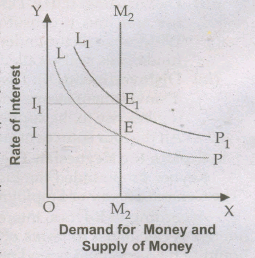
Equilibrium between Demand and Supply of Money:
The equilibrium between liquidity preference and demand for money determine the rate of interest. In short run, the supply of money is assumed to be constant Rs.200.
.PNG)
LP is the liquidity preference Curve (demand curve). M2 M2 shows the supply curve of money to satisfy speculative motive. Both curves intersect at the point E, which is the equilibrium point. Hence, the rate of interest is 2.5. If liquidity preference increases from LP to L1P1 the supply of money remains constant, & the rate of interest would increase from 01 to all. Numerical examples given above can also be used for better understanding. Total demand for money = Mt + Mp + Ms = 0.125Y + 0.125Y + (450 - 100i). Total supply of money = Rs. 200. Mt and Mp are influenced by Y. Hence for the sake of easy understanding, Ms alone can be considered Demand for money = supply of money at equilibrium point: 450 - 100i = 200; 450, - 200 = 100i; 250 = 100i; i = 250/100 = 2.5. This is equilibrium interest. In reality, interest rate is also influenced by national income and commodity sector equilibrium. However, they are not included here for making the understanding easier. Suppose LP remains constant. If the supply of money is OM2, the interest is OI2 and if the supply of money is reduced from OM2 to OM3, the interest would increase from OI2 to OI3, If the supply of money is increased from OM2 to OM4, the interest would decrease from OI2 to OI4,
Criticisms:
(i) This theory does not explain the existence of different interest rates prevailing in the market at the same time.
(ii) It explains interest rate only in the short-run.
18.
The marginal product of a factor is expressed as MPP, VMP and MRP.
(1) Marginal Physical Product (MPP)
The Marginal Physical Product of a factor is the increment in the total product obtained by the employment of an additional unit of that factor.
(2) Value of Marginal Product (VMP)
The Value of Marginal Product is obtained by multiplying the Marginal Physical Product of the factor by the price of product. Symbolically
VMP = MPP x Price
(3) Marginal Revenue Product (MRP)
The Marginal Revenue Product of a factor is the increment in the total revenue which is obtained by the employment of an additional unit of that factor,
MRP = MPP x MR
19.
Marginal Productivity Theory of Distribution: Assumptions:
This theory is based on the following assumptions:
(i) All the factors of production are homogenous.
(ii) Factors of production can be substituted for each other.
(iii) There is perfect competition both in the factor market and product market.
(iv) There is perfect mobility of factors of production.
(v) There is full employment of factors.
(vi) This theory is applicable only in the long-run.
(vii) The entrepreneurs aim at profit maximization.
(viii) There is no government intervention in fixing the price of a factor.
(ix) There is no technological change.

11th Standard Syllabus & Materials
11th Standard
TN 11th Tamil பீடு பெற நில் - செய்யுள் - காவடிச்சிந்து Important Questions And Answers Study Material - QB365 Set A
NEW11th Standard
TN 11th Tamil பீடு பெற நில் - உரைநடை - மலை இடப்பெயர்கள் : ஓர் ஆய்வு Important Questions And Answers Study Material - QB365 Set A
NEW11th Standard
TN 11th Tamil மாமழை போற்றுதும் - துணைப்பாடம் - யானை டாக்டர் Important Questions And Answers Study Material - QB365 Set A
NEW11th Standard
TN 11th Tamil மாமழை போற்றுதும் - செய்யுள் - ஐங்குறுநூறு Important Questions And Answers Study Material - QB365 Set A



Tamilnadu Stateboard 11th Standard Subjects

Maths

Commerce
Economics

Biology

Business Maths and Statistics

Accountancy

Computer Science

Physics

Chemistry
Maths
Biology
Economics
Physics
Chemistry

History
Business Maths and Statistics

Computer Science
Accountancy

Computer Applications
History
Computer Technology
Commerce
Computer Applications
Computer Technology

Tamil

English

French
Tamilnadu Stateboard Standards
