
 100% FREE ACCESS
11th Standard Syllabus & Materials
11th Standard
TN 11th Tamil இயற்கை வேளாண்மை,சுற்றுச்சூழல் -செய்யுள் - மனோன்மணீயம் Important Questions And Answers Study Material - QB365 Set A
NEW11th Standard
TN 11th Tamil என்னுயிர் என்பேன் -துணைப்பாடம் - இசைத்தமிழர் இருவர் Important Questions And Answers Study Material - QB365 Set A
NEW11th Standard
TN 11th Tamil மொழி கலை -செய்யுள் - ஒவ்வொரு புல்லையும் Important Questions And Answers Study Material - QB365 Set A
NEW11th Standard
TN 11th Tamil பீடு பெற நில் - இலக்கணம் - பகுபத உறுப்புகள் Important Questions And Answers Study Material - QB365 Set A
NEW11th Standard
TN 11th Tamil பீடு பெற நில் - துணைப்பாடம் - வாடிவாசல் Important Questions And Answers Study Material - QB365 Set A
NEW11th Standard
TN 11th Tamil பீடு பெற நில் - செய்யுள் - குறுந்தொகை Important Questions And Answers Study Material - QB365 Set A

Published on: 21/01/2020
Download Tamil Nadu 11th Standard Economics question papers, model tests, one-mark questions, important questions, and public exam papers in PDF format. Free study materials and answer keys for TN State Board students.
Questions + Answers key
Take MCQ Economics Test
1.
Describe the V.K.R.V. Rao's Contribution to Indian economy.
2.
Elucidate the monetary and financial sector reforms.
3.
Describe the Agrarian Crisis after Reforms?
4.
A producer has the total cost function TC(Q) = \(2Q^{ 3 }+{ 8Q }^{ 2 }+12Q+20\) where costs are given in rupees. Find the marginal cost (MC) and the average variable cost (AVC), when Q = 4.
5.
Solve by Cramer's rule the equations
\(2{ x }_{ 1 }+2{ x }_{ 2 }-{ x }_{ 3 }-1=0;\)
\( { x }_{ 1 }+{ x }_{ 2 }-{ x }_{ 3 }=0\)
\(3{ x }_{ 1 }+2{ x }_{ 2 }-3{ x }_{ 3 }=1\)
6.
Enumerate the determinants of Demand?
7.
Discuss the highlights of Tamil Nadu Economy?
8.
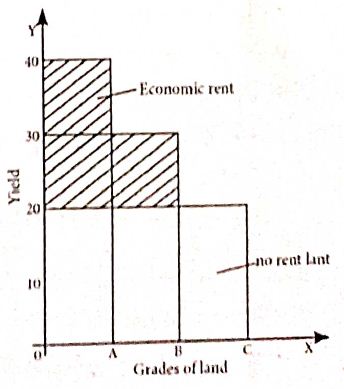
What are the Assumptions of Ricardian Theory?
9.
Explain the meaning of Fixed and Variable factors and costs.
10.
What are the factors determining supply?
11.
Elucidate the law of diminishing marginal utility with diagram.
12.
13.
Examine Adam Smith's Definition of Economics.
14.
Explain the role of SSIs in economic development ?
15.
16.
17.
Explain the objectives and characteristics of SEZs.
18.
19.
20.
Write the importance of mineral resources in India.
1.
According to P.R. Brahmananda:" the great trinity of pre-independent and post independent Indian economists consisted of D.R. Gadgill, CN. Vakil and V.K.R.V. Rao. These scholars were imbibed with a missionary zeal and analyzed the Indian economic problems with a view to designing and propagating economic policies/programmes and plans to India's national advantage." V.K.R.V.Rao was a prolific writer. V.K.R.V.Rao was deeply interested in three large themes. They were:
(i) National Income,
(ii) Food, nutrition and the distribution of good; and
(iii) Employment and occupational distributions.
(i) National Income Methodology: As an applied economist, Rae's name is remembered for his pioneering work on the enumeration of national income of India. Rao was a pupil of J.M. Keynes and he worked with Colin Clark H.W Singer considered V.K.R.V.Rao as "the best equipped of all Keynes' pupils". He attempted
(a) to develop the national income concepts suited to India and developing countries generally;
(b) to analyze the concepts of investment, saving and the multipliers in an underdeveloped economy; and
(c) to study the compatibility of the national incomes of industrialized and underdeveloped countries. Rao's paper on "Full Employment and Economic Development" was 'one of the earliest contributions in the field of development towards employment.
(ii) International Food Aid: Rao was influential in creating ideas and shaping policy in the international attack on world poverty, not only through his contributions to the question of international aid and improved flows of external resources, but also through his activities in the field of food aid.
(iii) Support for Socialism: During the early phases of planning in India, Rao supported the case of a socialist India, where the state would control the commanding heights of the economy and the public sector would play a dominant role in economic development.
(iv) Rao's Views on Industrialisation: In his pamphlet "What is wrong with Indian Economic Life?" (1938), Rao gave the following reasons for low per capita income and low levels of per capita nutrition in India.
(a) Uneconomic holdings with subdivisions and fragmentation;
(b) Low levels of water availability for crops;
(c) Excess population pressure on agriculture due to the absence of a large industrial sector;
(d) Absence of capital;
(e) Absence of autonomy in currency policy, and in general in monetary matters encouraging holding of gold.
(v) Village Clusters: Rao felt that rural communities had to be given a viable base. Therefore he suggested that a cluster of villages should form a unit for rural development, so that both social and economic interactions between villages could develop, and they could effectively generate and fashion their own development with a more meaningful participation by people.
(vi) Investment, Income and Multiplier: Rao's examination of the "interrelation between investment, income and multiplier in an under developed economy" (1952) was his major contribution to macroeconomic theory. As a thinker, teacher, economic adviser and direct policy maker, V.K.R.V.Rao followed the footsteps of his great teacher, John Maynard Keynes.
(vii) Institution Builder: He founded three national level research institutes namely Delhi School of Economics, Institute of Economic Growth (both at Delhi) and Institute for Social and Economic Change (Bangalore).
2.
Monetary reforms aimed at doing away with interest rate distortions and rationalising the structure of lending rates. The new policy tried in many ways to make the banking system more efficient. Some of the measures undertaken were:
(i) Reserve Requirements: Reduction in Statutory Liquidity Ratio (SLR) and the Cash Reserve Ratio (CRR) were recommended by the Narasimham Committee Report, 1991. It was proposed to cut down the SLR from 38.5 percent to 25 percent within a time span of three years. Similarly, it was proposed that the CRR be brought down to 3 to 5% over a period of four years.
(ii) Interest Rate Liberalisation: Earlier, -RBI controlled
(a) the interest rates payable on deposits,
(b) the interest rates which could be charged for bank loans.
(iii) Greater competition among public sector, private sector and foreign banks and elimination of administrative constraints.
(iv) Liberalisation of bank branch licensing policy in order to rationalize the existing branch network.
(v) Banks were given freedom to relocate branches and open specialized branches
(vi) Guidelines for opening new private sector banks.
(vii) New accounting norms regarding classification of assets and provisions of bad debt were introduced in tune with the Narasimham Committee Report.
3.
(i) High input costs: The biggest input for farmers is seeds. Before liberalisation, farmers across the country had access to seeds from state government institutions. The institutions produced own seeds and were responsible for their quality and price. With liberalisation, India's seed market was opened up to global agribusinesses. Also, following the deregulation many state government institutions were closed down in 2003. These hit farmers doubly hard: seed prices' shot up, and fake seeds made an appearance in a big way.
(ii) Cutback in agricultural subsidies: Farmers were encouraged to shift from growing a mixture of traditional crops to export oriented 'cash crops' like chill, cotton and tobacco. Liberalisation policies reduced the subsidies on pesticide, fertilizer and elasticity. As a result prices have increased by 300%. However, the prices of agricultural goods have not increased to that extent.
(iii) Reduction of import duties: With a view to open India's markets, the liberalization' reforms also withdrew tariffs and duties on imports. By 2001, India completely removed restrictions on imports of almost 1,500 items including food. As a result, cheap imports flooded the market, pushing prices of crops like cotton and pepper down.
(iv) Paucity of credit facilities: After 1991 the lending pattern of commercial banks, including nationalised bank drastically changed. As a result, loan was not easily adequate. This has forced the farmers to rely on moneylenders who charge exorbitant rate of interest.
4.
Given \(TC(Q)=2Q^{ 3 }+{ 8Q }^{ 2 }+12Q+20\)
To find MC differentiate the function with respect to Q.
\(MC(Q)=\frac { d(TC) }{ d(Q) } =2(3){ Q }^{ 3-1 }+8(2){ \quad Q }^{ 2-1 }+12(1)\quad { Q }^{ 1-1 }+0\)
\(={ 6Q }^{ 2 }+16Q^{ 1 }+12\)
\(When\quad Q=4\)
\(MC(Q)=6{ (4) }^{ 2 }+16(4)+12\)
\(=96+64+12\)
\(MC(Q)=172\)
To find AVC
\(AVC(Q)=TVC(Q)/Q\)
\(AVC(Q)=TC(Q)-TFC(Q)\)
In TC(Q)-Constant Value is TFC(Q) [\(\therefore \) Value of constant =20]
\(\therefore TFC(Q)={ 2 }Q^{ 3 }+{ 8Q }^{ 2 }+12Q\)
\(AVC(Q)=\frac { TVC(Q) }{ Q } =\frac { { 2Q }^{ 3 }+{ 8Q }^{ 2 }+12Q }{ Q } \)
\(={ 2Q }^{ 2 }+8Q+12\)
\(when \ Q=4\)
\(AVC(Q)=2({ 4) }^{ 2 }+8(4)+12\)
\(=2(16)+8(4)+12=32+32+12\)
\(AVC(Q)=76\)
\(marginal\ cost=172;AV\quad cost=76\)
5.
The matrix form of these equations is
\(\left[ \begin{matrix} 2 & 2 & -1 \\ 1 & 1 & -1 \\ 3 & 2 & -3 \end{matrix} \right] \)
\(=2[-3+2]-2[-3+3]-1[2-3]\)
\(=2[-1]-2[0]-1[-1] =-2+1\)
\(\triangle =-1\)
\(\triangle { x }_{ 1 }=\left| \begin{matrix} 1 & 2 & -1 \\ 0 & 1 & -1 \\ 1 & 2 & -3 \end{matrix} \right| \)
\(=1(-3+2)-2(0+1)-1(0-1)\)
\(=1(-1)-2(1)-1(-1) -1-2+1\)
\(\triangle { x }_{ 1 }=-2\)
\( \triangle { x }_{ 2 }=\left| \begin{matrix} 2 & 1 & -1 \\ 1 & 0 & -1 \\ 3 & 1 & -3 \end{matrix} \right| \)
\(=2(0+1)-1(-3+3)-1(-1-0)\)
\(=2(1)-1(0)-1(1)=2-1\)
\( \triangle { x }_{ 2 }=1\)
\(\triangle { x }_{ 3 }=\left| \begin{matrix} 2 & 2 & 1 \\ 1 & 1 & 0 \\ 3 & 2 & 1 \end{matrix} \right| \)
\(=2(1-0)-2(1-0)+1(2-3)=2(1)-2(1)+1(-1)=2-2-1\)
\(\triangle { x }_{ 3 }=-1\)
\(By\quad Cramer's\quad rule\)
\({ x }_{ 1 }=\frac { \triangle { x }_{ 1 } }{ \triangle } \)
\(=\frac { -2 }{ -1 } =2\)
\({ x }_{ 2 }=\frac { \triangle { x }_{ 2 } }{ \triangle } \)
\(=\frac { 1 }{ -1 } =-1\)
\({ x }_{ 3 }=\frac { \triangle { x }_{ 3 } }{ \triangle } \)
\(=\frac { -1 }{ -1 } =1\)
\(\text {solution set} \left( { x }_{ 1 },{ x }_{ 2 },{ x }_{ 3 } \right) =\left( 2,-1,1 \right) \)
6.
Introduction: Demand is always related to price. Demand is always a specific quantity which a consumer is willing to purchase.
Demand Function: Demand depends upon price. This means demand for a commodity is a functions of price. D = f (P)
Determinants of Demand:
i. Changes in Tastes and Fashions:
The demand for some goods and services is very susceptible to changes in tastes and fashions.
ii. Changes in Weather:
An unusually dry summer results in a increase in the demand for cool drinks.
iii. Taxation and Subsidy:
The subsidies will bring down the prices. Therefore taxes reduce demand and subsidies raise demand.
iv. Changes in expectations:
Expectation of rise in price in future results in increase in demand,
v. Changes in savings:
Savings and demand are inversely related.
vi. State of Trade Activity:
During the period of boom and prosperity demand for all commodities tendes to increase. On the contrary, during time to depression, there is general slackening of demand.
vii. Advertisement:
Advertisement is a powerful instrument increasing the demand in the market.
viii. Changes in income:
An increase in family income may increase the demand for durables like video recorders and refrigerators. Equal distribution of income enables poor to get more income.
ix. Change in population:
The demand for goods depends on the size of population. An increase in population tends to increase the demand for goods and a decrease in population tends to decrease the demand (if other things remain constant).
7.
Growth of SGDP in Tamil Nadu has been among the fastest in India since 2005.
Poverty reduction in Tamil Nadu has been faster than that in many other States.
Tamil Nadu contains a smaller proportion of India's poor population.
Tamil Nadu is the second largest contributor to India's GDP.
Tamil Nadu ranks 3rd in Human Development Index (source: UNDP - 2015)
Tamil Nadu is placed third in health index as per the NITI AAYOG report.
Tamil Nadu has a highest Gross Enrolment Ratio in higher education.
Tamil Nadu has the largest number of engineering colleges
Tamil Nadu has emerged as a major hub for renewable energy.
Tamil Nadu has highest credit Deposit Ratio in commercial and Cooperative banks.
Tamil Nadu has highest ranks first on investment proposals filed by MSMEs.
8.
(i) Land differs in fertility
(ii) The law of diminishing returns operates in agriculture
(iii) Theory assumes perfect competition
(iv) Land is used for cultivation only
(v) Most fertile lands are cultivated first.
9.
Fixed cost and variable cost: Fixed cost and variable cost are helpful in understanding the behaviour of costs over different levels of output.
Meaning of Fixed and Variable factors and costs:
Fixed and variable factors are with reference to short run production function. Short run is a period of time over which certain factors of production cannot be changed, and such factors are called fixed factors. The costs incurred on fixed factors are called fixed costs. The factors whose quantity can be changed in the short run are variable factors, and the costs incurred on variable factors are called variable costs
Fixed costs are those which are independent of output, that is, they do not change with changes in output. These costs are a 'fixed' amount, which must be incurred by a firm in the short run whether the output is small or large. E.g. contractual rent, interest on capital invested, salaries to the permanent staff, insurance premia and certain taxes. Variable costs are those costs, which are incurred on the employment of variable factors of production whose amount can be altered in the short run. Thus the total variable costs change with the level of output. It rises when output expands and falls when output contracts. When output is nil, variable cost becomes zero. These costs include payments such as wages of labour employed, prices of raw materials, fuel and power used arid the transport costs.
10.
1. Price of the commodity
Higher the price larger the supply Price IS the incentive for the producers and sellers to supply more.
2. Price of other commodities
The supply of a commodity depends not only upon its price but also price of other commodities For instance if the price of commercial crops like cotton rise, this may result in reduction in cultivation of food crops like paddy and so its supply.
3. Price of factors
When the input prices go up, this result in rise in cost and supply will be affected.
4. Price expectations
The expectation over future prices determines present supply. If a rise in price is anticipated in future sellers tend to retain their produce for future sale and so supply in present market is reduced.
5. Technology
With advancement in technology production level improves, average cost production level improves average cost declines and as a result supply level increases.
6. Natural factors
In agriculture, natural factor like monsoon, climate etc. play a vital role in determining production level.
7. Discovery of new raw materials The discovery of new raw materials which are cheaper and of high quality tends to increase supply of the product.
8. Taxes and subsidies
Subsidies for inputs, credit, power etc. encourage the producers to produce more. Withdrawal of such incentives will hamper production. Taxes both dirt and indirect kill the ability and willingness to produce more.
9. Objective of the firm
When the goal of the firm is sales maximisation or improving market share, the supply of the product is likely to be higher.
11.
Introduction:
(i) H. H. Gossen first formulated this law.
(ii) So Jevons called it "Gossen's First law of consumption"
(iii) Marshall perfected it on the basis of cardinal analysis.
(iv) It is based on the satiable character of human wants.
Definition
Marshall states the law as "the additional benefit which a person derives from a given increase of his stock of a thing, diminishes with every increase in the stock that he already has".
Assumptions
(i) Utility can be measured - 1,2,3.
(ii) Marginal utility of money is constant.
(iii) The consumer is rational. He wants maximum satisfaction.
(iv) The units consumed must be reasonable in size.
(v) The commodity must be homogeneous.
(vi) The consumption must be continuous.
(vii) There is no change in taste, habit, preferences, fashion, income & character of the consumer.
Illustration:
(i) Suppose a consumer wants to consume 7 apples one after another.
(ii) The utility from the first apple is 20.
(iii) The utility from the 2nd apple is less than the first (15), the utility from the 3rd apple is less than the 2nd (10) and so on.
(iv) Finally the utility from the 5th apple becomes zero and the utility from the 6th apple is -5.
| Number of Apples | Total utility | Marginal Utility |
| 1 | 20 | 20 |
| 2 | 35 | 15(35 - 20) |
| 3 | 45 | 10(45 - 35) |
| 4 | 50 | 5 (50 - 45) |
| 5 | 50 | 0 (50 - 50) |
| 6 | 45 | -5 (45- 50) |
| 7 | 35 | -10 (35-45) |
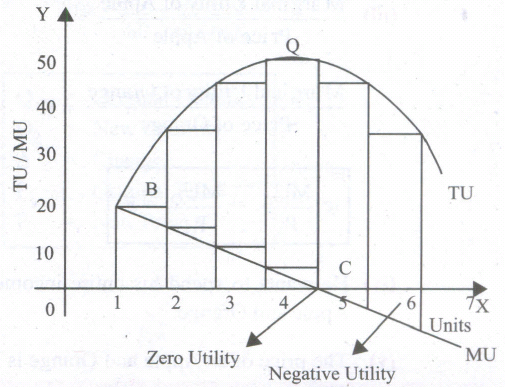
Explanation:
(i) TU goes on increasing but at a diminishing rate.
(ii) MU goes on diminishing
(iii) When MU is zero TU is maximum.
(iv) When MU becomes negative, TU diminishes.
Criticism:
(i) Utility is subjective so cannot be measured numerically.
(ii) The assumptions are unrealistic.
(iii) The law is not used for indivisible commodities.
Exceptions:
(i) Hobbies
(ii) Drunkards
(iii) Readings
(iv) Misers
(v) Music
(vi) Poetry
Importance:
(i) It is a fundamental law of consumption.
(ii) It is the basis for the law of demand, elasticity of demand, consumer's surplus.
(iii) Finance Minister uses it for progressive taxation.
(iv) Redistribution of income is justified.
(v) Adam Smith uses it for his "diamond water paradox".
Conclusion:
The law of diminishing marginal utility is of great use in our daily life.
12.
13.
(i) Adam Smith (1723 - 1790) in his book "An Inquiry into Nature and Causes of Wealth of Nations" (1776) defines "Economics as the science of Wealth"
(ii) He explains how a nation's wealth is created and increased.
(iii) He considers that the individual in the society wants to promote his own gain and led by an "invisible hand".
(iv) He states that every man is motivated by his self-interest
(v) Severe competition in factories and the society help in bettering the product
Criticism:
(i) Economics consists of wealth-getting activities and wealth-spending activities.
(ii) He ignores human welfare as an essential part of economics.
(iii) Smith gives his definition when religious and spiritual values are held high.
(iv) Ruskin and Carlyle criticized economics as a 'dismal science'. 'pig science' etc
14.
Introduction :
(i) Small scale industries play an important role for the development of Indian economy.
(ii) 60 - 70% of total innovations in India comes from SSIs.
Provides employment:
(i) SSIs use labour intensive techniques.
(ii) They provide employment to artisans, technically qualified persons and professionals, people engaged in traditional arts, people in villages and unorganized sector.
(iii) The employment-capital ratio is high.
Brings balanced regional development:
(i) SSIs are set up in backward and rural areas.
(ii) This promotes decentralised development of industries.
(iii) They reduce congestion, slums, sanitation and pollution in cities since they are found outside city limits.
(iv) They improve the standard of living of people in suburban and rural areas
(v) The entrepreneurial talent is tapped from different regions.
Helps in mobilization of local resources:
(i) SSIs mobilize and use local resources like small savings, entrepreneurial talent etc of the entrepreneurs which might have remained idle.
(ii) It promotes traditional family skills and handicrafts.
Paves for optimisation of capital:
(i) SSIs needs less capital. They give quick profit due to shorter gestation period.
(ii) SSIs functions as a stabilizing force by providing high output-capital ratio and high employment capital ratio.
(iii) They encourage people living in rural areas to save and channelize them into industrial activities.
Promotes export:
(i) Since they do not need sophisticated machinery, import of machinery from abroad is not needed.
(ii) There is great demand for goods produced by SSIs.
(iii) They reduce the pressure on balance of payment as they earn foreign exchange
Complements large scale industries:
(i) They provide components, parts, accessories to large scale industries.
(ii) They serve as ancillaries to large scale units.
Meets consumer demand:
(i) SSIs produce a wide range of consumer products.
(ii) They serve as an anti-inflationary force by providing goods of daily use.
Develops entrepreneurship:
(i) SSIs help to develop entrepreneurs.
(ii) They help the job seekers to become job givers.
(iii) They promote self-employment and a spirit of self-reliance.
(iv) It increases the per capita income of India.
(v) There is development of backward areas and weaker sections.
(vi) It helps in equitable distribution of income.
15.
16.
17.
Introduction:
(i) In order to promote export and industrial growth SEZ was introduced in many countries.
(ii) India was one of the first in Asia to set up EPZ (Kandla, 1965).
(iii) SEZ covers free trade zones, export processing zones, industrial parks, economic and technology development zones, high-tech zones, science and innovation parks, free ports, enterprise zones.
Major objectives of SEZs
(i) To enhance foreign investment, to attract foreign direct investment and increase GDP.
(ii) To increase shares in global export.
(iii) To generate additional economic activity.
(iv) To create employment opportunities.
(v) To develop infrastructure facilities.
(vi) To exchange technology in the global market.
Characteristics:
(i) Geographically demarcated area with physical security.
(ii) administered by single authority.
(iii) Streamlined procedures.
(iv) Having separate customs area.
(v) Governed by more liberal economic laws.
(vi) Greater freedom to firms located in SEZs.
(vii) They need not respect the government's rules and regulations.
(viii) The social and environmental impacts were disastrous.
18.
19.
20.
Introduction:
Mineral resources are valuable natural resources that play an important role in the economic development of India. Important minerals found in India include iron ore, coal, lignite, bauxite, mica, crude oil, gold, and diamonds.
1. Iron Ore
India has abundant reserves of high-quality iron ore. It is the basic raw material for the iron and steel industry. Major iron ore producing states are Odisha, Chhattisgarh, Karnataka, Jharkhand, and Goa.
2. Coal and Lignite
Coal is the most important source of commercial energy in India. It is used for electricity generation and industrial purposes. Major coal-producing states include Jharkhand, Odisha, Chhattisgarh, West Bengal, and Madhya Pradesh.
3. Bauxite
Bauxite is the chief ore of aluminium. Aluminium is widely used in transport, construction, and electrical industries. Odisha is the leading producer of bauxite in India.
4. Mica
Mica is a good insulator and heat-resistant mineral. It is used in electrical and electronic industries. India is one of the leading producers of mica.
5. Crude Oil
Crude oil is an important source of energy. It is used to produce petrol, diesel, kerosene, and other petroleum products. Major oil-producing areas are Assam, Gujarat, and offshore regions.
6. Gold and Diamonds
Gold and diamonds have high commercial value. They support the jewellery industry and contribute to exports.
Conclusion:
Mineral resources are essential for industrial development, energy production, employment generation, and economic growth. Therefore, they are a valuable asset for India's development.

11th Standard Syllabus & Materials
11th Standard
TN 11th Tamil பீடு பெற நில் - செய்யுள் - காவடிச்சிந்து Important Questions And Answers Study Material - QB365 Set A
NEW11th Standard
TN 11th Tamil பீடு பெற நில் - உரைநடை - மலை இடப்பெயர்கள் : ஓர் ஆய்வு Important Questions And Answers Study Material - QB365 Set A
NEW11th Standard
TN 11th Tamil மாமழை போற்றுதும் - துணைப்பாடம் - யானை டாக்டர் Important Questions And Answers Study Material - QB365 Set A
NEW11th Standard
TN 11th Tamil மாமழை போற்றுதும் - செய்யுள் - ஐங்குறுநூறு Important Questions And Answers Study Material - QB365 Set A



Tamilnadu Stateboard 11th Standard Subjects

Maths

Commerce
Economics

Biology

Business Maths and Statistics

Accountancy

Computer Science

Physics

Chemistry
Maths
Biology
Economics
Physics
Chemistry

History
Business Maths and Statistics

Computer Science
Accountancy

Computer Applications
History
Computer Technology
Commerce
Computer Applications
Computer Technology

Tamil

English

French
Tamilnadu Stateboard Standards
