
 100% FREE ACCESS
11th Standard Syllabus & Materials
11th Standard
TN 11th Tamil இயற்கை வேளாண்மை,சுற்றுச்சூழல் -செய்யுள் - மனோன்மணீயம் Important Questions And Answers Study Material - QB365 Set A
NEW11th Standard
TN 11th Tamil என்னுயிர் என்பேன் -துணைப்பாடம் - இசைத்தமிழர் இருவர் Important Questions And Answers Study Material - QB365 Set A
NEW11th Standard
TN 11th Tamil மொழி கலை -செய்யுள் - ஒவ்வொரு புல்லையும் Important Questions And Answers Study Material - QB365 Set A
NEW11th Standard
TN 11th Tamil பீடு பெற நில் - இலக்கணம் - பகுபத உறுப்புகள் Important Questions And Answers Study Material - QB365 Set A
NEW11th Standard
TN 11th Tamil பீடு பெற நில் - துணைப்பாடம் - வாடிவாசல் Important Questions And Answers Study Material - QB365 Set A
NEW11th Standard
TN 11th Tamil பீடு பெற நில் - செய்யுள் - குறுந்தொகை Important Questions And Answers Study Material - QB365 Set A

Published on: 21/01/2020
Download Tamil Nadu 11th Standard Economics question papers, model tests, one-mark questions, important questions, and public exam papers in PDF format. Free study materials and answer keys for TN State Board students.
Questions + Answers key
Take MCQ Economics Test
1.
Discuss Residual Claimant Theory of Wages.
2.
The revenue function and demand function from marginal revenue function. Give the Reason.
3.
What is meant by Differential Calculus?
4.
What is the Leather production of Tamil Nadu?
5.
What is the slope of the function \(y=3x^{ 3 }\) when x=5?
6.
Find the equation of a straight line which passes through two points (2, 8) and (4, 4) which are (X1 , Y1) and (X2 , Y2 ) respectively.
7.
Write a short note on 'Kissan Credit Card Scheme'.
8.
Mention the importance of Rural Road
9.
When does a shift in the demand curve occur? Explain the shift in the demand curve with the help of a diagram.
10.
Explain the different types of goods?
11.
Write a short note on Land Resources.
12.
Explain the Internal and External diseconomies of scale.
13.
A producer has the total cost function TC(Q) = Q3 - 18Q2+ 91Q + 10 where costs are given in rupees. Find the Marginal cost (MC) and the average variable cost (AVC), When Q = 3.
14.
What do you know about green revolution?
15.
Enumerate the remedial measures to Rural poverty.
16.
What are the functions of Entrepreneur?
17.
Mention the similarities between perfect competition and monopolistic competition.
18.
Explain different types of economic activities.
19.
Define opportunity cost and provide an example.
20.
Write the strategy of Jawaharlal Nehru in India's planning.
1.
Residual Claimant Theory of Wages was propounded by the American economist F.A.Walkar in 1875, in his book Political Economy.
According to this theory, wage is the residual portion after paying the remuneration of all the other three factors, namely, land, capital and organisation.
Criticisms:
(i) This theory does not explain the role of trade unions can secure higher wage for workers.
(ii) Demand side of labour in the determination of wages needs to be considered.
2.
If R is the total revenue function when the output is x, then marginal revenue.
\(MR=\frac { dR }{ dx } \) integrating with respect to 'x' we get.
Revenue Function: R = ഽ(MR) dx + k
where 'k' is the constant of integration which can be evaluated under given conditions when x = 0, total revenue R = 0.
Demand Functi.on: P = \(\frac { R }{ x } ,x\neq 0\).
3.
The fundamental operation of calculus is differentiation. Derivative is used to express the rate of change in any function. Derivative means a change in the dependent variable with respect to small change (closer to zero) in independent variable.
Let the function be,
y = f(x)
Differentiating y with respect to x is,
\(\frac { d\left( y \right) }{ dx } =\frac { df\left( x \right) }{ dx } \)
4.
Tamil Nadu accounts for 30 percent of leather exports and about 70 percent of leather production in the country. Hundreds of leather and tannery industries are located around Vellore, Dindigul and Erode. Every year the State hosts the India International Leather Fair in Chennai.
5.
Given function \(y=3x^{ 3 }\)
slope=\(\frac { dy }{ dx } \)
\(\frac { dy }{ dx } \)=3(3) \({ x }^{ 3-1 }={ 9x }^{ 2 }\)
When x=5, then slope=\({ 9(5) }^{ 2 }\)=\(9\times 5\)=225
slope=225
6.
Here X1 =2, Y1 =8
X2 =4, Y2 =4
Formula for constructing a stright line
\(\frac { y-{ y }_{ 1 } }{ { y }_{ 2 }-{ y }_{ 1 } } =\frac { x-{ x }_{ 1 } }{ { x }_{ 2 }-{ x }_{ 1 } } \)
Applying the values
\(\frac { Y-8 }{ 4-8 } =\frac { X-2 }{ 4-2 } \)
\(\frac { Y-8 }{ -4 } =\frac { X-2 }{ 2 } \)
2(Y-8) = -4(X-2)
2Y-16 = -4X+9
2Y = -4X + 8 + 16
2Y = -4X+ 24
\(Y=\frac { -4X+24 }{ 2 } \)
\(Y=-2X+12\)
\(\therefore Y=-2x+12\)
slope =-2 m=-2
Intercept = 12
When X=0, Y=12
When Y=0, X=\(\frac { 12 }{ 2 } \)=+6
7.
Kisan Credit Card Scheme:
(i) A Kisan Credit Card (KCC) is a credit delivery mechanism that is aimed at enabling farmers to have quick and timely access to affordable credit.
(ii) It was launched in 1998 by the Reserve Bank of India and NABARD.
(iii) The scheme aims to reduce farmer dependence on the informal banking sector for credit - which can be very expensive and suck them into a debt spiral.
(iv) The card is offered by cooperative banks, regional rural banks and public sector banks.
(v) Based on a review of the working of the KCC, the government has advised banks to convert the KCC into a smart card cum debit card.
8.
(a) Road transport is an important constituent of the transport system. Rural roads constitute the very life line of rural economy.
(b) A well-constructed road network in rural area would bring several benefits including the linking of remote villages with urban centres, reduction in cost of transportation of agricultural inputs and promotion of marketing for rural produces.
(c) It helps the farmers to bring their produce to the urban markets and to have access to distant markets and other services.
(d) Rural roads in India constitute 26.50 lakh kms, of which 13.5 percent of the roads are surfaced.
9.
Shift in the Demand Curve:
(i) A shift in the demand curve occurs with a change in the value of a variable other than its price in the general demand function.
(ii) An increase or decrease in demand due to changes in conditions of demand is shown by way of shifts in the demand curve.
(iii) On the left hand side of the diagram, the original demand curve is d1d1, the price is OP1 and the quantity demanded is \({ OQ }_{ 1 }\) Due to change in the conditions of demand (change in income, taste or change in prices of substitutes and lor complements) the quantity demanded decreases from \({ OQ }_{ 1 }\) to \({ OQ }_{ 2 }\) This is shown in the demand curve to the left. The new demand curve is \({ d }^{ 1 }{ d }^{ 1 }\) This is called decrease in demand.
(iv) On the right hand side of the diagram, the original price is \({ OP }_{ 1 }\) and the quantity demanded is \({ OQ }_{ 1 }\) Due to changes in other conditions, the quantity purchased has increased to. \({ OQ }_{ 2 }\)Thus the demand curve shifts to the right \({ d }^{ 1 }{ d }^{ 1 }\) This is called increase in demand.
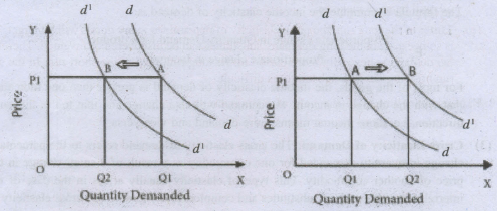
(v) 'Extension' and 'Contraction' of demand follow a change in price. Increases and decreases in demand take place when price remains the same and the other factors bring about demand changes.
10.
Introduction: Goods and services satisfy human wants. Goods also called "Products", "Commodities", "things" etc.
Types of Goods
1. Free and Economic Goods: Free goods are available in nature and in abundance. They do not command a price in the market: (Ex) Air, Sunshine. Economic goods common a price in the market. They are scarce in relation to supply (Ex) T.V, Furniture.
2. Consumer goods and capital goods: Consumer goods directly satisfy human wants (Ex) Table, Chair. Capital goods also called Producers goods do not directly satisfy the consumer wants. They help to produce consumer goods. (Ex) Machinery.
3. Perishable goods and durable goods: Perishable goods are short-lived. Their life span is limited (Ex) Fish, Fruits. Durable and semi-durable goods have a little longer life time than the perishable goods (Ex) TV, Table.
11.
Land Resources:
(i) In terms of area India ranks seventh in the world with a total area of 32.8 lakh sq. k.m. It accounts for 2.42% of total area of the world. Land-man ratio is not favourable because of the huge population size.
(ii) According to Agricultural Census, the area operated by large holdings (10 hectares and above) has declined and area operated under marginal holding (less than one hectare) has increased. This indicates that land is being fragmented and become in economic.
12.
Diseconomies of scale: The diseconomies of the scale are a disadvantage to a firm or an industry or an organisation. This necessarily increases the cost of production of a commodity or service.
These diseconomies are of two types:
a) Internal Diseconomies of Scale and
b) External Diseconomies of Scale
a) Internal Diseconomies of Scale: When the scale of production increases beyond optimum limit, its efficiency may come down.
b) External ·Diseconomies of Scale: The term "External diseconomies of scale" refers to the threat or disturbance to a firm or an industry from factor lying outside it. For example a bus strike prevents the easy and correct entry of the workers into a firm. Similarly the rent of a firm increases very much if new economic units are established in the locality.
13.
Given TC(Q) = Q3 - 18Q2 + 91Q + 10, To find MC differentiate the function with respect to Q.
\(MC(Q)=\frac{d(TC)}{dQ}=3Q^{3-1}-18(2)Q^{2-1}\)+ 91(1)Q1-1 + 0
= 3Q2 - 36Q1 + 91Q0 + 0
MC(Q) = 3Q2 - 36Q + 91 (\(\therefore\) Q0 = 1)
When Q = 3
MC(Q) = 3(32) - 36(3) + 91
= 3(9) - 108 + 91
=27 - 108 + 91
= 118 - 108
=10
To find AVC
Given TC(Q) = Q3 - 18Q2 + 91Q + 10
We know TVC (Q) = Q3 - 18Q2
+ 91Q (\(\therefore\) constant value is fixed cost)
AVC(Q) = TVC(Q)/Q
AVC(Q) = Q2 - 18Q + 91
When Q = 3
AVC (Q) = 32 - 18(3) + 9
= 9 - 54 + 91
= 100 - 54 = 46
14.
(i) The term green revolution refers to the renovation of agricultural practices.
(ii) During 1960's the traditional agricultural practices were gradually replaced by modern technology and agricultural practices.
(iii) The new technology was tried in 1960 - 61 as a pilot project in seven districts.
15.
1. 20 Point Programme - 1975
2. Integrated Rural Development Programme - 1978
3. Training Rural Youths for Self-Employment - 1979
4. Food for Work Programme - 1977
5. National Rural Employment Programme - 1980
6. Rural Landless Employment Guarantee Programme - 1983
7. Jawahar Rozgar Yojana - 1989
8. Mahatma Gandhi National Rural Employment Guarantee Scheme - 2006
9. Pradhan Mantri Adarsh Gram Sadak Yojana - 2010
10. Bharat Nirman Yojana - 2005
11. Indira Awas Yojana - 1985
12. Jawaharlal Nehru National Urban Renewal Mission - 2005
13. Rajiv Awas Yojana - 2009
14. National Rural Health Mission - 2005
15. National Rural Livelihood Mission - 2011
16. National Food Security Scheme - 2013
16.
Initiation: He considers the situation and availability of resources and plans the process of production.
Innovation: He introduces new methods in the production process.
Co-ordination: He uses a particular combination of the factors of production.
Control, direction & supervision: He directs the factors to get better results and supervises for the efficient functioning of all factors.
Risk taking, uncertainty bearing: Risk is insured, uncertainties cannot be insured.
17.
| Perfect Competition | Monopolistic competition |
| 1. The cost curve is 'U' shaped | 1. The cost curve is 'U' shaped |
| 2. There are large number of sellers | 2. There are many sellers |
| 3. There are large number of buyers | 3. There are large number of buyers. |
| 4. There is free entry & exit of firms | 4. There is free entry & exit of firms. |
| 5. There is abnormal profit or loss in the short run. | 5. There is abnormal profit or loss in the short run. |
| 6. There is normal profit in the long run. | 6. There is normal profit in the long run. |
18.
Consumption: Human wants come under consumption.
Production: It deals with the transformation of inputs into output.
Exchange: It deals with trade and commerce.
Distribution: It deals with the reward to the factors of production.
19.
(i) It refers to the cost of next best alternative use.
(ii) It is the value of the next best alternative foregone
(iii) It is also called alternative cost or transfer cost.
(vi) (eg) A farmer can cultivate paddy or sugarcane in his land.
(v) If he cultivates paddy the opportunity cost of paddy output is the amount of sugarcane output given up.
20.
(i) During Nehru's period as Prime Minister planning was introduced in India.
(ii) He said planning is to find the best way to utilize all resources of manpower or money.
(iii) Planning was linked with industrialization leading to self-reliance and economic growth.

11th Standard Syllabus & Materials
11th Standard
TN 11th Tamil பீடு பெற நில் - செய்யுள் - காவடிச்சிந்து Important Questions And Answers Study Material - QB365 Set A
NEW11th Standard
TN 11th Tamil பீடு பெற நில் - உரைநடை - மலை இடப்பெயர்கள் : ஓர் ஆய்வு Important Questions And Answers Study Material - QB365 Set A
NEW11th Standard
TN 11th Tamil மாமழை போற்றுதும் - துணைப்பாடம் - யானை டாக்டர் Important Questions And Answers Study Material - QB365 Set A
NEW11th Standard
TN 11th Tamil மாமழை போற்றுதும் - செய்யுள் - ஐங்குறுநூறு Important Questions And Answers Study Material - QB365 Set A



Tamilnadu Stateboard 11th Standard Subjects

Maths

Commerce
Economics

Biology

Business Maths and Statistics

Accountancy

Computer Science

Physics

Chemistry
Maths
Biology
Economics
Physics
Chemistry

History
Business Maths and Statistics

Computer Science
Accountancy

Computer Applications
History
Computer Technology
Commerce
Computer Applications
Computer Technology

Tamil

English

French
Tamilnadu Stateboard Standards
